How to personalise member experience for engagement

TL;DR:
- Personalisation improves member engagement, satisfaction, retention, and event attendance.
- Effective personalisation requires clean data, integrated tools, clear segmentation, and regular measurement.
- Small, relevant efforts like timely messages or tailored content outweigh complex automation for genuine impact.
Generic communications are one of the most persistent frustrations in membership management. When every member receives the same email, the same event invite, and the same renewal reminder regardless of their interests or history, engagement suffers. Research consistently shows that personalisation increases member satisfaction and retention in meaningful ways. This article walks you through a practical, step-by-step approach to tailoring digital experiences for your members, from laying the groundwork to measuring real impact.
Table of Contents
- Understanding why personalisation matters
- Setting the groundwork: prerequisites and tools
- Step-by-step guide to personalising member experience
- Measuring impact and avoiding common pitfalls
- Our perspective: personalisation needs to serve both sides
- Take the next step in personalising member experience
- Frequently asked questions
Key Takeaways
| Point | Details |
|---|---|
| Personalisation drives engagement | Tailoring the member experience leads to stronger loyalty and satisfaction. |
| Digital tools are essential | The right CRM and data platforms empower you to segment and automate effectively. |
| Measure and adapt | Tracking outcomes helps you refine your strategy and avoid costly missteps. |
| Balance tech and empathy | Automate what makes sense but keep member needs at the centre of all efforts. |
Understanding why personalisation matters
A one-size-fits-all approach to member engagement is not just ineffective; it actively signals to members that your organisation does not truly know them. When members feel like a number rather than a valued participant, they disengage quietly and eventually lapse. The cost of replacing a lapsed member is significantly higher than retaining one, making personalisation a strategic priority rather than a nice-to-have.
Personalisation works because it aligns your communications and offerings with what each member actually values. A long-standing member who attends every annual conference has very different needs from a new member still exploring your resources. Treating them identically wastes both their time and yours.
Here are the core benefits organisations typically see after introducing personalisation into their member communications:
- Higher open and click-through rates on emails and newsletters
- Improved event attendance when invitations reflect member interests
- Stronger renewal rates driven by demonstrated value
- Greater satisfaction scores in annual member surveys
- Reduced churn as members feel recognised and understood
Strategies for improving member engagement consistently highlight personalisation as one of the highest-impact levers available to membership organisations. The evidence is clear: members who receive relevant content are far more likely to remain active participants.
“Personalisation is no longer a luxury for membership organisations. It is the baseline expectation of a digitally engaged audience.”
Practical examples of effective personalisation include sending event recommendations based on past attendance, delivering content tailored to a member’s professional sector, and triggering milestone messages such as anniversary congratulations. These are not complex gestures, but they carry significant weight. Exploring engagement tool essentials can help you identify which tools best support these approaches. Insights from personalisation strategies further reinforce that engaging members from their very first interaction sets the tone for long-term loyalty.
Setting the groundwork: prerequisites and tools
With the value of personalisation established, here is what you need in place before launching any new initiatives. Rushing into personalisation without the right foundations leads to inconsistent experiences, data errors, and wasted effort.
The first step is auditing your existing data sources. What member information do you currently hold? Where is it stored? Is it accurate and up to date? Poor data quality is the single biggest barrier to effective personalisation. Before selecting any new tools, focus on data hygiene: remove duplicates, standardise fields, and ensure consent records are compliant with data protection regulations.
Digital transformation for membership organisations requires a clear-eyed assessment of your current digital systems. As highlighted in guidance on digital transformation for nonprofits, effective member personalisation depends on having integrated, reliable digital infrastructure in place.
Here is a summary of the key digital tools you will likely need:
| Tool | Primary purpose | Integration needed |
|---|---|---|
| CRM software | Store and segment member data | Email, event, payment systems |
| Event management platform | Track attendance and preferences | CRM, communications tools |
| Email marketing system | Deliver tailored communications | CRM, segmentation data |
| Analytics dashboard | Measure engagement and outcomes | All platforms |
| Consent management tool | Manage data permissions | CRM, email system |
Before you begin, confirm the following prerequisites are in place:
- Clean, structured member data with accurate contact details
- Clear consent records aligned with GDPR requirements
- Staff buy-in and basic training on personalisation principles
- Defined member segments based on meaningful criteria
- An agreed process for reviewing and updating data regularly
Exploring membership management basics is a useful starting point if your data infrastructure still needs work. Specialist digital personalisation services can also support organisations that need external expertise during the setup phase.
Pro Tip: Before investing in new software, prioritise integrating the tools you already have. A well-connected CRM and email platform will outperform a fragmented collection of advanced tools every time.
Step-by-step guide to personalising member experience
Having the right tools in place, let us walk through how to apply them for real member impact. This process is designed to be iterative, meaning you build, test, and refine rather than attempting a complete overhaul at once.
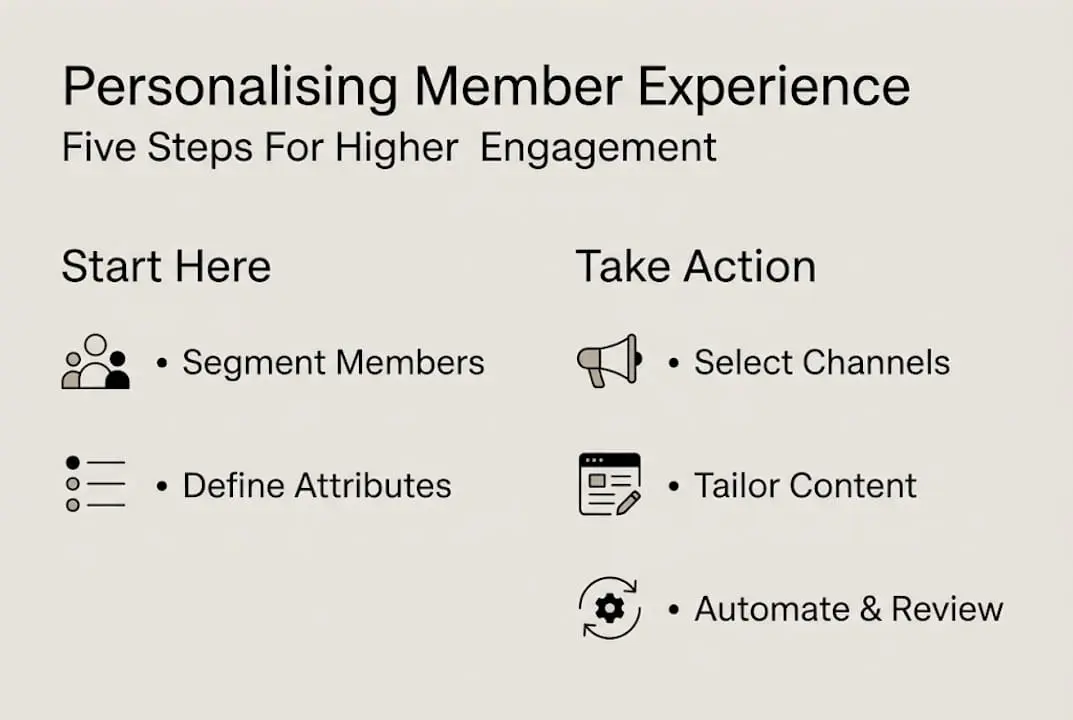
Step 1: Segment your members Group members by meaningful criteria such as membership tier, interests, location, engagement history, or career stage. Avoid creating too many segments initially. Four to six well-defined groups are more manageable and actionable than twenty narrow ones. Member segmentation and tailored communications are proven drivers of engagement.

Step 2: Define personalisation attributes For each segment, identify what personalised experience looks like. What content topics matter to them? Which events are relevant? What communication frequency do they prefer? Document these attributes clearly so your team applies them consistently.
Step 3: Select your digital channels Choose the channels where personalisation will have the greatest impact first. Email is typically the most immediate win. Event invitations and member portal content are strong secondary channels. Refer to member engagement strategies for channel-specific guidance.
Step 4: Create tailored content Develop content variations for each segment. This does not mean writing entirely different articles; it means adjusting subject lines, featured events, and calls to action to reflect each group’s priorities.
Step 5: Automate and review Use your email and CRM platforms to automate delivery based on triggers such as renewal dates, event registrations, or inactivity periods. Schedule regular reviews, at least quarterly, to assess what is working. Connecting fundraising engagement ideas with personalised outreach can also boost participation in campaigns.
Here is a comparison of manual versus automated personalisation approaches:
| Approach | Scalability | Consistency | Time investment | Recommended for |
|---|---|---|---|---|
| Manual personalisation | Low | Variable | High | Very small organisations |
| Automated personalisation | High | Consistent | Low (once set up) | Growing organisations |
Pro Tip: Pilot your personalisation changes with a small member segment first. Gather feedback, review the metrics, and refine before rolling out to your full membership base.
Measuring impact and avoiding common pitfalls
Executing your plan is only half the equation; success depends on tracking progress and learning from missteps. Without measurement, personalisation efforts can drift without anyone noticing until renewal rates drop.
The key metrics to track include:
- Email engagement rates: open rates, click-through rates, and unsubscribes by segment
- Event attendance: comparing attendance rates before and after personalised invitations
- Member satisfaction scores: gathered through regular surveys or net promoter score (NPS) questions
- Retention and renewal rates: the clearest long-term indicator of personalisation success
- Portal login frequency: a reliable signal of whether members find the digital experience relevant
Set up a simple measurement process using your analytics dashboard. Review results monthly for the first six months, then quarterly once patterns stabilise. Engagement tools for measurement can help automate data collection and reporting so you spend less time gathering numbers and more time acting on them.
As reinforced in guidance on boosting member engagement, measuring digital initiatives is essential for ongoing improvement rather than a one-off exercise.
“What gets measured gets improved. Personalisation without measurement is simply guesswork dressed up as strategy.”
The most common mistakes organisations make include:
- Over-segmentation: creating so many member groups that content production becomes unmanageable
- Privacy pitfalls: using member data without clear consent or in ways members would not expect
- Inconsistent content: personalising email but leaving the member portal completely generic
- Set-and-forget automation: building automated journeys and never reviewing whether they still reflect member needs
When metrics reveal a problem, act quickly. If a particular segment shows declining engagement, revisit the content you are sending them and ask whether it still reflects their interests. Guidance on email marketing personalisation offers practical techniques for refining your approach based on real data.
Our perspective: personalisation needs to serve both sides
With measurement strategies in hand, it is worth stepping back to reflect on what really matters when personalising member journeys. There is a temptation, particularly when automation becomes easy, to personalise everything and lose sight of why you are doing it.
We have seen organisations build elaborate segmentation models and automated journeys, only to find that members still feel disconnected. The reason is almost always the same: the technology was optimised for efficiency rather than genuine relevance. Automation is a tool, not a substitute for understanding your members.
Small, meaningful changes consistently outperform large system overhauls in member satisfaction. A well-timed anniversary message, a genuinely relevant event recommendation, or a renewal reminder that acknowledges a member’s specific contributions will always resonate more than a technically sophisticated but impersonal campaign.
The realities of digital transformation for nonprofits remind us that technology should serve people, not the other way around. Personalisation works best when it reflects authentic organisational knowledge of your members, not just algorithmic pattern-matching. Balance efficiency with empathy, and your members will feel the difference.
Take the next step in personalising member experience
If you are ready to enhance engagement through personalisation, Colossus Systems is built to help you do exactly that. Our platform brings together the tools your organisation needs to deliver tailored member experiences at scale, without the complexity of managing multiple disconnected systems.
From our membership management features that centralise your member data, to event management software that tracks attendance and preferences, and CRM software for members that powers intelligent segmentation, everything works together in one unified platform. Speak to our team today to see how Colossus Systems can help your organisation move from generic communications to genuinely personalised member engagement.
Frequently asked questions
What are the easiest ways to get started with personalisation for members?
Segmenting your members is the most effective first step. Start by tailoring just one key communication channel, such as email or event invitations, before expanding to others.
How do I choose the right digital tools for personalising member experience?
Select tools that integrate well with your current systems and support automation, segmentation, and analytics. Integrated digital tools are far more effective than a collection of standalone platforms.
How can I tell if personalisation is actually working?
Track engagement metrics, satisfaction surveys, and renewal rates consistently over time. Measuring digital initiatives is essential for understanding whether your personalisation strategy is delivering real improvement.
What are common mistakes to avoid in member personalisation?
Avoid over-segmentation and privacy issues by keeping your segments manageable and ensuring all data use is fully consented. Inconsistent content delivery across channels is equally damaging to member trust.
Recommended
- Improving Member Engagement: Proven Strategies for 2025|CS
- How to Boost Member Engagement and Why use Engagement Software|CS
- Essential engagement tools to transform your membership organisation|CS
- 7 Powerful Community Building Ideas for Member Organisations|CS
- ?? Personalization and Digital Experience: HOW TO ENGAGE THE CLIENT from the First Moment | Sales Mates Podcast #61 - Sales Label IT Consulting