Member retention tips: Practical strategies to boost loyalty

TL;DR:
- Most membership organizations have higher retention rates than assumed, providing a strong foundation for growth.
- Building engagement and community culture are key to improving long-term member loyalty.
- Digital tools support tracking, automating, and enhancing retention strategies effectively.
Most membership organisation leaders assume their retention rates are disappointingly low, but the reality is quite the opposite. Member retention rates are far higher than donor retention rates in the nonprofit sector, which means your organisation likely has a stronger foundation than you realise. The real opportunity lies in building on that foundation with deliberate, practical strategies. This guide walks you through how to measure your current retention rate accurately, which engagement tactics genuinely move the needle, and how digital tools can make the entire process more manageable and measurable for your team.
Table of Contents
- Understanding member retention and why it matters
- Diagnosing and measuring your member retention rate
- Engagement: The heart of member loyalty
- Building a lasting community culture
- Leveraging digital tools to increase retention
- Our take: The retention myth most leaders overlook
- Take your member retention to the next level with Colossus Systems
- Frequently asked questions
Key Takeaways
| Point | Details |
|---|---|
| Retention rates are higher for members | Member-based organisations enjoy median retention rates of 84%, far above donor retention figures. |
| Engagement is the foundation | Personalised communication and active involvement are proven to increase member loyalty. |
| Community building pays off | Fostering a sense of belonging drives both satisfaction and retention. |
| Measure and adapt | Regularly track retention data and use insights to refine your strategy. |
| Leverage digital tools | Modern platforms simplify tracking, automate tasks, and help prevent member churn. |
Understanding member retention and why it matters
Member retention refers to the percentage of existing members who choose to renew their membership within a given period. It sounds simple, but the implications are significant. When a professional association retains a member for three, five, or ten years, that relationship compounds in value. The member becomes an advocate, a volunteer, a referral source, and a contributor to your community’s identity.
It is worth distinguishing member retention from donor retention. Donors give money to a cause and may not expect anything tangible in return. Members, by contrast, join because they anticipate ongoing value: networking, professional development, resources, and community. This expectation creates both a challenge and an opportunity. When you consistently deliver that value, members stay. Understanding membership management basics helps leaders appreciate why retention deserves as much attention as recruitment.
A common misconception is that retention rates across all membership types are universally low. In reality, member retention median sits at 84%, which is considerably higher than typical donor retention figures. That is an encouraging baseline, but it also means there is room to push further.
“Retention is not a metric to chase. It is a signal of how well your organisation delivers on its promise to members.”
High retention delivers several concrete benefits for your organisation:
- Reduced recruitment costs: Acquiring a new member costs significantly more than retaining an existing one.
- Reliable revenue: Renewals provide predictable income that supports long-term planning.
- Deeper relationships: Long-standing members contribute more, volunteer more, and advocate more.
- Stronger community: Consistent membership creates a stable, engaged community that attracts new members organically.
- Built-in advocacy: Loyal members become your most credible ambassadors.
When leaders treat retention as a strategic priority rather than an afterthought, the entire organisation benefits.
Diagnosing and measuring your member retention rate
Now that we know retention is central, let us break down how to assess your current rate and spot where improvements can be made.
Calculating your member retention rate is straightforward. Follow these steps:
- Identify your starting membership count. Record how many members you had at the beginning of the period (e.g., 1 January).
- Record your ending membership count. Note how many of those original members are still active at the end of the period (e.g., 31 December). Do not include new members acquired during the period.
- Apply the formula. Divide the number of retained members by the starting count, then multiply by 100.
- Interpret the result. A result of 80% means 80 out of every 100 members renewed.
For example, if you began the year with 500 members and 420 of them renewed, your retention rate is 84%. That aligns closely with the median retention rate of 84%, which is a healthy benchmark for member-based organisations.
| Organisation type | Typical retention rate |
|---|---|
| Professional associations | 80–90% |
| Trade associations | 75–85% |
| Nonprofit membership groups | 70–80% |
| Donor-based nonprofits | 40–50% |
The contrast between member and donor retention is stark. Membership organisations operate with a structural advantage. The goal is to capitalise on it.
Pro Tip: Measure retention at multiple intervals, not just annually. Quarterly tracking reveals seasonal patterns and allows you to intervene before a lapse becomes permanent. Explore membership retention ideas to build a measurement-driven improvement cycle.
Once you have your figures, compare them against sector benchmarks and set realistic improvement goals. Even a 3% improvement in retention can translate to significant revenue gains over time. Pair your measurement with a review of your recruitment and retention strategies to ensure both ends of the membership lifecycle are working together.
Engagement: The heart of member loyalty
Measuring your rate is one thing. Taking action is another. Building real engagement is at the centre of loyalty, and member engagement directly drives stronger retention outcomes.
Engagement is the leading predictor of whether a member will renew. A member who attends events, participates in forums, and receives personalised communications feels connected. A member who receives only an annual renewal invoice does not.
Here are practical engagement tactics that consistently support higher retention:
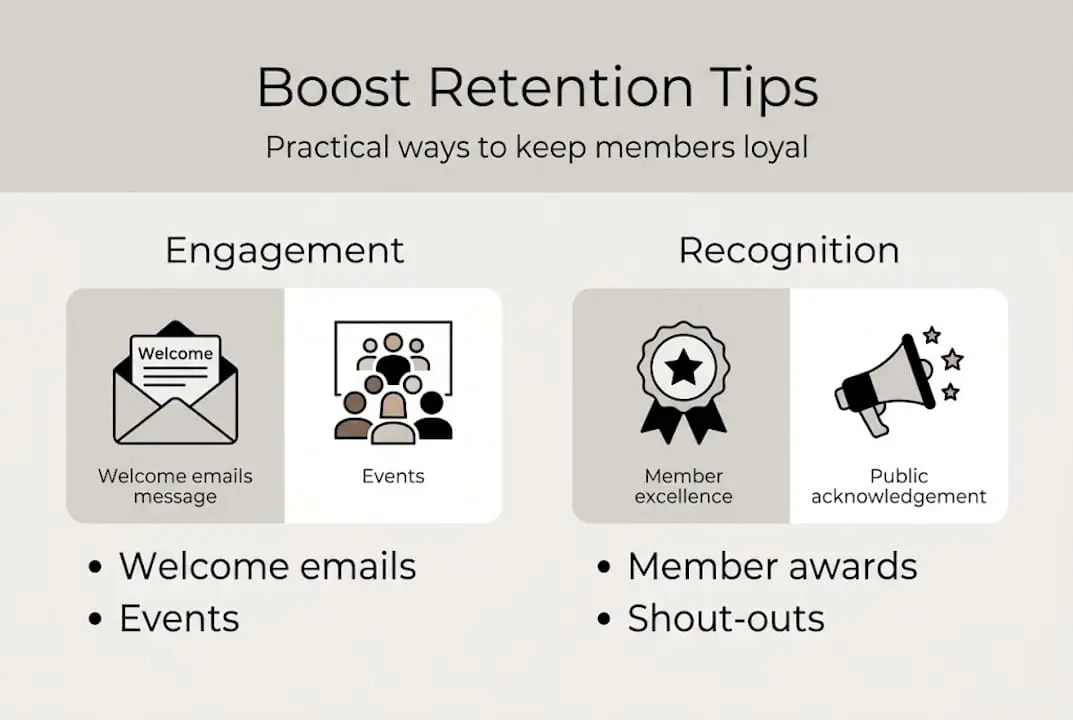
- Personalised communication: Address members by name, reference their interests, and tailor content to their membership stage.
- Regular events: In-person and virtual events create touchpoints that reinforce the value of membership. Strong event marketing ideas can significantly increase attendance and engagement.
- Feedback loops: Ask members what they value and act on what they tell you. A simple survey shows respect and generates actionable data.
- Recognition programmes: Celebrate milestones, contributions, and achievements. Recognition costs little but builds significant loyalty.
- Exclusive resources: Members-only content, tools, or discounts reinforce the tangible value of belonging.
| Engagement tactic | Typical retention impact |
|---|---|
| Personalised email campaigns | High |
| Member events (in-person) | High |
| Online community forums | Medium to high |
| Generic newsletters | Low to medium |
| Annual surveys with follow-up | Medium to high |
Pro Tip: Segment your members by journey stage. A new member needs onboarding and welcome communications. A long-standing member needs recognition and leadership opportunities. Tailoring your approach to each stage is one of the most effective ways to boost member engagement across your entire membership base.
Consider a professional association that introduced quarterly virtual roundtables for members in their first year. Renewal rates for that cohort rose by 11% within two years. The cost was minimal. The impact was measurable. Connecting engagement to fundraising and engagement ideas can further reinforce the cycle of participation and loyalty.
Building a lasting community culture
Beyond engagement tactics, the most resilient organisations foster a community culture that keeps members coming back year after year.

Community culture is not a soft concept. It is a retention driver with measurable outcomes. Associations and professional groups that cultivate a genuine sense of belonging see strong retention rates driven by professional value and community connection, not just perks or discounts.
Here are steps to foster a culture of belonging within your organisation:
- Host inclusive events that welcome members at all stages, from newcomers to veterans.
- Create structured networking opportunities so members can build meaningful professional relationships.
- Communicate your shared mission clearly and consistently, so members feel part of something larger than themselves.
- Offer leadership pathways such as committee roles, mentoring positions, or advisory seats that give members a genuine stake in the organisation’s direction.
- Celebrate member contributions publicly and regularly to reinforce that every member matters.
Creative recognition is particularly powerful. When a member sees their name in a newsletter, receives a shout-out at an event, or earns a badge in your member portal, they feel ownership. That ownership translates directly into loyalty. Explore community building ideas for practical approaches tailored to membership organisations.
Pro Tip: Transparent communication builds trust faster than any perk. When you share your organisation’s challenges, progress, and plans openly with members, you signal that they are genuine stakeholders, not just customers. Research on retention and satisfaction consistently shows that environments where people feel valued and informed produce significantly higher loyalty.
Reviewing your strategies for engagement alongside your community-building efforts ensures both are pulling in the same direction.
Leveraging digital tools to increase retention
Modern organisations are turning to digital tools to make retention both measurable and manageable. The right platform does not just store member data. It actively supports the strategies outlined throughout this guide.
Digital platforms, particularly those combining CRM (customer relationship management) and engagement functionality, give your team real-time visibility into member behaviour. You can see who is engaging, who is at risk of lapsing, and what content or events are driving the most value. Tracking retention digitally with dedicated software produces the best results because it removes guesswork and replaces it with data.
When evaluating digital tools for your organisation, look for these features:
- Automated renewal reminders: Timely, personalised messages reduce lapses caused by simple forgetfulness.
- Engagement analytics: Dashboards that show event attendance, content consumption, and communication open rates.
- Feedback management: Built-in survey tools that capture member sentiment and surface actionable insights.
- Personalised member journeys: Automated workflows that deliver the right message to the right member at the right time.
- Integration capabilities: Compatibility with your existing email, payment, and event systems to avoid data silos.
Organisations that adopt integrated digital platforms consistently report improvements in renewal rates, largely because they can identify at-risk members early and intervene before a lapse occurs. Understanding membership management software basics is the first step toward selecting a platform that fits your organisation’s needs.
Digital tools also support growth. When retention is strong and operations are streamlined, your team has more capacity to focus on growing membership strategies that bring new members into a community that is already thriving.
Our take: The retention myth most leaders overlook
Here is the one reality about retention that most leaders miss in the rush to offer more tangible perks: discounts and free gifts have a very short shelf-life as retention tools.
We see organisations invest heavily in incentives, reduced renewal fees, or added extras, only to find that members still lapse. Why? Because those members never felt genuinely connected in the first place. The incentive delayed the departure. It did not prevent it.
Members stay primarily for value and community, not just perks. Professional advancement, a sense of belonging, and meaningful relationships are the real anchors. These are harder to build than a discount code, but they are far more durable.
Our view is that organisations should invest their retention budget in experiences and relationships rather than incentives. A well-run event, a recognition moment, or a mentoring connection creates an emotional tie that a discount never can. This is also why volunteer retention insights are so instructive for member organisations: the same emotional drivers apply across both groups.
“The members who stay longest are not the ones who got the best deal. They are the ones who felt most at home.”
Shifting your focus from transactional retention to relational retention, supported by the right improving engagement strategies, is the single most impactful change most organisations can make.
Take your member retention to the next level with Colossus Systems
If you are now rethinking your retention approach, the right tools can make all the difference.
At Colossus Systems, we have built our platform specifically for membership organisations that want to move beyond manual processes and guesswork. Our membership management features give you the analytics, automation, and engagement tools to retain more members with less effort. From our event management software that drives attendance and connection, to our CRM software that tracks every member interaction, everything works together in one seamless platform. Ready to see how it works for your organisation? Contact Colossus Systems today for a personalised walkthrough.
Frequently asked questions
What is a good member retention rate for associations?
A good retention rate for member-based organisations is around 84%, which is notably higher than average donor retention rates and reflects the stronger ongoing value exchange in membership models.
Which member engagement strategies work best for retention?
Personalised communications, regular events, and meaningful recognition consistently support higher retention, as engagement drives the emotional connection that keeps members renewing year after year.
How can digital tools help improve member retention?
Digital tools track engagement, automate renewal reminders, and reveal churn risks early, making it easier to act proactively. Data-driven retention strategies consistently outperform manual approaches.
Does a sense of community really affect retention?
Yes. Research shows members are more loyal when they feel a genuine sense of belonging and professional value, making community culture one of the strongest long-term retention drivers available to any organisation.
Recommended
- 7 Proven Membership Retention Ideas for Organisations|CS
- Master member engagement metrics to improve retention|CS
- Improve member onboarding: best practices to boost retention|CS
- Master Membership Recruitment and Retention Strategies|CS
- Role of Cleaning in Staff Retention: 25% Higher Satisfaction
- Improve client engagement in beauty: proven strategies | Xolapp