Gamification in member engagement: 5 strategies for impact

TL;DR:
- Thoughtfully designed gamification can improve long-term member engagement and community bonds.
- Relying solely on points and leaderboards risks superficial participation and member frustration.
- Successful gamification aligns rewards with meaningful behaviors and continuously evolves to sustain interest.
Membership organisations everywhere are adding points, badges, and leaderboards to their platforms, convinced that gamification will transform participation overnight. Yet many leaders are left wondering why their carefully planned initiative produced a short burst of activity followed by silence. The reality is that gamification is neither a guaranteed solution nor a gimmick. When designed thoughtfully, it can meaningfully shift member behaviour and strengthen community bonds. When deployed carelessly, it wastes resources and frustrates the very people you are trying to engage. This guide cuts through the noise with evidence-backed clarity, so you can avoid costly missteps and build engagement that actually lasts.
Table of Contents
- What is gamification and how does it work?
- Benefits and risks of gamification for member engagement
- Designing gamification for sustained engagement and retention
- Practical examples and success stories
- Why most gamification fails (and what leaders should really focus on)
- Next steps: empowering your member engagement strategy
- Frequently asked questions
Key Takeaways
| Point | Details |
|---|---|
| Design for mission fit | Always align gamification mechanics with your organisation’s core values for meaningful results. |
| Pilot, measure, adapt | Test small, monitor responses, and refine to suit your community’s demographics and motivations. |
| Beware superficial tactics | Avoid overusing points and badges as they can reduce real engagement and cause novelty to fade quickly. |
| Evolve for sustainability | Keep content and rewards dynamic and tied to intrinsic motivators for long-term impact. |
What is gamification and how does it work?
Gamification means applying game-design elements to non-game contexts, such as membership communities, to influence behaviour and increase motivation. The most common approach uses what researchers call PBL mechanics: Points, Badges, and Leaderboards. Points reward activity, badges signal achievement, and leaderboards create competition. On paper, this sounds compelling. In practice, the results are far more complicated.
Understanding the impact of gamification on member communities requires looking beyond the surface appeal. PBL mechanics work by triggering extrinsic motivation, meaning members act because of the reward rather than genuine interest. This is fine for simple, repetitive tasks. For complex behaviours like attending events, contributing knowledge, or mentoring peers, extrinsic rewards can actually reduce the quality of participation.
Research highlights a concept called the overjustification effect: when you reward someone for something they already enjoy doing, the external reward can undermine their natural enthusiasm. As noted in discussions on expert gamification pitfalls, gamification often fails when focused solely on external rewards and can backfire through this very mechanism. Adding cognitive load without changing underlying motivation is a common and costly mistake.
Surface-level vs. meaningful gamification
| Feature | Surface-level gamification | Mission-aligned gamification |
|---|---|---|
| Primary driver | External rewards | Intrinsic motivation and community value |
| Typical mechanic | Points and leaderboards | Progress milestones and peer recognition |
| Member experience | Novelty, then fatigue | Sustained involvement and belonging |
| Organisational outcome | Short-term spikes | Long-term retention and loyalty |
Gamification works best when it is tailored to your audience and tested before full rollout. Younger, tech-savvy members tend to respond more positively to digital game mechanics. Older or professionally focused communities may find them patronising. Consider these conditions for success:
- Audience fit: Confirm your members actually want game-style interactions before investing.
- Behavioural alignment: Reward actions that genuinely matter to your mission, not just logins.
- Pilot testing: Launch with a small cohort, gather data, and refine before scaling.
- Ongoing evolution: Static game mechanics lose their appeal within weeks without fresh challenges.
Gamification is a tool, not a strategy. Treat it as one component of a broader engagement approach and you will be far better positioned to see real results.
Benefits and risks of gamification for member engagement
With an understanding of gamification’s mechanics, we need to explore both the potential rewards and the notable risks for your membership community. The upsides are real, but so are the traps.
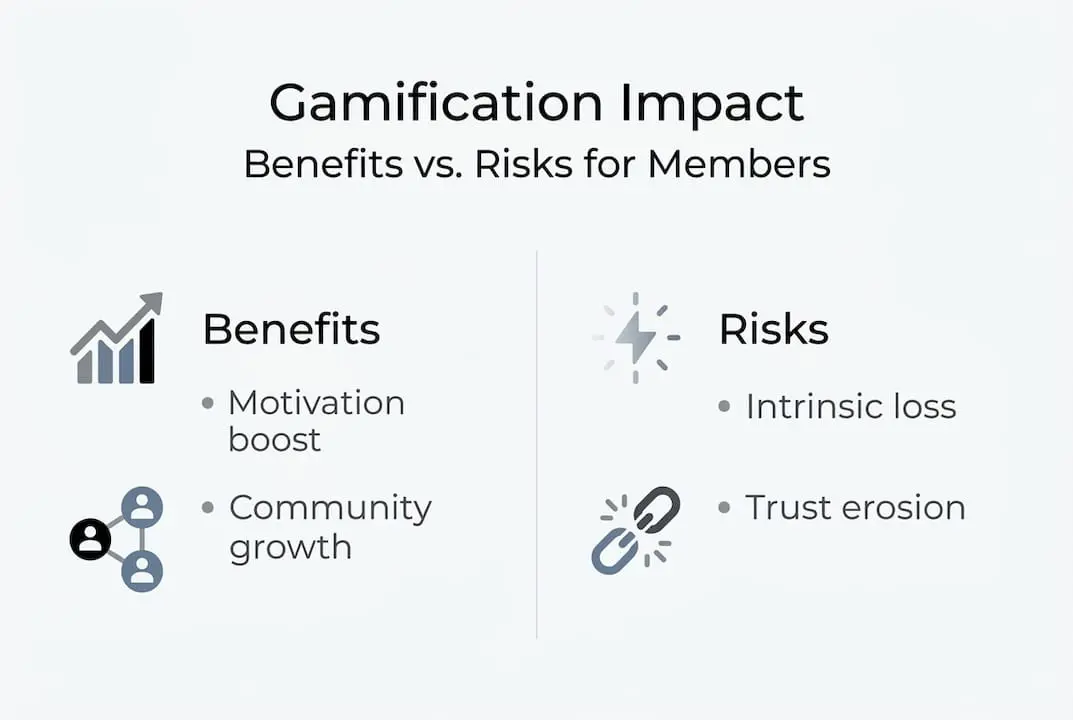
Potential benefits include increased participation in events and forums, a stronger sense of progress for members working towards goals, and higher retention when members feel recognised. Gamification can also surface your most active advocates, making it easier to identify future leaders within your community. Thoughtful improving member retention rates approaches often incorporate recognition mechanics as a supporting layer.
However, the risks deserve equal attention:
- Gimmick fatigue: Members quickly see through mechanics that feel shallow or disconnected from real value.
- Short-lived novelty: Participation spikes then drops below baseline if content does not evolve.
- Superficial engagement: Chasing points replaces genuine contribution, reducing the quality of community interactions.
- Cultural mismatch: Competitive leaderboards can alienate collaborative or mission-driven communities.
Organisational outcomes: a realistic comparison
| Outcome area | Positive result | Negative result |
|---|---|---|
| Participation | Higher event sign-ups and forum activity | Hollow activity driven by reward-chasing |
| Retention | Members stay longer when progress is visible | Drop-off after novelty fades |
| Community culture | Peer recognition strengthens bonds | Competitive mechanics breed resentment |
| Brand perception | Innovative and engaging | Gimmicky and out of touch |
The cautionary evidence is stark. Poorly aligned gamification in major organisations led to toxic culture and community destruction, as seen in failed attempts by large brands that prioritised mechanics over meaning. Your engagement strategies must account for these risks from the outset.
“Sustainability and intrinsic motivation are the critical factors that separate gamification success from expensive failure.”
Pro Tip: Always pilot gamification features with a small, representative segment of your membership before any large-scale rollout. Gather both quantitative data and qualitative feedback to understand whether the mechanics are adding genuine value or simply creating noise.
Designing gamification for sustained engagement and retention
Recognising the hazards, it is time to focus on how to design meaningful, motivating gamification that builds long-term engagement. The starting point is not the mechanics. It is your mission.

Ask yourself: what behaviours genuinely advance your community’s goals? Attending a webinar, completing a training module, mentoring a newer member, or contributing to a working group all carry real value. Design your gamification to reward these actions, not just logins or page views. This mission-first approach is what separates sustainable programmes from novelty experiments.
Here is a practical framework for designing gamification that lasts:
- Define your motivational triggers. Survey members to understand what recognition means to them. Some value public acknowledgement; others prefer private progress tracking.
- Map rewards to meaningful behaviours. Link points or badges directly to actions that reflect your organisational values, not arbitrary activity.
- Introduce tiered progression. Give members a visible journey with milestones that feel genuinely earned, not just collected.
- Build in peer recognition. Allow members to acknowledge each other’s contributions. Social validation is a powerful intrinsic motivator.
- Schedule content evolution. Plan new challenges, seasonal campaigns, and refreshed rewards at regular intervals to prevent novelty decay.
- Measure and iterate. Track not just participation rates but quality indicators like discussion depth, event feedback scores, and renewal rates.
As sustainable engagement insights confirm, success requires alignment with core community values and ongoing evolution once the initial novelty fades. Organisations that treat gamification as a one-time launch consistently underperform those that treat it as a living system.
Pro Tip: Map every reward to a specific behaviour and ask whether that behaviour would matter if there were no reward attached. If the answer is no, reconsider whether you are incentivising the right things.
Using engagement software strategies that support flexible reward structures and analytics will make this iterative process far more manageable. Pairing gamification design with robust member retention strategies ensures your mechanics serve a broader organisational purpose rather than existing in isolation.
Practical examples and success stories
With a framework in hand, let us turn to tangible examples that show both smart application and missteps in member engagement gamification.
One professional association introduced cohort-based team challenges ahead of its annual conference. Members were grouped into small teams and earned collective points for completing pre-event learning modules and submitting discussion questions. The result was a 34% increase in event preparation activity and noticeably richer in-room conversations. The key was that the mechanic served a clear purpose: better-prepared attendees created a better event for everyone.
Contrast this with a trade body that launched a leaderboard ranking members by forum post volume. Within six weeks, the forum was flooded with low-quality, one-line responses from members chasing position. Genuine contributors disengaged. The leaderboard was removed, but the reputational damage to the forum took months to repair.
These outcomes reflect what context and alignment determine: whether gamification helps or harms. Proponents and critics alike agree that follow-through and fit with community culture are the deciding factors.
For fundraising engagement tactics and community building ideas, the same principle applies: design for the outcome you actually want, not the metric that is easiest to count.
Do’s and don’ts for piloting gamification
- Do start with one clearly defined behaviour you want to encourage.
- Do involve a cross-section of members in the design process.
- Do set a defined pilot period with clear success criteria.
- Don’t launch organisation-wide without testing.
- Don’t use competitive mechanics in communities built on collaboration.
- Don’t ignore qualitative feedback in favour of activity numbers alone.
Younger, digital-first members tend to adapt quickly to game mechanics and often welcome the structure. More established or professionally senior communities frequently respond better to recognition and status-based rewards than to points and leaderboards. Knowing your audience before you design is non-negotiable.
Why most gamification fails (and what leaders should really focus on)
Stepping back from examples, it is worth questioning the assumptions driving most gamification initiatives in the sector. The uncomfortable truth is that many leaders invest in game mechanics because they are visible, measurable, and easy to pitch internally. Genuine community value is harder to quantify and slower to build.
The overuse of PBL mechanics can burden members and erode community trust, particularly when those mechanics feel disconnected from the reason members joined in the first place. Points and badges do not replace authentic connection, transparent communication, or a clear sense of shared purpose.
Our view is that the most resilient membership communities we observe are built on mission fit and peer relationships, with gamification playing a supporting rather than central role. Leaders who invest in digital transformation strategies with this mindset consistently outperform those chasing engagement metrics through mechanics alone. Prioritise sustained, meaningful participation over surface-level activity counts, and your gamification efforts will finally have a foundation worth building on.
Next steps: empowering your member engagement strategy
Ready to put these advanced member engagement principles into practice with technology that works seamlessly? Translating strategy into results requires the right platform behind you.
At Colossus Systems, our membership software features are built to support flexible, measurable engagement initiatives, from recognition programmes and progress tracking to targeted communications and analytics. Our event management tools make it straightforward to design cohort challenges, track participation, and gather the feedback you need to iterate confidently. We combine CRM, email marketing, and member portals in one unified platform, so your gamification strategy is supported by data at every stage. Speak with our team today to explore how we can help your organisation build engagement that genuinely lasts.
Frequently asked questions
What is the overjustification effect in gamification?
The overjustification effect occurs when external rewards for an activity reduce members’ intrinsic motivation to participate, making them less likely to engage without incentives over time.
How do I know if gamification is right for my membership organisation?
Gamification suits younger, tech-savvy communities best. Pilot test with a small group before widespread adoption to avoid cultural misalignment and wasted resource.
Does gamification really boost retention long-term?
Gamification can support retention if it aligns with core community values and evolves beyond initial novelty, but superficial tactics lose their effect quickly.
What is a simple first step to gamify member engagement?
Start with a focused pilot targeting one key behaviour, such as event participation, gather both quantitative and qualitative feedback, and refine before scaling across your membership.