The Essential Guide to the Impact of Gamification

More than 60 percent of british organisations have experimented with gamification in recent years, yet many still struggle to harness its full potential. As businesses and membership societies look for new ways to boost engagement and motivation, gamification stands out as a proven strategy rooted in psychology and behaviour. This introduction will help you uncover the principles and practical benefits of gamification, showing how these tools can create lasting impact for british communities and organisations.
Table of Contents
- Defining Gamification And Core Principles
- Common Types And Real-World Applications
- Key Benefits For Membership Organisations
- Potential Risks And Barriers To Adoption
- Best Practices For Effective Implementation
Key Takeaways
| Point | Details |
|---|---|
| Understanding Gamification | Gamification integrates game elements into non-game contexts to enhance user motivation and participation, focusing on psychological drives. |
| Core Motivational Drives | The Octalysis Framework identifies eight key motivational factors essential for effective gamification, including meaning, accomplishment, and empowerment. |
| Real-World Applications | Gamification extends to various sectors like education and corporate training, transforming engagement through interactive experiences. |
| Implementation Best Practices | Successful gamification requires personalised design, clear objectives, and a balanced approach to reward mechanisms to ensure genuine participation. |
Defining Gamification and Core Principles
Gamification represents a strategic approach to transforming traditional engagement methods by integrating game-design elements into non-game contexts. Wikipedia defines this methodology as a process of embedding game mechanics into systems to enhance user motivation and participation. At its core, gamification goes beyond simple reward structures, creating sophisticated frameworks that tap into human psychological drives.
The Octalysis Framework, developed by Yu-Kai Chou, provides a sophisticated model for understanding gamification’s fundamental mechanics. Wikipedia highlights eight critical motivational drives that underpin successful gamified experiences:
- Meaning and Purpose: Connecting users to something greater than themselves
- Accomplishment: Providing clear goals and progressive challenges
- Empowerment: Enabling user creativity and strategic decision-making
- Ownership: Creating a sense of personal investment
- Social Influence: Leveraging community dynamics and social interaction
- Scarcity: Introducing limited-time opportunities
- Unpredictability: Adding elements of surprise and curiosity
- Avoidance: Motivating through potential negative consequences
Understanding these core principles allows organisations to design engagement strategies that are not merely transactional, but genuinely transformative. By thoughtfully applying game design elements, membership organisations can create more interactive, dynamic environments that motivate members to participate more deeply. Improving Member Engagement: Proven Strategies for 2025 offers additional insights into implementing these sophisticated engagement techniques across various organisational contexts.
Common Types and Real-World Applications
Gamification has evolved far beyond simple point systems, with increasingly sophisticated applications across multiple professional and academic domains. Wikipedia highlights the emergence of serious games, which are specifically designed to achieve objectives beyond traditional entertainment, focusing on critical areas such as education, healthcare, professional training, and organisational development.
In scientific and research contexts, human-based computation games represent a particularly innovative application of gamification principles. Wikipedia reveals fascinating examples like the ESP Game, which ingeniously transforms image labelling into an engaging interactive experience, and Foldit, a game where players contribute to complex protein folding research. These platforms demonstrate how gamification can convert complex computational tasks into compelling participatory experiences.

The real-world applications of gamification span diverse sectors:
- Corporate Training: Creating interactive learning modules that improve skill retention
- Healthcare: Developing motivation systems for patient rehabilitation and wellness tracking
- Education: Designing learning platforms that make complex subjects more engaging
- Research: Crowdsourcing scientific problem-solving through game-like interfaces
- Customer Engagement: Building loyalty programmes that transform transactional relationships
Organisations seeking to implement gamification strategies can gain deeper insights from Change Management Principles: Complete Guide for Organizations, which offers comprehensive guidance on successfully integrating innovative engagement techniques across different operational contexts.
Key Benefits for Membership Organisations
Gamification offers transformative potential for membership organisations, providing strategic approaches to enhance engagement and organisational effectiveness. ArXiv research highlights that personalised gamification strategies can significantly boost member participation, satisfaction, and long-term loyalty by tailoring experiences to individual characteristics and contextual dynamics.
In professional environments, gamification extends far beyond simple reward mechanisms. ArXiv demonstrates that incorporating game elements into organisational processes can dramatically improve productivity and collaborative interactions. This approach creates more dynamic, interactive environments where members feel genuinely motivated to contribute and participate.
The key benefits for membership organisations include:
- Enhanced Member Engagement: Creating interactive experiences that encourage active participation
- Improved Knowledge Retention: Designing learning modules that make complex information more accessible
- Increased Motivation: Developing reward systems that recognise and celebrate member achievements
- Better Communication: Establishing more intuitive and appealing communication channels
- Data-Driven Insights: Generating detailed analytics about member behaviours and preferences
Organisations looking to implement these strategies can find comprehensive guidance in Membership Software for Societies and Clubs, which offers practical insights into leveraging technological solutions for more engaging membership experiences.
Potential Risks and Barriers to Adoption
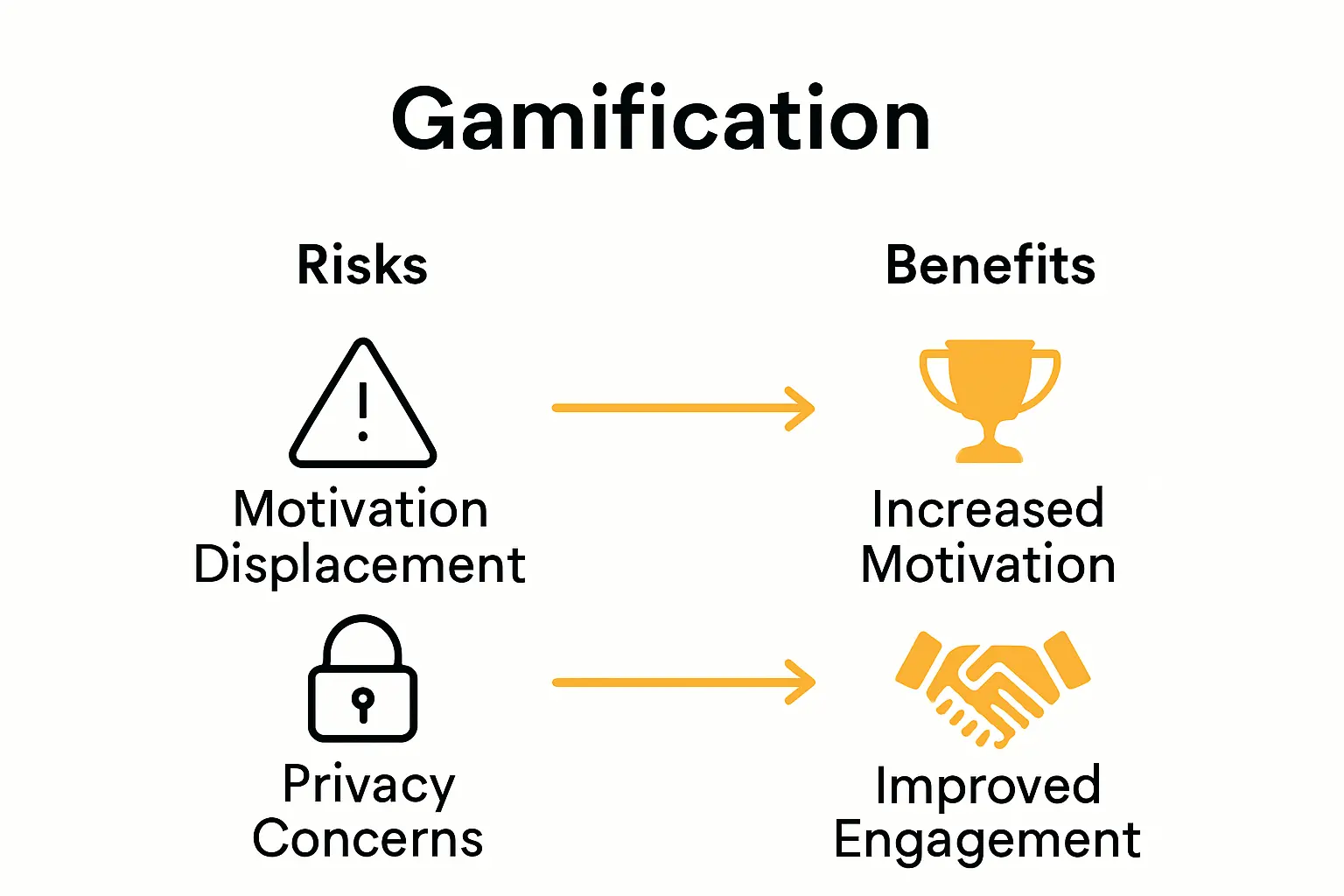
While gamification offers tremendous potential, organisations must navigate several critical challenges during implementation. ArXiv research reveals that poorly designed gamification systems can inadvertently undermine user motivation, particularly when there is an overemphasis on extrinsic rewards that diminish intrinsic engagement and authentic participation.
ArXiv further highlights the importance of user diversity, demonstrating that gamification strategies which fail to account for individual differences can produce counterproductive outcomes. This challenge extends beyond simple demographic considerations, requiring nuanced approaches that recognise varied user preferences, learning styles, and motivational triggers.
Key potential risks for membership organisations include:
- Reward System Manipulation: Members potentially gaming the system rather than genuinely participating
- Motivation Displacement: External rewards overshadowing intrinsic interest
- Complexity Fatigue: Overly complicated gamification mechanisms deterring participation
- Unequal Engagement: Designing systems that inadvertently exclude certain member groups
- Privacy Concerns: Potential perception of excessive monitoring through gamified tracking
Organisations seeking to mitigate these risks can find strategic guidance in The Benefits of Integrating Job Boards into Membership Organisations, which offers insights into creating balanced, inclusive engagement strategies.
Best Practices for Effective Implementation
Successful gamification demands a sophisticated, nuanced approach that goes far beyond simplistic point systems. ArXiv research emphasises the critical importance of personalised design, highlighting that effective gamification must meticulously align game elements with specific user characteristics and contextual dynamics to create truly engaging experiences.
Data-driven strategies are fundamental to implementation success. ArXiv underscores the necessity of deep user preference analysis, demonstrating that organisations can dramatically improve engagement by tailoring gamification approaches to their members’ unique motivational profiles and behavioural patterns. This requires continuous monitoring, iterative design, and a willingness to adapt strategies based on real-world performance.
Key best practices for membership organisations include:
- Comprehensive User Research: Conduct thorough assessments of member demographics and preferences
- Flexible Design: Create adaptable systems that can evolve with changing member needs
- Clear Objectives: Establish precise, measurable goals for gamification initiatives
- Balanced Reward Mechanisms: Design reward structures that motivate without creating perverse incentives
- Transparent Communication: Clearly explain gamification rules and expected member interactions
Organisations seeking to refine their strategic approach can gain additional insights from 7 Essential Tips for Effective Goal Setting for Organizations, which provides complementary guidance on creating meaningful, achievable organisational objectives.
Unlock Member Engagement with Tailored Gamification Solutions
The challenge of creating engaging, personalised gamification experiences for diverse membership audiences can feel overwhelming. This article highlights key pain points such as balancing reward mechanisms without displacing intrinsic motivation and designing adaptable systems that truly resonate with your members’ unique preferences. Colossus Systems understands these complexities and offers a comprehensive SaaS platform to streamline your member management while integrating gamified engagement strategies.
Empower your organisation to:
- Increase active participation through customised event planning and interactive portals
- Enhance communication with flexible CRM and email marketing tools
- Leverage data-driven insights to refine your gamification approaches continuously
Ready to transform your membership experience with expert gamification and engagement tools? Explore the power of Colossus Systems by connecting with our team today. Discover how our platform can help your organisation grow effectively by delivering not just management efficiency but vibrant member motivation. Take the next step now by visiting Contact Us or learn more about boosting your membership with Membership Software for Societies and Clubs and strategic insights from Improving Member Engagement: Proven Strategies for 2025.
Frequently Asked Questions
What is gamification and how does it work?
Gamification is the integration of game-design elements into non-game contexts to enhance user motivation and participation. It works by tapping into psychological drives, such as a sense of accomplishment and social influence, to create engaging experiences in areas like corporate training, education, and customer engagement.
What are the core principles of the Octalysis Framework?
The Octalysis Framework identifies eight critical motivational drives that underpin successful gamified experiences: Meaning and Purpose, Accomplishment, Empowerment, Ownership, Social Influence, Scarcity, Unpredictability, and Avoidance. Understanding these principles helps organisations create transformative engagement strategies.
How can gamification benefit membership organisations?
Gamification can significantly enhance member engagement by creating interactive experiences, improving knowledge retention, and increasing motivation. It fosters better communication and provides data-driven insights into member behaviours, which can lead to long-term loyalty and satisfaction.
What potential risks are associated with implementing gamification?
Potential risks include poorly designed systems that can undermine motivation, manipulation of reward systems, complexity fatigue, unequal engagement, and privacy concerns. Organisations must consider these risks and design inclusive strategies to mitigate them.