Why Professional Standards Matter: Trust, Safety and Growth

Professional standards matter because they turn a promise of competence into something that can be checked. They tell the public what to expect, tell practitioners what is required, and give an organisation a fair basis for acting when someone falls short. Without them, trust rests on reputation alone, and reputation is slow to build and quick to lose.
This guide explains what standards do in practice, who benefits, where they go wrong, and how a membership body can make them part of daily work rather than a document in a drawer.
TL;DR
- Standards set the minimum for safe, effective practice. They protect the public first and practitioners second.
- They give associations, charities and regulators a shared benchmark for decisions, so that fairness does not depend on who is judging.
- They signal quality to funders, partners and new members, which is why they support growth as well as compliance.
- Standards fail when they are treated as a one-off exercise or written as vague aspirations. They need actionable behaviours and regular review.
- Membership software can make standards visible and measurable through records, renewals, training and reporting.
Table of Contents
- What professional standards actually are
- Why they matter: five reasons
- What good standards look like
- Where organisations get it wrong
- How to put standards to work in your organisation
- Our perspective: standards need systems
- Making standards visible with Colossus
- FAQ
- Sources
What professional standards actually are
A professional standard is an agreed statement of what a competent, ethical practitioner knows and does. Some are set in law by a regulator. Others are set voluntarily by a professional body, a charity or an industry group.
Social work in England is a clear example. Social Work England describes its professional standards as the threshold requirements for safe and effective practice, covering the knowledge, understanding and behaviour every social worker must maintain to stay registered. They include building relationships, communicating well, practising without discrimination and being accountable for professional decisions.
The word “threshold” matters. Standards are not a description of excellence. They mark the line below which practice is not good enough, and they give everyone, from the practitioner to the person using the service, the same reference point.
Not every occupation is regulated by law. The Professional Standards Authority accredits registers of people in health and social roles that have no statutory regulator. Joining those registers is voluntary, but the register must meet published standards to be accredited. Voluntary standards, in other words, can carry real weight when they are credible and independently checked.
Why they matter: five reasons
1. They protect people from harm
The clearest case is health care. The World Health Organization’s Global patient safety report 2024 states that nearly 1 in 10 patients is harmed while receiving hospital care and that more than 3 million deaths a year are linked to unsafe care, with around half of that harm considered preventable. The report treats safety standards, regulation and accreditation as one of its core strategies.
You do not need a hospital to see the principle. Any field where a client cannot judge quality for themselves, such as finance, law, social care, engineering or education, relies on standards to do that judging on their behalf.
2. They build trust that can be proved
Anyone can claim to be trustworthy. Standards let you show it. According to the National Council of Nonprofits, a code of ethics gives an organisation principles that guide decisions and behaviour for employees, volunteers and board members alike. For a charity or association, that is what donors, funders and the public look for when they decide whether to back you.
The same logic applies online, where audiences judge credibility in seconds. A practical overview of building trust online shows how visible, consistent signals of quality shape whether people believe an organisation.
3. They make decisions fairer and more consistent
When the rules are written down, a complaint or a disciplinary question is judged against the same yardstick every time. That protects the public from a lenient decision and protects the practitioner from an arbitrary one. A paper in PubMed on maintaining professional standards in medicine argues that clear processes should protect doctors from unfair or mismanaged performance procedures covering conduct, capability and health.
For an association, this is the difference between a membership decision that can be defended and one that cannot.
4. They shape a shared professional identity
Research on professional associations in the journal Voluntary Sector Review describes them as co-creators of expertise, not merely regulators. By defining and promoting standards, an association helps members internalise a professional identity, which legitimises the field and builds practitioners’ confidence in their own expertise.
ASAE makes a similar point: associations support their industries by defining and promoting the markers of a qualified professional. That is a large part of why people join and stay.
5. They help organisations work across borders and sectors
ISO describes standards as a kind of business language: a shared baseline that allows organisations in different countries to cooperate and communicate. Academic work on certification points the same way. A study in the Journal of International Management found that international standards certification lowers transaction costs and raises exports for firms in developing countries, largely by signalling quality where local institutions are weak.
Most UK associations are not exporters, but the lesson carries over. A recognised standard shortens the distance between you and a partner who has never met you.
What good standards look like
Having a standard is not the same as having a useful one. Three features separate the two.
| Feature | Weak version | Strong version |
|---|---|---|
| Wording | General values such as “act with integrity” | Specific behaviours, such as declaring conflicts of interest in writing |
| Enforcement | No route for concerns | A clear, protected way to raise a concern, and a fair process afterwards |
| Review | Written once, never revisited | Scheduled review against changes in the field |
| Visibility | Buried on a website | Referenced in onboarding, renewals, training and board papers |
Guidance from the Foreign Service association AFSA on creating codes of ethics in professional associations warns about codes that are purely aspirational and detached from reality. Effective ones act where the law is vague, giving practitioners mechanisms for whistleblowing and conflict-of-interest disclosure that protect the person reporting.
ISO makes the review point from its own side: standards are a consensus on good practice that must be reviewed regularly to stay relevant. A standard that is five years out of date is not neutral. It quietly lowers the bar.
Where organisations get it wrong
Treating standards as a one-off exercise. Research on standards and innovation, published in the Journal of Standardization, notes the risk that firms pay for certification without gaining the efficiencies that come from embedding the standard in daily operations. The benefit comes from the change in how work is done, not from the certificate.
Writing for the regulator, not the member. If members cannot say in one sentence what the standard asks of them, it will not shape behaviour.
Separating standards from data. Many bodies hold their standards in one place and their member records in another. They cannot easily answer simple questions. Who has completed the required training? Who is overdue for renewal? Which members have declared a conflict this year?
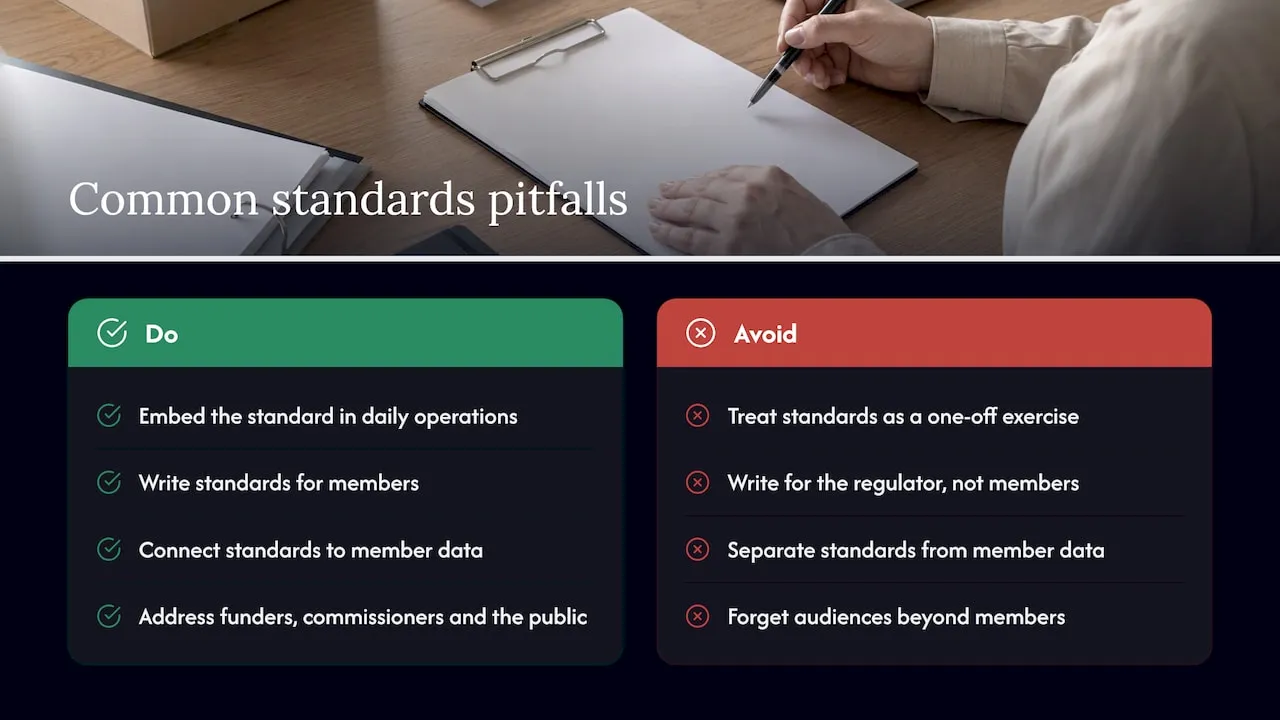
Forgetting the audience beyond members. Funders, commissioners and the public are all reading the signals. The National Council of Nonprofits and ASAE both point to ethical and professional standards as foundations of organisational sustainability, because they institutionalise trust. Our own guide to what association financial sustainability really means explains how that trust turns into stable income.
How to put standards to work in your organisation
- Start with the risk. Ask what could go wrong for the public, for members and for your reputation. Write standards for those risks first.
- Describe behaviour, not virtue. For each principle, add two or three examples of what meeting it looks like and what falling short looks like.
- Build in a safe route for concerns. Define who receives a concern, how the person raising it is protected, and what happens next.
- Link standards to membership. Make agreement to the standards part of joining and renewing, and record it.
- Connect them to learning. Tie required or recommended training to specific standards, and track completion.
- Report to your board. Give trustees a short, regular summary: complaints, training completion, renewals, open reviews. Our guide on improving board engagement covers how to keep that attention.
- Review on a schedule. Put the review date in the calendar and name the person responsible.
If you are starting from scratch, our article on what a code of ethics is and why members need one is a good first step. For the legal side of running a charity, see nonprofit compliance requirements and their impact.
Our perspective: standards need systems
We work with membership organisations, associations, nonprofits and educational institutions, and the same pattern appears often. The standards are sound. The difficulty is that nothing connects them to what the organisation does day to day.
A code of conduct lives in a PDF. Member records sit in a spreadsheet. Training attendance is in a separate tool, and renewals are chased by email. When someone asks whether the organisation can show that its members meet the standard, the answer takes a week to assemble.
We built Colossus Systems to close that gap. When membership management, events, virtual training, CRM, email and reporting share one platform, a standard becomes something you can operate. Agreement to a code can be recorded at joining. Required learning can be tracked in a learner portal. Reminders can go out automatically. Your board can see the figures without anyone building a report by hand.
Our advice is simple. Write standards that describe behaviour. Review them on a calendar. Then make sure the way you manage members makes them easy to follow and easy to evidence.
— Rob
Making standards visible with Colossus
If your standards depend on records, renewals and training, the right platform makes them easier to uphold. Our membership management software keeps member data, renewals and portals in one place, and our event management software handles registration for the training and CPD sessions that support your standards.
Plans start with Core at £349 per month, followed by Growth at £699 per month, Scale at £1,299 per month and Enterprise from £2,500 per month. You can compare them on our pricing page.
FAQ
Why are professional standards important in health and social care?
People who use these services are often vulnerable and cannot easily judge the quality of care themselves. Standards set the minimum for safe practice and give regulators a basis for acting when it is not met. The WHO’s 2024 patient safety report links unsafe care to millions of deaths a year, around half of the harm being preventable.
What standards do professionals have?
It depends on the field. Some professions, such as social work in England, have statutory standards set by a regulator. Others follow codes of ethics or conduct set by their professional association, or voluntary registers accredited by bodies such as the Professional Standards Authority. Most combine technical competence with ethical behaviour and accountability.
What is the difference between a standard and a code of ethics?
A standard usually defines the level of knowledge and practice expected. A code of ethics sets out the principles and behaviours that guide decisions, including how to handle conflicts of interest and raise concerns. Strong organisations use both and link them to membership.
How often should professional standards be reviewed?
There is no universal interval, because it depends on how quickly your field changes and on any regulator’s requirements. ISO’s guidance stresses that standards need regular review to stay relevant. Set a fixed date, name an owner and review sooner if the law or your sector changes.
Sources
- Social Work England: professional standards
- Professional Standards Authority: Standards for Accredited Registers
- WHO: Global patient safety report 2024
- National Council of Nonprofits: codes of ethics and values statements
- PubMed: Maintaining High Professional Standards
- Voluntary Sector Review: professional associations as co-creators of expertise
- ASAE: How Associations Prove Professional Quality
- ISO: standards as a business language
- ScienceDirect: international standards certification and exports
- AFSA: Creating Codes of Ethics in Professional Associations
- Journal of Standardization: standards and innovation
- How to build trust online