Why email lists matter for organisations: a practical guide

Email lists matter because they give organisations a durable, owned channel that drives repeat engagement and measurable revenue, independent of platform algorithms or paid media budgets.
Three facts make the case immediately. First, your email list is an asset you own outright: no social platform can restrict your reach overnight or change the rules on who sees your content. Second, the compounding value of a list means subscribers acquired today often continue generating revenue for years, shifting list-building from a marketing expense to a long-term asset. Third, segmented campaigns consistently outperform broadcast emails, with notably higher open rates and click-through rates compared with unsegmented sends.
The practical consequences for your marketing programme are direct:
- Retention: Regular, relevant email keeps members and customers engaged between purchases or renewals without paying for each impression.
- Re-engagement: Dormant contacts can be reactivated at a fraction of the cost of acquiring new leads.
- Low cost per send: Once your list exists, the marginal cost of reaching each subscriber is minimal compared with paid social or display.
Table of Contents
- What an email list actually delivers for your organisation
- How segmentation and personalisation lift opens, clicks and conversions
- How to grow a high-quality email list in the UK
- Maintaining list health and UK compliance
- The metrics and benchmarks worth tracking
- When to prioritise email over social and paid channels
- How an email-first approach pays off for membership organisations
- Key takeaways
- Why I prioritise email for organisations above every other channel
- Colossus makes email-first membership marketing practical
- Further reading and useful sources
What an email list actually delivers for your organisation
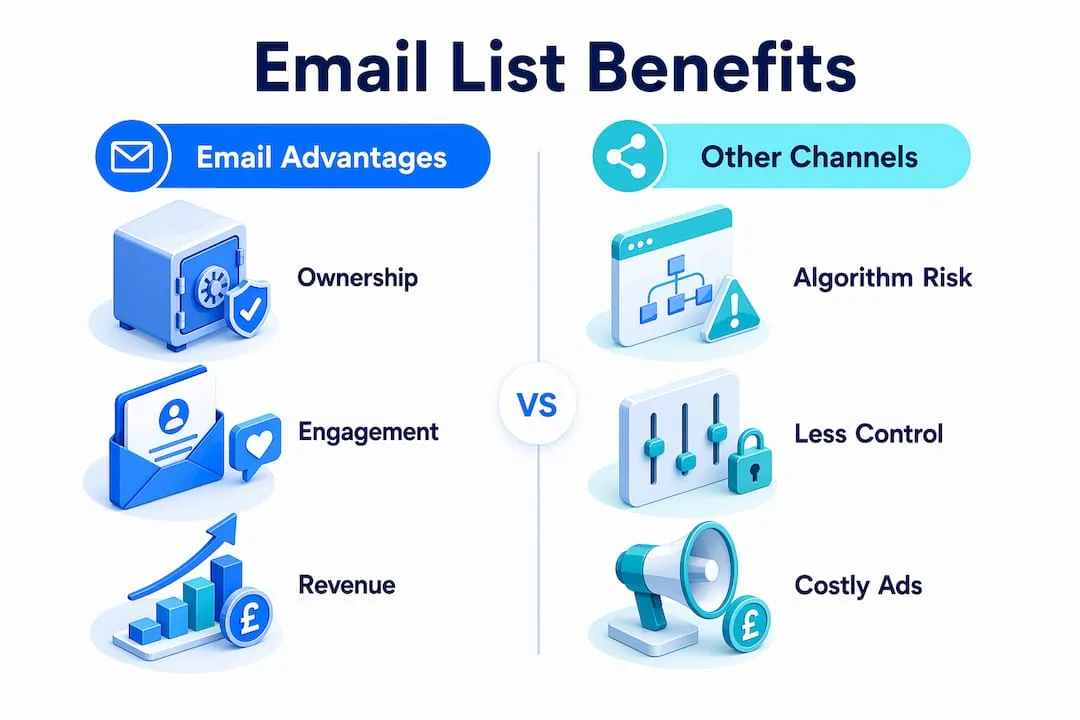
Owning your audience is the single most underrated advantage in digital marketing. Social channels, paid search, and display advertising all sit on rented ground: the platform sets the rules, controls the algorithm, and can change both without notice. An email list belongs to your organisation. Email remains one of the few channels organisations truly control, with no algorithm standing between sender and recipient.
That ownership translates directly into revenue. Email supports repeat purchases through lifecycle automation, cross-sell sequences, and renewal reminders. A well-structured welcome series alone can convert a new subscriber into a paying member or customer before they have visited your website a second time. For membership bodies, the renewal email sequence is often the single highest-revenue touchpoint in the entire calendar year.
Engagement metrics reinforce the case. Email open rates and click-through rates consistently outperform organic social reach for retention use cases. When a subscriber opens your email, they have actively chosen to engage; that intent is qualitatively different from a passive scroll past a social post. The personal nature of email drives higher conversion rates than most other digital channels for direct acquisition and re-engagement alike.
How segmentation and personalisation lift opens, clicks and conversions
Segmentation is where the importance of email lists moves from theory to measurable results. Segmented campaigns typically see approximately 30% higher open rates and 50% higher click-through rates than unsegmented broadcasts. The mechanism is straightforward: relevant messages get opened; irrelevant ones get ignored or, worse, reported as spam.

Three mechanisms explain the uplift. Relevance means the content matches the subscriber’s actual situation or interest. Frequency control means high-engagers receive more touchpoints while dormant contacts receive fewer, reducing fatigue. Lifecycle messaging means the right offer arrives at the right stage: a welcome offer for a new subscriber, a renewal prompt for a lapsing member, a cross-sell for a recent purchaser.
For a practical guide on how to segment email lists effectively, the three segment types below give you a reliable starting framework.
| Segment type | What it captures | Expected performance lift |
|---|---|---|
| Behavioural | Opens, clicks, page visits, event attendance | Highest: directly signals active interest |
| Transactional | Purchase history, renewal date, membership tier | High: enables timely, relevant offers |
| Demographic | Role, location, organisation size | Moderate: useful for content relevance |
Pro Tip: Start with two segments before building anything more complex: recent purchasers or new members (last 90 days) and high-engagers (opened at least three of your last five emails). These two groups respond fastest and give you clean data to refine your broader segmentation strategy.
How to grow a high-quality email list in the UK
List growth is only valuable when the subscribers you add are genuinely interested and have explicitly opted in. In the UK, that is not just good practice; it is a legal requirement under PECR and GDPR. The tactics below are both effective and compliant.

Website forms and pop-ups are the highest-volume acquisition tool for most organisations. Adding a pop-up form can significantly increase list growth rates for practitioners who implement them carefully. Exit-intent pop-ups and timed overlays on high-traffic pages consistently outperform static footer forms. Keep the value proposition clear: tell visitors exactly what they will receive and how often.
Lead magnets convert passive visitors into subscribers by offering something immediately useful: a guide, a checklist, a template, or access to gated content. The offer must be specific enough to attract the right audience, not just anyone with an email address.
Events are particularly powerful for membership organisations. Attendees have already demonstrated interest in your subject matter; a post-event opt-in sequence converts that interest into a long-term relationship. For organisations running supporter and campaign outreach, events are often the single best source of high-quality new contacts.
Referrals and partner promotions extend your reach to audiences you cannot access directly. A co-branded webinar or a reciprocal newsletter mention from a complementary organisation can deliver highly qualified subscribers at near-zero cost.
What not to do:
- Never buy email lists. Purchased lists lower deliverability, increase spam complaints, and violate most platform policies. The short-term volume gain destroys long-term sender reputation.
- Never scrape addresses from websites or directories without explicit consent.
- Never email non-opted-in contacts from your CRM as if they were marketing subscribers.
Pro Tip: Your existing transactional contacts (people who have purchased, registered, or enquired) are your warmest potential subscribers. Send a single re-permission email explaining what your marketing list offers and asking them to opt in. Done once, cleanly, this can add a significant number of high-quality subscribers without any new acquisition spend.
Maintaining list health and UK compliance
A large list that does not deliver is worse than a small one that does. Deliverability depends on list hygiene, and hygiene is a continuous process, not a one-time clean.
Key hygiene actions keep your sender reputation intact:
- Validate new addresses at the point of capture using a real-time validation tool to block obvious typos and disposable addresses.
- Remove hard bounces immediately after every send; a hard bounce means the address does not exist and continuing to send to it signals poor list management to inbox providers.
- Suppress role addresses (info@, admin@, support@) from marketing sends unless an individual has explicitly opted in from that address.
- Flag and segment inactive subscribers (no opens or clicks in 90–180 days) before they drag down your overall engagement metrics.
Re-engagement workflow: Send a short sequence of two or three emails to inactive subscribers over three to four weeks. Make the subject line direct: “We have not heard from you” works better than a vague “We miss you.” Offer something of genuine value. Anyone who does not re-engage after the sequence should be suppressed or removed.
UK compliance essentials under GDPR and PECR are non-negotiable. The ICO’s guidance on direct marketing sets out the lawful basis requirements clearly. For most marketing emails to individuals, you need freely given, specific, informed consent. The soft opt-in exemption under PECR allows you to email existing customers about similar products or services without fresh consent, provided you gave them a clear opportunity to opt out at the point of collection and in every subsequent email.
Maintenance timeline:
- Monthly: Review bounce rates, unsubscribe rates, and spam complaint rates after every campaign. Suppress hard bounces immediately.
- Quarterly: Run your re-engagement sequence on the inactive segment. Review your opt-in forms for clarity and compliance.
- Annually: Audit your consent records, review your privacy notice, and assess whether your lawful basis documentation is current.
This article is general information, not legal advice. Confirm your specific compliance position with the ICO or a qualified data protection professional.
The metrics and benchmarks worth tracking
Measuring the value of your email programme requires a small set of metrics that each tell a different part of the story.
| Metric | What it indicates | Benchmark to aim for |
|---|---|---|
| Delivery rate | List hygiene and sender reputation | — |
| Open rate | Subject line quality and sender trust | — |
| Click-through rate | Content relevance and call-to-action clarity | 2–5% |
| Conversion rate | Offer relevance and landing page alignment | 1–3% |
| Unsubscribe rate | Content fatigue or frequency mismatch | — |
| List growth rate | Net new subscribers minus unsubscribes | Positive month-on-month |
Two simple formulas make the financial case to stakeholders. Revenue per subscriber = total email-attributed revenue divided by total active subscribers. If your list of 5,000 active subscribers generates £25,000 in email-attributed revenue per year, each subscriber is worth £5 annually. Campaign ROI = (campaign revenue minus campaign cost) divided by campaign cost, expressed as a percentage. These figures give you a clear basis for measuring email marketing performance and justifying investment in list growth.
The compounding effect matters here too. Small organisations often see the clearest returns in years 3–5 as the list matures, engagement data accumulates, and automation sequences become more precisely targeted. Early investment in list quality pays disproportionately later.
A list of 1,000 engaged subscribers consistently outperforms a list of 10,000 disengaged ones on every metric that matters: opens, clicks, conversions, and revenue per send.
When to prioritise email over social and paid channels
Email, social, and paid channels each have a natural job. Confusing those jobs is where most marketing budgets leak.
Paid social and search excel at acquisition: reaching people who do not yet know your organisation exists. They are expensive per contact and the moment you stop paying, the reach stops. Organic social builds brand awareness and community, but algorithmic reach for most organisations is unpredictable and declining. Email is the retention and re-engagement channel: it reaches people who have already expressed interest, at a cost per send that does not scale with audience size.
Three scenarios where email should lead:
- Membership renewals: A timed sequence of renewal reminders, delivered directly to the member’s inbox, consistently outperforms social posts or paid retargeting for this use case.
- Re-engagement drives: Reactivating a dormant contact via email is typically far cheaper than re-acquiring them through paid channels.
- Lifecycle communications: Onboarding sequences, event follow-ups, and anniversary messages all require the personal, direct nature of email to land effectively.
The strongest programmes combine channels deliberately. Use paid social to drive traffic to a lead magnet and grow the list. Use email to convert and retain. Use social retargeting to re-engage subscribers who have gone cold. For organisations running fundraising outreach campaigns, this combined approach consistently outperforms any single-channel strategy.
How an email-first approach pays off for membership organisations
Membership organisations have a structural advantage with email that most commercial businesses do not: a defined, consented audience with a clear shared interest. The challenge is activating that audience consistently rather than only at renewal time.
Association email marketing data from Colossus shows that organisations using a structured email programme with CRM integration achieve 26% higher member engagement than those relying on ad hoc communications. That figure reflects the difference between a reactive approach (sending when there is news) and a proactive lifecycle strategy (sending the right message at the right stage of the member journey).
Consider a practical example. A professional association with 2,000 members moves from a monthly newsletter to a segmented programme: new members receive a four-email onboarding sequence, active members receive event invitations matched to their stated interests, and lapsing members receive a two-email re-engagement sequence 60 days before renewal. The result is a measurable uplift in renewal rates and event attendance, with no increase in total send volume.
Colossus’s CRM and automation features make this practical without a dedicated email developer. Member data flows directly from the membership database into segmented lists, event registrations trigger automated follow-up sequences, and renewal dates prompt timely reminders. The email marketing tools for nonprofits and membership bodies built into the platform remove the manual work that typically prevents smaller organisations from running sophisticated programmes.
Organisations that move from broadcast newsletters to segmented lifecycle email typically see their most significant engagement gains within the first two renewal cycles.
Key takeaways
Email lists are a compounding owned asset: organisations that invest in list quality, segmentation, and consistent lifecycle communication consistently outperform those relying on rented channels for retention and re-engagement.
| Point | Details |
|---|---|
| Ownership is the core advantage | An email list cannot be taken away by an algorithm change or platform policy update. |
| Segmentation drives measurable uplift | Segmented campaigns typically see approximately 30% higher open rates and 50% higher click-through rates than unsegmented sends. |
| Pop-ups accelerate list growth | Adding a pop-up form can increase list growth rates by around 50.8%, making it the fastest single tactic. |
| Compliance is non-negotiable in the UK | GDPR and PECR require explicit consent for most marketing emails; ICO guidance sets the standard. |
| Colossus supports lifecycle email for memberships | Colossus’s CRM and automation features deliver notably higher member engagement for associations using structured email programmes. |
Start today: Audit your current opt-in forms, create one welcome automation for new subscribers, and schedule a hygiene sweep of contacts inactive for more than 90 days. Those three actions will improve deliverability, engagement, and revenue per subscriber within a single send cycle.
Why I prioritise email for organisations above every other channel
The conventional wisdom in digital marketing is that you need to be everywhere: social, paid, search, video, and email. My view is that this spreads most organisations too thin, particularly membership bodies and nonprofits with limited marketing resource.
Email is the one channel where the relationship compounds. A subscriber who joined your list three years ago and has opened consistently is worth more than a new follower on any social platform, because the trust has been built incrementally over time. The data you hold on that subscriber, their interests, their event attendance, their renewal history, is something no social platform will ever give you about your own audience.
The organisations I see getting the clearest long-term returns are not the ones with the biggest lists. They are the ones with the most consistent programmes: a reliable welcome sequence, a clean renewal cadence, and a quarterly re-engagement sweep. Consistency beats sophistication every time, particularly in years three to five when the compounding effect of a well-maintained list becomes genuinely visible in the revenue figures.
The mistake most organisations make is treating email as a broadcast tool rather than a relationship channel. The moment you start segmenting by behaviour and lifecycle stage, the metrics shift noticeably. That shift is not a coincidence; it is what happens when you stop interrupting people and start being relevant to them.
Colossus makes email-first membership marketing practical
Most membership organisations know they should be doing more with email. The barrier is rarely strategy; it is the operational complexity of connecting member data, event registrations, and renewal dates into a coherent communication programme.
Colossus brings CRM, segmentation, automation, and event management into a single platform built specifically for membership bodies. Your member data is always current, your segments update automatically, and your lifecycle sequences run without manual intervention. Three features make the difference for membership teams:
- Centralised member contacts: Every interaction, from event attendance to renewal history, feeds a single contact record, giving you the segmentation data you need without manual data entry.
- Automated renewal and onboarding sequences: Set up once, and Colossus handles the timing, personalisation, and delivery across the entire member lifecycle.
- Event-triggered email workflows: When a member registers for an event, a confirmation, reminder, and follow-up sequence fires automatically, keeping engagement high without additional effort from your team.
If you are ready to move from ad hoc newsletters to a structured, data-driven email programme, explore Colossus’s membership management features and see how the platform supports every stage of the member journey.
Further reading and useful sources
The sources below are worth bookmarking if you want to go deeper on any of the topics covered above.
| Source | Why it is useful |
|---|---|
| ICO direct marketing guidance | The primary UK reference for GDPR and PECR compliance in email marketing; covers consent, soft opt-in, and recordkeeping. |
| Mailchimp: how to build your email list | Practical tactics for opt-in forms, pop-ups, and lead magnets, with benchmark data on list growth uplift. |
| Mailchimp: never purchase email lists | Clear explanation of why bought lists damage deliverability and violate platform policies. |
| Colossus: association email marketing and engagement | Internal data and practical guidance on achieving higher member engagement through structured email programmes. |
| Colossus: how to segment email lists | Step-by-step segmentation guidance tailored to membership and nonprofit audiences. |
| Mailflow Authority: why build an email list | Practitioner analysis of compounding list value and long-term revenue contribution, with realistic time horizons. |