Monthly Billing System: How to Choose One in 2026

A monthly billing system charges your members or customers automatically on a set schedule, issues the invoices and records the money. The right one for you depends on what else it has to do. A software company needs subscription logic and revenue reporting. A membership organisation also needs renewals, member records, events and, in the UK, Direct Debit and Gift Aid. Below we compare the main options, say what each is best at, and give you a checklist for choosing.
TL;DR
- A billing system does more than take a card payment: it manages the full subscription lifecycle, from plans and invoices to failed-payment recovery and reporting.
- Stripe Billing, Chargebee, Zoho Billing and Recurly are general subscription billing tools. GoCardless is a specialist for Direct Debit collection.
- Membership organisations often end up joining a billing tool to a separate CRM, event system and member portal. An all-in-one platform removes that join.
- Colossus plans start at £349 per month (Core) and run to Enterprise from £2,500 per month.
- Check integrations, reporting, payment methods, security and support before you commit, not after.
Table of Contents
- What a monthly billing system actually does
- The main options compared
- Why membership organisations need more than a billing tool
- What to check before you choose
- How to choose by organisation size
- A simple way to compare total cost
- See it with your own membership model
- FAQ
- Sources
What a monthly billing system actually does
At its simplest, a recurring payment is an automatic charge to a customer’s card or bank account at regular intervals, usually using payment details saved with the customer’s consent, as Checkout.com explains. Most of the systems below start from that idea and add the machinery around it.
There are two billing patterns worth separating:
- Fixed recurring billing: the amount is the same every cycle. Checkout.com notes that monthly memberships commonly work this way.
- Variable recurring billing: the amount changes with usage, which is the model Checkout.com links to utilities.
Most membership organisations are on the fixed model, with the odd complication: different tiers, mid-year joiners who need a pro-rata first payment, family or corporate memberships, and add-ons such as event tickets or training.
A good system also manages what happens around the charge. TechTarget describes subscription management as overseeing the complete lifecycle of products or services sold repeatedly, not merely charging a card, and says the software typically ties together customer data, payment gateways and revenue-cycle processes. In practice that means:
- Plans, prices and billing dates held in one place
- Automatic invoices and receipts
- Retries and reminders when a payment fails
- Upgrades, downgrades, pauses and cancellations
- Reports on income, churn and renewals
- A link to your accounting package
The main options compared
The table groups the tools by what they do best. We have kept pricing out of the competitor rows where it depends on volume, plan or negotiation, because those figures change. Check each provider’s own pricing page for the current rate.
| Option | Type | Best for | Payment methods | Pricing model |
|---|---|---|---|---|
| Colossus | All-in-one membership platform | Associations, nonprofits and educational bodies that want billing, CRM, events and portals together | Online payment gateway integrations; Direct Debit support for UK membership | Flat monthly plans from £349 |
| Stripe Billing | Developer-friendly billing layer on a payment processor | Organisations with in-house technical resource and custom needs | Cards, wallets and other methods through Stripe | Charged on Stripe’s published terms |
| GoCardless | Direct Debit and bank payments specialist | Collecting regular payments cheaply from UK bank accounts | Bank-to-bank only, no cards | 1% + 20p per UK domestic transaction, capped at £4 on Standard |
| Chargebee | Subscription management layer over your gateway | Growing subscription businesses with several gateways or complex plans | Via connected gateways | Tiered by plan and revenue |
| Zoho Billing | Billing within the Zoho suite | Teams already using Zoho accounting and CRM | Via connected gateways | Tiered by plan |
| Recurly | Subscription management for high-volume digital commerce | Large consumer subscription businesses | Via connected gateways | Quote or tiered |
The GoCardless figure comes from a UK fee comparison of GoCardless, which also reports no monthly fee and no minimum contract on its Standard and Advanced plans. Confirm it on GoCardless’s own site before you budget.
Stripe Billing
Stripe Billing sits on top of Stripe’s payment processing and lets you set up recurring prices, usage-based charges and automated invoices. It is flexible, and that flexibility is its main selling point and its main cost: someone has to configure it, connect it to your member database and maintain that connection. It suits organisations with developers or a strong technical partner.
GoCardless
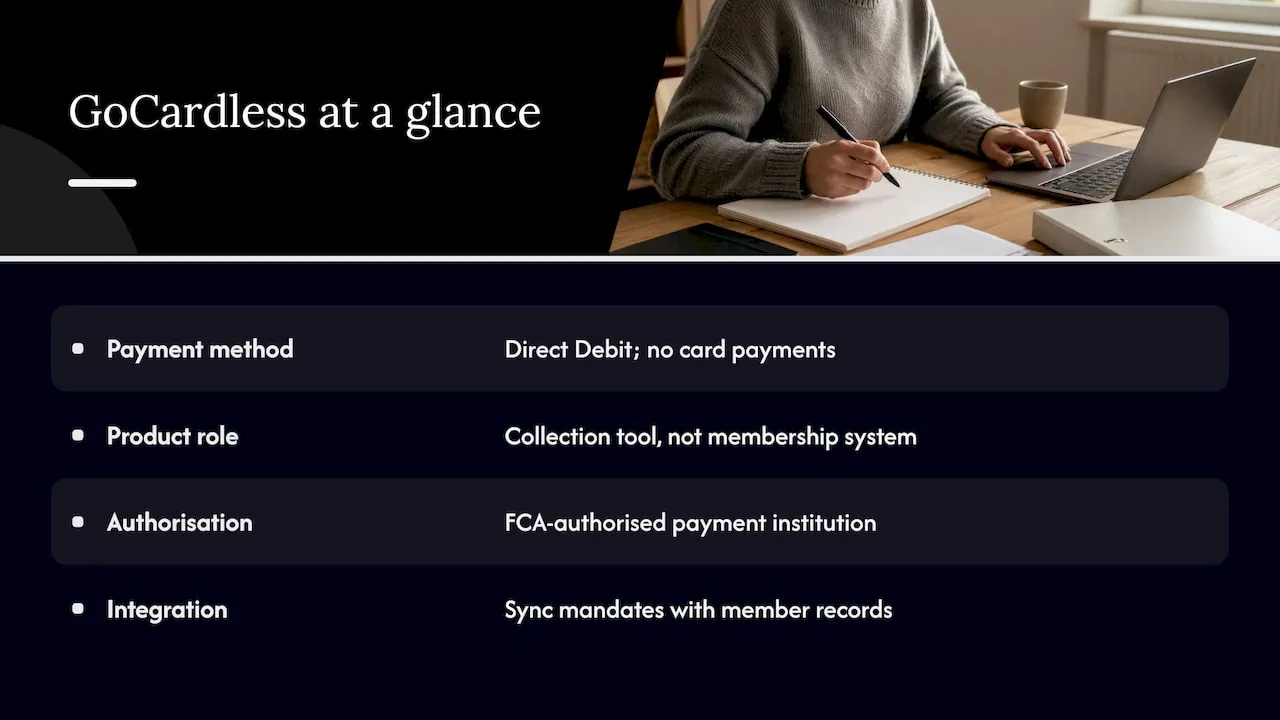
GoCardless collects by Direct Debit, which is the payment method many UK members already know from gym, charity and professional body subscriptions. It does not take card payments, so it is a collection tool, not a full membership system. The same fee comparison states that GoCardless is FCA-authorised as a payment institution, which will matter to your finance director or trustees.
It works well alongside a membership platform that can sync mandates with member records.
Chargebee and Recurly
Both are subscription management layers built mainly for software and digital subscription companies. They are strong on plan logic, prorations and revenue operations. Membership-specific needs, such as member directories, committee roles, event registration and CPD records, are outside their core, so you would normally add other systems.
Zoho Billing
Zoho Billing makes sense if your finance and CRM already live in the Zoho suite. You get a joined-up set of business tools, but you will still need to bring in event management and a member portal from elsewhere, or configure Zoho’s other products to fill the gap.
Colossus
Colossus is built for membership-based organisations, so billing is part of the same platform as member management, events and virtual training, CRM, email marketing, e-commerce and member portals. Payments run through integrated online payment gateways, and we publish our plan prices openly:
| Plan | Price |
|---|---|
| Core | £349 per month |
| Growth | £699 per month |
| Scale | £1,299 per month |
| Enterprise | from £2,500 per month |
| Contributor licence | from £29 per month |
Current details are on our pricing page.
Why membership organisations need more than a billing tool
A billing tool answers one question: has this person paid? A membership organisation asks several more. Is their membership active? What can they access? Did they register for the conference? Should they receive a renewal reminder next week? Have they lapsed after a failed payment?
When billing is a separate system, someone has to carry the answers between tools. Typical points of friction:
- A payment fails in the billing tool, but the member still has portal access because the membership record was never updated.
- A member upgrades tier, and the new price applies in one system but not the other.
- Finance reports one membership number and the membership team reports another.
- Event discounts for members need a manual check against a spreadsheet.
A single platform removes these hand-offs because the payment, the membership status and the member’s access are all one record. That is the case for an all-in-one approach, and it is the thinking behind how we built Colossus. If you want more on the UK side, our guide to membership payment software for UK organisations covers Direct Debit and Gift Aid, and our piece on Direct Debit mandates synced to your CRM explains how the mandate lifecycle works.
What to check before you choose
Gartner’s description of the recurring billing category lists the core capabilities as periodic invoices, payment collection, general-ledger integration and revenue-recognition logic aligned with IFRS 15 and ASC 606. That is a useful baseline. For a membership body, add the checks below.
Integrations
- Does it connect to your accounting package, and does it post invoices and payments automatically?
- Does it share data with your CRM and email tool, or will you export and import?
- Is there an API if you later need a custom connection?
Payment methods
- Cards, Direct Debit and bank transfer: which do your members actually use?
- If members are international, which currencies can you charge in?
- Who bears the processing fee, and is it on top of the software subscription?
Failed payments and renewals
- Does the system retry failed payments automatically, and can you set the schedule?
- Do reminders go out before renewal and after a lapse?
- What happens to member access when a payment fails?
Reporting
- Can you see monthly recurring income, renewals due and lapsed members without building a report from scratch?
- Can your finance team reconcile payments to bank deposits?
Security and support
- Does the provider say how card data is handled and where member data is stored?
- Is support included, and who answers when a payment run goes wrong on the first of the month?
- Is onboarding and data migration included or charged separately?
How to choose by organisation size
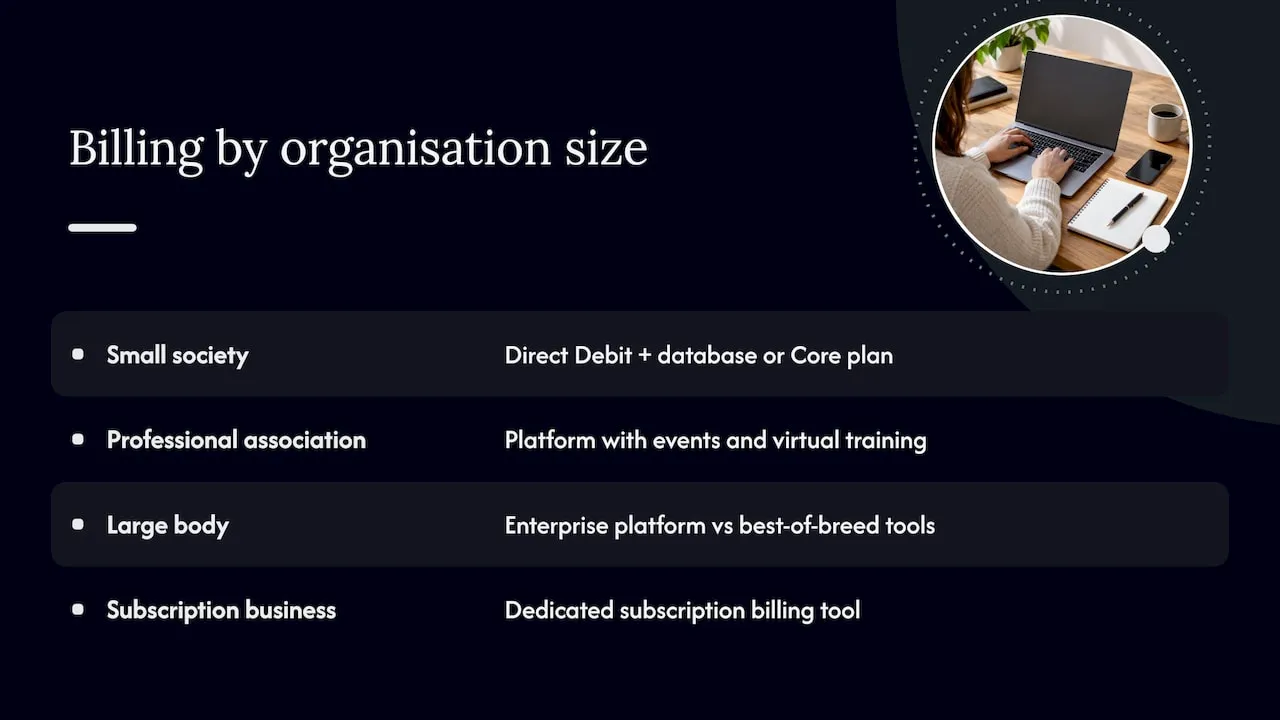
A small society or local charity with a few hundred members. You mainly need to collect subscriptions reliably and keep records tidy. A Direct Debit specialist plus a simple member database can work, but a Core plan from an all-in-one platform saves you running two tools.
A professional association with events and training. Your billing has to talk to registrations, CPD and portals. Here the integration cost of a separate billing tool usually outweighs the saving, and a platform with events and virtual training built in is the better fit.
A large body with multiple chapters, tiers and a finance team. You will need configurable workflows, strong reporting and probably an API. Compare an enterprise membership platform against a stack of best-of-breed tools and count the integration and maintenance work honestly.
A subscription business that is not membership-based. If your product is software or content with usage-based pricing, a dedicated subscription billing tool like Stripe Billing, Chargebee or Recurly is the more natural starting point.
A simple way to compare total cost
Software prices are only part of the bill. For each shortlisted option, put the following in one row of a spreadsheet:
- Monthly or annual software fee
- Payment processing fees, estimated on your own payment mix
- Add-ons you will need: events, CRM, email, portal
- Integration or developer time
- Onboarding and migration charges
- Staff time currently spent on reconciling and chasing
A tool that looks cheaper on line 1 can lose on lines 3 to 6. This is where bundling pays off for membership organisations, since the add-ons are already inside the plan.
Our perspective
We build Colossus for membership organisations, and the pattern we see is the same: billing is rarely the hard part on its own. The hard part is keeping payments, membership status, events and communication in step with each other.
That is why we put member management, events and virtual training, CRM, email marketing, e-commerce and portals on one platform. When a payment is recorded, the member record, their access and your reports all reflect it. There is no second system to update and no spreadsheet to reconcile.
Our view is that most associations and nonprofits should start with the platform that matches how their members actually join, renew and take part, then choose how payments are collected within it. We also publish our plan prices, because you should be able to budget before you speak to anyone.
Rob
See it with your own membership model
If you want billing, member records, events and portals in one place, Colossus plans start at £349 per month on Core and scale up with your needs. Our membership management software handles tiers, renewals and member portals, and you can see every plan on the pricing page.
For a closer look at what is included, browse our membership software features. If you are a charity, our guide to subscription payments for nonprofits is a good next read.
FAQ
What is the difference between a billing system and a payment gateway?
A payment gateway securely passes card or bank details to the processor and authorises the charge. A billing system decides when and how much to charge, issues invoices, retries failures and reports on the results. Most subscription tools need a gateway underneath them.
Is Direct Debit better than card for monthly membership payments?
Many UK organisations use Direct Debit for fixed monthly subscriptions because it collects straight from the bank account. For example, GoCardless is a Direct Debit specialist with no card payments, so organisations that also want cards need a second method. The better choice depends on what your members prefer, so offering both is common.
Do I need a separate billing tool if I use membership software?
Not necessarily. A membership platform with integrated payment gateways can take payments and keep member status in step with them. A separate tool becomes worthwhile when you have unusual billing logic, such as heavy usage-based charging, that membership software does not cover.
What should I look for in a billing system for a charity?
Look for Direct Debit support, Gift Aid handling, reliable failed-payment retries and reports your trustees can read. Check that donations and membership fees can be reported separately. Our membership software for non-profits and charities page sets out what we offer.
Sources
- What are recurring payments? Checkout.com
- Subscription management, TechTarget
- Recurring Billing Applications Reviews and Ratings, Gartner
- GoCardless Review UK 2026: Fees and Direct Debit, Compare Card Fees