Subscription payments solution for nonprofits: 2026 guide

TL;DR:
- Subscription payment solutions automate recurring billing, improve member experience, and reduce revenue leakage.
- Effective platforms support features like automated proration, native surcharging, self-service portals, and real-time reporting.
A subscription payments solution is software that automates the collection, scheduling, and management of recurring payments, replacing manual invoicing and spreadsheet tracking with a single, reliable billing engine. For nonprofits and professional associations, this means membership dues, recurring donations, and event subscriptions are collected on time, every time, without staff intervention. Platforms such as Stripe, Maxio, and PayBito represent the current generation of recurring billing software, each offering different strengths across payment methods, fee structures, and automation depth. The right platform does more than collect money. It reduces involuntary churn, improves financial reporting, and gives members a self-service experience that strengthens their relationship with your organisation. For finance and operations managers exploring recurring payment solutions, the decision carries real consequences for revenue stability and member satisfaction.
What are the key features of effective subscription billing management software?

Effective subscription billing management software is defined by its ability to handle the full billing lifecycle without manual input at each stage. The core capabilities go well beyond simply charging a card on a set date.
The features that separate capable platforms from basic payment processors include:
- Automated billing cycles and proration. The system calculates charges automatically when members join mid-cycle, upgrade their tier, or cancel early. This removes a common source of billing disputes.
- Dunning management. When a payment fails, the platform sends timed, personalised recovery emails and retries the charge according to a configurable schedule. Automated retry logic significantly reduces involuntary churn caused by expired cards or temporary bank declines.
- Native surcharging. Native surcharging integration enables subscription businesses to recover up to 95% of credit card processing fees transparently and compliantly. Maxio, which manages over $18 billion in billings, built this capability directly into its invoice and checkout flows. Third-party surcharging add-ons, by contrast, create fragmented reporting and inconsistent buyer experiences that frustrate finance teams at audit time.
- Multi-currency and multi-payment-method support. Associations with international members need platforms that accept cards, bank transfers, and increasingly, cryptocurrency. The rise of crypto payments demands subscription gateways that unify traditional and modern payment methods to capture all subscriber segments.
- Self-service customer portals. Customer self-service portals enable subscribers to update payment methods and manage their subscriptions autonomously, reducing both churn and support tickets. Members who can fix a failed payment themselves at midnight are far less likely to lapse.
- Real-time reporting and reconciliation. Revenue dashboards that update in real time give finance managers an accurate picture of monthly recurring revenue, failed payments, and renewal rates without exporting data to a separate spreadsheet.
Pro Tip: When evaluating platforms, ask vendors specifically whether surcharging is native to the billing engine or handled by a third-party add-on. The difference directly affects your audit trail and the consistency of your member-facing receipts.
How do subscription payment gateways differ?
Not all subscription payment platforms are built on the same architecture, and the differences matter considerably for nonprofits and associations with diverse donor and member bases.
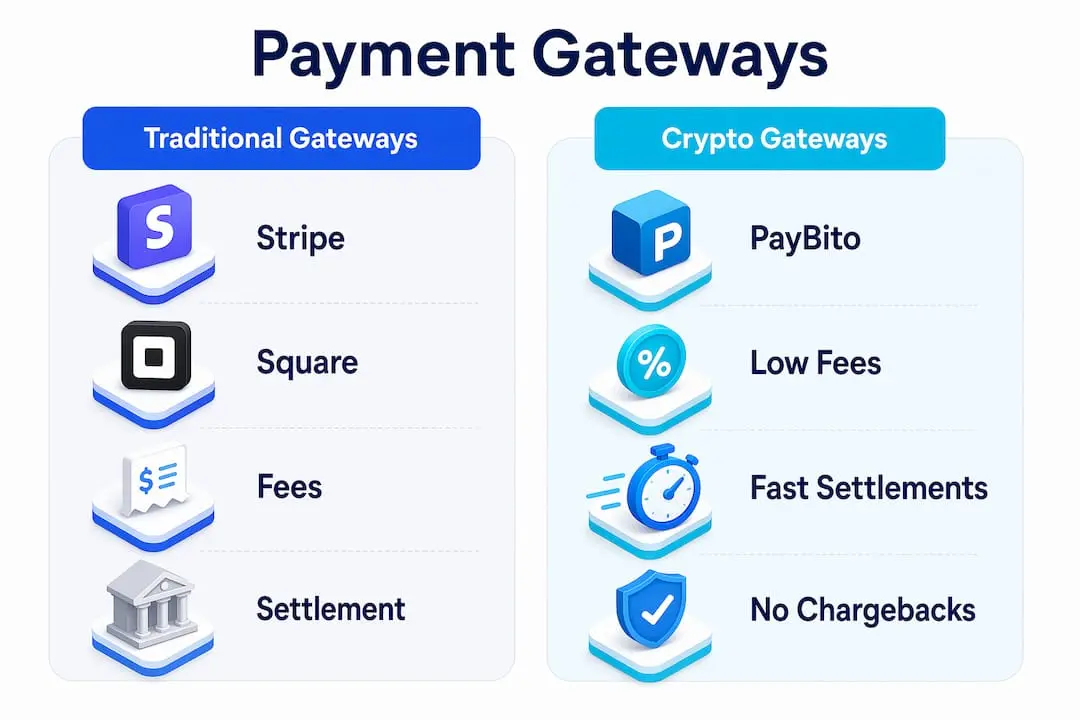
| Gateway type | Examples | Typical fees | Settlement speed | Best suited for |
|---|---|---|---|---|
| Traditional card-only | Stripe, Square | 2.4%–3.3% + fixed fee | 2–3 business days | Organisations with straightforward card billing |
| Crypto-native | PayBito, NexaPay.one | 1%–3% | Minutes | Organisations seeking lower fees and chargeback-proof payments |
| Hybrid (card + crypto) | PayBito Pro | Varies by method | Minutes to days | Associations wanting to support all subscriber preferences |
Standard online payment fees range from 2.4% to 3.3% plus fixed fees, while crypto-native solutions offer fees around 1% to 3% with settlement in minutes. For a nonprofit processing £200,000 in annual dues, even a 0.5% reduction in processing fees represents £1,000 returned to mission-critical spending.
Traditional gateways such as Stripe and Square are well-documented, widely integrated, and carry strong fraud protection. Their limitation is that they are card-centric, which excludes donors who prefer bank transfers or digital assets. Crypto-native gateways address this gap and offer an additional advantage: payments are final on settlement, removing the chargeback risk that affects card-based recurring billing. Hybrid gateways combine both worlds in a single integration, which reduces technical complexity for smaller associations without dedicated IT teams.
For nonprofits specifically, donor transparency is a deciding factor. Members and donors want to see exactly what they are being charged and why. Platforms that display fee breakdowns clearly at checkout, rather than burying them in terms and conditions, generate higher acceptance rates and fewer disputes.
What are best practices for integrating and automating subscription payment solutions?
Integration is where many organisations lose the efficiency gains they expected from adopting a subscription payment platform. The setup process is more straightforward than most finance managers assume. Modern subscription payment gateways can be integrated and live within 60 minutes for many business types, with setup involving connecting API credentials from providers such as Stripe or PayPal. The complexity comes not from the initial connection but from configuring the billing logic correctly from the start.
Follow these steps to set up and automate your subscription billing effectively:
- Connect your payment gateway API. Retrieve your API keys from your chosen provider and enter them into your membership management or billing platform. Test in sandbox mode before going live.
- Configure billing profiles for each membership tier. Define billing frequency, trial periods, proration rules, and any applicable discounts within the platform. Automated subscription management is essential for handling complex pricing models and avoiding revenue leakage at scale.
- Enable dunning sequences. Set up automated email sequences that trigger after a failed payment, with retry attempts spaced across 3, 7, and 14 days. Pair these with a self-service link so members can update their payment details directly.
- Activate native surcharging where permitted. Configure surcharging rules within the billing engine rather than through a third-party plugin. This keeps your reporting clean and your reconciliation accurate.
- Sync payment data with your CRM. Connect your billing platform to your CRM software so that payment status, renewal dates, and membership tier changes update automatically. Manual data entry between systems is the single largest source of revenue leakage in association finance operations.
- Communicate billing changes clearly to members. Send advance notice before any renewal, price change, or failed payment action. Transparent billing communication is the most underrated retention tool available to membership organisations.
Pro Tip: Avoid the temptation to manage subscription renewals in spreadsheets alongside a payment gateway. Using siloed tools for subscription renewals leads to revenue leakage. A true subscription billing solution must be a single system of record for contract terms, discounts, and usage components.
How to select the right subscription payments solution for your organisation
Selecting a subscription payment platform requires matching the platform’s capabilities to your organisation’s specific billing complexity, member base, and growth trajectory. There is no universal answer, but there are clear evaluation criteria that separate suitable platforms from poor fits.
Consider the following factors before committing to a platform:
- Subscription volume and billing complexity. A small association with 200 members on a single annual tier has very different needs from a professional body with 5,000 members across monthly, quarterly, and annual plans with tiered pricing. Platforms such as Maxio are built for high-volume, complex billing. Stripe suits simpler recurring models with strong developer support.
- Payment method preferences of your members. Survey your existing members before selecting a platform. If a meaningful segment prefers bank transfers or is interested in crypto payments, a card-only gateway will cost you renewals.
- Cost structure and surcharging policy. Calculate your total cost of ownership, not just the headline transaction fee. Factor in monthly platform fees, surcharging capabilities, and any costs for additional users or API calls. Multi-currency support, automated reconciliation, and intelligent retry logic are features that growing subscription businesses depend on, and not all platforms include them in base pricing.
- Integration with your existing tools. Your billing platform must connect cleanly to your membership management software, CRM, and email marketing tools. Disconnected systems create the manual reconciliation burden you are trying to eliminate.
- Regulatory compliance. Confirm that the platform complies with PCI DSS for card data, GDPR for member data if you operate in the UK or EU, and any sector-specific financial regulations that apply to your organisation type.
- Vendor support and reliability. Check uptime guarantees and the availability of live support. A billing outage during your annual renewal period is a serious operational risk.
Run a pilot with a small cohort of members before full rollout. This surfaces configuration issues before they affect your entire membership base and gives your team time to refine dunning sequences and portal messaging.
Key takeaways
A subscription payments solution built on native surcharging, automated dunning, and CRM integration is the most effective way for nonprofits and associations to protect recurring revenue and reduce member churn.
| Point | Details |
|---|---|
| Native surcharging saves margin | Platforms like Maxio recover up to 95% of card processing fees without fragmented reporting or manual reconciliation. |
| Self-service portals reduce churn | Members who can update payment details autonomously are less likely to lapse due to failed transactions. |
| Single system of record is critical | Siloed spreadsheets and disconnected tools cause revenue leakage; billing must sync with your CRM and membership platform. |
| Gateway type affects cost and reach | Crypto-native and hybrid gateways offer lower fees and broader payment method support than card-only processors. |
| Pilot before full rollout | Testing with a small member cohort surfaces configuration issues before they affect your entire renewal cycle. |
What I have learned about subscription payments in membership organisations
After working with nonprofits and professional associations on their revenue operations, the pattern I see most often is this: organisations invest in a capable billing platform and then undermine it by keeping a parallel spreadsheet “just in case.” That spreadsheet becomes the de facto system of record within six months, and the billing platform becomes a payment terminal rather than a revenue management tool. The efficiency gains disappear entirely.
The second consistent observation is that finance managers underestimate the member experience dimension of billing. A clunky renewal email, a confusing surcharge line on a receipt, or an inability to update a card without calling the office are not minor inconveniences. They are churn triggers. The organisations that retain members at the highest rates treat billing communication with the same care they give to event invitations and membership benefits.
On the technology side, I think the conversation about crypto payments is moving faster than most association executives realise. It is no longer a fringe preference. Younger professional members and international donors increasingly expect it as an option. Hybrid gateways that handle both card and crypto in a single integration are worth evaluating now, before your renewal rates start reflecting the gap.
The organisations that get this right share one characteristic: they treat their subscription payment platform as infrastructure, not an afterthought. They configure it properly, connect it to their CRM, and let automation do the work. The result is predictable revenue, fewer support queries, and members who barely notice the billing process because it simply works.
— Rob
How Colossus supports subscription payment automation for your organisation
Colossus is built specifically for membership organisations, nonprofits, and professional associations that need billing, member management, and engagement tools working together in one place.
Our platform connects subscription billing directly to member records, CRM data, and email communications, so your team is never reconciling payment data across separate systems. From automated dunning sequences to self-service member portals, Colossus gives your finance and operations teams the control they need without the manual overhead. Explore the full range of membership management features designed for organisations like yours, or learn more about how membership software for nonprofits can support your revenue goals in 2026.
FAQ
What is a subscription payments solution?
A subscription payments solution is software that automates recurring billing, payment collection, and renewal management for organisations with membership or subscription models. It replaces manual invoicing with scheduled, automated charges and handles failed payments through dunning sequences.
How does automated dunning reduce member churn?
Automated dunning sends timed recovery emails and retries failed payments across a configurable schedule, recovering revenue that would otherwise be lost to expired cards or temporary bank declines. Pairing dunning with a self-service portal allows members to update payment details without contacting support.
What is native surcharging and why does it matter?
Native surcharging is a billing feature that adds card processing fees transparently at checkout, built directly into the billing engine rather than via a third-party add-on. Maxio’s native surcharging capability allows organisations to recover up to 95% of credit card processing fees while keeping reporting clean and audit-ready.
Are crypto payment options relevant for nonprofits and associations?
Crypto-native gateways such as PayBito offer fees of 1% to 3% with settlement in minutes and eliminate chargeback risk, making them a cost-effective option for organisations with international members or donors who prefer digital assets. Hybrid gateways that support both card and crypto payments in a single integration are the most practical starting point for most associations.
How quickly can a subscription payment platform be set up?
Modern subscription payment gateways can be integrated and live within 60 minutes for many business types, with the primary setup step being the connection of API credentials from providers such as Stripe or PayPal. The more time-intensive work is configuring billing profiles, dunning sequences, and CRM integrations correctly before going live.