Streamline membership dues management: boost engagement

Most membership organisations are quietly losing revenue and members without realising it. The culprit is rarely a poor product or weak mission. It is outdated, rigid dues management that frustrates members and overwhelms staff. While some associations still rely on manual invoicing and spreadsheets, a growing number are modernising their approach and seeing real results. This guide covers the most effective dues strategies, pricing models, digital tools, and practical problem-solving techniques available today. By the end, you will have clear, actionable steps to improve how your organisation collects dues, retains members, and grows sustainably.
Table of Contents
- Why effective membership dues management matters
- Choosing the right membership dues model
- Digital tools and automation for dues management
- Balancing member value and price: strategies for sustainable dues
- How Colossus Systems supports your dues management
- Frequently asked questions
Key Takeaways
| Point | Details |
|---|---|
| Use the right pricing model | Tailor dues strategies to your members, opting for tiered or value-based models when diversity is high. |
| Automate dues management | Leverage digital tools to reduce admin, manage payments, and offer better member experiences. |
| Prioritise member value | Justify any increases with improved benefits, transparent communication, and gradual adjustments. |
| Monitor and review regularly | Reassess dues structures at least annually to stay aligned with financial needs and member retention. |
Why effective membership dues management matters
Membership dues are the financial backbone of most associations and nonprofits. Without a reliable, well-managed dues process, even the most mission-driven organisation will struggle to fund its programmes, staff, and events. Getting this right is not just an administrative task. It is a strategic priority.
Poor dues management creates a cascade of problems. Late payments go unnoticed. Lapsed members slip through the cracks. Staff spend hours chasing invoices instead of delivering value. Understanding membership management basics is the first step towards building a process that actually works for your team and your members.
Here is what is at stake when dues management breaks down:
- Lost revenue from uncollected or delayed payments
- Member churn caused by friction in the renewal process
- Staff overload from manual follow-ups and data entry
- Inaccurate reporting that makes financial planning unreliable
- Damaged trust when members feel their experience is disorganised
Inflation and rising operational costs are adding further pressure. Gradual hikes and non-dues revenue are now widely recommended to mitigate churn risk when costs must be passed on to members. Organisations that ignore this balance risk alienating the very people they serve.
“The risk of member churn increases significantly when dues increases are not aligned with perceived value. Gradual, transparent increases paired with strong non-dues revenue strategies offer the most sustainable path forward.”
For organisations in the charity and nonprofit sector, the stakes are even higher. Reviewing membership software for charities can reveal tools specifically designed to handle the unique financial and compliance needs of these organisations.
Choosing the right membership dues model
With an understanding of dues’ importance, the next question is which pricing model will move your organisation forward most effectively. There is no single correct answer, but the data points clearly in one direction for many associations.
The three primary models are:
- Flat-rate pricing: Every member pays the same amount. Simple to administer, but it can feel unfair to smaller members subsidising larger ones.
- Tiered pricing: Fees are structured by member size, revenue, or category. This model aligns cost with capacity and perceived value.
- Value-based pricing: Fees reflect the specific benefits a member receives. More complex to implement, but highly effective for diverse member bases.
Tiered pricing boosts revenue by 15 to 25% by aligning fees with company size or revenue, making it the most commercially effective model for associations with varied membership profiles. It is no surprise, then, that 46% of associations already use tiered or category-based pricing.

| Model | Best for | Revenue potential | Admin complexity |
|---|---|---|---|
| Flat-rate | Small, homogeneous groups | Moderate | Low |
| Tiered | Diverse member sizes | High | Medium |
| Value-based | Benefit-driven associations | Very high | High |
Choosing the right model depends on your organisation’s size, the diversity of your membership, and your mission. A well-maintained membership database makes it far easier to segment members and model different pricing scenarios before committing to a change.
If you are evaluating platforms to support a new pricing structure, exploring association software options will help you identify systems built to handle tiered billing, automated renewals, and member categorisation. Smaller clubs and societies should also consider software for societies that offers flexible dues configuration without enterprise-level complexity.
Pro Tip: Before switching pricing models, run a simulation using your existing member data. Map each member to the new tier and calculate projected revenue. This prevents surprises and helps you communicate changes confidently.
Digital tools and automation for dues management
Once the right pricing model is selected, modern technology ensures the process is seamless and sustainable. Manual dues management is not just inefficient. It is a liability. Automation removes human error, accelerates payment collection, and frees your team to focus on member experience.
When evaluating dues management software, look for these core capabilities:
- Automated payment reminders sent at configurable intervals before and after renewal dates
- Recurring billing that supports monthly, quarterly, and annual payment cycles
- Failed payment handling with automatic retries and configurable grace periods
- Deferred revenue tracking for multi-year or lifetime memberships
- Real-time reporting dashboards showing collection rates, outstanding balances, and renewal trends
- CRM integration to link dues data with member profiles, engagement history, and communications
Failed payments require auto-retries and grace periods, and multi-year or lifetime memberships need deferred revenue recognition to remain compliant with accounting standards. These are not edge cases. They are everyday realities for most associations, and your software must handle them without manual intervention.
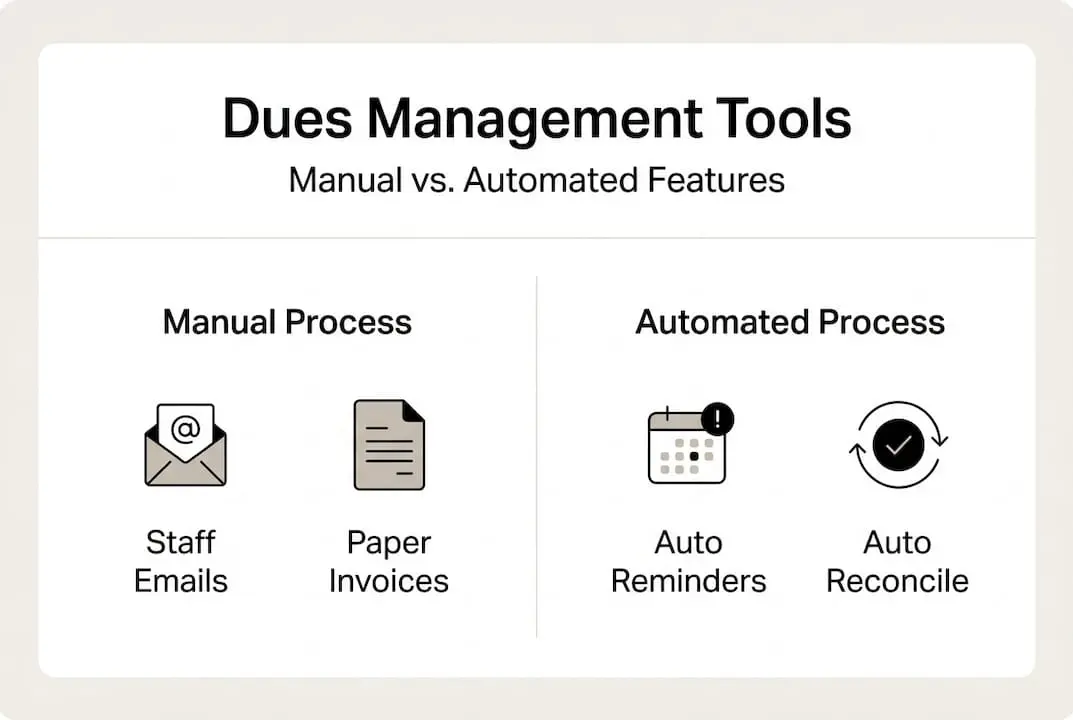
| Feature | Manual process | Automated process |
|---|---|---|
| Payment reminders | Staff sends emails | System triggers automatically |
| Failed payment recovery | Manual follow-up | Auto-retry with grace period |
| Renewal reporting | Spreadsheet updates | Real-time dashboard |
| Revenue recognition | Manual journal entries | Automated deferred revenue |
Exploring the full range of software features available on modern platforms will show you how far automation has come. For a deeper look at what to prioritise, reviewing core software features gives a structured breakdown of what genuinely matters for dues management.
Pro Tip: Set up a failed payment workflow that triggers three automated retries over seven days, followed by a personal outreach email from a staff member. This combination recovers significantly more payments than retries alone.
Integrating dues management with your events, email marketing, and digital fundraising strategies creates a unified picture of member value and engagement, making it easier to identify at-risk members before they lapse.
Balancing member value and price: strategies for sustainable dues
Automation solves many operational hurdles, but sustaining member loyalty also depends on perceived value and clear communication. Raising dues without a clear value narrative is one of the fastest ways to trigger member attrition.
The data is encouraging. 75% of associations plan 1 to 5% membership fee increases in 2025, and 49% raised dues in 2024. Modest, consistent increases are now the industry norm, and members generally accept them when they are communicated well.
Key strategies for sustainable dues increases:
- Communicate early and clearly. Give members at least 60 days’ notice before any price change, with a plain-language explanation of why costs are rising.
- Tie increases to tangible benefits. Announce new features, events, or resources alongside any price change to reinforce value.
- Offer payment flexibility. Monthly payment options reduce the perceived burden of annual dues and improve collection rates.
- Develop non-dues revenue streams. Sponsorships, event ticket sales, online courses, and merchandise reduce reliance on dues alone.
- Segment your communications. Different member tiers may need different messaging. A large corporate member and a sole trader have very different sensitivities.
“Organisations that pair dues increases with visible improvements to member benefits consistently report lower churn than those that raise prices without explanation.”
Building a culture of sustainable membership growth means treating dues not as a fixed line item but as a dynamic reflection of the value your organisation delivers. When members feel that their investment is worthwhile, renewal becomes a straightforward decision rather than a reluctant one.
Understanding the benefits of membership software also helps leaders make the case internally for investing in better tools. The return on investment becomes clear when you calculate the staff hours saved, the payments recovered, and the members retained through a more professional experience.
How Colossus Systems supports your dues management
Managing dues effectively requires the right platform behind your team. Colossus Systems brings together member management, automated billing, CRM, event planning, and email marketing in one unified system.
Our platform supports tiered pricing structures, automated payment reminders, failed payment retries, and real-time financial reporting. Whether your organisation is a professional association, a charity, or a society, we provide the tools to streamline dues collection and improve the member experience from first invoice to renewal. You can configure payment cycles, set grace periods, and integrate dues data directly with your member profiles and communications. If you are ready to move beyond spreadsheets and manual follow-ups, Colossus Systems is built to support exactly that transition.
Frequently asked questions
How do I choose between flat-rate and tiered dues?
Assess the diversity of your membership base and the range of value different members receive. Tiered pricing boosts revenue by 15 to 25% for organisations with varying member sizes, making it the stronger choice for most associations.
How often should we review our membership dues structure?
Most associations re-evaluate dues annually, factoring in inflation, operational costs, and member feedback. 75% of associations plan fee increases of 1 to 5% in 2025, reflecting how common annual reviews have become.
What is the best way to handle failed payments?
Use automated payment retries combined with short grace periods to recover payments without damaging member relationships. Auto-retries and grace periods are considered best practice for associations managing recurring billing at scale.
Can digital tools integrate dues with other membership functions?
Yes. Modern membership management platforms connect dues billing directly with CRM records, event registrations, and accountancy systems, giving your team a single, accurate view of every member’s status and history.