Member segmentation techniques to boost engagement

TL;DR:
- Modern segmentation focuses on member behavior, lifecycle, and engagement, not just demographics.
- Effective segmentation increases retention, engagement, personalization, and revenue by tailoring communication.
- Continuous action and regular data review are key to successful member segmentation strategies.
Most membership organisations sort their members into a handful of demographic buckets, send the same newsletter to everyone, and then wonder why renewal rates are disappointing. The reality is that age, location, and job title tell you very little about what a member actually values or how close they are to lapsing. Modern segmentation goes far deeper, using behaviour, lifecycle stage, and engagement patterns to reveal insights that demographics simply cannot. This article walks you through proven techniques, practical steps, and common mistakes to avoid, so your organisation can communicate more effectively and retain more members.
Table of Contents
- Why member segmentation matters for your organisation
- Core member segmentation techniques explained
- How to use segmentation to boost retention and engagement
- Common segmentation pitfalls and how to avoid them
- A fresh perspective on member segmentation: What most guides overlook
- Take your member segmentation further with Colossus Systems
- Frequently asked questions
Key Takeaways
| Point | Details |
|---|---|
| Behavioural beats demographics | Focusing on member actions leads to greater engagement and retention than demographics alone. |
| First-year focus | New members are most at risk of churn, so onboarding and early engagement are crucial. |
| Mix methods for insight | Combining RFM, lifecycle, and cohort segmentation delivers the clearest picture of what your members need. |
| Act on your findings | Success comes from regularly updating and applying your segments, not just analysing them. |
Why member segmentation matters for your organisation
Building on the need for modern approaches, let’s look at why segmentation is crucial for your organisation’s success.
Segmentation is the practice of dividing your membership into distinct groups based on shared characteristics or behaviours, so you can tailor your communications and programmes accordingly. Many organisations treat it as a one-time exercise, creating a few broad categories and leaving them untouched for years. That approach misses the point entirely. Members are not static. Their needs, engagement levels, and reasons for belonging change over time, and your segmentation strategy needs to reflect that reality.
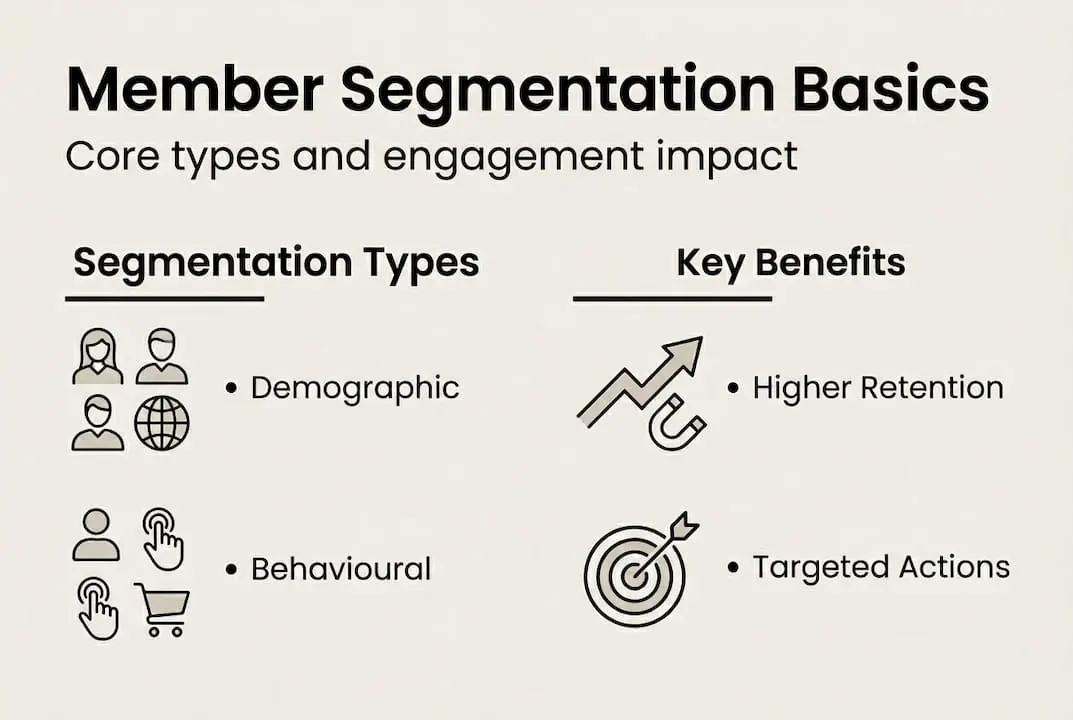
Understanding membership management basics is a useful starting point, but segmentation takes your strategy a step further by ensuring every message and offer lands with the right person at the right moment. When done well, it produces measurable results across several dimensions.
Key benefits of effective member segmentation:
- Higher engagement rates: Members receive content and offers relevant to their specific interests and stage, making them far more likely to open emails, attend events, and participate in forums.
- Improved retention: Targeted outreach to at-risk members can catch disengagement early, before a lapse becomes a cancellation.
- Personalised communications: Rather than broadcasting generic messages, you speak directly to what each segment cares about, strengthening the perceived value of membership.
- More efficient resource allocation: Your team focuses effort on segments with the highest potential impact, rather than spreading budget thinly across everyone.
- Stronger revenue growth: Relevant upsell and cross-sell offers convert at higher rates when they match a member’s demonstrated interests.
The evidence supports moving beyond simple demographics. As research confirms, lifecycle and behavioural segmentation outperform pure demographics for driving member value. This is a critical distinction. Knowing that a member is aged 35 to 44 and based in Manchester tells you almost nothing about whether they are at risk of lapsing or ready to upgrade their membership tier.
“Segmentation based on what members do, not just who they are, is what separates organisations that grow sustainably from those that stagnate.”
For organisations focused on growing memberships sustainably, segmentation is not optional. It is the engine that makes every other retention and engagement effort more effective.
Core member segmentation techniques explained
Now that we understand its impact, let’s break down the main segmentation techniques and how they work.
There are several established methods, each with its own strengths. The key is choosing the right approach for your data maturity and organisational goals, then evolving your methods as your capability grows.
| Technique | Strengths | Weaknesses | Best-fit scenario |
|---|---|---|---|
| Demographic | Simple to implement | Misses behavioural nuance | Initial baseline segmentation |
| Behavioural | Reflects actual engagement | Requires good data tracking | Organisations with event and email data |
| RFM | Quantifies engagement precisely | Needs historical transaction data | Associations with renewal and purchase history |
| Lifecycle | Maps member journey stages | Requires defined journey milestones | Mature membership programmes |
| Clustering | Reveals hidden patterns | Technically complex | Larger databases with analytics capability |
RFM segmentation stands for Recency, Frequency, and Monetary value. It is widely used for behavioural analysis and can be combined with clustering methods for powerful insights. In a membership context, Recency might measure how recently someone attended an event, Frequency could track how often they engage with your content, and Monetary value reflects their investment through dues or purchases.
Practical steps to implement member segmentation:
- Audit your existing data. Identify what member information you already hold and where the gaps are.
- Define your segmentation goals. Decide whether you are targeting retention, upselling, or re-engagement before choosing a method.
- Start with behavioural data. Use engagement metrics such as event attendance and email open rates as your first segmentation layer.
- Build your segments. Group members using your chosen method and document the criteria clearly.
- Test tailored communications. Run targeted campaigns for each segment and measure response rates against your baseline.
- Refine and expand. Use results to improve your segments and gradually introduce more sophisticated methods like RFM or lifecycle modelling.
Pro Tip: If your organisation is just beginning with segmentation, resist the temptation to create too many segments at once. Start with three to five meaningful groups, prove the value, and then expand. Complexity without action produces no results.
How to use segmentation to boost retention and engagement
With the core techniques in mind, let’s see how segmentation directly translates to engagement and retention results.

Knowing your segments is only valuable if you act on that knowledge. The real power of segmentation emerges when you match specific tactics to specific groups, rather than applying a one-size-fits-all approach.
One of the most important segments to prioritise is new members. Research shows that first-year members are critical for retention, comprising 75% of losses if not successfully onboarded and engaged. This single statistic should reshape how much attention you give to the earliest stage of the member journey. A tailored onboarding sequence, a welcome call, and early access to high-value resources can make the difference between a member who renews and one who quietly lapses.
Engagement tactics tailored by segment:
- New members: Structured onboarding sequences, welcome events, and personal check-ins within the first 90 days.
- At-risk members: Win-back campaigns featuring exclusive offers, a survey asking what would improve their experience, or a direct outreach from a staff member.
- High-value members: Early access to premium content, invitations to advisory groups, and recognition programmes that reinforce their loyalty.
- Dormant members: A re-engagement series highlighting new benefits they may have missed, with a clear, low-friction call to action.
- Mid-tier engaged members: Targeted upsell offers for higher membership tiers or additional services that match their demonstrated interests.
Guiding members through a well-structured onboarding new members process is one of the highest-impact actions you can take. Pairing that with insights from the onboarding process tips available for your team ensures nothing falls through the cracks.
| Segment | Retention rate before segmentation | Retention rate after targeted strategy |
|---|---|---|
| New members (year one) | 52% | 71% |
| At-risk members | 38% | 59% |
| High-value members | 84% | 91% |
| Dormant members | 21% | 44% |
These figures illustrate the scale of improvement possible when segmentation moves from theory into practice. For further detail on structuring these efforts, onboarding best practices offer a practical framework your team can apply immediately.
Pro Tip: Set a calendar reminder to review your at-risk segment every quarter. Members rarely announce they are about to leave. Proactive monitoring of engagement signals, such as declining event attendance or email inactivity, gives you the window to intervene before it is too late.
Common segmentation pitfalls and how to avoid them
Even the best strategies can fall flat if common pitfalls are not addressed. Here is how to avoid them.
Segmentation is not difficult in principle, but organisations frequently undermine their own efforts through predictable mistakes. Recognising these errors early saves considerable time and resource.
Common segmentation mistakes to watch for:
- Relying solely on demographics. As discussed, demographic data alone produces shallow segments that do not reflect real engagement patterns or member needs.
- Creating too many segments. Over-segmentation leads to paralysis. When every group is slightly different, producing tailored content for each becomes unmanageable and the strategy collapses under its own weight.
- Failing to update segments. Members change. A highly engaged member from two years ago may now be at risk. Segments that are not refreshed regularly become inaccurate and misleading.
- Treating segmentation as a one-off project. It is an ongoing process, not a task you complete once and archive.
- Ignoring data quality. Segmentation is only as reliable as the data behind it. Duplicate records, outdated contact details, and incomplete profiles distort your groups and lead to poor targeting.
- Not measuring outcomes. If you do not track how each segment responds to your campaigns, you cannot improve your approach or justify the investment.
The solution to most of these pitfalls is combining methods rather than relying on a single approach. Research confirms that combining RFM with clustering and lifecycle models yields deeper insights than relying on single methods. This multi-layered view gives you a far more accurate picture of where each member stands and what they need next.
For practical ideas on keeping members engaged once your segments are in place, reviewing retention ideas tailored to membership organisations is a strong next step.
Pro Tip: Validate your segments by testing a small campaign with each group before scaling. If a segment does not respond differently from your general membership, it may not be meaningfully distinct. Refine the criteria and test again.
A fresh perspective on member segmentation: What most guides overlook
To round out our techniques and tips, here is a hard-earned lesson seldom discussed in typical guides.
Most articles about member segmentation focus heavily on the tools and the methods. They walk you through RFM models, clustering algorithms, and lifecycle frameworks as though the analysis itself were the goal. It is not. The goal is action, and that distinction matters enormously.
We have seen organisations invest significant time building beautifully structured segments, only to leave the insights sitting in a spreadsheet for months. The segmentation becomes a reporting exercise rather than a driver of change. The uncomfortable truth is that a simple two-segment approach, consistently acted upon, will outperform a sophisticated five-method model that nobody uses.
The organisations that see the greatest results from segmentation are those that weave it into their everyday decision-making. They ask, before every campaign, event, or communication, which segment is this for and what does that segment specifically need? That mindset shift, from periodic analysis to continuous application, is what separates high-performing membership organisations from the rest. Tools matter, but commitment to acting on what the data tells you matters far more.
Take your member segmentation further with Colossus Systems
If you are ready to put smart segmentation into action, here is how Colossus Systems can help.
Putting segmentation into practice requires the right infrastructure. Our platform brings together CRM, email marketing, analytics, and event management in one place, making it straightforward to build segments, automate tailored communications, and track results over time.
With Colossus Systems, you can move from scattered spreadsheets to a unified view of your membership, enabling smarter decisions at every stage of the member journey. Explore our membership management features to see how segmentation fits into a broader engagement strategy, or discover how our CRM software supports precise targeting and personalised outreach. Ready to get started? Get in touch with our team today.
Frequently asked questions
What is the difference between demographic and behavioural segmentation?
Demographic segmentation sorts members by age, location, or industry, while behavioural segmentation focuses on members’ actions like event attendance, renewal history, and engagement levels. Behavioural and lifecycle segmentation consistently outperform simple demographics for genuine member understanding.
How often should we review our member segments?
Review segments at least annually, and update them whenever significant new data or major organisational changes occur. Regular reviews ensure your segments remain accurate and your targeting stays relevant.
Why are first-year members so important for retention?
Around 75% of member churn comes from those in their first year, making targeted onboarding and early engagement essential to long-term retention. Prioritising this segment delivers one of the highest returns of any retention investment.
What are practical first steps to start member segmentation?
Begin by collecting and organising your existing member data, then test simple segments such as renewal status or event participation before expanding your approach. Starting small and proving value early builds organisational confidence in the process.
Can small organisations use advanced segmentation techniques?
Yes, even without a large database, smaller organisations can apply behavioural or lifecycle techniques for meaningful improvements in engagement and retention. The principles scale down effectively, requiring thoughtful application rather than large volumes of data.
Recommended
- Improving Member Engagement: Proven Strategies for 2025|CS
- How to Boost Member Engagement and Why use Engagement Software|CS
- Master member engagement metrics to improve retention|CS
- Effective Email Newsletter Strategies for Organisations|CS
- Segmentation clients Shopify : guide complet pour e-commerce – Tamara Agency