Measuring event ROI: a practical guide for managers

TL;DR:
- Broader event ROI includes financial gains, attendee engagement, knowledge transfer, and organizational impact.
- Different event formats influence metrics; in-person fosters stronger bonds, virtual offers wider reach and lower costs.
- Effective ROI maximization relies on clear goals, targeted marketing, engagement strategies, and post-event follow-up.
Most event managers walk away from a successful event feeling proud, but uncertain about one thing: did it actually deliver value? That uncertainty usually stems from a narrow definition of ROI, where the only question asked is whether ticket sales covered the costs. True event ROI is far broader than that. It captures attendee engagement, knowledge transfer, brand perception, and the long-term health of your organisation’s membership base. This guide will help you define, measure, and maximise event ROI in ways that go well beyond a simple profit calculation, equipping you with frameworks you can apply immediately.
Table of Contents
- Defining event ROI: more than just revenue
- Key metrics and formulas for measuring event ROI
- Comparing event ROI approaches: in-person vs virtual events
- Strategies to maximise event ROI for managers and organisations
- Why event ROI is about impact, not just numbers
- Take event ROI further with the right tools
- Frequently asked questions
Key Takeaways
| Point | Details |
|---|---|
| Broader ROI matters | Event ROI goes beyond money, encompassing engagement, knowledge, and organisational impact. |
| Metrics drive improvement | Using clear formulas and multiple metrics enables better decisions and stronger results. |
| Tailored strategies boost outcomes | Adapting ROI methods to your event type and goals ensures maximum value. |
| Technology simplifies tracking | Modern software turns complex ROI measurement into actionable insights for event managers. |
Defining event ROI: more than just revenue
The term ROI stands for Return on Investment. At its simplest, it answers one question: did we get back more than we put in? For most businesses, that question is answered with money. For membership organisations, associations, and nonprofits, however, the answer is rarely that straightforward.
Events are rarely run purely to turn a profit. They exist to build community, advance a mission, educate members, attract new audiences, and strengthen relationships. When you measure success only in pounds and pence, you risk overlooking the most valuable outcomes your event actually produced.
Financial returns are, of course, important. Registration fees, sponsorship income, merchandise sales, and donations all contribute to the financial side of your event ROI. These figures are tangible, easy to report, and essential for budget planning. But they only tell part of the story.
Engagement and experience are equally critical. How deeply did attendees participate? Did they complete sessions, network with peers, ask questions, and leave with new skills or knowledge? These factors directly influence whether members renew, refer others, or increase their level of involvement with your organisation. Thoughtful event promotion strategies can attract the right attendees and set the stage for meaningful engagement from the outset.
Organisational impact covers the longer arc. Did the event help you recruit new members? Did it reinforce your organisation’s reputation as a thought leader? Did it accelerate a key strategic goal, such as a fundraising campaign or policy advocacy effort? These outcomes may not appear on a balance sheet, but they shape the trajectory of your organisation over months and years.
To put it simply, a broader definition of event ROI looks like this:
“Event ROI is the measurable value an event generates relative to its total cost, including financial returns, participant engagement, knowledge outcomes, and long-term organisational impact.”
Key components of a full event ROI assessment include:
- Revenue and cost balance: Direct income versus total expenditure
- Attendee satisfaction and engagement: Measured through surveys, participation rates, and session completion
- Knowledge transfer: Pre and post-event assessments, skill development tracking
- Community growth: New member sign-ups, referrals, and increased participation
- Brand and reputation: Media coverage, social reach, and sentiment analysis
- Mission alignment: How well the event advanced your organisational goals
Holding all of these components together gives you a complete picture of what your event truly delivered.
Key metrics and formulas for measuring event ROI
With a full definition in hand, we move on to the numbers and metrics that underpin event ROI. The standard ROI formula provides a useful starting point:
ROI (%) = ((Return – Investment) / Investment) x 100
So if your event generated £20,000 in revenue and cost £15,000 to run, your financial ROI is ((20,000 – 15,000) / 15,000) x 100 = 33.3%. That is a solid result on paper. But if attendee satisfaction scores were low and only 40% of your members chose to attend, the full picture looks very different.
Here is how to build a more robust measurement framework using multiple ROI dimensions:
- Registration and attendance rate: Total registrations against your target, and the percentage who actually attended versus those who registered.
- Engagement rate: Session attendance, poll participation, Q&A involvement, and networking activity during the event.
- Net Promoter Score (NPS): Measures how likely attendees are to recommend your event to a colleague, on a scale of 0 to 10.
- Cost per attendee: Total event cost divided by number of attendees. Useful for benchmarking efficiency.
- Post-event actions: New memberships signed, donations made, or resources downloaded after the event.
- Sponsor satisfaction: Whether your sponsors felt their investment delivered value, influencing future sponsorship interest.
| ROI dimension | What it measures | How to measure it |
|---|---|---|
| Financial return | Revenue vs. cost | Income statements, registration reports |
| Attendee engagement | Participation depth | Polling tools, session data, app analytics |
| Knowledge transfer | Learning outcomes | Pre/post surveys, quiz completion rates |
| Member retention | Renewals post-event | CRM renewal tracking |
| Brand uplift | Awareness and reach | Social mentions, media coverage, reach data |
| Community growth | New member sign-ups | Registration and CRM data |
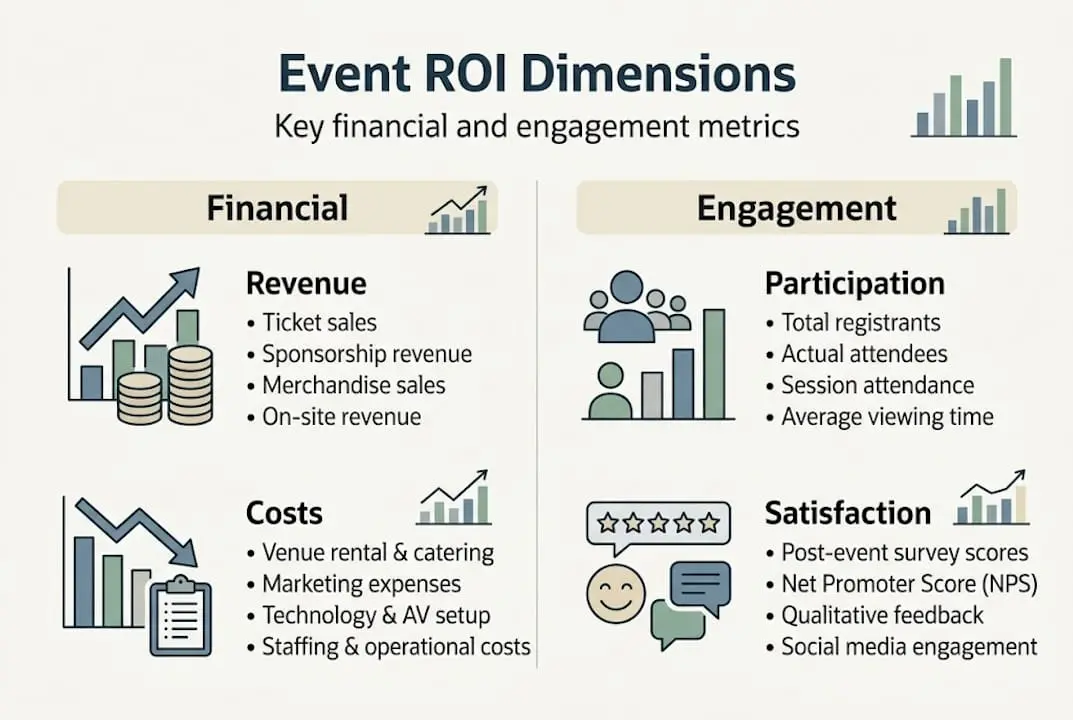
Good event planning methods start with deciding which dimensions matter most to your organisation before the event is built, not after it ends. Similarly, reviewing event attendance strategies early in your planning cycle helps ensure the right people show up, making every metric more meaningful.
Pro Tip: Align your ROI metrics to your event’s core objectives before you begin promotion. An educational workshop should weight knowledge transfer and engagement heavily. A fundraising gala should prioritise financial return and donor retention. There is no single correct set of metrics, only the ones that reflect what your event was designed to achieve.
Comparing event ROI approaches: in-person vs virtual events
Now let us see how ROI calculation and measurement changes depending on whether your event is in-person or virtual. The format of your event shapes not just the experience, but the very metrics you can meaningfully track.
In-person events have traditionally been the gold standard for engagement. Face-to-face networking, physical environments, and real-time interaction produce a quality of connection that is difficult to replicate digitally. However, in-person events carry significantly higher costs: venue hire, catering, travel, accommodation, and staffing all add up quickly. These higher costs mean the financial ROI bar is harder to clear.

On the positive side, in-person events tend to generate stronger community bonds. Attendees who meet face-to-face are more likely to become long-term, active members. Local impact, media presence, and brand visibility are also far easier to achieve when your event occupies a physical space in a community.
Virtual events changed the ROI equation dramatically in recent years, and they continue to hold significant advantages. Lower overheads mean financial ROI is often easier to achieve. Digital tools generate rich data automatically, including session view counts, average watch time, click-through rates on resources, and real-time chat participation. Virtual events also break geographical barriers, meaning your potential audience is far wider. A well-designed registration strategy for a virtual event can attract participants from across the country or internationally, dramatically increasing reach.
Research into event impact design shows that branded touchpoints, whether physical or digital, play a meaningful role in how attendees remember and value an event. Virtual events can replicate some of this through branded digital assets and merchandise dispatch, though the tactile element remains unique to in-person experiences.
| Factor | In-person events | Virtual events |
|---|---|---|
| Typical cost | Higher (venue, catering, travel) | Lower (platform, production) |
| Audience reach | Local to regional | National to global |
| Engagement depth | High (face-to-face networking) | Variable (depends on format) |
| Data availability | Limited, often manual | Extensive, largely automated |
| Networking quality | Strongest in-person connections | Dependent on facilitation tools |
| Brand visibility | Physical presence and media | Digital channels and social reach |
| Financial ROI ease | Harder to achieve | Often easier due to lower costs |
Key considerations when choosing your format:
- What is the primary purpose of the event: community building or knowledge transfer?
- What is your audience’s geographical spread?
- What budget constraints exist, and what cost model fits your organisation?
- How tech-comfortable is your membership base?
The smartest approach for many organisations is a hybrid model, blending in-person attendance for high-value engagement with virtual access for broader reach and data capture.
Strategies to maximise event ROI for managers and organisations
Now that you know how to measure ROI, let us explore how to actively maximise it, both before and after your event.
Pre-event planning is where the biggest ROI gains are made. Most organisations underinvest here, spending their energy on logistics rather than strategy. The reverse should be true.
- Set specific, measurable goals before anything else. Know exactly what a successful event looks like in terms of attendee numbers, engagement benchmarks, revenue targets, and post-event actions. Vague goals produce vague results.
- Define your target audience tightly. An event designed for everyone reaches no one effectively. The more precisely you understand who you are inviting and why, the more tailored and impactful your programming can be. Reviewing fundraising engagement tips can offer useful parallels for audience-centred thinking.
- Invest in targeted marketing early. Strong event advertising ideas applied weeks before the event date significantly increase registrations and the quality of attendee engagement. Email campaigns, social media, and member portal announcements each play a role.
- Build engagement into the event structure. Do not treat engagement as a nice-to-have. Interactive sessions, breakout discussions, live polls, and networking opportunities should be planned features, not afterthoughts.
- Integrate your technology from the start. Using a single platform for registration, communication, and data capture removes friction and ensures your data is accurate and complete. Effective charity web development principles also apply here: every digital touchpoint should feel seamless for your attendees.
Post-event follow-up is where most organisations leave ROI on the table. The event itself is just the beginning of a conversation.
- Send a follow-up survey within 48 hours while the experience is still fresh.
- Share recorded sessions, resources, or key takeaways to extend the value of the event for attendees and non-attendees alike.
- Analyse your data against your pre-set goals and document what worked and what did not.
- Conduct a formal debrief with your team to surface operational improvements for next time.
- Track post-event member actions, such as renewals, new sign-ups, and resource downloads, over the following 30 to 90 days.
Pro Tip: Use event management software with built-in analytics to capture data automatically throughout your event. Real-time dashboards allow you to make live adjustments during the event itself, such as promoting an undersubscribed session or resending a reminder to registered attendees who have not yet logged in. This kind of responsiveness can meaningfully shift your final ROI figures.
Quick wins for improving event ROI:
- Offer early-bird pricing to boost registrations and cash flow before the event
- Recruit engaged sponsors whose audiences align with your membership base
- Repurpose event content into blogs, social posts, or training resources post-event
- Segment your post-event communications based on attendee behaviour, not a single blanket email
- Track year-on-year trends to identify whether your events are improving in impact and efficiency
Why event ROI is about impact, not just numbers
Here is an uncomfortable truth that many event managers are reluctant to accept: a financially profitable event can still be a failure, and a loss-making event can still be one of the best investments your organisation has ever made.
We have seen organisations run polished, revenue-positive events that left members feeling disconnected and underserved. Renewals dipped. Enthusiasm faded. The numbers looked fine. The organisation did not.
Conversely, a carefully designed event that brings together the right people around a meaningful challenge, even if it barely breaks even financially, can catalyse years of growth. New leaders emerge. Collaborations form. Mission alignment deepens. These outcomes are harder to quantify, but they are entirely real.
Relying on conventional ROI frameworks alone risks optimising for the wrong outcomes. Organisations that invest in quality event coordination understand that the most powerful measure of any event is what it enables next. Did it move your members closer to a shared goal? Did it position your organisation as indispensable to their professional lives? Did it generate the kind of trust that no marketing campaign can buy?
ROI frameworks must evolve alongside the purpose of the event. Financial metrics remain essential, but they serve the mission, they do not define it.
Take event ROI further with the right tools
Measuring and maximising event ROI becomes significantly more manageable when you have the right technology in place.
At Colossus Systems, our platform brings together everything your organisation needs to plan, execute, and evaluate events with confidence. Our membership management features give you a clear view of how events influence member behaviour and retention over time. Our dedicated event management tools streamline registration, communication, and data capture in one place. And our CRM software ensures every post-event action is tracked and acted upon. If you are ready to turn event data into genuine organisational growth, we are here to help you do exactly that.
Frequently asked questions
What is the best way to calculate event ROI for a membership organisation?
The most effective approach combines the standard financial formula with engagement and impact metrics tailored to your organisation’s goals, rather than relying on revenue alone.
Can virtual events produce higher ROI than in-person events?
Virtual events frequently achieve higher financial ROI through reduced costs and greater reach, though the depth of personal connection may differ from in-person formats.
How often should event ROI be evaluated?
Review ROI immediately after each event using post-event data, and conduct a broader strategic assessment quarterly or annually to identify patterns and refine your approach.
Which software tools help measure event ROI?
Event management platforms and CRM systems are the most effective tools, as they automate data collection, centralise reporting, and connect event outcomes to member behaviour over time.
Do smaller events have lower ROI potential?
Not at all. Small, focused events tailored to a specific audience can produce outstanding ROI, particularly in member-driven organisations where personal relevance and strong engagement drive long-term value.