Master event marketing campaigns for membership growth

Event marketing now represents a projected $2.2 trillion industry by 2028, yet most membership organisations still measure success purely by attendance figures. This outdated approach misses the strategic power of integrated campaigns that drive retention, referrals and pipeline growth. This guide reveals how to build data-driven event marketing systems that align with organisational goals, segment audiences for personalised engagement, and measure real business impact beyond headcounts.
Table of Contents
- The Strategic Importance Of Event Marketing In Membership Organisations
- Understanding Your Audience: Segmentation And Personalised Messaging
- Strategic Planning: Framing Event Marketing As A Growth System
- Engagement Tactics Before, During, And After Events
- Technology And Tools: Leveraging Saas Platforms For Integrated Campaigns
- Measuring Success: Beyond Attendance To Business Impact
- Common Misconceptions And Pitfalls To Avoid
- Boost Your Event Marketing With Colossus Systems
- Frequently Asked Questions
Key takeaways
| Point | Details |
|---|---|
| Strategic alignment drives growth | Event marketing becomes infrastructure for member acquisition and retention when tied to organisational KPIs rather than isolated attendance goals. |
| Segmentation increases conversions | Personalised messaging based on member behaviour and demographics can drive up to 45% of event ticket sales. |
| Lifecycle engagement matters most | Pre-event communications boost attendance by 30%, whilst post-event follow-ups increase retention by 15%. |
| Technology enables scale | Integrated platforms automate workflows, reducing manual tasks by 40% whilst increasing engagement by 25%. |
| Business metrics trump attendance | Pipeline contribution, retention rates and referral generation reveal true campaign effectiveness. |
The strategic importance of event marketing in membership organisations
Membership organisations increasingly recognise events as core growth infrastructure rather than isolated activities. The numbers support this shift: event marketing budgets now consume approximately 14% of overall marketing spend globally, reflecting executive confidence in their strategic value. Unlike transactional marketing channels, events create immersive experiences that strengthen member relationships whilst generating measurable business outcomes.
The transformation from viewing events as occasional gatherings to treating them as systematic growth engines represents a fundamental mindset change. Forward-thinking organisations connect event outcomes directly to membership KPIs such as acquisition costs, lifetime value and renewal rates. This strategic alignment enables cross-functional collaboration between marketing, member services and leadership teams, creating unified campaigns that deliver compound returns over time.
“Events are no longer nice-to-have member perks. They’re essential touchpoints where organisations demonstrate value, gather intelligence and convert engagement into long-term loyalty.”
The event marketing industry’s rapid expansion reflects broader shifts in how professional associations and membership groups operate. As digital transformation accelerates, organisations that master integrated event campaigns gain competitive advantages in attracting and retaining members. The key lies in moving beyond attendance tracking to measure pipeline contributions, referral rates and post-event engagement patterns that predict sustained membership growth.
Understanding your audience: segmentation and personalised messaging
Deep member data transforms generic invitations into compelling calls to action that resonate with specific audience segments. Effective segmentation divides your membership base by demographics, past event participation, engagement history and professional interests. This granular approach enables marketing teams to craft messages that speak directly to each segment’s motivations and pain points.

Personalised messaging dramatically outperforms one-size-fits-all communications. Email campaigns using segmentation drive up to 45% of event ticket sales, whilst member referrals generated through targeted outreach show 18% higher loyalty rates. These statistics reveal how relevance directly impacts both immediate registrations and long-term retention outcomes.
Practical segmentation strategies include:
- Behavioural groups based on past event attendance patterns and session preferences
- Career stage segments targeting early professionals, mid-level managers and senior executives differently
- Geographic clusters for regional events with location-specific messaging
- Interest categories aligned with professional development topics or industry specialisations
- Engagement tiers separating highly active members from those needing re-engagement campaigns
Pro Tip: Review and update your segmentation criteria quarterly using participation analytics and member feedback. Interests and career stages evolve, so static segments quickly become outdated and ineffective.
The membership recruitment and retention strategies you develop should leverage these segments throughout the entire member journey. Personalisation extends beyond event invitations to include customised agendas, networking recommendations and post-event content that addresses segment-specific challenges. This tailored approach transforms events from generic experiences into valuable touchpoints that members actively seek out.
Strategic planning: framing event marketing as a growth system
Integrating event campaigns into your broader membership growth framework requires systematic planning that connects activities to measurable organisational objectives. Rather than treating each event as an independent project, successful organisations build repeatable systems with clear KPIs, coordinated teams and feedback loops that drive continuous improvement.
The strategic planning process involves five core steps:
- Define objectives aligned with membership goals such as acquisition targets, retention benchmarks or revenue milestones
- Set measurable KPIs beyond attendance including pipeline contribution, engagement scores and post-event conversion rates
- Coordinate cross-functional teams bringing together marketing, member services, content and technology stakeholders
- Develop comprehensive campaign timelines mapping pre-event, live and post-event activities across all channels
- Plan data tracking systems and feedback mechanisms to capture insights for future campaign optimisation
Organisations with strategic event plans see 30% higher ROI compared to those running ad hoc campaigns. This performance gap stems from alignment between event activities and business priorities, enabling resource allocation decisions based on expected returns rather than tradition or convenience.
| Approach | One-off events | Integrated growth system |
|---|---|---|
| Planning horizon | Weeks before event | Quarterly or annual cycles |
| Success metrics | Attendance numbers | Pipeline, retention, engagement |
| Team coordination | Isolated marketing effort | Cross-functional collaboration |
| Data utilisation | Basic registration tracking | Comprehensive analytics driving decisions |
| Member experience | Generic invitations | Personalised journey mapping |
This comparison highlights why treating event planning and marketing management as interconnected systems produces superior outcomes. When marketing teams coordinate with member services to track post-event engagement and with leadership to align objectives, events become strategic assets rather than operational tasks.
Implementing best event marketing ideas for membership organisations within this framework ensures consistency, repeatability and continuous refinement. Each campaign generates insights that improve subsequent efforts, creating a virtuous cycle of increasingly effective member engagement.
Engagement tactics before, during, and after events
Maximising event impact requires deliberate engagement strategies across three distinct phases, each with specific objectives and tactics that build momentum and sustain member interest beyond the live experience.
Pre-event communications set attendance expectations and generate anticipation. Targeted reminders and teaser content boost attendance by up to 30% when delivered through segmented campaigns that highlight relevant benefits for each audience group. Effective pre-event tactics include countdown emails featuring speaker previews, exclusive content releases for registered attendees, and personalised agendas suggesting sessions aligned with member interests.
During the event, real-time engagement transforms passive attendance into active participation. Live polling, Q&A sessions and facilitated networking opportunities deepen member satisfaction whilst generating valuable data about preferences and priorities. Interactive elements also create shareable moments that extend your event’s reach through social media and member-generated content.
Post-event follow-up sustains momentum and converts experience into long-term value. Communications featuring session recordings, exclusive resources or special offers enhance retention by approximately 15% when delivered within 48 hours of event conclusion. This critical window capitalises on fresh enthusiasm and positions your organisation as a continuous value provider rather than an occasional event host.
Pro Tip: Encourage members to share their event experiences through testimonials, photos or social posts. This user-generated content provides authentic social proof whilst extending your marketing reach through trusted peer networks.
Successful event planning strategies for member events integrate these three phases into cohesive campaigns where each touchpoint builds on previous interactions. Maintaining consistent messaging and visual identity across all phases reinforces your brand whilst creating seamless member experiences.
The connection between event engagement and membership retention becomes clear when you track how participation patterns predict renewal rates. Members who actively engage before, during and after events demonstrate significantly higher loyalty than those who simply register and attend passively.
Technology and tools: leveraging SaaS platforms for integrated campaigns
Modern event marketing demands technology platforms that unify member data, automate communications and provide real-time analytics across all campaign activities. Integrated systems eliminate manual data entry, reduce errors and enable personalisation at scale that would be impossible through disconnected tools.
Integrated event and membership CRMs form the foundation for sophisticated campaigns by maintaining comprehensive member profiles that inform targeting decisions. These platforms track participation history, engagement patterns and communication preferences, enabling marketing teams to deliver relevant messages through preferred channels. The result is higher open rates, better conversions and improved member satisfaction.
Automation capabilities within these platforms reduce manual workload by up to 40% whilst simultaneously increasing engagement by 25% through timely, consistent communications. Automated workflows handle routine tasks like registration confirmations, reminder sequences and post-event follow-ups, freeing staff to focus on strategic planning and relationship building.
Key technology features to prioritise include:
- Unified member database integrating event registrations with broader engagement history
- Multi-channel campaign management supporting email, SMS and social media from one interface
- Real-time analytics dashboards tracking registrations, engagement and conversion metrics
- Segmentation tools enabling dynamic audience groups based on behaviour and attributes
- Integration capabilities connecting event platforms with payment gateways, marketing automation and analytics tools
- Mobile optimisation ensuring seamless experiences across devices
The value of integrating your website into membership CRM extends beyond data consolidation to enable personalised web experiences. Members logging into your portal can view recommended events, register with pre-filled forms and access customised content based on their profile and history.
Measuring success: beyond attendance to business impact
Attendance figures provide incomplete pictures of event marketing effectiveness. Sophisticated membership organisations track metrics that reveal true business impact, connecting event activities to pipeline development, retention outcomes and engagement depth.
Key performance indicators for membership event marketing include registration conversion rates, active participation percentages during events, referral incidence from attendees, new membership conversions attributed to events, and post-event retention rates compared to non-attendees. Each metric illuminates different aspects of campaign performance and member value.
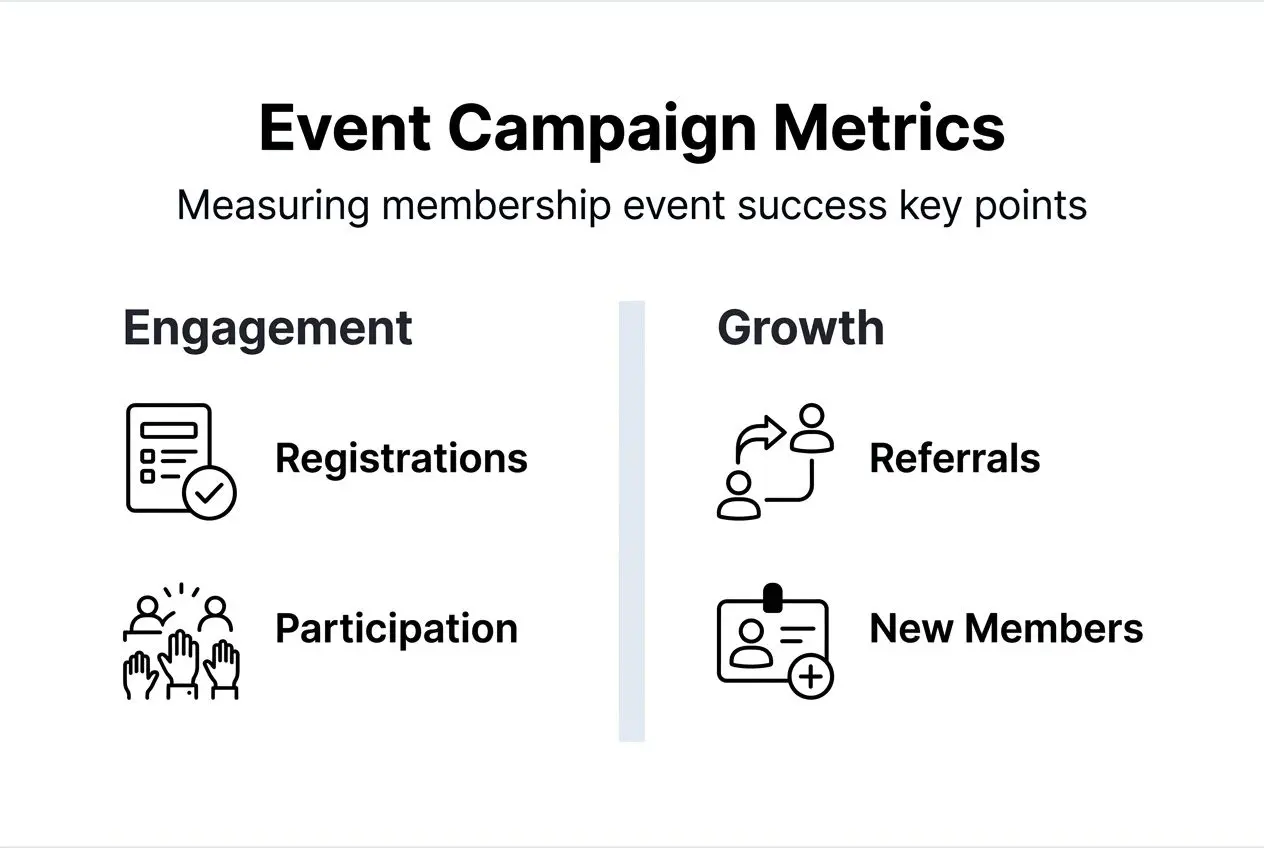
| KPI | Definition | Measurement method | Typical target |
|---|---|---|---|
| Registration rate | Percentage of invited members who register | Registrations divided by invitations sent | 15-25% |
| Active participation | Attendees engaging with polls, Q&A or networking | Platform analytics tracking interactions | 40-60% |
| Member referrals | Attendees bringing non-member guests | Registration data tracking referral sources | 8-12% |
| Conversion to membership | Non-members joining after event attendance | CRM tracking membership applications | 10-15% |
| Post-event retention | Renewal rates for event participants vs non-participants | Comparative cohort analysis | 10-20% higher |
Pro Tip: Establish baseline metrics from past events before implementing new strategies. This comparative data reveals which improvements deliver measurable impact versus those that simply feel better without changing outcomes.
Integrated analytics tools automate KPI tracking whilst generating actionable reports that inform future campaign decisions. Rather than manually compiling spreadsheets, marketing teams access dashboards showing real-time performance against targets, enabling mid-campaign adjustments when metrics fall short of expectations.
The maximising member engagement framework connects event KPIs to broader organisational health indicators. Events that drive pipeline growth, strengthen retention and generate referrals demonstrate clear ROI that justifies continued investment and resources.
Common misconceptions and pitfalls to avoid
Several persistent myths undermine event marketing effectiveness in membership organisations. Challenging these assumptions enables more strategic approaches that deliver superior results.
The attendance fallacy represents the most damaging misconception. Organisations celebrating high turnout without examining engagement quality, pipeline impact or retention outcomes miss opportunities to optimise campaigns for business results. A smaller event with highly engaged participants often generates better outcomes than a large gathering with passive attendees.
Generic messaging reduces effectiveness by failing to resonate with specific member segments. Treating all members identically ignores the diversity of motivations, interests and career stages within your audience. Personalisation based on segmentation data consistently outperforms one-size-fits-all communications across all metrics.
Common pitfalls to avoid include:
- Treating events as isolated campaigns rather than integrated components of ongoing member engagement systems
- Focusing promotion budgets on acquiring new attendees whilst neglecting re-engagement of past participants
- Measuring success solely through attendance counts without tracking business impact metrics
- Launching campaigns without clear objectives tied to organisational priorities
- Neglecting post-event follow-up that converts experience into sustained engagement
- Using outdated segmentation data that no longer reflects member interests and career stages
“The shift from attendance-focused metrics to pipeline and retention measures transforms how organisations approach event marketing. Success becomes about lasting relationships rather than temporary headcounts.”
Understanding these pitfalls helps membership professionals design event marketing campaigns for membership groups that avoid common failures. Strategic thinking, data-driven decisions and systematic planning replace intuition and tradition as the foundation for effective campaigns.
Boost your event marketing with Colossus Systems
Successful event marketing campaigns require integrated technology that unifies member data, automates personalised communications and tracks performance across all touchpoints. Colossus Systems provides membership organisations with comprehensive platforms designed specifically for these challenges.
Our event management software streamlines registration, promotion and analytics whilst our CRM software maintains unified member profiles that inform targeting and personalisation strategies. These integrated solutions eliminate manual data transfers, reduce administrative burden and enable sophisticated segmentation that drives measurable improvements in attendance and engagement.
Explore our complete membership management software features to discover how Colossus Systems supports every aspect of member engagement from initial outreach through post-event follow-up. Request a demonstration to see how our platforms can transform your event marketing outcomes whilst reducing the workload on your team.
Frequently asked questions
What is an event marketing campaign in a membership organisation?
An event marketing campaign comprises strategic promotional activities designed to engage members and drive organisational growth through targeted events aligned with business objectives. Unlike general event management focused on logistics, event marketing emphasises personalised member engagement, measurable KPIs and integration with broader membership systems. Successful campaigns connect event participation to pipeline development, retention outcomes and referral generation.
How can segmentation improve event attendance?
Segmentation groups members by behaviour, demographics and preferences, enabling personalised messaging that resonates with specific audiences and increases registrations. Targeted email campaigns can boost ticket sales by up to 45% compared to generic communications sent to entire databases. Relevant invitations reduce drop-off rates whilst improving member experience through content that addresses segment-specific interests and challenges.
What metrics should I track to measure event marketing success?
Track registration conversion rates, active participation during events, referral generation, new membership conversions and post-event retention rates to assess true campaign effectiveness. Pipeline contribution and member retention reveal long-term business impact better than attendance figures alone. Comparative cohort analysis showing how event participants perform against non-attendees provides clear evidence of ROI and justifies continued investment.
What are common mistakes to avoid in event marketing?
Avoid measuring success solely through attendance without examining engagement quality or business outcomes. Don’t use generic messaging for all members when segmentation data enables personalisation that dramatically improves conversions. Integrate events into broader organisational growth strategies rather than treating them as isolated campaigns disconnected from retention, acquisition and revenue objectives.
Recommended
- 7 Best Event Marketing Ideas for Membership Organisations|CS
- Event Marketing Ideas for Membership Groups | Colossus Systems
- Event Planning Marketing and Management: Maximising Member Engagement|CS
- Event Marketing Strategies for Membership Groups and Associations|CS
- Qué es menú para grupos y su valor en eventos