Event Strategy: Driving Membership Impact Globally

Planning an event for a global membership organisation can feel like juggling a dozen competing priorities at once. Without a clear strategy, events risk becoming scattergun activities that drain resources and fail to connect with your audience. A deliberate event strategy transforms gatherings into powerful tools for enhancing engagement, strengthening your brand, and driving long-term organisational growth. This guide explains how strategic event planning unites objective alignment, member-focused design, and integrated execution to deliver measurable results on an international scale.
Table of Contents
- Defining Event Strategy In Membership Organisations
- Core Types Of Event Strategies Explained
- Phases Of Strategic Event Planning Success
- Leveraging Technology For Event Engagement
- Common Pitfalls And How To Avoid Them
Key Takeaways
| Point | Details |
|---|---|
| Strategic Alignment | Events should align with organisational goals to enhance member engagement and deliver measurable outcomes. |
| Member-Centric Design | Tailoring events to meet the specific needs and preferences of members increases participation and satisfaction. |
| Integrated Execution | Seamless coordination across planning, marketing, and operations ensures that all aspects of the event reinforce desired objectives. |
| Continuous Improvement | Collecting feedback and analysing data post-event aids in refining future strategies and enhancing overall event value. |
Defining Event Strategy in Membership Organisations
Event strategy in membership organisations means far more than simply booking a venue and sending invitations. It’s the deliberate alignment of events with your organisation’s broader objectives, member needs, and long-term vision for growth.
At its core, event strategy functions as a bridge between your organisation’s mission and member engagement. When executed properly, events become tools for communicating brand positioning and reinforcing organisational values across your membership base.
Why Strategy Matters for Membership Events
Without strategy, events become ad hoc activities that drain resources without measurable return. With strategy, they become calculated investments that strengthen member relationships, generate revenue, and amplify your organisation’s reach.
Consider these core reasons strategy transforms event effectiveness:
- Purposeful design ensures every event element serves a defined objective
- Resource optimisation means you allocate budget and staff where they matter most
- Measurable outcomes let you track return on investment and refine future events
- Member value increases when events address specific audience needs and pain points
- Global scalability becomes possible when strategy guides regional and virtual event approaches
Strategic events don’t just happen—they’re scientifically planned, executed, and evaluated to support organisational objectives across borders.
The Three Pillars of Membership Event Strategy
Objective alignment starts first. Your events must directly support membership growth, retention, revenue goals, or brand positioning. A conference shouldn’t exist simply because you held one last year; it should exist because data shows it drives member renewals or attracts new segments.
Member-centric design comes second. Successful strategies account for who your members are, what they need, and how they prefer to engage. Virtual attendees require different formats than in-person participants. Experienced members need different content than newcomers.
Integrated execution completes the picture. Event strategy requires seamless integration of event management, marketing, and operational planning so that promotion, registration, delivery, and follow-up all reinforce your message and objectives.

Building Your Event Strategy Framework
Start with clear questions before designing any event:
- What specific membership goal does this event serve?
- Who is the target audience within your membership?
- What outcomes will define success for this event?
- How does this event connect to your broader annual engagement calendar?
- What resources—budget, staff, technology—does this require?
Your strategy should document these answers. It becomes your decision-making guide when tough choices arise about format, timing, or investment levels.
Pro tip: Map your annual event calendar to specific membership objectives first—retention events in Q2, acquisition events in Q1 and Q3, community-building events quarterly—then design each event to achieve those targets rather than filling your calendar with generic activities.
Core Types of Event Strategies Explained
Membership organisations don’t use a one-size-fits-all approach to events. Different strategic purposes demand different event types, and understanding which type aligns with your goals is fundamental to success.
Your choice of event strategy directly shapes how you design, promote, and measure impact. The wrong type wastes resources; the right type delivers measurable member value.
Recognition of Core Event Strategy Types
Six core event types serve distinct strategic purposes within membership organisations:
- Conferences and meetings focus on knowledge sharing, networking, and thought leadership
- Trade shows and exhibitions emphasise business connections, product discovery, and partnerships
- Festivals and celebrations build community spirit, strengthen emotional bonds, and create memorable experiences
- Concerts and entertainment events drive attendance, generate excitement, and attract new audiences
- Special events and ceremonies mark milestones, recognise achievement, and reinforce organisational culture
- Sports and competitive events encourage participation, foster healthy competition, and build loyalty
Your event strategy type must align with what you’re trying to achieve—retention, acquisition, revenue, or brand positioning.
Strategic Purpose Categories
Beyond event format, membership organisations employ varied event strategies including marketing-focused approaches, destination branding initiatives, and experiential engagement models.
Marketing-driven strategies prioritise customer acquisition and sales. These events spotlight your value proposition, capture contact information, and convert prospects into members. Think webinars, product launches, or membership recruitment drives.
Loyalty and engagement strategies deepen relationships with existing members. These events reward participation, create exclusive experiences, and strengthen emotional commitment. Annual galas, VIP networking dinners, and member-only workshops fit this category.
Destination and brand strategies position your organisation as a leader. Large conferences, international summits, or signature annual events build reputation and attract quality members seeking association with excellence.
Community and experience strategies create belonging. These focus less on transactions and more on shared identity, learning, and mutual support amongst members.
The following table summarises how different event strategies impact membership organisation objectives:
| Strategy Type | Primary Organisational Objective | Typical Event Example |
|---|---|---|
| Marketing-driven | Acquire new members, raise awareness | Recruitment webinar |
| Loyalty and engagement | Retain members, deepen relationships | Member-only gala dinner |
| Destination and brand | Strengthen reputation, attract influencers | International conference |
| Community and experience | Build sense of belonging and support | Quarterly social meet-up |
Matching Strategy Type to Your Goals
Choosing your event strategy requires honest assessment of what you need right now.
Are you struggling with member retention? Implement loyalty-focused events. Need new members? Launch marketing-driven acquisition events. Building global presence? Design destination-level events.
Most successful organisations don’t rely on one strategy type. Instead, they balance multiple types throughout the year to meet different member segments and organisational objectives.
Pro tip: Create a matrix mapping each planned event to its strategy type and primary goal, then distribute your budget across types proportionally—if retention is your top priority, allocate 50% of event budget to loyalty strategies, 30% to acquisition, and 20% to brand building.
Phases of Strategic Event Planning Success
Successful events don’t happen by accident. They follow a structured progression from initial concept through post-event evaluation, with each phase building on the previous one.
Understanding these phases transforms planning from chaotic scrambling into methodical, measurable execution that consistently delivers member value.
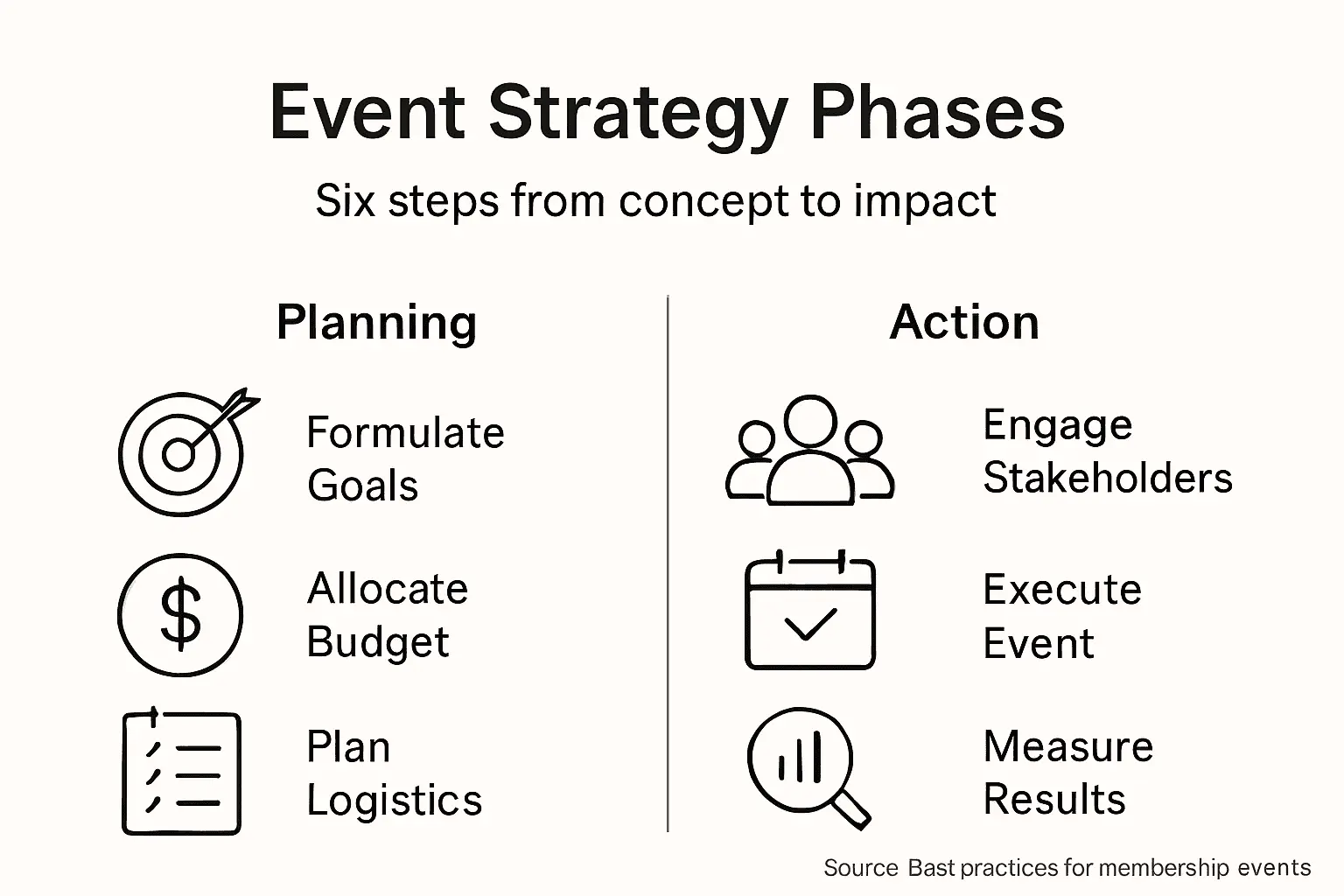
Phase 1: Strategy Formulation and Goal Setting
Before booking venues or sending invitations, define exactly what success looks like. This foundational phase establishes your event’s purpose, target audience, desired outcomes, and alignment with organisational objectives.
Ask yourself these critical questions:
- What membership goal does this event serve?
- Who specifically are we trying to reach?
- What measurable outcomes define success?
- What resources can we realistically allocate?
- How does this event fit our annual engagement calendar?
Documenting clear answers prevents scope creep and keeps teams aligned throughout planning.
Phase 2: Budget and Resource Allocation
Strategic event planning requires deliberate budget allocation and resource planning to maximise return on investment.
Determine your realistic budget first. Then allocate funds across essential categories:
- Venue hire and catering
- Marketing and promotion
- Speaker fees or entertainment
- Technology and registration platforms
- Contingency buffer (typically 10-15%)
Assign clear ownership for budget management. Track spending throughout planning to avoid surprises.
Underfunded events look cheap; overfunded events waste member contributions. Right-sized budgets deliver professional experiences within organisational means.
Phase 3: Detailed Planning and Logistics
With strategy and budget locked, dive into specifics. Create comprehensive timelines, task lists, and process documentation.
This phase includes selecting event registration strategies that streamline member sign-ups and data collection, designing the event flow, securing speakers or entertainers, arranging logistics, and preparing marketing materials.
Break large tasks into smaller milestones with clear deadlines. Assign accountability. Regular status checks prevent last-minute chaos.
Phase 4: Stakeholder Management and Communication
Keep everyone informed: team members, speakers, partners, and members. Regular updates prevent misalignment and build momentum.
Communicate timelines, expectations, and any changes promptly. Address concerns before they escalate.
Phase 5: Execution and On-Site Management
Your preparation meets reality. Maintain flexibility whilst sticking to core plans. Have backup solutions ready for common problems.
Delegate clearly. Empower team members to solve issues without constant escalation.
Phase 6: Performance Measurement and Continuous Improvement
Collect data on attendance, satisfaction, engagement, and outcomes. Compare results against your initial goals.
Identify what worked, what fell short, and what to adjust next time. This learning drives continuous improvement.
Pro tip: Create a post-event debrief meeting within one week—while details are fresh—and document lessons learnt in a centralised template you reuse for every event, building institutional knowledge that improves your entire event programme over time.
Leveraging Technology for Event Engagement
Technology transforms how membership organisations connect with attendees. When chosen strategically, it amplifies reach, deepens engagement, and creates seamless experiences across in-person and virtual environments.
Without technology, you’re limited by geography and logistics. With it, you scale member impact globally.
Virtual Platforms and Hybrid Delivery
Hybrid events—combining in-person and virtual attendance—have become the standard for global membership organisations. When hosting hybrid events, you need platforms that deliver seamless experiences for both physical attendees and remote participants.
Virtual platforms enable:
- Real-time participation regardless of location
- Recorded sessions accessible after the event
- Interactive features like live polls, chat, and Q&A
- Networking opportunities through virtual breakout rooms
- Cost-effective global reach without travel requirements
Hybrid events aren’t just about inclusivity—they’re about multiplying your audience capacity and extending event value beyond the live date.
Real-Time Engagement and Interaction Technologies
Integrate these tools into your events:
- Live polling software captures member opinions and drives participation
- Gamification elements reward attendance, networking, and content engagement
- Mobile apps centralise schedules, speaker bios, and networking features
- Social media integration extends conversations beyond the event
- Networking matching tools connect members with shared interests
These technologies transform passive attendees into active participants.
Data Analytics and Member Insights
Technology captures invaluable data about member behaviour, preferences, and engagement patterns. Track attendance, session popularity, networking interactions, and post-event satisfaction.
Use this data to refine future events. Which sessions attracted the most members? Which speaker formats generated the highest engagement? What times drive peak attendance?
Registration and Payment Systems
Seamless registration removes friction from event access. Integrated payment processing streamlines transactions and captures essential member data automatically.
Modern systems allow tiered pricing, member discounts, group registration, and automated confirmation emails—all handled without manual work.
Here is a comparison of three key technologies and their benefits in membership event management:
| Technology | Main Benefit | Example Use Case |
|---|---|---|
| Virtual event platforms | Broader global reach | Hybrid AGM with remote voting |
| Member data analytics | Improve targeting and design | Tailoring content based on engagement |
| Automated registration | Streamlined attendee process | Self-service sign-ups with reminders |
Post-Event Engagement Technology
The event doesn’t end when attendees leave. Technology maintains momentum through email sequences, recorded session libraries, and learning management systems that extend event value through ongoing content access.
Members should access recordings, downloadable resources, and speaker contact details for months after your event concludes.
Pro tip: Select technology that integrates with your existing member database—avoid tools requiring manual data entry between systems, as disconnected platforms waste staff time and create data quality problems that undermine your analytics.
Common Pitfalls and How to Avoid Them
Most event failures aren’t due to bad luck. They stem from predictable mistakes that derail engagement, waste budgets, and damage member relationships. Understanding these pitfalls helps you sidestep them entirely.
Self-awareness is your strongest prevention tool.
Pitfall 1: Misaligned Goals and Member Needs
The most damaging mistake organisations make is designing events without clear alignment between event goals and member needs, leading to poor engagement and wasted investment.
You plan a two-day conference assuming members want in-depth learning, but they actually want quick networking wins. You schedule sessions during work hours when members can’t attend. You invite speakers who don’t resonate with your audience.
Result? Empty seats and frustrated members.
Avoid this: Conduct member research before event design. Surveys, interviews, and focus groups reveal what your audience actually wants.
Pitfall 2: Inadequate Planning and Timelines
Rushed planning creates chaos. Unprepared teams miss deadlines, overlook logistics, and scramble at the last minute.
Common timeline mistakes include:
- Starting promotion less than 6 weeks before the event
- Confirming speakers or venues too close to the date
- Skipping detailed task planning and accountability
- Failing to build contingency time into schedules
Avoid this: Create comprehensive timelines at least 4-6 months before major events. Assign clear owners for each task. Schedule regular progress reviews.
Pitfall 3: Insufficient Marketing and Promotion
A brilliant event nobody knows about attracts nobody. Weak promotion leads to poor attendance, low revenue, and disappointed members.
Many organisations spend 80% of budget on the event itself and only 20% on marketing. This ratio is backwards. Your event’s success depends entirely on getting the right people to register.
Avoid this: Allocate 30-40% of your event budget to marketing. Start early. Use email, social media, member portals, and partnerships to build awareness consistently.
Pitfall 4: Ignoring Technology Integration
Manual registration systems, disconnected payment processing, and no analytics leave you flying blind. You can’t measure engagement, track attendance patterns, or improve future events.
Avoid this: Select integrated platforms that connect registration, payment, analytics, and member data. Technology should reduce administrative burden, not increase it.
Pitfall 5: Skipping Post-Event Follow-Up
Your event ends and members vanish. No recordings, no thank-you sequences, no capitalisation on momentum.
Post-event engagement extends value and strengthens relationships. Members expect access to recorded sessions, downloadable resources, and speaker contact information.
Avoid this: Plan your post-event strategy before the event happens. Document recordings automatically. Send thank-you emails within 48 hours. Share resources within one week.
Pro tip: Create a lessons-learnt checklist after every event, documenting what worked, what didn’t, and specific adjustments for next time—treating each event as data that improves your entire programme rather than a one-off activity.
Unlock the Power of Strategic Event Planning for Your Membership Organisation
Driving impactful membership events that align with your organisational goals requires more than just great ideas. The article highlights common challenges such as misaligned event objectives, inefficient resource allocation, and technology gaps that can hinder global engagement and member retention. If your membership organisation wants to overcome these obstacles and create seamless, member-centric events supported by real-time analytics and integrated communication tools, you need a solution tailored to these needs.
Colossus Systems offers a comprehensive platform designed to empower membership organisations with customisable event management, virtual and hybrid engagement capabilities, streamlined registration and payment processing, and advanced marketing automation that directly address the core event strategy demands explored in the article. Whether you are managing multi-type event strategies for member acquisition, loyalty, or brand positioning, our unified system ensures smooth execution and insightful performance measurement.
Experience how strategic event planning translates into measurable membership growth and enhanced engagement by partnering with Colossus Systems. Take the next step to elevate your event strategy and organisation-wide impact by contacting us today. Discover more at our contact page and see how our platform can streamline your member management and event success. Start transforming your membership events with Colossus Systems now.
Frequently Asked Questions
What is the importance of having an event strategy for membership organisations?
An event strategy ensures that events align with organisational objectives, optimising resources, enhancing member engagement, and measuring return on investment effectively.
How can I create a successful event strategy for my membership organisation?
Start by defining clear goals, understanding your audience, designing member-centric events, and integrating planning, marketing, and execution processes to align with your organisational objectives.
What types of events should membership organisations consider to achieve their strategic goals?
Membership organisations can consider conferences, trade shows, community-building events, ceremonies, or virtual events, each serving different strategic purposes, such as member retention, acquisition, or brand positioning.
How can technology enhance the effectiveness of events in membership organisations?
Technology can improve engagement through hybrid delivery, real-time interactions, data analytics for member insights, and streamlined registration processes, ultimately extending the reach and impact of events.