Leadership and management training: what associations need

The right platform for delivering leadership and management training to members is one built for membership organisations from the ground up, not a repurposed corporate LMS: a member-centred portal with native AMS/CRM integration and full credential lifecycle tracking. Colossus Systems is built specifically for this brief, combining learner portals, event registration, CRM and certification tracking in one system rather than three that need stitching together.
Three capabilities separate a genuine fit from a compromise:
- Single sign-on synced to your AMS, so members never juggle a second login just to start a course.
- Cohort and portal support, letting chapters or corporate members run branded learning spaces under one central roof.
- Certification tracking that survives audits, recording completions, renewals and continuing education credits as permanent records, not disappearing quiz scores.
For associations weighing this decision now, Colossus Systems is worth a direct look. It’s built for organisations that treat member education as a trust signal, not a side project, and a short demo call will tell you within thirty minutes whether it matches your chapter structure and revenue model.
Key Takeaways
Choosing a leadership and management training platform for a membership organisation comes down to AMS integration depth, certification lifecycle support, and portal architecture that scales across chapters.
| Point | Details |
|---|---|
| Prioritise AMS integration level | Confirm whether the vendor offers Level 3 sync (SSO, purchase, transcript sync back to your AMS). |
| Budget beyond the licence | Data migration, content conversion and certification workflow setup usually drive the real cost. |
| Pilot before full rollout | Launch to administrators, then instructors, then one cohort before opening to all members. |
| Track renewal, not just completion | Link course participation to retention lift and revenue per member, not just pass rates. |
| Consider Colossus Systems | It combines learner portals, cohort management, certification tracking and CRM in one platform built for membership organisations. |
Table of Contents
- Essential features for leadership and management training platforms
- How should you evaluate leadership development programme platforms?
- What does implementation actually cost and take?
- Onboarding instructors, administrators and learners
- How do you measure the impact of a leadership programme?
- Security and privacy checklist for member data
- A working example: leadership training on an integrated platform
- Why most procurement teams get this wrong
- How Colossus Systems supports leadership and management training
- Sources
Essential features for leadership and management training platforms
Before comparing vendors, decide what “good enough” looks like. Ellipsis Partners’ guidance on selecting the right LMS for an association makes a fair point: whether learning is a core member benefit, an emerging programme, or a niche extra changes the entire shape of what you need to buy. A platform built for a niche add-on will buckle under a flagship credentialing programme.
Once that’s settled, run every shortlisted platform against this checklist.
Learner experience
- Virtual and in-person course delivery from one calendar, not two disconnected systems.
- Cohort-based learning with shared discussion spaces, not just solo video playback.
- Mobile access so members can complete a module between meetings, not only at a desk.
Administration and governance
- Assessment tools with configurable pass thresholds and automatic certificate issuance.
- Event and hybrid support that handles both a ticketed in-person conference and a livestreamed session.
- Accessibility built to WCAG standards, because a portal that excludes members with visual or motor impairments is a compliance risk, not just a bad look.
Integration and data
- SSO with role-based permissions tied to membership tiers.
- SCORM and xAPI support for content portability.
- A clear AMS transcript flow. Ellipsis Partners frames this as three practical integration levels: Level 1 is simple SSO, Level 2 adds purchase flow, Level 3 syncs completed transcripts back into your AMS automatically. Most associations underestimate how much manual admin Level 3 saves until they’ve lived without it.
Higher Logic’s Association LMS Buyer’s Guide adds a detail corporate buyers rarely consider: your platform needs separate access rules for members and non-members, plus native e-commerce, because associations sell courses to people who haven’t joined yet.
How should you evaluate leadership development programme platforms?
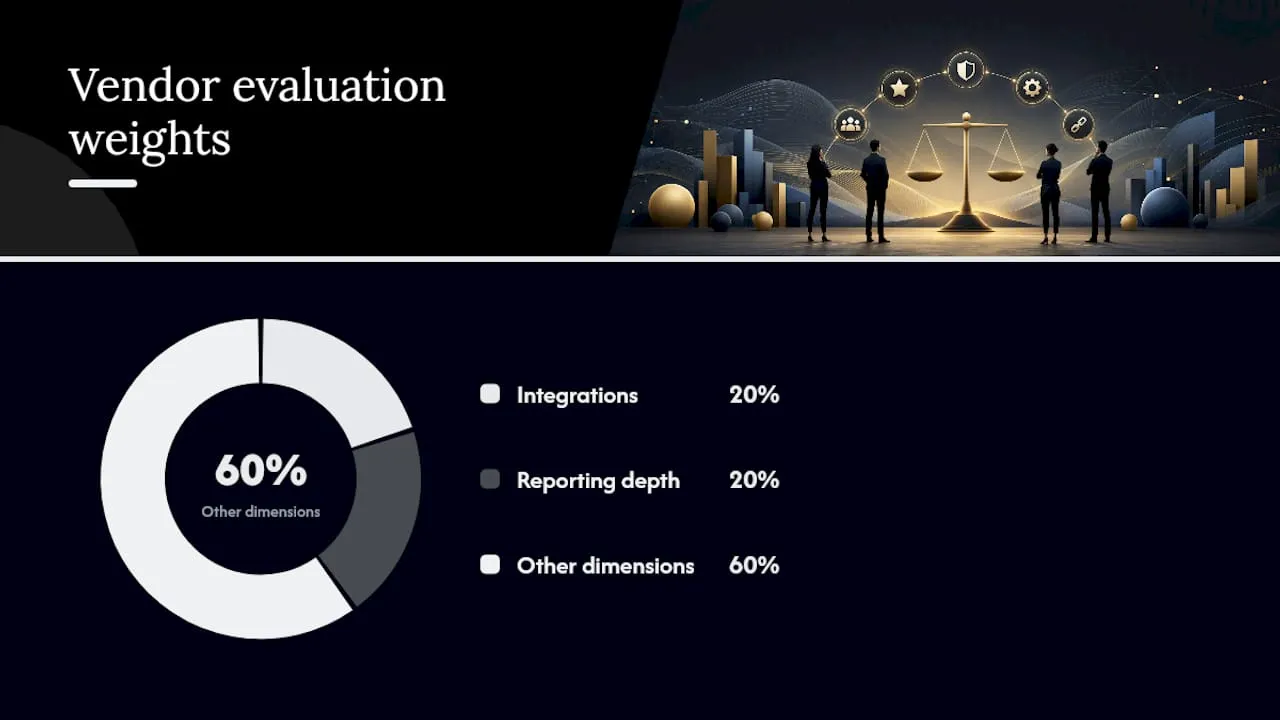
Score vendors, don’t just compare feature lists side by side. A simple weighted framework keeps the process honest and gives your board something concrete to review.
Use these eight dimensions, each scored 1 to 5:
- Ease of use and admin UX — can a non-technical staff member build a course without a ticket to IT?
- Customisation and workflows — can you configure your own certification rules and approval chains?
- Integrations — does it talk to your CRM, payment processor and calendar without middleware?
- Support and implementation services — is onboarding a real service or a PDF?
- Reporting depth — can it tell you which course drives renewal, not just who clicked “complete”?
- Security and compliance — does it meet the standards your legal counsel would sign off on?
- Scalability — will it hold up with ten chapters as well as it does with one?
- Pricing model and total cost of ownership — what’s the real annual number once add-ons are counted?
Weight integrations and reporting depth at double the others if learning drives real revenue for you. A vendor scoring 4/5 on ease of use but 2/5 on integrations will still create years of manual data reconciliation.
Bring the right people to the demo. eLearning Industry’s piece on training management system evaluation flags a mistake that’s more common than it should be: marketing gets left out of vendor selection, and organisations end up with a platform that can’t segment members or track which campaign actually drove a course sign-up. Invite marketing, IT, operations, finance and whoever owns your learning programme to the same call, and ask each vendor how their reporting would answer next quarter’s board question about member retention.
What does implementation actually cost and take?
Expect five phases: discovery and requirements, data migration and integration, a pilot with a small group, staged rollout, and ongoing optimisation. Discovery is where most of the real decisions happen, and it’s the phase organisations most often rush.
| Organisation size | Typical timeline | Phase that usually takes longest |
|---|---|---|
| Small (under 10,000 members) | Around 10 weeks | Data migration |
| Medium (between 10,000 and 25,000 members) | Around 12 weeks | Integration and testing |
| Large (25,000+ members, multiple chapters) | Around 20 weeks | Staged rollout across chapters |
Costs rarely come from the software licence itself. They come from the decisions around it:
- Custom integrations with a legacy AMS that wasn’t built to talk to anything.
- Converting old content into SCORM or xAPI packages.
- Building certification workflows with multiple approval steps.
- Cleaning membership data before migration, which is nearly always underestimated.
- Third-party licensing fees and the support SLA tier you choose.
Ellipsis Partners’ guidance on vendor questions is worth following closely here: ask every vendor directly what upgrades cost, what data export looks like if you ever leave, and what “support” actually includes beyond the first ninety days.
Onboarding instructors, administrators and learners
Launch success depends less on the software and more on sequencing. Rush it, and even a strong platform gets a reputation as “the thing nobody uses.”
- Administrators first. Give them two to three weeks to build the course catalogue, set permission roles, and configure certification rules before anyone else touches the system.
- Instructors next. Run a single training session covering content upload, assessment building and how to read their own engagement reports. One hour is usually enough if the interface is genuinely simple.
- Learners last, in a pilot cohort. Launch to one chapter or one course before opening to your full membership. Fix what breaks quietly, before it breaks loudly.
- Full rollout. Communicate the launch through the same channels you’d use for a membership renewal push. Email, portal banners, and a short video walkthrough outperform a single announcement email every time.
Chapter or corporate members need particular attention. LMS Portals’ research on learning portals for membership organisations confirms what most associations discover the hard way: branded, delegated portals let individual chapters manage their own courses and administrators while your central team retains oversight and consolidated reporting. Building this in from day one avoids a painful re-architecture later.
Pro Tip: Recruit two or three enthusiastic members as early champions before the full launch. Their unscripted feedback in the pilot cohort will surface friction points your admin team never would have spotted, and their word-of-mouth does more for adoption than any campaign.

How do you measure the impact of a leadership programme?
Completion rates tell you almost nothing about whether a programme is working. Track outcomes that connect learning to the health of the organisation itself.
| KPI | What it tells you |
|---|---|
| Course completion rate | Whether content and pacing are working for your members |
| Certification pass rate | Whether assessments are calibrated correctly |
| Revenue per member from courses | Non-dues revenue generated by paid learning |
| Free-to-paid conversion rate | How well free events feed your paid course catalogue |
| Retention lift among course participants | Whether learning correlates with renewal |
Executive dashboards should stay high-level: retention lift, revenue per member, and year-over-year enrolment growth. Operational dashboards need more granularity: which modules see drop-off, which instructors get the strongest feedback scores, and which chapters are lagging.
Higher Logic’s buyer’s guide makes the sharpest point on this topic: good analytics should let staff answer which programmes actually drive renewal, not just which ones got clicked on. If your reporting stack can’t connect a completed certification to a renewed membership twelve months later, you’re flying blind on the metric that matters most to your board.
Security and privacy checklist for member data
Member records carry more sensitivity than most staff realise: payment history, professional credentials, and sometimes health or licensing data tied to continuing education requirements. Confirm these controls before signing anything.
- Encryption at rest and in transit, as a baseline, non-negotiable requirement.
- SOC 2 or ISO 27001 controls, or an equivalent audited framework.
- Role-based access permissions that limit who can see full member records versus course progress alone.
- Detailed access logs so you can trace who viewed or exported member data and when.
- Documented backup schedules and disaster recovery time objectives, not a vague promise of “regular backups.”
- Clear data residency terms and a straightforward export process if you ever need to migrate away.
Meridian’s analysis of association LMS requirements puts this well: once your LMS becomes the system of record for professional credentials, it’s carrying legal and reputational weight far beyond a simple training log. Ask every vendor for their data export policy in writing before you sign, not after.
A working example: leadership training on an integrated platform
Picture a mid-sized professional association running a twelve-week leadership certification for emerging managers among its members. The brief: portal-based delivery, cohort discussion groups, and a certificate that counts toward continuing education credit.
Configuration used:
- A branded learner portal for the certification programme, separate from general member content.
- Cohort groups of 25, each with a dedicated instructor and discussion thread.
- Automated certification issuance tied to assessment thresholds, synced back to the AMS.
Launch responsibilities:
- Association staff handled content upload and cohort scheduling.
- IT managed the AMS/CRM integration and single sign-on configuration.
- The learning team ran instructor onboarding and monitored the pilot cohort.
- Payments integrated directly for programme fees, with no separate checkout system.
Outcomes to expect: engagement well above typical webinar attendance, since cohort accountability keeps people showing up week to week, and a measurable uptick in course revenue once the certification builds a reputation among members who see peers earning it.
Why most procurement teams get this wrong
The biggest mistake I’ve seen in association learning procurement isn’t a bad feature list. It’s treating the LMS selection as an IT decision when it’s really a membership strategy decision. Teams spend weeks comparing SCORM compliance and skip the harder question: does this platform make a member feel like part of something, or like they’ve logged into a corporate compliance tool?
The do-not is equally clear: never buy a platform before mapping your certification and renewal logic. I’ve watched associations discover, three months post-launch, that their new system can’t handle a multi-year certification that expires and requires re-testing. That’s not a minor bug fix. That’s a re-architecture.
If you’re weighing this decision now, Colossus Systems is worth a direct conversation. Ask to see how it handles a real certification lifecycle, not a demo built around a single course.
How Colossus Systems supports leadership and management training
Every capability covered above maps directly to what Colossus was built to do. On ease of use, the admin interface lets non-technical staff build a course and configure certification rules without a support ticket. On integrations, native CRM and payment connections mean member data, course enrolment and revenue tracking sit in one system rather than three that need syncing overnight.
On reporting, dashboards connect course completion to membership renewal, answering the exact question most associations struggle to answer with a bolted-together stack. On security, member data sits behind role-based permissions and encrypted storage. On scalability, the portal architecture supports multiple branded chapter or corporate portals under one central account, exactly the multi-tenant setup that scales more cleanly than running separate LMS instances per chapter.
For pricing, Colossus Systems uses a subscription model that grows with your membership rather than penalising you for adding a second course. Explore the full feature set, see how event management handles hybrid conference delivery, or check how the CRM keeps member records and learning history in sync. Book a demo and bring your certification workflow. Within one call, you’ll know if it fits.
Sources
- 10 Tips for Selecting the Right LMS For Your Association
- Building Learning Portals for Membership Organizations
- Evaluating a training management system: 7 sales & marketing features you need
Ready to see how this fits your organisation? Visit the Colossus Systems contact page to arrange a demo built around your own certification workflow.