Data Decisions: How Membership Bodies Use Data Well

A data decision is a choice you make on the strength of evidence you can check, rather than on habit, the loudest voice in the room or a hunch. For a membership organisation, association, charity or school, that means looking at renewals, attendance, giving and learner progress before you change a fee, cut an event or launch a campaign. This guide shows you how the process works, which data to use, what goes wrong, and how to start without a data team.
TL;DR
- A data decision starts with a named question and a named owner, not with a dashboard. Collect only the evidence that could change the answer.
- Most membership bodies already hold the data they need: member records, event registrations, donations, programme results and finance reports. The hard part is joining it up.
- Data supports judgement, it does not replace it. Research on nonprofits warns of mission drift, staff resistance and thin technical skills.
- Privacy and governance are part of the decision. Know what you hold, who can see it and what the law allows you to do with it.
- Start small: one decision, three measures, one review date.
Table of Contents
- What a data decision actually is
- Why it matters for membership organisations
- The data you already have
- A six-step process you can reuse
- Plan first, measure second
- Worked examples
- What goes wrong
- Privacy and governance are part of the decision
- Our perspective
- Putting your data in one place
- A first month plan
- FAQ
- Sources
What a data decision actually is
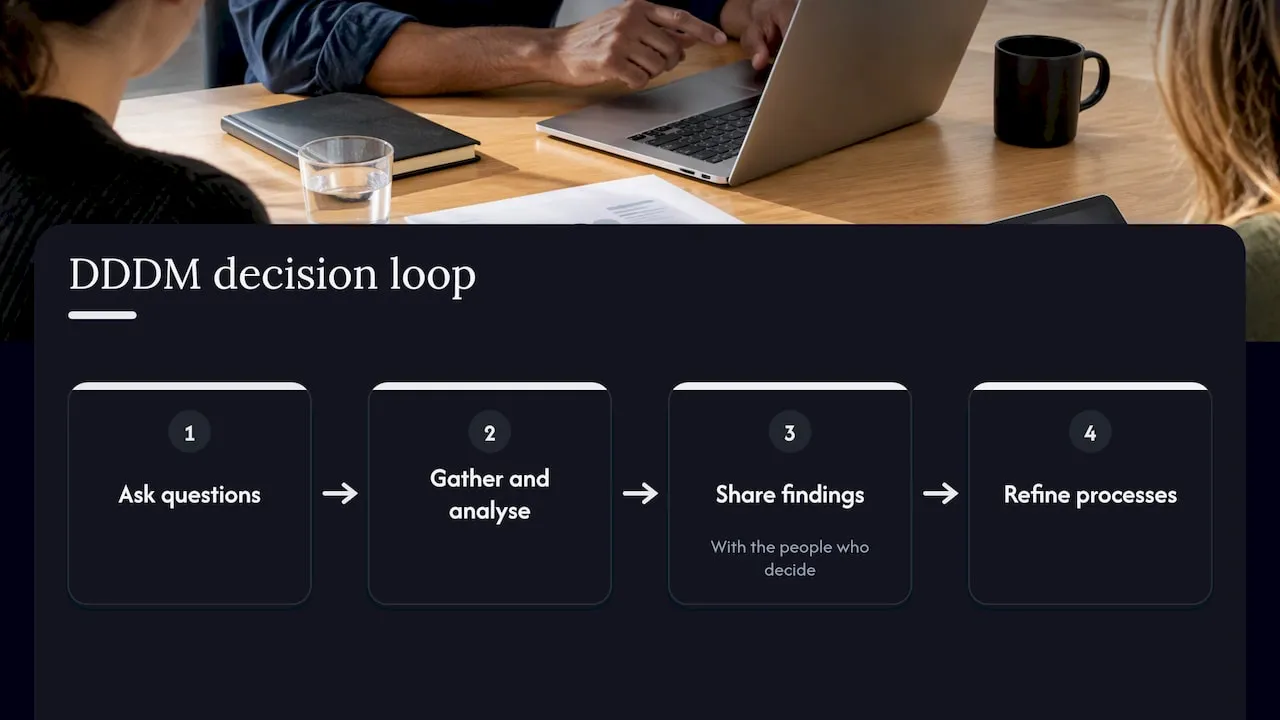
Data-driven decision-making, often shortened to DDDM, is the use of data and analysis to inform choices instead of relying on intuition. IBM describes it as a sequence: define the objective, collect and analyse the data, then evaluate the outcome against your goals. A guide prepared for the US Department of Health and Human Services frames it as a loop rather than a one-off: begin with key questions, gather and analyse data, share the findings with the people who decide, then refine your processes and programmes.
Two points matter for organisations like yours.
First, “data-driven” does not mean “data-only”. Your trustees, committee or leadership team still decide. The data narrows the argument to the facts that are actually in dispute.
Second, a membership body is not a retailer. You cannot always read success from a sales figure. The Urban Institute notes that charitable organisations often struggle to measure performance because they lack the clear win-or-loss signal of competitive industries and work to tight budgets. That is why the framing step below carries so much weight.
Why it matters for membership organisations
The case for using data is straightforward. Real-time insight lets you see a problem while you can still act on it, and IBM argues that this supports sustainable growth, where gut feeling can lead the other way. Bill Schmarzo makes a similar point in a TechTarget framework: a structured approach keeps decisions tied to facts rather than assumptions and reduces the chance of failure.
In practice, for a membership body, that looks like this:
- Renewals: spotting which member groups lapse after year one, and what they had in common, before you redesign the joining journey.
- Events: deciding whether a conference, webinar or regional meet-up earns its place from registration, attendance and feedback, not from tradition.
- Communications: choosing the message, frequency and channel that members respond to, instead of sending the same newsletter to everyone.
- Funding and reporting: showing funders and boards what changed because of your work.
- Learning: seeing which courses learners finish, and where they drop off.
The benefits are not automatic, though. The same evidence base that supports DDDM also records its costs, covered in the risks section below.
The data you already have
Most organisations are not short of data. They are short of data that sits in one place. A practitioner paper on nonprofit data sources separates internal sources, such as membership databases, donor records, programme data and financial reports, from external ones, such as government statistics, public records and third-party research used for benchmarking.
Internal data
| Source | Typical questions it answers |
|---|---|
| Member records | Who joins, who renews, who lapses, and when? |
| Event registrations and attendance | Which formats and topics fill, and who turns up? |
| Email engagement | Which messages are opened, clicked and acted on? |
| Payments and invoices | Which membership tiers and products carry the revenue? |
| Learner or programme records | Who completes, who stalls, what outcomes follow? |
| Surveys and feedback | Why do members stay or leave? |
The value comes from connecting these. A member who stopped opening emails, skipped the last two events and has an unpaid invoice tells you more than any one of those facts alone. That is the practical argument for holding records in a single system. If you are weighing up the tooling, our guide to a nonprofit technology stack sets out how the pieces fit together.
External data
External data answers questions your own records cannot: how big is the need, how do you compare, and what is changing around you. In the UK, the Office for National Statistics is one of the main sources, and Charity Digital’s round-up of data resources is a handy starting list. Local needs data is also useful. For instance, published facts and shelter statistics on homelessness in New York City show the kind of community-level figures a charity might use to size a problem, though you would want the equivalent for your own area.
The same practitioner paper stresses that collection works best when staff are trained, tools are piloted and the technology matches what your team can realistically run. A sophisticated tool nobody maintains produces worse data than a simple one used consistently.
A six-step process you can reuse
This is the loop from the government guide and the IBM outline, adapted for a membership organisation.
1. Name the decision, the owner and the date
Write one sentence: “By the end of March, the membership committee will decide whether to introduce a student tier.” Name the person accountable. Without an owner and a date, analysis drifts.
2. Agree what evidence would change your mind
Before you look at any numbers, decide what result would lead you to say yes, and what would lead you to say no. This is the cheapest protection against picking the figures that suit a view you already hold.
3. Choose a few measures
The ASAE Foundation distinguishes between process indicators, which show whether you carried out the activity, and outcome indicators, which show what it achieved. You need both. Knowing you sent 12,000 emails (process) tells you nothing about whether renewals improved (outcome).
4. Collect and clean the data
Pull the records, remove duplicates, and note gaps. If a third of your members have no join date, say so in the analysis rather than quietly ignoring them.
5. Analyse and share
Present the finding in a page, not a spreadsheet: the question, the evidence, what it suggests, and how confident you are. The government guide emphasises communicating results to the people who decide, which is easy to forget.
6. Decide, then review
Record the decision and set a review date. At that point, check the outcome indicators you chose in step 3 and feed what you learned into the next decision.
Plan first, measure second
Planning documents make measurement far more likely. ASAE Foundation research from 2019 found that associations with a planning document, such as a strategic plan or logic model, were much more likely to formally track organisational metrics: 67% against 9% for those without one.
It makes sense. A plan tells you what success means, and that tells you what to count. If you run programmes with defined outcomes, a logic model for health programmes shows how inputs, activities and outcomes link, which is exactly the structure that makes process and outcome indicators easy to pick. For a wider view of how planning supports engagement, see our piece on strategic planning for nonprofits.
Worked examples
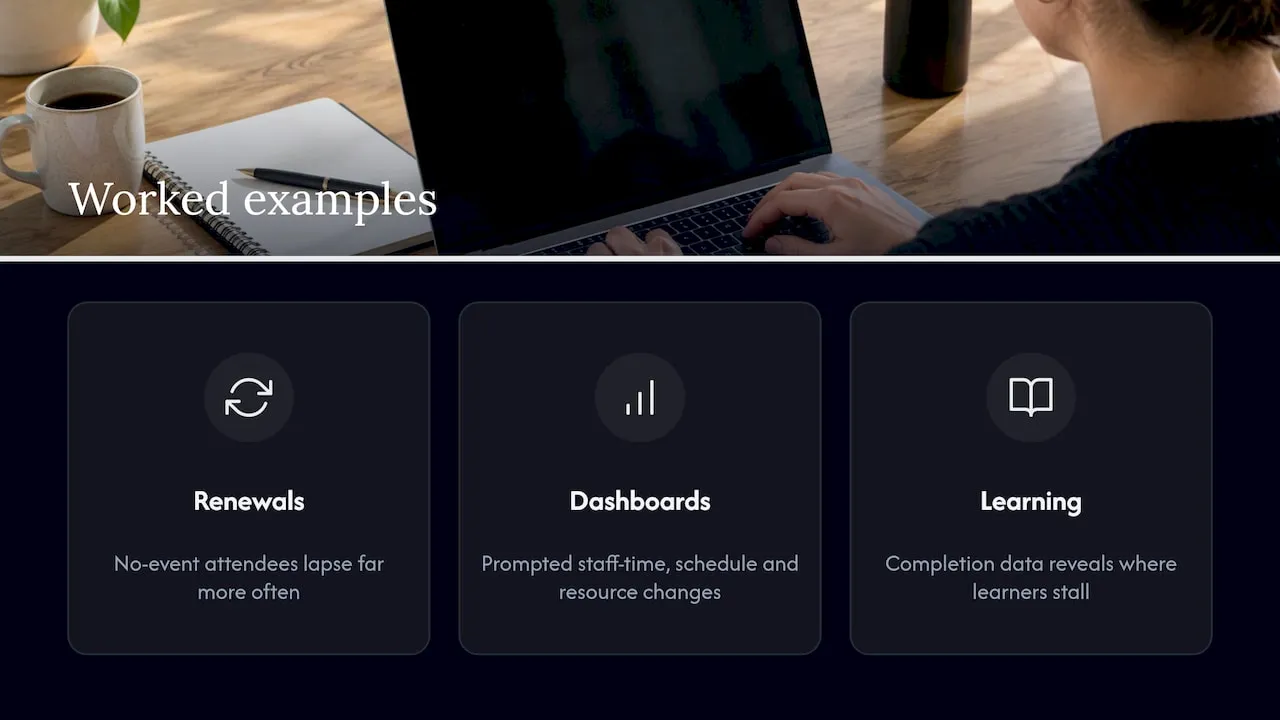
A professional association and its renewals. Suppose your renewal rate drops in the second year. You pull member records by joining route and by event attendance in year one. If members who attended no event lapse far more often, the decision might be to build a welcome sequence and a first-90-days event invitation. You then review the second-year renewal rate for the next joining cohort. Note that the number is illustrative of the method, not a benchmark.
A nonprofit and its programme dashboards. The Bridgespan Group’s case study of Our Piece of the Pie describes an organisation that used dashboards to spot programme problems, which prompted management discussions and changes to staff time, service schedules and resource allocation. The team’s own lesson was that data does not solve problems by itself, but it leads to focused discussion in place of undocumented assumptions.
An educational provider and learner progress. Completion and engagement data can show where learners stall. Our guide to tracking student achievement for nonprofits covers the practical side. Education has its own privacy questions, which we come to next.
What goes wrong
Being honest about the limits makes your decisions better.
- Hard to turn data into insight. An academic study of data use in nonprofits points to difficulty identifying meaningful information, limited technical ability, trouble prioritising data work and pressure from outside influences. It also records non-financial costs such as mission drift and staff resistance.
- Measuring what is easy, not what matters. If you can only count attendance, attendance becomes the goal. Keep at least one outcome measure tied to your mission.
- Dirty data. Duplicates, stale addresses and inconsistent fields undermine every chart. Fix the source, not the report.
- Too many measures. Three good indicators beat thirty ignored ones.
- Treating the number as the decision. A figure informs a discussion. It does not end it.
The “five Cs of data” appear in the questions people ask. There is no single agreed list. One review of nonprofit analytics, citing Thomas (2020), describes big data by volume, variety, velocity, value and veracity. For a membership body, the practical equivalent is a short checklist: is the data complete, consistent, current, correct and collected for a clear purpose?
Privacy and governance are part of the decision
Member, donor and learner data is personal, and often sensitive. The ASAE Ethics Toolkit treats confidentiality as part of a board’s fiduciary duty, noting that associations must protect sensitive member, donor and employee information. The Urban Institute’s performance measurement playbook recommends clear data security plans covering access controls and breach procedures, confidentiality policies, and staff training in data literacy to prevent accidental misuse.
In practice:
- Keep a simple register of what you hold, why, and who can see it.
- Limit access by role, so a events volunteer does not see payment history.
- Decide in advance what happens in a breach and who is told. If you are in the UK, your data protection officer or the Information Commissioner’s Office is the place to check current rules.
- Check marketing permissions before you segment. The ICO announced that, under the Data (Use and Access) Act 2025, a charitable purposes soft opt-in came into force on 5 February 2026, letting charities email supporters who have shown interest in their cause without fresh consent, if the conditions are met. It applies to charities, not every membership body, so confirm your status first.
Education raises further issues. A systematic review of learning analytics in higher education lists ethical and privacy issues among its challenges, and research by Viberg and colleagues finds that privacy is often poorly defined, which can undermine trust in data-driven approaches. Students, teachers and institutions see privacy differently, so consult each group.
If you are experimenting with AI tools on member data, ASAE advises that associations identify which information can safely enter AI tools, separating personal, organisational and public data, and keep governance policies flexible, iterative and tied to objectives. Our own notes on member data security basics and nonprofit compliance requirements go deeper.
Our perspective
We build membership software, so we see the same pattern in organisation after organisation. The data exists, but it lives in a membership spreadsheet, an events tool, an email platform and a finance package that never speak to each other. Someone spends two days each quarter stitching them together, and by the time the report lands, the decision has already been made on instinct.
Our view is that the first gain from data is not clever analytics. It is a single, current record of each member: what they joined, what they attended, what they bought, what they were sent and how they responded. Once that exists, the questions in this article become a ten-minute job rather than a project.
We also think organisations should resist the urge to track everything. Choose the decision first, then the measures. Be wary of any tool that promises insight without asking what you want to decide.
Finally, treat member trust as an asset. Collect what you need, explain why, and protect it. Members who believe you handle their data well engage more openly, and that makes your data better.
— Rob
Putting your data in one place
This is where a unified platform earns its keep. Colossus Systems brings membership management, events, CRM, email marketing, e-commerce, member portals and analytics into one system, so the renewal, attendance and engagement data in this article sits in a single record per member. You can tailor workflows and sales pipelines, and connect online payment gateways.
Our published monthly plans start with Core at £349, Growth at £699 and Scale at £1,299, while Enterprise starts from £2,500. A contributor licence is available from £29 per month. You can compare them on our membership software pricing page, or look at the membership management software, event management and CRM products individually.
If you want to see the reporting side first, the features overview shows what you can measure from day one.
A first month plan
You do not need a data team. Try this:
- Week one: pick one decision your organisation faces this quarter and write the one-sentence version with an owner and a date.
- Week two: list the three measures that would settle it, one of them an outcome. Find where each lives.
- Week three: pull the data, fix the obvious gaps and write a one-page summary.
- Week four: take it to the people who decide, record the outcome and set the review date.
Repeat it. After three or four rounds, you will find the questions get sharper and the data gets cleaner, because people know it is being used.
FAQ
What is data-driven decision-making and how does it work?
It is the practice of using evidence to guide choices rather than relying on intuition alone. You define the objective, gather and analyse relevant data, make the decision, then check the results against your goals. The cycle repeats, so each decision improves the next.
What are examples of data a membership organisation can use?
Internally, think of member records, event registrations, email engagement, payments, donor records and programme results. Externally, government statistics, public records and published research help you benchmark and size need. The most useful insight usually comes from joining several sources together.
What are the five Cs of data?
There is no single standard list. Some reviews describe big data through volume, variety, velocity, value and veracity. A practical check for your own data is whether it is complete, consistent, current, correct and collected for a clear purpose.
What are the main risks of using data to make decisions?
Research on nonprofits points to difficulty finding meaningful information, limited technical skills, staff resistance and mission drift. Privacy and security are the other big risks, since member and donor information is sensitive. Plan access controls, breach procedures and staff training from the start.
Sources
- What Is Data-Driven Decision-Making? IBM
- Guide to Data-Driven Decision Making, US Department of Health and Human Services
- Beyond overhead: Better capturing nonprofit performance, Urban Institute
- 6 key steps form a data-driven decision-making framework, TechTarget
- Common Data Sources for Non-Profit Organizations, Neya Global
- The best data resources for charities, Charity Digital
- Homelessness in NYC: Facts, Data and Shelter Statistics
- Maximize Your Data With Performance Measurement Processes, ASAE Foundation
- Logic Model for Health Programs: A Practical Guide
- Our Piece of the Pie: From Data to Decision-making, Bridgespan
- Exploring data use in nonprofit organizations, ScienceDirect
- A Systematic Review and Taxonomy of Data Analytics in Nonprofit Organisations
- ASAE Ethics Toolkit for Associations (2025)
- Measure4Change Performance Measurement Playbook, Urban Institute
- Charities given new flexibility to contact supporters, ICO
- Learning Analytics Methods, Benefits, and Challenges in Higher Education
- Privacy in LA Research: Understanding the Field to Improve the Practice
- Smart, Safe, and Strategic: How Associations Can Harness AI, ASAE