CRM programs: a practical guide for membership leaders
TL;DR:
- A modern CRM is a strategic platform that enhances member engagement and operational efficiency.
- CRM automates tasks, personalizes communication, and provides data insights to improve retention.
- Choosing and implementing a CRM requires focus on usability, integration, and ongoing cultural adoption.
Many membership leaders assume a CRM (Customer Relationship Management) program is simply a glorified contact list. That assumption is costing organisations real growth. A modern CRM program is a strategic platform that tracks every interaction, automates routine tasks, and gives leaders a clear picture of member behaviour and needs. This guide explains exactly what CRM programs do, how they strengthen member engagement, how they streamline daily operations, and how to choose the right solution for your organisation. Whether you run a professional association, a nonprofit, or a community group, understanding CRM is now essential.
Table of Contents
- Understanding CRM programs
- How CRM programs enhance member engagement
- Streamlining operations and improving efficiency with CRM
- Choosing and implementing a CRM program
- A fresh perspective: what most leaders miss about CRM
- Unlock membership success with CRM software
- Frequently asked questions
Key Takeaways
| Point | Details |
|---|---|
| Beyond simple databases | CRM programs offer practical tools for automating workflows and engaging members beyond basic record keeping. |
| Engagement impact | Effective CRM use leads to higher member satisfaction, retention, and tailored communication for membership organisations. |
| Streamlined operations | CRM solutions automate manual tasks and centralise data, making operations more efficient for organisations. |
| Choosing the right software | Selecting and implementing a CRM requires careful planning, focus on necessary features, and avoiding common pitfalls. |
Understanding CRM programs
A CRM program is software designed to manage and improve an organisation’s relationships with its members, prospects, and stakeholders. The term “Customer Relationship Management” originates in the commercial sector, but its core purpose translates powerfully to membership organisations. Instead of managing customers, you are managing members. Instead of driving sales, you are nurturing long-term belonging and participation.
At its most fundamental level, a CRM program collects and organises data about every person connected to your organisation. It records contact details, membership status, communication history, event attendance, payment records, and much more. All of this information lives in one place, making it immediately accessible to every member of your team.
But a CRM is far more than a database. The real value lies in what it does with that data. As CRM software examples for member groups illustrate, a well-configured CRM actively facilitates engagement by triggering automated messages, flagging at-risk members, and generating actionable reports. It turns raw information into informed decisions.
For membership organisations specifically, CRM programs perform several core functions:
- Member tracking: Monitoring membership status, renewal dates, activity levels, and participation history across events and programmes
- Communication management: Storing records of every email, call, newsletter, and notification sent to each member
- Data segmentation: Grouping members by category, interest, geography, or engagement level so you can target communications precisely
- Reporting and analytics: Producing dashboards and reports that reveal trends in membership growth, retention, and engagement
- Task automation: Handling repetitive processes such as renewal reminders, welcome emails, and event confirmations without manual input
- Integration with other tools: Connecting seamlessly with email platforms, payment gateways, and event management systems
Understanding CRM in the context of CRM for membership growth means recognising it as the operational backbone of your organisation, not just an administrative convenience.
Pro Tip: Before selecting a CRM, map out your organisation’s core workflows, such as onboarding, renewals, and event registration. Then choose a CRM that matches those specific processes rather than purchasing one loaded with features you will never use.
The right CRM aligns with your team’s size, technical capacity, and strategic goals. It should feel like a natural extension of how your organisation already works, not an additional burden that requires constant management.
How CRM programs enhance member engagement
Member engagement is the lifeblood of any membership organisation. When members feel connected, valued, and informed, they renew their memberships, attend events, recruit others, and contribute actively. CRM programs are uniquely positioned to make that level of connection consistent and scalable.
The most immediate way a CRM improves engagement is through personalised communication. Without a CRM, sending tailored messages to specific groups of members requires significant manual effort. With one, you can segment your audience instantly and deliver messages that speak directly to each member’s interests, history, or membership tier. A long-standing member nearing renewal receives a different message from a first-year member still exploring your programmes. That relevance makes a measurable difference to how members respond.
Here is how a CRM programme systematically builds engagement across the member journey:
- Welcome automation: New members receive a tailored onboarding sequence automatically, introducing them to benefits, events, and resources relevant to their profile
- Event reminders: The CRM tracks event registrations and sends timely reminders, reducing no-shows and keeping members actively involved
- Renewal nudges: Automated renewal reminders go out at the right time, with the right message, reducing lapsed memberships without requiring staff intervention
- Milestone recognition: Birthdays, membership anniversaries, and achievement milestones can trigger personalised messages that make members feel genuinely valued
- Re-engagement campaigns: Members who have gone quiet trigger alerts, enabling your team to reach out proactively before they lapse entirely
The power of centralised member profiles cannot be overstated. When every team member can see a complete picture of any individual’s history with your organisation, every interaction becomes more informed and more effective. There is no more searching through spreadsheets or asking colleagues what was previously discussed.
“Organisations that use CRM tools to personalise member outreach consistently report stronger retention and higher event attendance compared to those relying on manual processes. The data does not lie: relevant communication drives action.”
As nonprofit CRM usage and benefits demonstrate, even smaller membership organisations see significant improvements in retention rates once they adopt a CRM that supports targeted communication. A medium-sized professional association, for example, might use a CRM to identify members who have not attended any events in six months. A targeted email campaign built around those members’ stated interests, delivered automatically through the CRM, can bring a meaningful proportion of them back into active participation.
Consider also how CRM software examples show the benefit of real-time engagement tracking. When you can see immediately which members opened an email, clicked a link, or registered for an event, you can refine your approach continuously. That feedback loop is something manual processes simply cannot replicate.
Streamlining operations and improving efficiency with CRM
Operational efficiency is not a secondary concern for membership organisations. It is foundational. When staff spend the majority of their time on manual data entry, chasing down renewal forms, or reconciling spreadsheets, they have far less capacity for the strategic work that actually moves an organisation forward.

CRM programs address this directly by automating workflows and centralising data in ways that fundamentally change how teams operate.
Consider the contrast between a manual process and a CRM-supported one:
| Task | Manual process | CRM-automated process |
|---|---|---|
| Member onboarding | Staff manually send welcome emails and add records | CRM triggers automatic welcome sequence and creates member profile |
| Renewal management | Staff track dates in spreadsheets and send individual reminders | CRM sends automated renewal reminders at scheduled intervals |
| Event registration | Staff collect registrations by email and update lists manually | CRM handles registration, payment, and confirmation automatically |
| Reporting | Staff compile data from multiple sources into reports | CRM generates real-time dashboards and exportable reports |
| Communication tracking | Records stored separately in inboxes | All communications logged against each member’s profile |
The efficiency gains are not trivial. Organisations that adopt CRM platforms report significantly reduced administrative overhead, allowing staff to focus on member experience and strategic initiatives. As membership software for nonprofits and charities illustrates, even resource-constrained organisations benefit enormously from CRM adoption because the time saved on manual tasks directly translates to better member service.
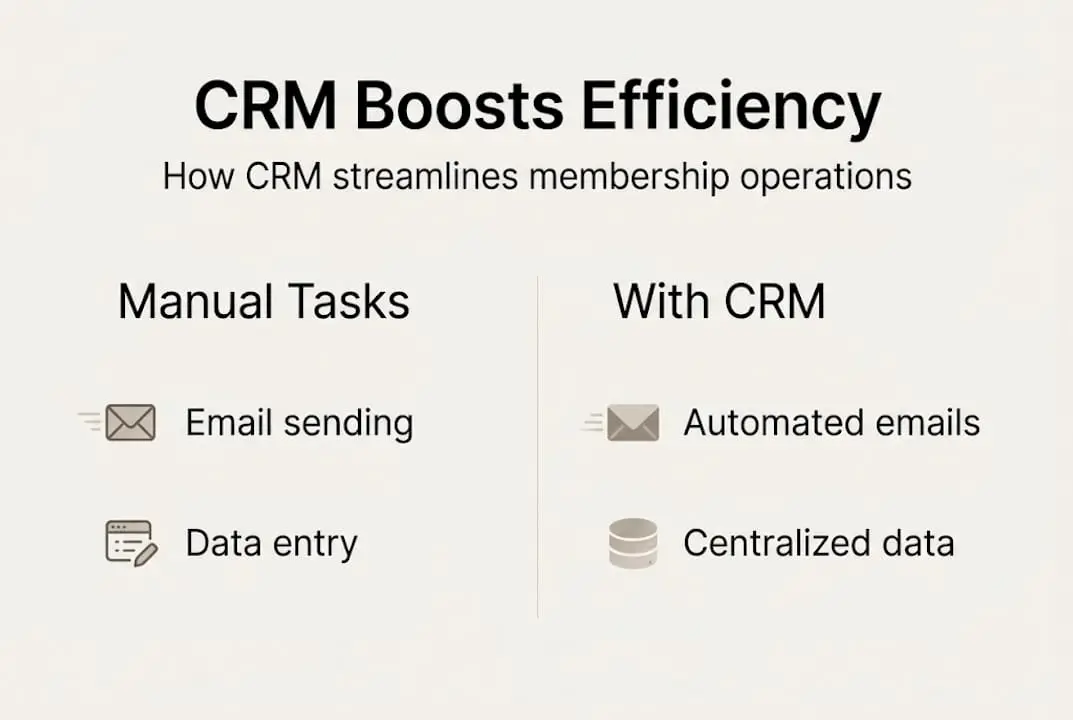
CRM platforms also improve accuracy. Manual data entry is inherently error-prone. Duplicate records, outdated contact details, and missed renewal dates are common when processes rely on human input across multiple systems. A CRM with automated data capture and validation eliminates most of these errors at the source.
Another significant operational advantage is centralised reporting. Leaders no longer need to pull together information from multiple spreadsheets, email systems, and payment records to understand how the organisation is performing. The CRM provides a live view of membership numbers, revenue, event attendance, and communication metrics in one place. This makes strategic planning far more reliable and far less time-consuming.
Effective donor management with CRM also shows how these same operational principles apply to fundraising and grant management within membership organisations, particularly nonprofits that combine member services with philanthropic activity.
Pro Tip: Integrate your CRM with your email marketing and event management platforms from the outset. Disconnected tools create data silos that undermine the efficiency gains a CRM is designed to deliver. A unified system is always more powerful than a collection of separate tools.
Choosing and implementing a CRM program
Selecting the right CRM program is one of the most consequential technology decisions your organisation will make. A poor fit leads to low adoption, wasted investment, and frustration. A strong fit accelerates every aspect of your operations and member engagement strategy.
The most important selection criteria for membership organisations are as follows:
- Ease of use: Staff at all levels must be able to navigate the system confidently. A CRM that requires extensive technical knowledge will be underused
- Customisation: Your organisation’s workflows, membership categories, and communication strategies are unique. The CRM should adapt to your needs, not the other way around
- Integration capability: The system should connect smoothly with your existing tools, including email platforms, event management software, and payment gateways
- Reporting and analytics: Look for a CRM that provides clear, actionable dashboards rather than raw data exports that require additional processing
- Scalability: As your organisation grows, the CRM should grow with it, accommodating more members, more data, and more complex workflows
- Support and training: Implementation is only the beginning. Ongoing support and training resources are essential for long-term success
Understanding types of CRM software helps clarify which category of solution fits your organisation’s scale and complexity. Some CRMs are built specifically for membership organisations, offering features like tiered membership management and event registration out of the box. Others are general-purpose platforms that require significant configuration.
When it comes to implementation, a structured approach makes all the difference. Many organisations underestimate the change management required when introducing a CRM. A phased rollout, beginning with core functions and expanding over time, is far more effective than attempting a full deployment all at once.
| Implementation phase | Key activities |
|---|---|
| Planning | Define goals, map workflows, identify integration requirements |
| Configuration | Set up membership categories, automation rules, and reporting dashboards |
| Data migration | Import existing member records, clean duplicates, validate data |
| Training | Provide role-specific training for all staff who will use the system |
| Pilot launch | Test with a small team or specific membership segment before full rollout |
| Full deployment | Launch organisation-wide with ongoing support and feedback loops |
A common pitfall is neglecting to align CRM adoption with email marketing for nonprofits strategy. Your CRM and email platform must work together seamlessly. As top email marketing comparisons for nonprofits demonstrate, the best outcomes occur when CRM data directly informs email segmentation and campaign targeting. Treating these as separate tools undermines both.
Another common mistake is failing to secure team buy-in before implementation begins. If staff do not understand why the CRM is being introduced, or how it will make their work easier, resistance is inevitable. Invest time in communicating the rationale clearly and involving key team members in the selection process.
A fresh perspective: what most leaders miss about CRM
Most conversations about CRM adoption focus on features and cost. That is understandable, but it misses the deeper challenge. The organisations that struggle with CRM implementation are rarely struggling because of the software. They are struggling because they have not shifted their operational culture to match what the CRM makes possible.
A CRM is only as powerful as the commitment to using it consistently. If staff continue to store member information in personal spreadsheets, or send communications outside the system, the CRM becomes an expensive overlay rather than a genuine transformation. Real efficiency and engagement gains come when the entire team trusts the system and inputs data faithfully.
There is also a tendency to treat CRM implementation as a one-time project rather than an ongoing practice. CRM for membership growth is not achieved at the point of going live. It is achieved through continuous refinement of workflows, regular review of analytics, and a genuine commitment to using member data to make better decisions over time.
The organisations that get the most from their CRM are those that treat it as a living system, not a fixed installation. That mindset shift is where the real opportunity lies.
Unlock membership success with CRM software
Understanding CRM programs is the first step. Taking action is what drives real results for your organisation.
At Colossus Systems, we build CRM and membership software features specifically for organisations like yours. Our platform brings member management, event planning, email marketing, and analytics together in one seamlessly integrated system. Whether you are looking to improve member retention, automate renewals, or gain clearer insight into your organisation’s performance, our CRM software solutions are tailored to help you achieve those goals efficiently and confidently. Speak to our team today and discover how we can support your organisation’s growth.
Frequently asked questions
How does a CRM program differ from a simple database?
A CRM program enables interactive workflows, automated communication, and advanced analytics, whereas a basic database simply stores information without acting on it. CRM software for member groups shows the practical gap between the two approaches.
Can CRM software help increase member retention?
Yes. CRMs support personalised engagement and timely automated reminders, both of which are proven to strengthen retention. Nonprofit CRM benefits show consistent retention improvements when these tools are used effectively.
What features should membership organisations look for when selecting a CRM?
Organisations should prioritise ease of use, integration capability, customisation options, and robust reporting tools. Membership software for nonprofits highlights why these criteria matter most for resource-conscious organisations.
Is it possible to integrate CRM with event and email management tools?
Yes, most CRM platforms support seamless integration with both event management and email marketing tools, creating a unified communication and engagement system. Email marketing comparisons for nonprofits outlines the advantages of connecting these platforms directly to your CRM.