CRM for membership leaders: What you need to know

TL;DR:
- CRM is about people, processes, and technology working together, not just a software buy.
- Successful CRM implementation requires organizational readiness, clear goals, and staff engagement.
- The best CRM boosts communication, engagement tracking, automation, and data-driven decisions.
Most membership leaders assume CRM is simply a database. Buy the software, import your contacts, and watch engagement soar. That assumption is precisely what causes so many CRM projects to stall. The reality is that CRM, which stands for customer relationship management, is as much about people and processes as it is about platforms. For membership organisations in particular, where relationships are the foundation of everything you do, getting CRM right means rethinking how your entire team works, communicates, and makes decisions. This guide cuts through the confusion and gives you a clear, practical path forward.
Table of Contents
- What is CRM? Core concepts for membership organisations
- How CRM empowers membership organisations
- Common challenges: Why CRM projects fail (and how to avoid it)
- Selecting the right CRM: Key criteria for membership leaders
- Why CRM adoption fails (and succeeds): Beyond technology
- Discover CRM solutions for your membership organisation
- Frequently asked questions
Key Takeaways
| Point | Details |
|---|---|
| CRM is a strategy | CRM means aligning people, process, and technology—not just buying software. |
| Membership impact | Effective CRM boosts engagement, retention, and informed decision-making. |
| Readiness first | Success depends on your organisation’s willingness to change and define clear data practices. |
| Choose wisely | Look for CRM solutions that fit your group’s unique needs and support long-term growth. |
What is CRM? Core concepts for membership organisations
CRM stands for customer relationship management, though many membership organisations rightly adapt this to “constituent relationship management” to reflect their community focus. At its core, CRM refers to the strategy, processes, and technology an organisation uses to manage and strengthen its relationships with members, prospects, and stakeholders.
It is tempting to think of CRM purely as software. In practice, CRM is a combination of three pillars:
- People: The staff and volunteers who enter data, follow up with members, and act on insights
- Processes: The workflows and standards that govern how member information is collected, shared, and used
- Technology: The platform that stores data and automates routine tasks
For membership organisations, a well-implemented CRM for membership growth brings these three pillars together to support communication, engagement tracking, event management, and long-term member retention. Rather than managing spreadsheets across multiple departments, your team works from a single source of truth.
Consider what this means in practice. A member attends a webinar. Your CRM logs that attendance automatically. A follow-up email goes out within hours. The membership coordinator sees engagement data without manually checking three systems. That kind of joined-up experience is what good CRM enables, but it only happens when the underlying processes and people are aligned.
The most common trap is viewing CRM as a technology purchase rather than a strategic change initiative. Organisations that fall into this trap often end up with expensive software that nobody uses consistently. Research confirms this pattern: CRM implementation failures are more about organisational readiness than the software itself. That means your selection process, your internal preparation, and your data governance decisions matter just as much as the features on the product’s brochure.
Understanding what a CRM database and member retention strategy looks like in real terms is a strong starting point. A CRM database is not simply a list of names and email addresses. It is a dynamic record of every interaction, event attendance, communication preference, membership tier, and renewal history for each member. When that data is accurate and consistently maintained, it becomes one of your most powerful tools for identifying who is at risk of lapsing and who is ready to deepen their involvement.
Getting this right from the start requires clarity. What data will you collect? Who owns it? How will you keep it clean? These are not IT questions. They are leadership decisions that shape how effective your CRM investment will ultimately be.
How CRM empowers membership organisations
With an understanding of CRM fundamentals, it is vital to see how CRM unlocks value for your organisation in practical, day-to-day terms.
The membership CRM benefits are wide-ranging, but they cluster around four key areas: communication, engagement, automation, and decision-making.
Communication and follow-ups. CRM removes the guesswork from member communication. Instead of relying on individual team members to remember when to follow up, the system triggers reminders and automated emails based on member behaviour. A member who has not logged in for 60 days can automatically receive a re-engagement message. A lapsed member approaching renewal can receive a tailored prompt, without anyone manually checking a spreadsheet.
Engagement tracking. One of the most powerful features of a well-configured CRM is its ability to flag at-risk members. By tracking enhancing member engagement signals such as event attendance, email open rates, and portal logins, your team can intervene early before a member decides to leave quietly.

Event and programme automation. CRM can automate event registration confirmations, waitlist management, post-event surveys, and attendance records. This reduces administrative burden dramatically, allowing your team to focus on relationship-building rather than data entry.
Data-driven programme improvements. When your CRM is feeding consistent data into your reporting dashboards, you can make confident decisions. Which events drive the highest post-attendance renewal rates? Which member segments engage most with online resources? These are the questions good CRM answers with evidence rather than instinct.
| CRM capability | Operational impact |
|---|---|
| Automated renewal reminders | Reduces manual follow-up workload by up to 60% |
| Engagement scoring | Identifies at-risk members before they lapse |
| Event registration tracking | Eliminates double-booking and manual entry |
| Segmentation and targeting | Improves email open rates and response rates |
| Reporting dashboards | Supports strategic decisions with real data |
Pro Tip: Before you configure anything in your CRM, sit down with your team and agree on data definitions. What counts as an “active member”? What engagement score triggers a follow-up? Consistency here is the difference between a CRM that empowers your team and one that creates more confusion.
The organisations that extract the most value from CRM are those that treat it as an ongoing practice, not a one-off project. Regular data audits, staff training refreshers, and quarterly reviews of automated workflows keep the system working in your favour month after month.
Common challenges: Why CRM projects fail (and how to avoid it)
Having seen the benefits, understanding the obstacles is essential because this is where many projects stumble. It is worth being direct: most CRM failures have nothing to do with the software.
“CRM implementation is an opportunity to strengthen your team.” Nonprofits Decoded
That insight reframes the challenge entirely. The real opportunity in a CRM rollout is not simply choosing the right platform. It is CRM implementation readiness that separates successful projects from expensive shelfware. Without it, even the most feature-rich platform sits largely unused.
| Success factors | Common failure causes |
|---|---|
| Clear goals agreed across leadership | Vague or competing objectives |
| Defined data ownership | No one responsible for data quality |
| Strong change management | Resistance from staff not involved early |
| Phased implementation plan | Trying to do everything at once |
| Ongoing training and support | One-off training with no follow-up |
| Leadership buy-in and visible use | Leaders who do not use the system themselves |
The membership CRM barriers most organisations encounter follow a predictable pattern. Staff feel the new system is being done to them, not with them. Data arrives in the CRM in inconsistent formats because nobody agreed on standards upfront. Leadership champions the project in the first month and then disengages. Sound familiar?
Here is a numbered approach to building genuine organisational readiness before you even begin evaluating software:
- Define your goals clearly. What specific outcomes do you want CRM to deliver in 12 months? Increased renewal rates? Faster event registration? More targeted communications? Write these down and share them with the whole team.
- Map your current processes. Before you can improve workflows, you need to understand them. Document how member data currently moves through your organisation and where the gaps or duplications exist.
- Appoint a data champion. This person owns the integrity of your CRM data. They set standards, run audits, and resolve inconsistencies. Without this role, data quality degrades rapidly.
- Engage your team early. Involve frontline staff in the evaluation and selection process. People support what they help to build. Early engagement reduces resistance significantly when go-live arrives.
- Secure visible leadership commitment. When senior leaders use the CRM themselves and refer to its data in meetings, it signals to the rest of the organisation that this is a strategic priority, not just an IT upgrade.
Proper CRM software implementation planning, with these foundations in place, gives your organisation a significantly higher chance of achieving a return on its investment quickly and sustainably.
Selecting the right CRM: Key criteria for membership leaders
Now that you know what goes wrong, here is how to choose a CRM that delivers lasting results for your organisation.
Selection is not about finding the platform with the longest feature list. It is about finding the system that fits how your team actually works, scales as your membership grows, and integrates with the tools you already rely on. Organisational readiness and data definitions are key to CRM selection success because the platform you choose needs to match the processes you have built, not the other way around.
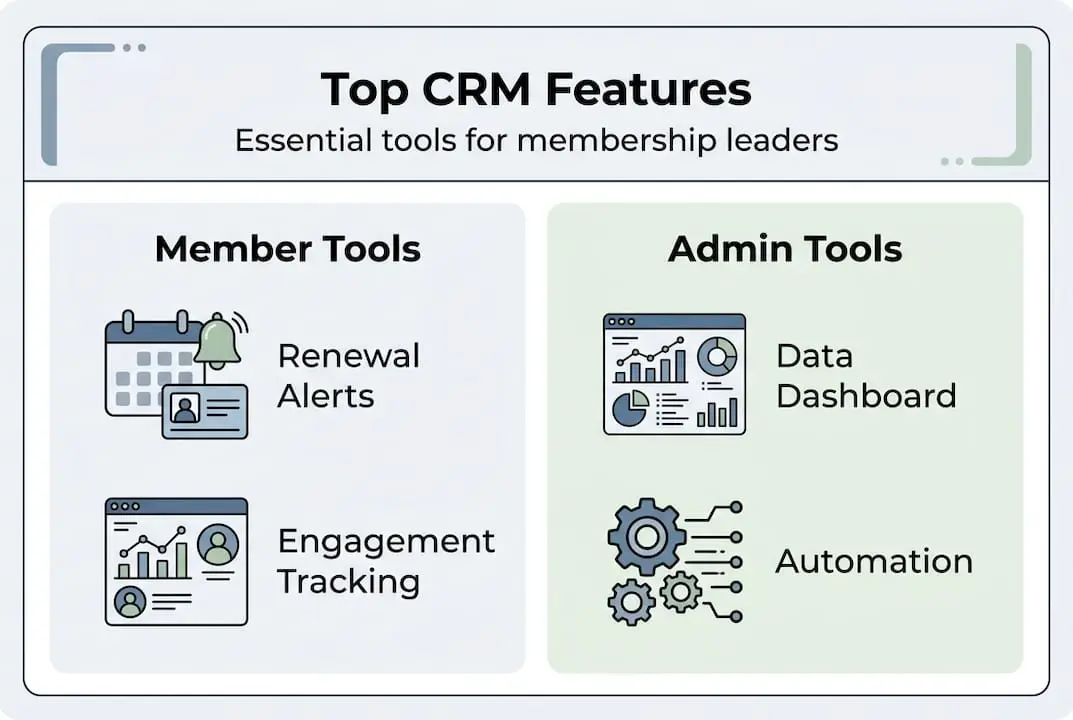
Here are the must-have features and criteria for membership organisations evaluating a CRM:
- Member profile management: Centralised, detailed records for each member including history, preferences, and engagement data
- Automated communication tools: Built-in email marketing, triggered messages, and segmentation capabilities
- Event management integration: Seamless connection between member records and event registrations, attendance, and follow-ups
- Renewal and subscription tracking: Automated alerts and workflows for renewals, lapses, and upgrades
- Reporting and analytics: Dashboards that surface meaningful engagement metrics without requiring technical expertise
- Scalability: The ability to grow with your organisation without costly migrations or rebuilds
- Integration capability: APIs or native connectors to your existing tools such as payment gateways, email platforms, and website portals
- Ease of use: An interface your team will actually adopt, not avoid
When reviewing your options, also consider the support offered by the vendor. What does onboarding look like? Is training included? Is there a dedicated contact when issues arise? These factors affect adoption as much as the software features themselves.
Reviewing the best CRM for membership leaders in 2026 reveals a clear pattern: the organisations that get the best results are those that selected a platform designed specifically for membership management, rather than adapting a general-purpose sales CRM to fit their needs. Understanding what makes a good CRM for your context helps you ask the right questions during demonstrations and trials.
Do not overlook the connection between email marketing and CRM. The most effective membership CRM platforms bring these functions together, so your campaigns are informed by real engagement data rather than static contact lists.
Pro Tip: Involve two or three frontline staff members directly in CRM demonstrations. Ask them to perform their most common daily tasks in the system. Their feedback will tell you more about real-world usability than any feature comparison document.
Why CRM adoption fails (and succeeds): Beyond technology
After reviewing selection steps, here is what most leaders overlook about CRM adoption. The organisations we see thrive with CRM are not necessarily those with the largest budgets or the most technically sophisticated platforms. They are the ones where leadership treats CRM as a strategic investment in culture and process, not a plug-and-play technology fix.
The uncomfortable truth is that CRM projects fail when the organisation is not ready to change how work happens. Buying a new system does not fix unclear ownership, siloed teams, or inconsistent data habits. Those are people and culture problems that no software can resolve on its own.
True CRM success is measured by outcomes: improved collaboration between your membership, events, and communications teams; greater accountability around member follow-ups; and demonstrably better member experiences that drive retention. When you use a CRM guide for organisations to frame your strategy, you start asking the right questions before you spend a single pound on software. That shift in thinking is where lasting change begins.
Discover CRM solutions for your membership organisation
The guidance in this article reflects a straightforward reality: CRM done well transforms how membership organisations operate, engage their members, and grow sustainably. The difference lies in preparation, people, and choosing a platform built for your specific needs.
At Colossus Systems, we have built our platform specifically for membership organisations like yours. Our membership management features bring CRM, communications, event management, and analytics together in one place, so your team works from a single system rather than a fragmented collection of tools. Whether you are planning your first CRM implementation or replacing a system that has not delivered, our event management software and CRM software solutions are designed to help your organisation grow with confidence. Speak with our team today to explore what is possible for your organisation.
Frequently asked questions
What makes CRM vital for membership organisations?
CRM supports engagement, retention, and operational efficiency, enabling organisations to understand and meet member needs more effectively through centralised data and automated communication workflows.
Why do CRM projects often fail?
Most failures stem from insufficient organisational readiness, unclear data definitions, and low staff adoption. CRM implementation failures come less from the software itself and more from weak change management and poor data governance.
How can organisations ensure CRM success?
Success depends on defining clear goals, clarifying data responsibilities, securing leadership buy-in, and choosing a solution that fits team workflows. CRM implementation without alignment and governance consistently falls short of expectations.
Which CRM features matter most for membership groups?
Flexibility, easy integration, scalable member tracking, strong engagement reporting, and responsive vendor support are the top priorities for membership organisations evaluating CRM platforms in 2026.