Academic Integrity Policies: Building Member Trust

Most british universities still lack explicit policies to manage the rising threat of AI-enabled academic misconduct, despite growing global concern. For compliance officers in international associations, this highlights a critical gap that can undermine member confidence. Understanding the changing nature of academic integrity and debunking old assumptions is key to shaping fair policies and open communication that maintain trust in every professional community.
Table of Contents
- Academic Integrity Policies Defined And Debunked
- Key Categories And Forms Of Integrity Breaches
- Compliance Frameworks And Legal Underpinnings
- Typical Policy Features And Implementation
- Member Roles, Duties And Consequences
- Risks, Common Pitfalls And Best Practices
Key Takeaways
| Point | Details |
|---|---|
| Evolving Academic Integrity | Contemporary policies must adapt to challenges posed by artificial intelligence and other technologies, necessitating a redefinition of misconduct. |
| Holistic Policy Frameworks | Effective academic integrity policies incorporate educational strategies, transparent assessment methods, and agile enforcement mechanisms. |
| Collective Responsibility | All members of an institution must understand their roles and responsibilities in maintaining academic integrity, promoting a culture of ethical behaviour. |
| Focus on Development | Policies should be designed as educational tools that foster understanding and ethical skill-building, rather than solely punitive measures. |
Academic Integrity Policies Defined and Debunked
Academic integrity represents a foundational ethical framework that defines acceptable scholarly conduct within educational and research environments. While traditionally focused on preventing plagiarism and cheating, contemporary policies are rapidly evolving to address unprecedented technological challenges, particularly those introduced by artificial intelligence tools.
The emergence of generative AI technologies has fundamentally disrupted established academic integrity models. Recent global research highlights significant gaps in existing institutional policies, revealing that many universities lack explicit guidelines regarding technological threats like AI-generated content. This technological shift demands a comprehensive reimagining of academic integrity frameworks that balance innovation, ethical considerations, and educational objectives.
Modern academic integrity policies now require multifaceted approaches incorporating technological understanding, policy reform, educational strategies, and assessment redesign. Faculty perceptions underscore the complexity of implementing such comprehensive guidelines, identifying barriers such as increased workload, insufficient institutional support, and ambiguous regulatory language. Successful policies must therefore be agile, culturally sensitive, and technologically informed.
Key components of contemporary academic integrity policies increasingly include:
- Clear definitions of technological misconduct
- Explicit guidelines on AI tool usage
- Transparent assessment methodologies
- Proactive educational interventions
- Consistent enforcement mechanisms
Pro tip: Develop a dynamic academic integrity policy that views technological challenges as opportunities for educational growth rather than merely punitive obstacles.
The following table compares traditional and modern academic integrity policy approaches:
| Aspect | Traditional Policies | Modern Policies with AI Focus |
|---|---|---|
| Main Concern | Plagiarism and standard cheating | Technological misconduct and AI misuse |
| Policy Adaptation | Static, infrequent updates | Agile, continuous policy revisions |
| Stakeholder Support | Minimal training, limited engagement | Proactive education and empowerment |
| Enforcement Methods | Punitive, fixed consequences | Balanced, educative consequences |
Key Categories and Forms of Integrity Breaches
Academic integrity breaches represent a complex landscape of unethical scholarly behaviours that fundamentally undermine research credibility and institutional trust. These violations extend far beyond simplistic notions of cheating, encompassing a sophisticated range of misconduct that can significantly compromise academic standards and professional reputation.

Historical perspectives on academic misconduct reveal multiple nuanced categories of integrity breaches. These typically include fabrication, falsification, plagiarism, misrepresentation of research data, and emerging technological forms of misconduct such as undisclosed AI assistance. Each category represents a distinct violation of scholarly ethics, with potentially profound consequences for individual researchers and institutional credibility.
The most prevalent forms of academic integrity breaches can be systematically categorised as follows:
- Plagiarism: Presenting another’s intellectual work without appropriate attribution
- Data Fabrication: Inventing or manipulating research data to support predetermined conclusions
- Research Falsification: Deliberately altering or omitting critical research findings
- Collusion: Unauthorised collaboration or sharing of academic work
- Contract Cheating: Outsourcing academic assignments to third-party providers
- AI-Enabled Misconduct: Using generative AI tools without proper disclosure
Comprehensive studies on research misconduct highlight that these breaches are not merely individual failures but systemic challenges requiring institutional intervention. The growing complexity of technological tools has further complicated traditional approaches to maintaining academic standards, demanding more sophisticated and adaptable integrity frameworks.
Pro tip: Implement regular academic integrity training that focuses on ethical decision-making frameworks rather than punitive measures, emphasising understanding over punishment.
Compliance Frameworks and Legal Underpinnings
Compliance frameworks represent the critical architectural foundations that define ethical boundaries and accountability mechanisms within academic and research environments. These structured systems go beyond mere regulatory checklists, embodying comprehensive approaches that integrate legal requirements, institutional values, and procedural guidelines to maintain integrity and professional standards.
Comprehensive institutional guidelines outline the fundamental responsibilities of organisations in establishing robust academic integrity frameworks. These frameworks typically encompass detailed mechanisms for investigating potential misconduct, ensuring procedural fairness, and implementing transparent processes that protect both the institution’s reputation and the rights of individuals involved in potential integrity investigations.
Key components of effective compliance frameworks include:
- Clear articulation of ethical expectations
- Detailed procedural guidelines for investigating potential breaches
- Transparent reporting mechanisms
- Consistent and fair enforcement protocols
- Mechanisms for continuous policy review and adaptation
- Professional development and training programmes
Research integrity policies must evolve dynamically to address emerging challenges, particularly those introduced by technological innovations. Modern frameworks must balance rigorous standards with flexible approaches that recognise the nuanced nature of academic misconduct in an increasingly complex technological landscape.
Pro tip: Develop a dynamic compliance framework that views policy implementation as an ongoing dialogue rather than a static set of rules, encouraging continuous organisational learning and ethical development.
Typical Policy Features and Implementation
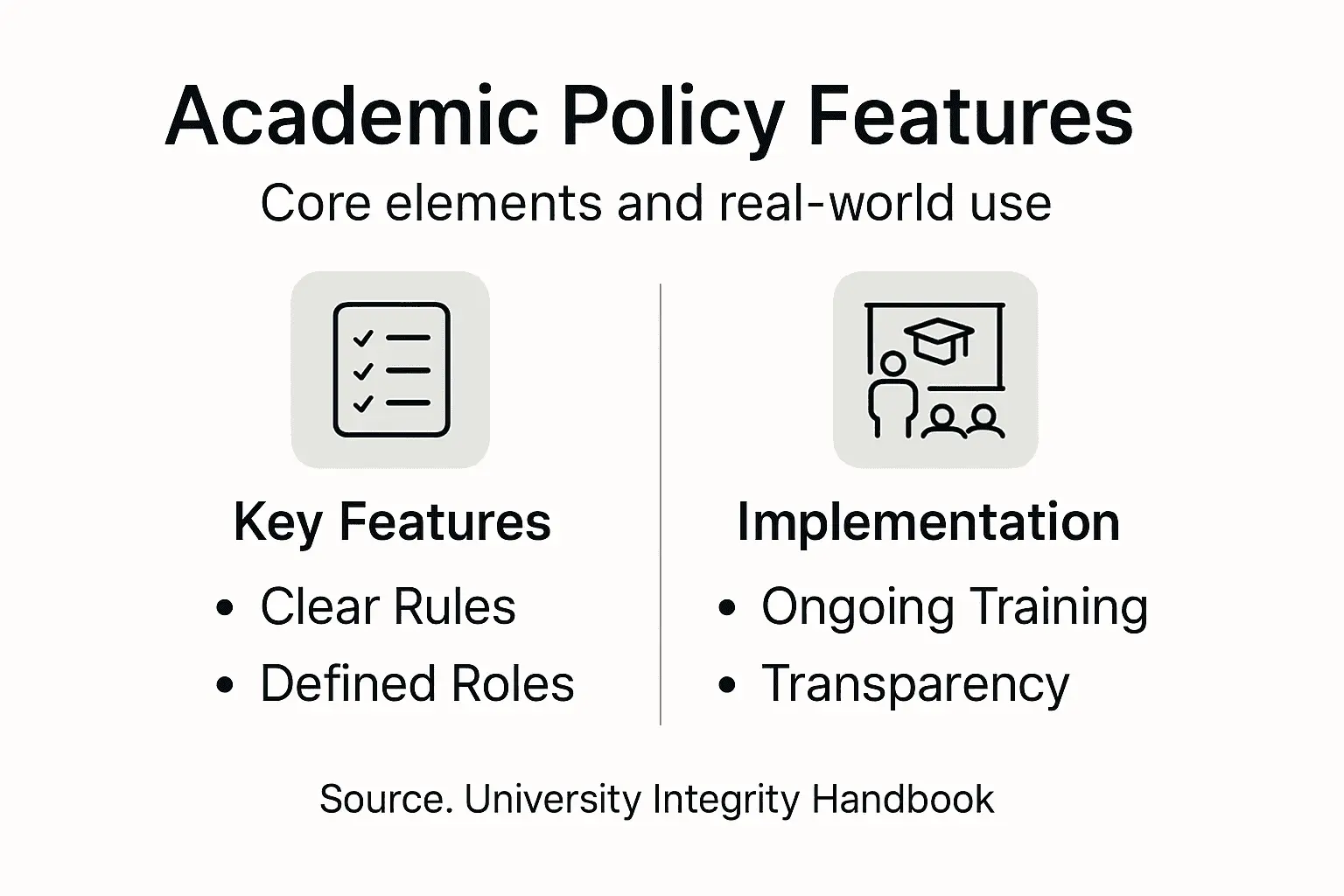
Academic integrity policies require sophisticated, multifaceted implementation strategies that transcend simple punitive approaches. These frameworks must create comprehensive ecosystems of ethical understanding, proactively addressing potential misconduct while simultaneously educating and supporting institutional members.
International academic integrity guidelines emphasise a holistic approach that balances clear behavioural expectations with supportive educational mechanisms. Successful implementation involves defining precise boundaries of acceptable conduct, establishing transparent investigation procedures, and creating a culture that values ethical behaviour as an inherent institutional value.
Key implementation features typically include:
- Comprehensive staff and student training programmes
- Clear, accessible policy documentation
- Multiple reporting channels for potential breaches
- Graduated response mechanisms
- Regular policy review and adaptation processes
- Technology-enabled monitoring systems
- Confidential investigation protocols
Regulatory guidance frameworks underscore the importance of balancing rigorous standards with procedural fairness. Modern academic integrity policies must create nuanced approaches that distinguish between inadvertent mistakes and deliberate misconduct, ensuring proportionate and constructive responses that support continuous learning and institutional growth.
Pro tip: Design academic integrity policies as developmental tools rather than purely punitive documents, focusing on education, understanding, and ethical skill-building.
Member Roles, Duties and Consequences
Academic integrity is a collective responsibility that demands clear understanding and active engagement from every institutional member. Each role within an organisation carries specific ethical obligations that contribute to maintaining a robust culture of academic honesty and professional conduct.
Academic community member responsibilities encompass a comprehensive set of expectations that extend beyond traditional compliance. These responsibilities require proactive participation, continuous learning, and a commitment to upholding institutional ethical standards across different organisational levels.
Specific roles and corresponding duties include:
Student Responsibilities:
- Understand and adhere to academic integrity policies
- Submit original work
- Properly cite sources
- Report observed misconduct
- Participate in integrity training programmes
Faculty Responsibilities:
- Model ethical academic behaviour
- Design assessments that discourage misconduct
- Provide clear assignment guidelines
- Address potential integrity breaches transparently
- Support student learning about academic ethics
Administrative Responsibilities:
- Develop comprehensive integrity frameworks
- Create accessible reporting mechanisms
- Ensure fair investigation processes
- Provide ongoing educational resources
- Implement consistent consequence structures
Faculty engagement studies highlight the critical importance of institutional support in effectively implementing academic integrity policies. Consequences for breaches must balance punitive measures with educational interventions, recognising the nuanced nature of academic misconduct.
Pro tip: Develop a transparent, educative approach to consequences that emphasises learning and personal growth rather than purely punitive actions.
Risks, Common Pitfalls and Best Practices
Academic integrity management represents a complex landscape fraught with evolving challenges that demand sophisticated, nuanced approaches. Organisations must navigate intricate ethical terrains while maintaining robust systems that protect institutional reputation and support genuine learning environments.
Academic integrity research highlights critical risks that extend beyond simplistic compliance models. Modern frameworks require understanding integrity as a developmental skill rather than a purely punitive mechanism, emphasising contextual sensitivity and proactive cultural interventions.
Key risks and potential pitfalls include:
- Over-reliance on punitive enforcement mechanisms
- Insufficient policy contextualisation
- Lack of stakeholder engagement
- Inadequate technological adaptation
- Cultural misalignment in policy implementation
- Limited understanding of emerging ethical challenges
Global institutional standards underscore the importance of integrated assurance frameworks that balance technological monitoring, continuous policy review, and comprehensive member training. Successful approaches recognise that academic integrity is fundamentally about cultivating ethical understanding rather than implementing restrictive controls.
Pro tip: Design academic integrity strategies as collaborative learning experiences that empower members to understand ethical principles rather than viewing them as external constraints.
Here is a summary of common risks and recommended best practices for academic integrity management:
| Risk Area | Example Challenge | Recommended Best Practice |
|---|---|---|
| Technological Disruption | AI-generated submissions | Update policies for new technologies |
| Cultural Misalignment | Policy not regionally fit | Localise guidelines and training |
| Limited Stakeholder Buy-in | Lack of involvement | Foster collaborative policy creation |
| Over-emphasis on Punishment | Deterrence only focus | Prioritise ethical skill development |
Strengthen Academic Integrity and Member Trust with Colossus Systems
Academic Integrity Policies demand more than just rules they require clear communication, proactive education, and transparent enforcement across your membership community. Managing these complexities while ensuring effective member engagement can feel overwhelming. The article highlights challenges such as balancing ethical standards, compliance frameworks, and member responsibilities to cultivate a culture of trust and continuous learning.

Take control by leveraging a platform designed for membership organisations that need to streamline operations and enhance ethical engagement. Colossus Systems offers tools to customise communication channels, deliver targeted virtual training, and create transparent reporting workflows. This creates an environment where members understand their roles and integrity policies are implemented with fairness and clarity. Act now to transform your organisation’s approach to academic integrity, increase member confidence, and build a thriving community by connecting with us today at Contact Colossus Systems. Discover how our solutions support ongoing policy adaptation and member development in complex environments.
Frequently Asked Questions
What are the key components of modern academic integrity policies?
Modern academic integrity policies include clear definitions of technological misconduct, explicit guidelines on AI tool usage, transparent assessment methodologies, proactive educational interventions, and consistent enforcement mechanisms.
How do academic integrity breaches differ from traditional cheating?
Academic integrity breaches encompass a range of unethical behaviours beyond traditional cheating, including plagiarism, data fabrication, misrepresentation of research data, and emerging forms such as AI-enabled misconduct.
What role do students play in upholding academic integrity?
Students are responsible for understanding and adhering to academic integrity policies, submitting original work, properly citing sources, reporting observed misconduct, and participating in integrity training programmes.
What are the risks associated with managing academic integrity?
Key risks include over-reliance on punitive enforcement mechanisms, insufficient policy contextualisation, lack of stakeholder engagement, inadequate technological adaptation, and cultural misalignment in policy implementation.