Year-round member engagement: 5 strategies for retention

TL;DR:
- Effective onboarding within the first 90 days significantly increases member renewal rates.
- Building long-term engagement requires guiding members up the engagement ladder from passive to leadership roles.
- Continuous digital communities and personalised communication are key to maintaining year-round member involvement.
Keeping members engaged after the buzz of a major event fades is one of the most persistent challenges facing membership organisations today. Benchmark data shows that median overall retention sits at 84%, yet first-year retention drops to 75%, and 55% of associations report flat or declining retention. Those numbers reveal a clear pattern: organisations excel at attracting members but struggle to sustain meaningful connection throughout the year. This guide walks you through five evidence-backed strategies, from structured onboarding to digital community building, that will help your organisation build genuine, year-round engagement and protect the membership base you have worked hard to grow.
Table of Contents
- Start strong: Effective onboarding for lasting engagement
- From passive to leader: Building the engagement ladder
- Always-on engagement: Digital communities and continuous touchpoints
- Personalisation and feedback loops: Improving engagement through segmentation
- Perspective: Why retention trumps recruitment and how to avoid the end-of-year slump
- Take your member engagement further with tailored solutions
- Frequently asked questions
Key Takeaways
| Point | Details |
|---|---|
| Onboarding shapes retention | A structured 90-day onboarding process is crucial for keeping new members engaged and encouraging renewal. |
| Engagement ladders drive involvement | Progressing members through stages from passive to leader creates stronger connection and loyalty to your organisation. |
| Digital communities enable year-round activity | Online forums and regular digest emails sustain engagement between events and help avoid seasonal drop-offs. |
| Personalisation and feedback matter | Segment activities, use gamification, and gather feedback frequently to adapt your strategy and increase satisfaction. |
| Retention is more cost-effective | Prioritising member retention, especially through volunteer involvement, delivers greater value than recruitment drives. |
Start strong: Effective onboarding for lasting engagement
The first 90 days of a new membership are arguably the most important period your organisation controls. Members who feel welcomed, informed, and connected early on are far more likely to renew. Those who receive nothing more than a confirmation email often drift quietly towards cancellation before their first anniversary arrives.
A structured onboarding sequence removes that risk. Research confirms that members who engage early renew at significantly higher rates, and a deliberate 90-day pathway is the most reliable way to achieve that early engagement. Here is a practical sequence you can implement immediately:
- Day 1: Send a warm welcome email with clear next steps and links to key resources.
- Day 7: Prompt the member to complete their profile and connect with relevant interest groups.
- Day 30: Invite them to an upcoming event, webinar, or peer networking opportunity.
- Day 60: Send a personal check-in from a staff member or volunteer ambassador.
- Day 90: Distribute a short survey asking what they value most and what could be improved.
This sequence keeps your organisation visible without being intrusive, and it gives members a clear path to involvement rather than leaving them to figure things out alone.
| Onboarding stage | Primary goal | Key action |
|---|---|---|
| Day 1 | First impression | Welcome email with resources |
| Day 7 | Profile completion | Personalisation prompt |
| Day 30 | Event participation | Event or webinar invitation |
| Day 60 | Relationship building | Personal check-in message |
| Day 90 | Feedback collection | Short satisfaction survey |
For a deeper look at how to structure this process, the onboarding new members guide on the Colossus Systems blog offers practical frameworks your team can adapt.
Pro Tip: Automate your onboarding sequence using your CRM or membership management platform. Automation ensures consistency across every new member, regardless of how busy your team is during peak recruitment periods.
From passive to leader: Building the engagement ladder
Onboarding sets the foundation, but sustained engagement requires a longer-term model. The engagement ladder methodology provides exactly that. This approach progresses members through five distinct stages: passive (dues payers), consumer (content readers), participant (event attendees), contributor (forum posters), and leader (volunteers and committee members). Each stage represents a deeper level of investment in your organisation.

The key insight here is that most organisations focus almost entirely on the bottom two stages. They celebrate event attendance without creating clear pathways for members to contribute or lead. That is where long-term retention is won or lost.
Here are targeted actions to move members up the ladder:
- Passive to consumer: Send curated content digests tailored to member interests and career stage.
- Consumer to participant: Offer low-barrier entry points such as short webinars or local meetups.
- Participant to contributor: Create online forums, discussion boards, or peer review opportunities.
- Contributor to leader: Actively recruit contributors for committees, working groups, or mentoring roles.
Tracking where each member sits on this ladder is essential. If you are not already monitoring engagement metrics for retention, you are likely missing early warning signs of disengagement.
| Engagement stage | Typical behaviour | Retention impact |
|---|---|---|
| Passive | Pays dues, minimal interaction | Highest churn risk |
| Consumer | Reads newsletters, downloads resources | Moderate risk |
| Participant | Attends events and webinars | Below-average churn |
| Contributor | Posts, reviews, shares ideas | Low churn risk |
| Leader | Volunteers, chairs committees | Strongest loyalty |
The contrast between passive and leader members is stark. Leaders rarely leave because they have personal investment in the organisation’s success. Building more leaders is, in practical terms, the most powerful improving retention rates strategy available to you.
Always-on engagement: Digital communities and continuous touchpoints
Events are valuable, but they are episodic. Your members live their professional lives between events, and that is precisely where digital communities and consistent touchpoints earn their keep. An always-on engagement strategy ensures your organisation remains relevant 365 days a year, not just during conference season.
Industry benchmarks show that online communities average 506 unique logins per month, with 15% of members active within any 120-day period and 14% classified as active contributors. Those figures might seem modest, but a well-managed community that consistently delivers value will outperform those averages significantly.
Here are the most effective always-on tactics:
- Resource libraries: Curate articles, toolkits, and recordings that members can access at any time.
- Discussion forums: Create topic-specific spaces where members can ask questions and share expertise.
- Peer networking groups: Segment members by role, region, or interest for more relevant connections.
- Regular digest emails: Summarise community activity and highlight new resources weekly or fortnightly.
- Live Q&A sessions: Schedule short, informal sessions between major events to maintain momentum.
Digest emails deserve special attention. Data indicates that community digest emails achieve open rates of 43 to 59%, compared to an industry average of 38%. Personalised digests perform even better. That is a meaningful advantage for organisations willing to invest in segmented communication.
For practical guidance on sustaining this kind of activity, the community engagement tactics resource covers channel selection and content planning in detail.
Pro Tip: Personalise digest emails based on each member’s stated interests and past behaviour. A member who regularly attends finance-focused webinars should receive different content highlights than one who engages primarily with leadership development resources.
Personalisation and feedback loops: Improving engagement through segmentation
Once your digital touchpoints are in place, the next step is making them feel genuinely relevant to each individual member. Blanket communications work to a point, but segmentation by interests and behaviour, combined with gamification mechanics, is what separates organisations with strong year-round participation from those that see engagement spike and dip unpredictably.
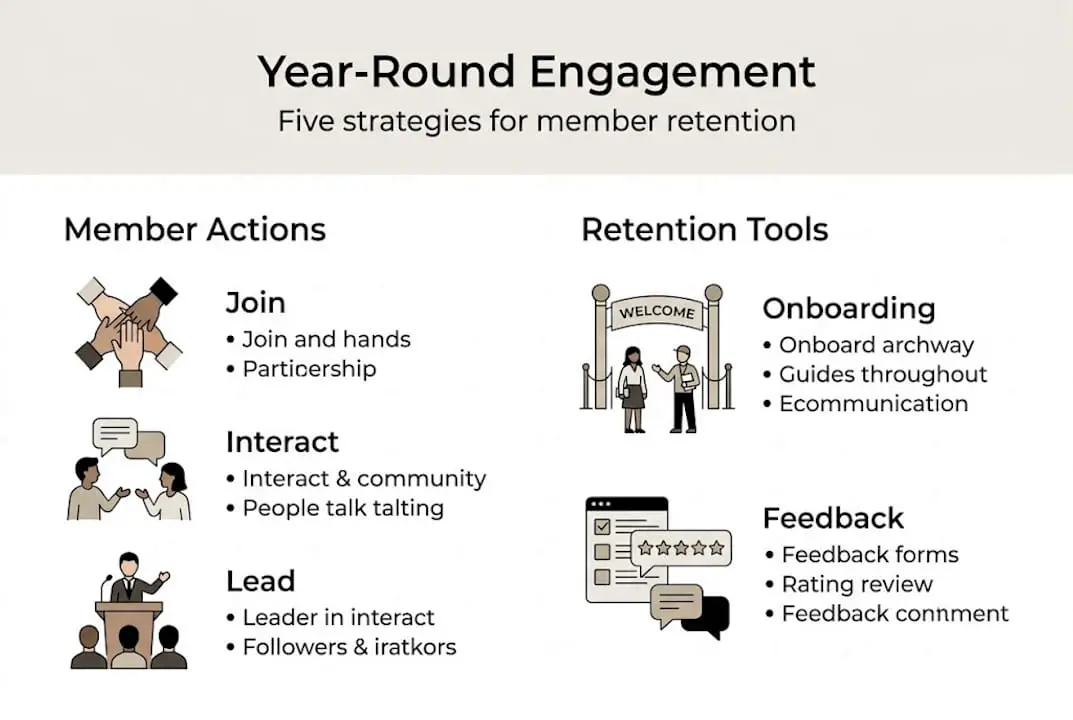
Behavioural segmentation means grouping members based on what they actually do, not just who they are. A member who attends three events per year and regularly downloads research reports has different needs from one who joined six months ago and has not logged in since. Treating them identically wastes your resources and frustrates both groups.
Here is a practical process for implementing segmentation and feedback loops:
- Define your segments: Start with two or three clear groups based on activity level, tenure, or role.
- Map content to each segment: Assign specific resources, events, and communications to each group.
- Introduce gamification: Award points for actions such as logging in, attending events, or posting in forums. Recognise top contributors publicly.
- Deploy quarterly surveys: Keep them short (five to seven questions) and focused on a specific aspect of the member experience.
- Act visibly on feedback: Share what you heard and what you changed. This closes the loop and builds trust.
“Members do not just want to be surveyed. They want to know their input shaped something real. Closing the feedback loop is what transforms a routine survey into a genuine retention tool.”
Research shows that 52% of members want more input into their organisation’s direction. That is a significant majority signalling that they are willing to engage more deeply if given the opportunity. Pair that with well-designed member retention tips and you have a system that continuously improves itself. For organisations running fundraising or donation campaigns alongside membership, following thank you page best practices can also reinforce the sense of being valued.
Perspective: Why retention trumps recruitment and how to avoid the end-of-year slump
Here is an uncomfortable truth that many membership organisations avoid confronting: a 5% gain in retention delivers more long-term value than doubling your recruitment budget. Yet most organisations allocate the majority of their energy and resources to attracting new members rather than deepening relationships with the ones they already have.
We believe this is a strategic error. Recruitment is visible and exciting. Retention is quieter, but the compounding effect of keeping members longer is profound. Volunteers, in particular, represent your most loyal cohort. They have skin in the game. Nurturing that group should be a deliberate priority, not an afterthought.
The end-of-year period is where this imbalance becomes most damaging. Many organisations go quiet in November and December, assuming members are too busy to engage. The smarter approach is to counter the slump with value-first outreach: best-of content recaps, year-in-review infographics, and early previews of Q1 events. None of these feel like a sales pitch. All of them reinforce why membership is worth renewing. Explore how a focused recruitment and retention strategies approach can rebalance your organisation’s priorities for 2026 and beyond.
Take your member engagement further with tailored solutions
The strategies covered in this article, from structured onboarding and engagement ladders to digital communities and personalised segmentation, all require reliable tools to execute consistently at scale. That is where technology makes the difference.
Colossus Systems brings together membership management features including CRM, email marketing, analytics, and member portals within a single, unified platform. Our event management tools streamline everything from registration to post-event follow-up, ensuring no engagement opportunity is missed. Whether you are building your first onboarding sequence or scaling a mature community programme, we can tailor a solution to fit your organisation’s specific needs. Get in touch with our team to explore how Colossus Systems can support your engagement goals.
Frequently asked questions
What are the most effective year-round engagement channels?
Online communities, resource libraries, and digest emails consistently provide continuous engagement between events. Communities average 506 unique logins per month, making them a reliable always-on touchpoint.
How can organisations identify disengaged members early?
Using engagement scoring, you can track logins, event attendance, and forum posts to spot at-risk members before they churn. Assigning points to member actions allows you to flag those scoring between 0 and 10 points for targeted outreach.
What role does gamification play in member engagement?
Gamification encourages participation and personalises the experience by rewarding members for specific actions. Segmentation combined with gamification motivates year-round involvement and helps sustain momentum between major events.
Why should feedback loops be part of the engagement strategy?
Regular surveys and visible action on the results ensure your strategies stay relevant and members feel genuinely valued. 52% of members want more input into their organisation’s direction, making feedback loops a practical retention tool.
How can organisations boost retention at year-end?
Value-led outreach such as best-of recaps, year-in-review infographics, and Q1 event previews works far better than sales-focused messaging. Countering the end-of-year slump with content-first communication keeps members engaged through the quieter months and into the new year.