What is CRM software in real estate and how to use it

Real estate agents often dismiss CRM software as bloated databases crammed with features they’ll never touch. The reality? Most agents rely on just a handful of critical daily functions. The difference between a CRM that transforms your business and one gathering digital dust isn’t feature count, it’s design that matches how you actually work. When your CRM aligns with real workflows, adoption soars and client relationships deepen. This guide cuts through the noise to explain what CRM software truly is, its tangible benefits for agents and brokers, common pitfalls that sabotage implementation, and proven strategies to maximise your investment in 2026 and beyond.
Table of Contents
- Understanding CRM Software For Real Estate Professionals
- Why Real Estate CRM Adoption Often Fails And How To Avoid It
- How CRM Software Streamlines Real Estate Operations And Boosts Conversions
- Choosing And Implementing The Right CRM Solution For Your Real Estate Business
- Explore Specialised CRM Software To Transform Your Real Estate Business
Key takeaways
| Point | Details |
|---|---|
| Focus on workflow alignment | CRM adoption succeeds when designed around agents’ critical daily tasks rather than feature breadth. |
| Data quality drives trust | Poor data hygiene with duplicates and errors destroys agent confidence and prompts system abandonment. |
| Automation creates efficiency | Real estate CRMs improve operations through automated follow-ups, centralised client data, and streamlined communication. |
| Strategic planning prevents failure | Failed implementations cost agencies time and money due to inadequate planning and lack of user buy-in. |
| ROI requires alignment | Strategic alignment of CRM with real workflows drives adoption and delivers measurable returns on investment. |
Understanding CRM software for real estate professionals
A real estate CRM is far more than a glorified contact list. A real estate CRM is a platform designed specifically to manage every relationship, interaction, and transaction in your business. It centralises all contact and client information in one intelligent database, creating a single source of truth for your entire operation.
The platform tracks every interaction, from emails and phone calls to property viewings and listing enquiries. This comprehensive history per contact means you never lose context when picking up a conversation three months later. You can see exactly when a prospect viewed a listing, what properties caught their attention, and which follow-up messages they opened.
Real estate CRMs help brokers and agents manage diverse relationship categories efficiently. Your database includes active leads, current clients, past clients who might refer business, and referral partners who send opportunities your way. Each category requires different communication strategies and follow-up cadences.
Core operational tasks become streamlined:
- Communication management across email, SMS, and phone calls
- Lead tracking from first enquiry through to closed transaction
- Deal status monitoring with pipeline visualisation
- Automated follow-up sequences based on lead behaviour
- Task reminders for critical touchpoints
The best platforms are tailored specifically to real estate workflows rather than adapted from generic business tools. This specialisation means features like property matching, listing syndication, and commission tracking come built in rather than requiring complex customisation. When evaluating CRM software examples, prioritise solutions designed with agent productivity and client relationship depth as primary objectives.
Why real estate CRM adoption often fails and how to avoid it
Low adoption rates plague real estate agencies, but the root cause isn’t complicated software or inadequate training. It’s a design problem. Many real estate CRM implementations fail due to avoidable mistakes made before, during, and after implementation, and most stem from fundamental misalignment between system design and actual agent behaviour.
When CRM workflows don’t match your real sales process, agents route around the system entirely. Imagine forcing agents to log five fields of lead information before accessing contact details, when they typically jot quick notes and follow up immediately. The friction creates resistance, and suddenly everyone’s back to spreadsheets and sticky notes.
Poor data hygiene destroys trust faster than any other factor. Duplicate contacts, outdated phone numbers, and incorrect property preferences make your database unreliable. CRM adoption failures often stem from a lack of clear benefits for individual agents, leading to poor data quality and reduced system trust. When agents pull up a contact and find three different versions with conflicting information, they stop believing the system adds value.
Agents need crystal-clear benefits to engage with any new platform:
- Performance dashboards showing personal conversion metrics
- Email templates that save 30 minutes daily
- Automated follow-up sequences that nurture leads whilst they sleep
- Mobile access to client history during property viewings
- Commission tracking that eliminates payment disputes
“The platforms that get used are the ones built around the agent’s daily workflow, not feature breadth. If your CRM doesn’t make the agent’s life easier within the first week, adoption will crater regardless of training investment.”
Leadership must prioritise strategic alignment and user buy-in from day one. This means observing how agents actually work before configuring a single field. Shadow your top performers for two weeks, noting every client touchpoint and information need. Configure your CRM software to support these observed workflows rather than imposing theoretical best practices that sound good in vendor demos but collapse under real-world pressure.
Pro Tip: Assign CRM champions within your team, experienced agents who test the system first and provide peer-to-peer training. Agents trust fellow agents far more than management mandates or external consultants.
How CRM software streamlines real estate operations and boosts conversions
Automation transforms how agents manage their pipeline by eliminating repetitive manual tasks. Instead of setting calendar reminders for every follow-up, your CRM triggers email sequences based on lead behaviour. When a prospect views a listing but doesn’t enquire, an automated message goes out 24 hours later with similar properties. This consistency ensures no lead falls through the cracks during busy periods.
Centralised data means every interaction gets documented automatically. Phone calls log with duration and notes, emails sync bidirectionally, and property viewings update deal stages. When a colleague picks up a client relationship, they access complete history instantly rather than piecing together fragments from multiple systems.

Recent case studies demonstrate quantifiable improvements. Real estate CRM implementation led to a 73% lead conversion increase at one Austin-based agency. Another study found lead-to-site-visit conversions improved by 47% and response times became 62% faster after implementing specialised CRM automation.
The financial returns justify the investment decisively. Businesses see an average return of £8.71 for every £1 invested in a CRM, with real estate agencies reporting notable revenue increases per lead. This ROI stems from multiple efficiency gains working in concert.
| Metric | Before CRM | After CRM | Improvement |
|---|---|---|---|
| Lead conversion rate | 2.8% | 4.8% | 71% increase |
| Average response time | 4.2 hours | 1.6 hours | 62% faster |
| Deals per agent monthly | 3.1 | 5.2 | 68% increase |
| Client retention rate | 34% | 61% | 79% improvement |
Clear operational advantages include:
- Faster lead routing that connects enquiries with available agents in minutes
- Systematic follow-up that nurtures leads over months without manual tracking
- Increased sales from better qualification and prioritisation of high-intent prospects
- Enhanced client satisfaction through personalised communication at scale
- Reduced administrative burden freeing agents for revenue-generating activities
Pro Tip: Track your baseline metrics for 30 days before CRM implementation, then measure the same metrics monthly afterwards. Concrete data proves ROI to sceptical team members and justifies continued investment in system optimisation.
When evaluating potential returns, consider the best CRM for real estate comparison to identify solutions delivering measurable outcomes rather than impressive feature lists that never get used.
Choosing and implementing the right CRM solution for your real estate business
Successful CRM selection starts with observation, not vendor demos. Shadow your agents for two weeks, documenting every client interaction, information need, and workflow step. Note when they switch between systems, what data they reference repeatedly, and which tasks consume disproportionate time. The platforms that get used are the ones built around the agent’s daily workflow, not feature breadth, so this observational phase prevents costly misalignment.
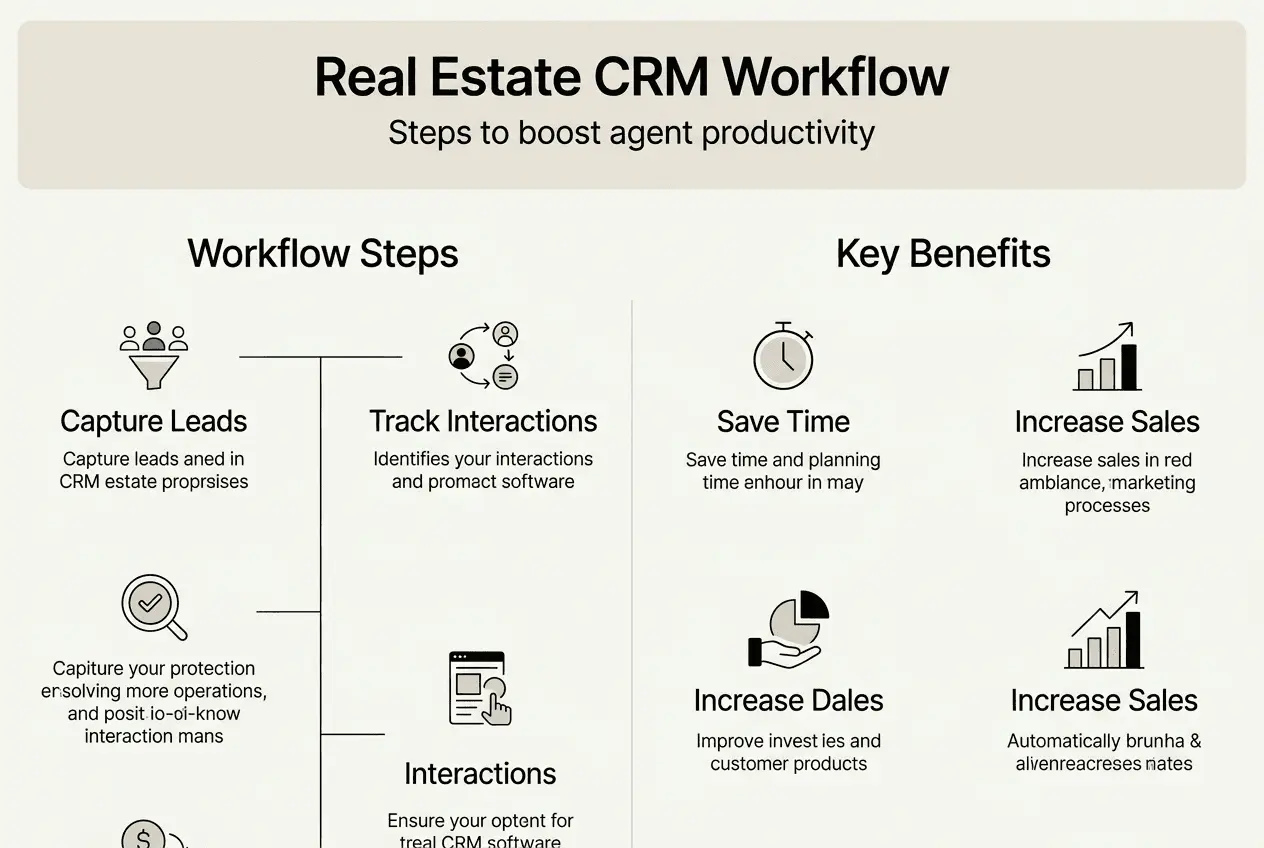
Compare solutions based on criteria that matter for real estate specifically:
| Feature Category | Essential Capabilities | Questions to Ask |
|---|---|---|
| Lead management | Automated routing, source tracking, behaviour scoring | Does it capture lead source automatically from website forms and listing portals? |
| Communication tools | Email templates, SMS integration, call logging | Can agents send personalised bulk emails without leaving the platform? |
| Property matching | Listing sync, preference tracking, automated alerts | Does it notify clients when properties matching their criteria become available? |
| Mobile functionality | Full feature access, offline mode, quick logging | Can agents access complete client history during property viewings without connectivity? |
| Integration potential | Website connection, listing platforms, accounting software | Does it sync bidirectionally with your existing technology stack? |
| Reporting capabilities | Pipeline visualisation, conversion metrics, agent performance | Can brokers generate commission reports and forecast revenue accurately? |
Implement using a phased rollout that builds confidence progressively:
- Start with data migration and cleaning, removing duplicates and standardising formats before agents touch the system.
- Configure workflows based on your observational research, matching system processes to actual agent behaviour.
- Pilot with your CRM champions for 30 days, gathering feedback and refining configurations.
- Roll out to the broader team with peer-to-peer training from champions who’ve proven the system works.
- Monitor adoption metrics weekly, addressing friction points immediately before bad habits form.
- Iterate based on usage data, eliminating unused features and enhancing heavily-used workflows.
Integration with your website and listings management adds substantial operational value. When enquiries from your site flow directly into the CRM with source attribution, you can measure marketing ROI accurately and optimise spending. Listing updates sync automatically, ensuring clients see current availability without manual data entry.
Avoid generic tools when scaling beyond small teams. Basic tools like Notion or Airtable begin to show limitations when a company reaches critical growth milestones, particularly around automation, reporting depth, and multi-user permissions. Specialised real estate CRMs handle complex scenarios like co-listing agreements, referral fee splits, and transaction compliance tracking that generic platforms require extensive customisation to support.
Pro Tip: Negotiate trial periods that match your sales cycle length, typically 60 to 90 days for real estate. This duration lets you test the system through complete lead-to-close workflows rather than superficial feature exploration.
Explore CRM and inventory management software comparison resources and review types of CRM software to understand which category aligns with your operational model and growth trajectory.
Explore specialised CRM software to transform your real estate business
You’ve now got a comprehensive understanding of how CRM software can revolutionise your real estate operations when implemented strategically. The difference between systems that deliver measurable ROI and those that gather dust comes down to alignment with your actual workflows and commitment to data quality.
Tailored CRM solutions simplify agent workflows whilst boosting productivity through intelligent automation and centralised client intelligence. Explore CRM software designed specifically for relationship-focused businesses that prioritise member engagement and operational efficiency. Discover membership management features that integrate seamlessly with your existing processes, delivering the automation and communication tools that transform casual enquiries into long-term client relationships. The right platform doesn’t just store contact information, it actively supports your growth through every stage of the client journey.
Frequently asked questions
What is CRM software in real estate?
CRM software is a specialised platform that helps real estate agents and brokers manage client relationships, leads, communications, and transactions efficiently. It centralises all relevant information, from initial enquiry through to post-sale follow-up, creating a single source of truth that improves service quality and operational consistency.
How does CRM software improve lead management in real estate?
CRM software automates lead routing, follow-ups, and logs all interactions to ensure timely responses without manual tracking. Real estate CRM implementation led to a 73% lead conversion increase in documented case studies, with response times improving by over 60% through automated workflows that nurture prospects systematically.
What are common mistakes to avoid with real estate CRM?
Not aligning the CRM with real agent workflows reduces adoption and usefulness, causing teams to abandon the system for familiar spreadsheets. Neglecting data hygiene leads to duplicates and incorrect information that destroys trust in the platform. Many real estate CRM implementations fail due to avoidable mistakes made before, during, and after implementation, particularly failing to communicate clear benefits that motivate individual agent engagement.
Can small real estate teams benefit from CRM software?
Small teams benefit significantly when they choose appropriately scaled solutions focused on core workflows rather than enterprise complexity. Start with essential features like lead capture, automated follow-ups, and centralised communication history. As your team grows, migrate to more sophisticated platforms that support advanced automation, detailed reporting, and multi-user permissions without disrupting established processes.
How long does CRM implementation typically take for real estate agencies?
Implementation timelines vary based on team size and data complexity, but expect 60 to 90 days for complete rollout including data migration, configuration, pilot testing, and full team adoption. Rushing implementation to meet arbitrary deadlines increases failure risk, whilst phased approaches that prioritise data quality and workflow alignment deliver better long-term adoption and ROI.