Beat Fit Pitches & Measurement: Trade Publication Strategy for PR

A trade publication strategy is a deliberate plan to get your organisation covered, quoted, or contributed in the specialist media that your industry’s decision-makers actually read. It works because trade audiences are smaller but more engaged than mainstream readers, and because editors in these outlets trust practitioner sources over generic press releases. Marketing and PR professionals should prioritise this approach when their buyers are professionals, not consumers.
TL;DR:
- Trade coverage influences 82% of buyers’ purchase decisions and is linked to 67% of revenue growth in B2B industries.
- Target outlets based on audience fit, publishing frequency, buyer influence, and engagement signals, then verify relevance with the beat-fit test.
- Short, specific pitches aligned with editorial language and proven recent coverage increase placement success, especially when including operational data.
- Building a consistent presence over months or years in targeted trade outlets yields better credibility and pipeline impact than short-term bursts.
- Tracking attribution through CRM and extending coverage via owned channels maximizes return on trade publication efforts.
Table of Contents
- What is a trade publication strategy made of?
- Why trade publications matter more than most PR teams assume
- How do you identify the right trade publications to target?
- How do you pitch and place contributed content in trade outlets?
- Setting KPIs and a realistic timeline for trade coverage
- What does this look like for membership organisations?
- Common challenges in trade publication strategy and how to fix them
- How trade publication strategy fits your wider marketing and PR mix
- When and how often should you publish in trade titles?
- Legal and ethical considerations in trade publication content
- Practitioner perspective: habits and pitfalls
- How Colossus Systems supports measurement and distribution for trade coverage
- Sources
What is a trade publication strategy made of?
A trade publication is a niche outlet built around a single industry and its practitioners, publishing technical features and analysis you won’t find in general news, as Spin Sucks explains. A trade publication strategy has four working parts: a mapped list of relevant outlets and their beats, an editorial calendar aligned to your product and industry news cycles, a mix of content formats (news tips, bylines, data pieces, case studies), and ongoing relationship management with named editors rather than generic inboxes.
Where it sits in your marketing mix matters too. Trade coverage typically comes before mainstream press, not after. Building a track record in the outlets your buyers already trust gives you the credibility to approach bigger, broader publications later, a sequencing sometimes called the publicity pyramid. Skip this step and a national feature pitch often lands with less weight behind it.
Why trade publications matter more than most PR teams assume
The influence numbers are hard to ignore. Trade coverage shapes real purchasing behaviour: A large proportion of buyers say trade media influences their enterprise purchase decisions, Many link trade coverage to sales or revenue growth, and a significant share of industry leaders name trade publications as their primary source of industry news.
Trade media by the numbers: 82% of buyers say trade publications influence purchase decisions, 67% tie coverage to revenue growth, and a considerable portion treat trades as their main industry news source.
That level of reliance explains why a smaller, specialist readership often outperforms a mass-market hit. A feature in a niche outlet reaches fewer people, but nearly all of them are qualified buyers, association board members, or procurement leads, rather than a general audience scrolling past. Editors at these titles also tend to build long relationships with contributors, which means coverage compounds over time instead of resetting with every pitch. PR Daily’s reporting on trade coverage frames it as a “workhorse” channel: less glamorous than a national splash, but far more consistent at converting attention into pipeline over a sustained run of placements.
How do you identify the right trade publications to target?
Not every outlet in your industry deserves a pitch. Run each candidate through a short filter before you invest any time:
- Audience fit: does the readership match your actual buyer, not just your industry label?
- Editorial cadence: does the title publish often enough to be worth building a relationship with?
- Buyer influence: is the outlet one the survey data above would actually predict purchase impact from?
- Engagement signals: do its stories get shared, commented on, or picked up by LinkedIn groups in your sector?
Once you’ve shortlisted outlets, apply the beat-fit test: name the specific section or column you’re pitching, then point to a recent piece that proves your story belongs there. This single step does more to prove relevance than any amount of background about your company.
Practical research is straightforward. Subscribe to the outlet’s newsletter, scan its editorial calendar if it publishes one, check the reporter’s recent bylines on LinkedIn, and read the masthead page to confirm who actually owns the beat you’re targeting.
Pro Tip: Before you pitch, read the last three issues of the exact column you want. If you can’t name a story from that column off the top of your head, you haven’t done the beat-fit test properly yet.
How do you pitch and place contributed content in trade outlets?
Trade editors run lean teams and have little patience for pitches that make them do your homework. The pitches that land are short, specific, and written in the outlet’s own editorial language rather than marketing copy, according to reporting from Maven Agency on placement success.
Four formats consistently work better than a generic press release:
- Short news tips flagging something genuinely new in your operation or sector.
- Bylined how-tos, typically 600 to 900 words, that teach the reader something practical rather than promote your product.
- Data-led insight pieces built around a statistic, survey finding, or operational metric unique to your organisation.
- Case studies showing a measurable outcome, ideally with numbers an editor can quote directly.
Structure your actual pitch around four beats: the angle, the evidence behind it, why it fits this specific section, and your availability to deliver a draft or interview. Keep the whole email under 150 words.
Pro Tip: Editors consistently favour contributors who bring operational data or a counterintuitive finding from their own organisation over anyone reciting industry talking points. Instant Press’s reporting backs this up directly: specificity and industry fluency beat polish every time.
Editors also expect responsiveness. If a reporter replies asking for a quote by end of day, that turnaround speed often decides whether your organisation becomes a regular go-to source or a one-off mention.
Setting KPIs and a realistic timeline for trade coverage
Trade placements reward patience. Expect weeks, sometimes months, between first contact and a byline going live, and build your reporting cadence around that reality rather than a campaign sprint.
The metrics worth reporting to leadership go beyond raw reach:
- Engagement quality: time on page, shares within relevant LinkedIn groups, and direct enquiries from the segment you targeted.
- Leads attributed: enquiries or demo requests that name the specific placement as their source.
- Content amplification: how many times your organisation or newsletter reshared the piece, and what response it got.
- Subscription or membership uptake: any measurable lift in sign-ups tied to the publication date.
PR Daily’s analysis makes the case that engagement quality should outrank raw reach when trade coverage reaches the right niche audience, even if the total readership is smaller than a mainstream hit. Combine that qualitative read with quantitative tracking (clicks, event sign-ups, CRM-tagged enquiries) so leadership sees both the story and the number behind it.
What does this look like for membership organisations?
Associations, professional bodies, and event organisers have an easier version of this problem than most B2B companies, because their story material is already sitting in their own data. Membership growth numbers, event ROI figures, and member survey findings are exactly the kind of practitioner-relevant evidence trade editors want, according to insight drawn from Colossus Systems’ work on trade-show marketing for member engagement.

The right target outlets for associations are usually the trades covering the professions their members belong to, plus event-industry titles if conferences are a major revenue line. Story angles write themselves from your own analytics: a 15% year-on-year membership lift, an event with unusually high repeat attendance, or engagement data pulled from your newsletter performance. Organisations already tracking these figures through their membership platform have a real advantage when a reporter asks for a number on deadline.
Common challenges in trade publication strategy and how to fix them
Most trade pitch programmes fail for a handful of predictable reasons, and each one has a straightforward fix.
Generic pitches sent to the wrong person. Many teams still blast a single press release to a list of outlets without checking who owns the relevant beat. The fix is the beat-fit test covered earlier: one named section, one recent example, every time.
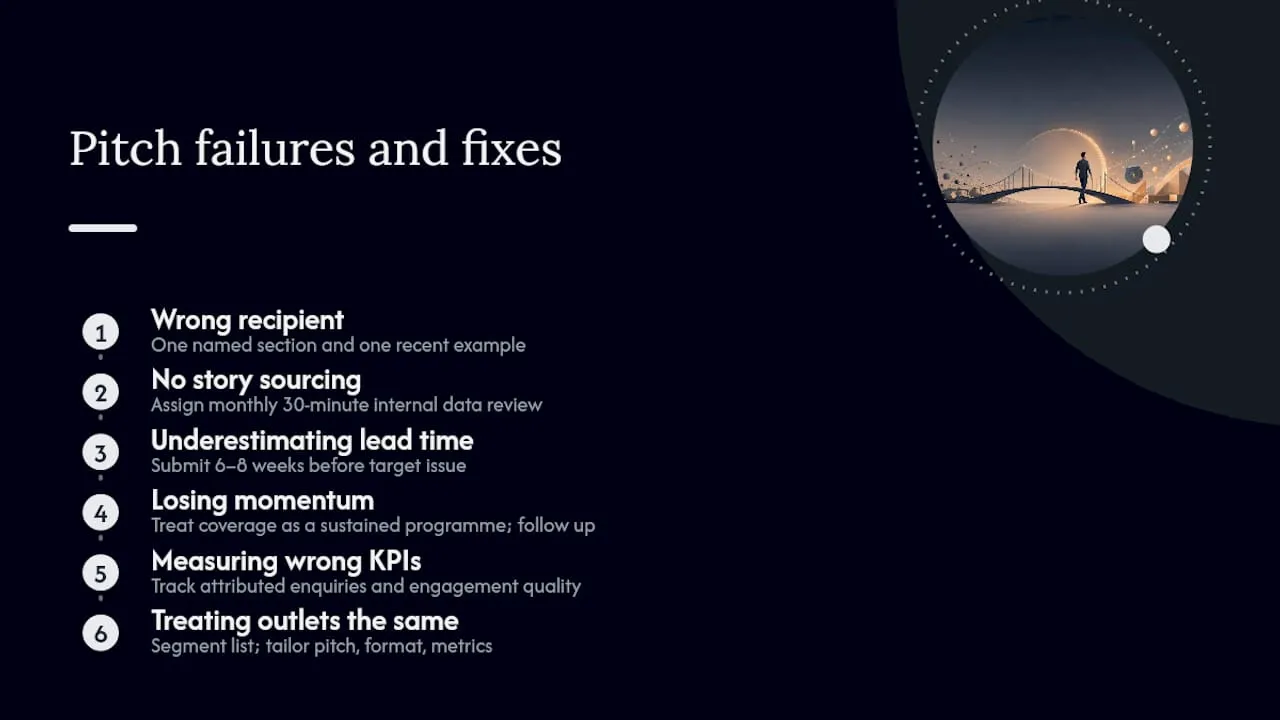
No internal system for sourcing story material. PR teams often run dry on angles because nobody owns the job of mining internal data (survey results, event attendance, member growth figures) for pitchable insight. Assign this explicitly, even if it’s a monthly 30-minute review of what changed in your numbers.
Underestimating the lead time. Trade titles frequently plan issues weeks or months ahead. A pitch sent the week you want coverage is usually too late; build submissions into your calendar at least six to eight weeks before target publication windows.
Losing momentum after one placement. A single feature rarely moves the needle alone. The organisations that see real results treat trade coverage as a sustained programme, not a one-off campaign, following up with the same editor on the next relevant story rather than starting from scratch with someone new.
Measuring the wrong things. Teams that report only impressions or ad-value equivalents struggle to justify continued investment, because those numbers don’t map to anything leadership cares about. Track attributed enquiries and engagement quality instead, and the return becomes far easier to defend at budget time.
Treating every outlet the same. A niche newsletter with 3,000 engaged subscribers and a large trade portal with 300,000 casual readers need different pitches, different formats, and different success metrics. Segment your target list accordingly rather than running one pitch across all of them.
How trade publication strategy fits your wider marketing and PR mix
Trade coverage works best as one layer of a broader plan, not a standalone tactic run in isolation from everything else. The publicity pyramid framework treats trades as the foundation: build a documented history of coverage there first, then use that record as social proof when pitching mainstream press, exactly as Selling Signals argues in its analysis of B2B media outcomes.
Owned channels amplify earned placements rather than compete with them. A byline in a trade outlet gets far more mileage when your newsletter links to it, your sales team references it in outreach, and your social channels reshare the editor’s framing rather than your own. This is where content marketing and PR stop being separate functions in practice, even if they sit in different budgets on paper. A broader content marketing plan that already produces data and case studies gives your PR team raw material to pitch, instead of starting from a blank page every quarter.
Crisis readiness belongs in this mix too. Any organisation building a regular media presence should assume a tougher interview or an unexpected question will eventually come up, and having a crisis communications plan already drafted means one difficult trade interview doesn’t undo months of credibility building.
When and how often should you publish in trade titles?
Frequency matters less than consistency. A single well-placed feature every quarter, sustained over two years, builds more credibility than a burst of six placements in one month followed by silence. Editors remember contributors who show up reliably, not ones who disappear after a single win.
Timing decisions come down to two factors: the outlet’s own editorial calendar and your organisation’s news cycle. Most trade titles plan themed issues or sections months in advance, particularly around major industry events or annual reporting periods, so ask directly about upcoming editorial calendars when you first build a relationship with an editor. Pitching a story that fits a themed issue already in planning dramatically increases your odds versus pitching cold.
Your own cycle matters just as much. Membership renewal periods, annual conference dates, and major research or survey releases are natural pegs for trade pitches, because they give you something concrete and time-bound to offer. Avoid pitching the same editor twice in a short window unless you have a genuinely new angle. Space follow-up pitches by at least a few weeks, and use quieter periods to build the relationship informally: sharing a relevant industry stat, commenting on a piece they wrote, or simply staying visible without asking for coverage.
Legal and ethical considerations in trade publication content
Contributed content in trade outlets carries real disclosure obligations, and getting this wrong can cost you the relationship permanently. If your organisation has a financial interest in the outcome you’re describing, whether that’s a product mention, a sponsored angle, or a case study involving a paying customer, disclose that relationship to the editor upfront rather than letting them discover it later.
Data and statistics you cite in a bylined piece need to be accurate and attributable. Editors increasingly fact-check contributed pieces before publication, and an inflated or unverifiable figure damages your credibility with that outlet for future pitches, not just the current one. If you’re citing a survey or internal metric, be ready to show your working if asked.
Sponsored or paid placements should always be labelled as such, both because most trade titles have editorial policies requiring it and because readers in specialist industries tend to spot undisclosed advertising quickly, which undermines the trust the whole strategy depends on. Keep contributed thought leadership clearly separate from anything paid, even when they run in the same publication.
Finally, respect embargoes and exclusivity agreements precisely as agreed. Trade journalism runs on a smaller number of repeat relationships than mainstream media, and breaking an embargo or shopping the same exclusive story to a competing outlet tends to travel fast within a tight-knit trade press community.
Practitioner perspective: habits and pitfalls
The organisations that win at this treat trade relationships as a weekly habit, not a campaign. That means a short check-in on what’s changed internally, a scan of what the target editor has published lately, and one small, low-effort touch (a comment, a data point, a congratulations on a piece) that costs nothing but keeps you visible.
The biggest waste of effort I see is a well-written pitch sent to the wrong desk, with none of the outlet’s own language in it. Trade coverage is a long game. Treat every placement as a deposit into a credibility account you’ll draw on again next year.
— Rob
How Colossus Systems supports measurement and distribution for trade coverage
Landing a trade placement is only half the work. Proving it moved the needle, and getting more mileage out of it, is where most PR teams lose momentum. Colossus Systems gives membership organisations and associations the analytics, newsletter workflows, and CRM tools to close that gap without hiring a separate measurement team.
Once a placement goes live, Colossus’s CRM tools let you tag enquiries by source, so you can show leadership exactly how many leads or sign-ups trace back to a specific byline rather than guessing at attribution. The newsletter workflows built into the platform make it simple to reshare a placement to your full membership list within the same day it publishes, extending its life well beyond the original outlet’s readership. And when your best story angles come from events, event management tools that already track attendance and ROI give you ready-made data for your next pitch.
Earned trade coverage and platform tools aren’t competing choices. Coverage builds the credibility; the platform helps you prove it worked and turn it into the next pitch. Explore the full feature set or get in touch to see how it fits your reporting to leadership.
Sources
- For Earned Media Success, Start With Trade Publications - Spin Sucks
- The case for trade pubs – and how to get placement - PR Daily
- How to Pitch Trade Publications (The Beat-Fit Test) | Instant Press
- The Hidden Power of Trade Publications for B2B Success - Selling Signals