How to Write a Newsletter for Effective Member Engagement

Every membership manager knows the challenge of getting members to truly engage with organisational newsletters. When communication feels generic, members from London to Sydney quickly lose interest. Creating newsletters that spark genuine connection requires understanding what people care about and using a strategic approach to every message. This article shares practical steps for writing newsletters that drive member engagement and retention through targeted content, thoughtful design, and clear communication.
Table of Contents
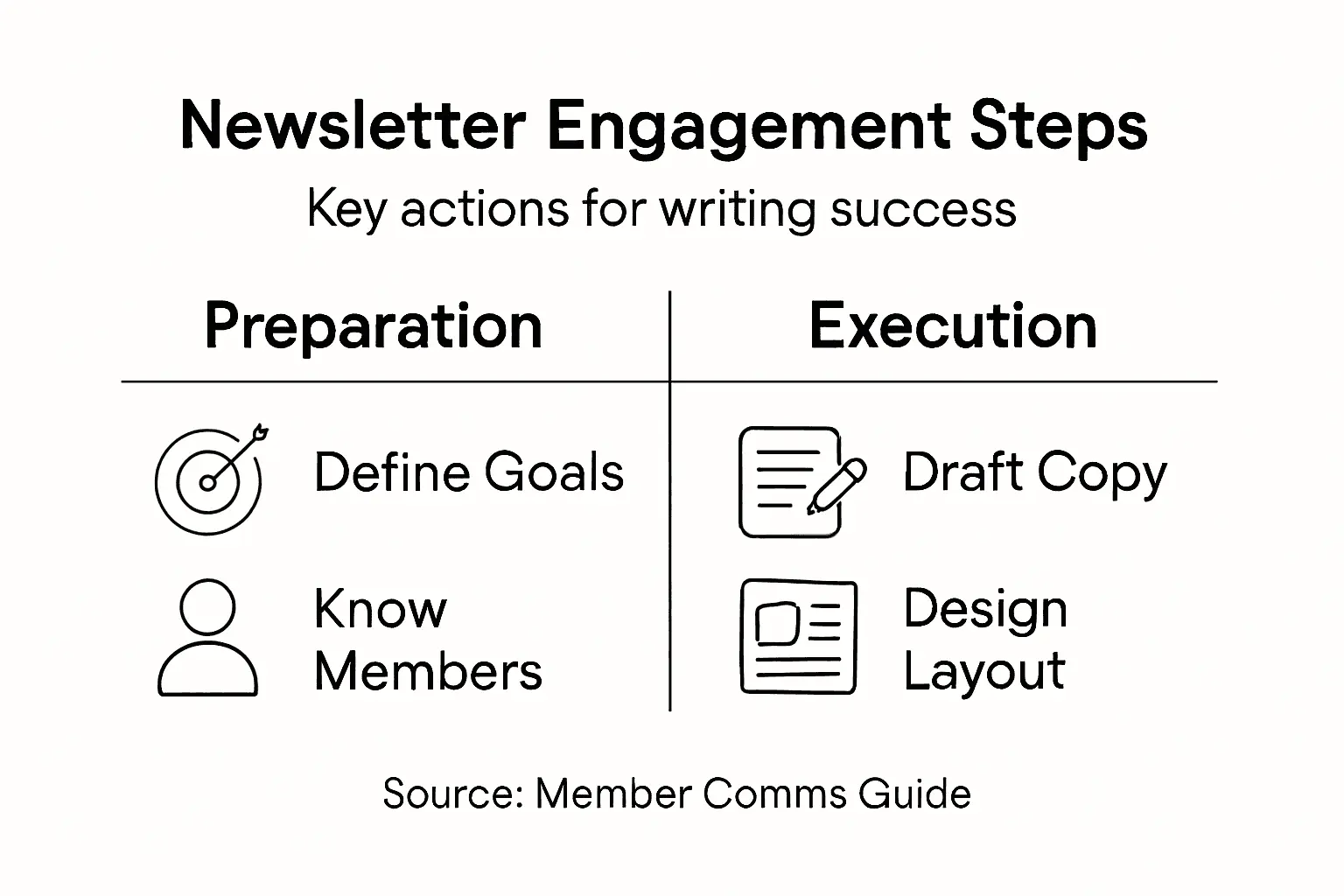
- Step 1: Identify Member Interests And Set Communication Goals
- Step 2: Plan Content And Tailor Messaging For Your Audience
- Step 3: Design An Appealing Layout Using Effective Branding
- Step 4: Draft Compelling Copy And Personalise Communication
- Step 5: Review, Test, And Optimise Before Distribution
Quick Summary
| Essential Insight | Detailed Context |
|---|---|
| 1. Conduct Audience Research | Understand member interests through surveys and data to create targeted content. |
| 2. Establish Clear Communication Goals | Set measurable objectives for your newsletters to maintain focus and accountability. |
| 3. Tailor Content to Audience Segments | Adapt messaging and topics based on the interests and backgrounds of different member groups. |
| 4. Create Consistent Visual Branding | Use uniform styles and layouts in your newsletters to enhance recognition and professionalism. |
| 5. Review and Test Before Sending | Thoroughly check for errors and test across platforms to ensure clarity and functionality. |
Step 1: Identify member interests and set communication goals
Before you write a single newsletter, you need to understand who you’re actually writing for. This step is about gathering genuine insight into what your members care about and defining what you want to achieve through your communications. When you know your members’ interests and have clear objectives, your newsletters shift from generic broadcasts into targeted conversations that people actually want to read.
Start by conducting audience research to understand your members’ needs and interests. This doesn’t require fancy tools or extensive resources. Survey your members directly with open-ended questions about what topics matter most to them, what challenges they face in your industry or cause area, and what value they expect from your organisation. You can embed quick surveys in your member portal, send them via email, or conduct brief interviews with a representative sample of your base. Review your existing engagement data too. Which past newsletters received the highest open rates? Which events generated the most registrations? Which topics sparked discussions in your member community? This tells you what resonates without asking a single question. As you gather this information, identify your specific audience segments. Not all members are identical. Your early-career professionals may want different content than your senior executives. Your local chapter volunteers may have completely different priorities than your international members. Understanding these distinctions allows you to tailor your communications rather than broadcasting the same message to everyone.
Once you understand your members, establish clear communication goals. These should answer specific questions: Do you want to increase event attendance? Encourage members to renew their subscriptions? Build awareness about a new service or initiative? Drive action on advocacy matters? Collect feedback on member concerns? Your goals should be measurable and realistic. Instead of “increase engagement,” aim for “increase monthly newsletter open rates from 28 percent to 35 percent within three months” or “encourage 40 percent of members to register for at least one online training per quarter.” Having concrete targets keeps you accountable and helps you evaluate whether your newsletter strategy actually works. When setting goals, consider what success looks like for your organisation and what role your newsletter plays in achieving it. Your newsletter won’t solve every challenge, but it can directly support specific organisational outcomes when you’re intentional about it.
Pro tip Survey your members every six months and review your engagement metrics monthly. Member interests shift, and what worked brilliantly last quarter may become stale in another six weeks, so keep adjusting your content approach based on fresh data rather than assumptions.
Step 2: Plan content and tailor messaging for your audience
With your member interests and communication goals mapped out, you can now design content that actually speaks to your audience. This step transforms your research into a concrete content strategy where every piece of your newsletter serves a purpose and resonates with the people receiving it. When you tailor your messaging thoughtfully, you build trust and encourage members to stay engaged rather than unsubscribe.
Start by mapping your content themes to member interests and organisational goals. Review the insights you gathered in the previous step. Which topics came up repeatedly in your surveys? Which content types generated the most engagement historically? Now cross-reference these with your communication objectives. If your goal is to increase event attendance, you’ll need content that promotes upcoming events and highlights the value of attending. If you’re focused on member retention, you might include success stories from existing members or exclusive benefits announcements. Create a content calendar that balances different types of material. Mix educational content that solves member problems with organisational updates, member spotlights, and calls to action. The key is variety. Members lose interest when newsletters become predictable or one-dimensional. As you plan, remember that tailoring messages by considering audience background, interests, and expectations ensures your content remains accessible and genuinely useful rather than generic or off-target.
Next, adapt your language and tone to match different member segments. Your nonprofit’s long-time donors may respond to different messaging than newer volunteers. International members might need different reference points than local ones. Write with plain, straightforward language that your audience actually uses rather than jargon or overly formal phrasing. Test your messaging approach with a few trusted members before sending to everyone. Does your language feel natural to them? Are the examples relevant? Does the content clearly explain the benefit or action you’re asking for? When you plan content this way, you move beyond sending information and start having genuine conversations with your members. This matters because planning newsletter content requires understanding the target audience and crafting messages in plain language that meet their specific needs. The newsletters that drive real results are the ones written for actual people, not vague audiences.
Pro tip Create a simple content template that includes the topic, target audience segment, key message, and desired action for each newsletter section before you start writing. This forces you to think strategically about what you’re including and why, rather than filling space with whatever comes to mind.
Here’s a quick comparison of key newsletter content elements and their strategic impacts:
| Content Element | Purpose | Strategic Impact |
|---|---|---|
| Event Promotion | Inform and encourage event participation | Higher attendance rates |
| Member Success | Share achievements and build community pride | Increased member retention |
| Calls to Action | Motivate members to engage or provide feedback | Improved responsiveness and input |
| Educational Content | Address member challenges and needs | Enhanced member trust and loyalty |
Step 3: Design an appealing layout using effective branding
Your content is solid, but how it looks matters just as much as what you write. A well-designed newsletter keeps members reading while a cluttered or confusing one gets deleted before they reach your main message. This step focuses on creating a layout that reflects your organisation’s brand identity whilst remaining clear, accessible, and visually balanced across all devices.

Start by establishing consistent visual branding throughout your newsletter. Your fonts, colours, and logo placement should match your organisation’s existing brand guidelines. When members see your newsletter, they should immediately recognise it as coming from you, not wonder if they’ve opened something unfamiliar. Keep your colour palette simple. Two to three primary colours paired with neutral backgrounds work far better than rainbow designs that overwhelm the eye. Choose readable fonts and stick with them consistently. Sans serif fonts like Arial or Helvetica work well for digital reading, whilst serif fonts can feel old-fashioned in email formats. Remember that visually appealing newsletters use simple and clean design elements with consistent fonts and colours aligned with your branding to support readability. This consistency builds trust and makes your communications feel intentional rather than haphazard.
Next, structure your content for easy scanning. Use clear section headings to break up your newsletter into digestible chunks. Most members won’t read your newsletter word for word like they would a book. They scan for headlines, skim paragraphs, and look for visuals that catch their attention. Honour that behaviour by making important information stand out. Balance text with images thoughtfully. High quality photos, infographics, or illustrations make your newsletter visually appealing, but too many images slow down load times and overwhelm the design. Include alt text on all images so screen readers can describe them to members with visual impairments. Keep your layout mobile-friendly because many members will read your newsletter on phones or tablets. Test your newsletter design across different devices and email clients before sending it to your full list. What looks perfect in your desktop email client might look terrible on an iPhone. Effective newsletter design focuses on concise content with a layout that balances text and visuals, maintaining reader interest and trust whilst enhancing engagement. White space matters too. Don’t feel pressured to fill every pixel. Breathing room around text and images makes your newsletter feel sophisticated rather than claustrophobic.
Pro tip Create a simple template in your email marketing platform that you reuse for every newsletter. This saves time and ensures consistent branding automatically, so you can focus your energy on writing great content instead of wrestling with design every time.
Below is a summary of essential newsletter design principles for maximising member engagement:
| Design Principle | Description | Member Benefit |
|---|---|---|
| Consistent Branding | Unified colours, fonts, and logo | Immediate recognition |
| Clear Structure | Use headings and sections | Easy to scan and navigate |
| Balanced Visuals | Photos and infographics, not clutter | Improved readability |
| Mobile Optimisation | Test across devices | Accessible on all platforms |
| Sufficient White Space | Leave room around text and images | Enhanced visual appeal |
Step 4: Draft compelling copy and personalise communication
Now comes the writing itself. Compelling copy draws members in, holds their attention, and motivates them to take action. Personalisation transforms your newsletter from a broadcast into a conversation, making each reader feel the message was written specifically for them. This step is where your research and planning finally pay off in actual words that connect with your audience.
Start by writing with clarity and directness. Use short sentences and active voice. Say “Join us for our annual conference” instead of “An annual conference is being organised by our organisation for members to consider attending.” Your members are busy. They’re skimming emails between meetings and scrolling through newsletters on their phones. Respect their time by getting to the point quickly. Use a conversational tone that matches how your members actually talk, not corporate-speak or jargon they have to decode. If your organisation typically uses formal language in official documents, your newsletter can afford to be slightly more relaxed and approachable. When you communicate clearly and concisely with a conversational tone tailored to your audience, you make your content more memorable and engaging. Address your members by name when possible. Modern email marketing platforms allow you to insert merge tags so each recipient sees “Hello Sarah” instead of “Hello Member.” This small touch dramatically increases the feeling that the message was written for them personally. Beyond names, personalise by referencing their specific interests. Did you learn that certain members care deeply about advocacy work? Include content about advocacy initiatives for them. Are some members focused on professional development? Highlight relevant training opportunities. When your newsletter feels tailored rather than generic, people actually read it.
Organise your copy logically so readers can follow your narrative easily. Start with your strongest hook or most important announcement. Use subheadings to break up longer sections. Put calls to action where they matter most, usually at the end of each section rather than burying them in the middle of paragraphs. Before you send your newsletter, read it out loud. Yes, actually read it aloud. You’ll catch awkward phrasing, repetitive words, and sections that don’t flow naturally. Ask yourself if the copy sounds like someone talking or like a robot. Effective drafting involves organising content logically and maintaining a consistent voice whilst revising to enhance clarity and flow. Get feedback from a colleague or trusted member before your full send. Fresh eyes catch things you miss after staring at your own work for hours.
Pro tip Write your first draft without worrying about perfection, then edit ruthlessly in a second pass. Remove any sentence that doesn’t serve your reader, cut jargon, and tighten up loose language. Great newsletter copy is almost always the result of aggressive editing, not inspired first drafts.
Step 5: Review, test, and optimise before distribution
You have done the research, planned your content, designed your layout, and written compelling copy. Before you hit send, take time to review and test your newsletter thoroughly. This step catches errors, ensures your message lands correctly, and gives you confidence that you are distributing something genuinely valuable to your members.
Begin with a careful read-through for accuracy and consistency. Check for spelling mistakes, broken links, and formatting issues. Verify that all names, dates, and event details are correct because inaccuracies damage your credibility and confuse members. Read through your copy one more time to ensure it flows naturally and your calls to action are clear. Look for inconsistencies in tone or messaging. If one section sounds formal and another sounds casual, adjust them to match. Make sure your newsletter actually addresses the communication goals you set at the beginning. Does it encourage event attendance? Does it promote member retention? Does it highlight something important about your organisation? If your newsletter doesn’t clearly serve at least one of your stated objectives, consider what you can cut or revise. Test your newsletter across multiple email clients and devices. Open it on Gmail, Outlook, Apple Mail, and mobile phones. A layout that looks perfect in one email client sometimes breaks in another. Images might not load, links might misalign, or text might overflow. By testing beforehand, you catch these issues before thousands of members see them. When you approach testing with process consistency and clarity to ensure messages resonate with intended members, you protect your organisation’s professionalism and maximise impact.
Get feedback from at least one other person before sending to your full list. Show your newsletter to a colleague, a board member, or a few trusted members from different audience segments. Ask them what stands out, whether the message is clear, and if they would take the action you are requesting. Their fresh perspective often catches things you have missed after working on the newsletter intensely. Pay attention to their feedback about clarity and tone. If multiple people say something confuses them, fix it. If they say a section feels off, trust that instinct. Make any final adjustments based on feedback, then do one last proofread. This final pass is typically where you catch typos you missed three times already. Once you have reviewed, tested, and received feedback, you are ready to send. Schedule your send for a time when your members are most likely to open emails. For nonprofit members, Tuesday through Thursday mornings often perform better than early Monday or Friday afternoon when inboxes are chaotic.
Professional tip Create a simple checklist you use before every send including links tested, spelling verified, images display correctly, calls to action are clear, and feedback received. This systematic approach prevents mistakes from slipping through and keeps your newsletter quality consistent over time.
Transform Your Member Engagement with Streamlined Solutions
The article highlights the crucial challenge of creating personalised newsletters that truly resonate with your diverse membership base and drive measurable engagement goals such as event attendance and member retention. Many membership organisations struggle with tailoring content, designing visually appealing layouts, and managing communications efficiently across segments. Colossus Systems offers a comprehensive SaaS platform designed to address exactly these pain points by combining member management, event planning, and targeted email marketing into one unified solution. This simplifies your workflow, allowing you to focus on crafting compelling content and personalising messages for every audience segment with ease.
With Colossus Systems you can:
- Tailor communication channels and automate personalised newsletter sends
- Manage event registrations and virtual trainings to boost participation
- Access advanced analytics for continuous content optimisation and engagement tracking
Discover how our platform can elevate your newsletter strategy and empower you to enhance member loyalty and organisational growth through smarter digital engagement.
Ready to take the guesswork out of member engagement and optimise your communications effectively Try Colossus Systems today by contacting our expert team for a personalised demo at Contact Us. Your members deserve a focused approach that truly connects and converts.
Frequently Asked Questions
How can I identify member interests for my newsletter?
To identify member interests, conduct audience research by surveying your members about their challenges and preferred topics. Aim to gather this feedback regularly to adapt your content within 30–60 days based on their evolving needs.
What communication goals should I set for my newsletter?
Set clear and measurable communication goals such as increasing event attendance or boosting newsletter open rates. For example, aim to increase monthly newsletter open rates from 28 per cent to 35 per cent within three months.
How do I plan content that resonates with different member segments?
Plan content by mapping themes to member interests and organisational goals. Use a content calendar to balance diverse material, ensuring each segment receives relevant topics that engage them effectively.
What design principles should I follow for an appealing newsletter layout?
Use consistent branding with a simple colour palette and clear headings in your newsletter. Structure your layout for easy scanning, balancing text and visuals while ensuring it is mobile-friendly for all devices.
How can I personalise my newsletter communications?
Personalise your communications by addressing members by name and tailoring content to their specific interests and needs. For example, if a member focuses on professional development, highlight relevant training opportunities in your newsletter.
What steps should I take to review and test my newsletter before distribution?
Thoroughly review your newsletter for accuracy, checking for typos, broken links, and formatting issues. Test across multiple email clients and devices to ensure it appears correctly, and seek feedback from colleagues or trusted members to refine your content.