How to Create Newsletters that Engage Members Effectively

More than half of british membership organizations report challenges in keeping their members consistently engaged through email communication. When every message counts, a thoughtful newsletter strategy can become your most valuable tool for connecting with members worldwide. Discover why defining clear newsletter goals, understanding your unique audience, and choosing the right tools lay the groundwork for stronger relationships and more impactful communication.
Table of Contents
- Step 1: Define Newsletter Objectives And Target Audience
- Step 2: Select Tools And Set Up Your Newsletter Platform
- Step 3: Plan Content And Design Your Newsletter Template
- Step 4: Craft Engaging And Relevant Newsletter Copy
- Step 5: Test, Review And Schedule Your Newsletter
- Step 6: Monitor Results And Refine Your Newsletter Strategy
Quick Summary
| Key Point | Explanation |
|---|---|
| 1. Define clear objectives first | Establish specific goals to guide the newsletter’s purpose, such as raising engagement or informing members. |
| 2. Know your target audience | Create detailed audience personas to tailor content and increase relevance and engagement. |
| 3. Choose the right platform | Select a newsletter platform that fits organisational needs with subscriber management and analytics features. |
| 4. Create engaging content | Use clear, concise language and a reader-friendly structure to connect with your audience. |
| 5. Monitor metrics regularly | Track performance indicators like open rates and engagement to continuously improve your newsletter strategy. |
Step 1: Define newsletter objectives and target audience
Creating an effective newsletter begins with clarity about your goals and understanding precisely who will receive your communication. Successful newsletters are strategic tools designed to connect with specific audiences by delivering targeted messages that resonate and inspire action.
To define your newsletter objectives, start by answering key strategic questions: What do you want to achieve? Are you aiming to inform members about upcoming events, share industry insights, or drive engagement with your organisation? Your objectives might include raising awareness about organisational activities or motivating members to participate in new initiatives. Consider both short term and long term goals that align with your broader organisational mission.
Understanding your target audience is equally critical. Create detailed audience personas that go beyond basic demographics. Consider factors like professional interests, career stage, communication preferences, and specific needs within your membership community. This granular understanding helps you craft content that feels personalised and relevant. By segmenting your audience and tailoring messages to their specific contexts, you increase the likelihood of meaningful engagement.
Pro tip: Create a simple audience matrix that maps each segment’s key characteristics, communication preferences, and likely information needs to guide your newsletter strategy.
Step 2: Select tools and set up your newsletter platform
Choosing the right newsletter platform is crucial for creating engaging communications that connect effectively with your members. Your selected platform will be the primary tool for designing, managing, and distributing your newsletters while providing essential features for audience interaction.
When evaluating newsletter platforms, consider key requirements such as subscriber management capabilities, email template customisation, and analytics tracking. Some organisations prefer open source newsletter software that offers flexibility and data control. Look for platforms that support multiple newsletter types, allow easy subscriber segmentation, and provide robust delivery mechanisms. Critically assess features like template design options, automation capabilities, integration with existing membership management systems, and comprehensive reporting tools.
Ensure your chosen platform aligns with your organisation’s technical infrastructure and communication goals. Evaluate factors such as cost, scalability, user friendliness, and technical support. Some platforms offer specialised features for nonprofit organisations, including advanced segmentation, budget friendly pricing, and specific engagement tracking metrics that can help you refine your communication strategy over time.
Here is a summary matrix highlighting key factors to consider when selecting a newsletter platform:
| Consideration | Description | Impact on Organisation |
|---|---|---|
| Subscriber Management | Ability to segment and manage contacts | Enables targeted communication |
| Template Customisation | Flexibility in design and branding | Ensures cohesive brand image |
| Reporting & Analytics | Access to detailed performance data | Improves content strategy |
| Integration Options | Compatibility with membership systems | Streamlines workflow |
| Cost & Scalability | Affordability and room for future growth | Supports long-term use |
Pro tip: Request free trials from multiple newsletter platforms and conduct a side by side comparison to determine the most suitable solution for your specific membership communication needs.
Step 3: Plan content and design your newsletter template
Designing an effective newsletter template requires strategic planning and thoughtful content curation that captures your members’ attention and delivers value with every issue. Your template serves as the visual framework that communicates your organisation’s personality and provides a consistent reading experience.
Start by developing a comprehensive content calendar that outlines key topics, themes, and publication dates. Consider including diverse content segments such as member spotlights, upcoming event announcements, industry insights, and organisational updates. Visual elements play a crucial role in engagement choose a clean layout with consistent typography, colour schemes, and strategic image placements that align with your brand identity. Ensure your template allows for flexible content sections that can be easily adapted to showcase different types of information while maintaining a professional and cohesive look.

When designing your template, prioritise readability and visual hierarchy. Use headings and subheadings to break up text, incorporate white space to prevent overwhelming readers, and select fonts that are legible across different devices. Consider creating multiple template variations for different content types such as monthly newsletters, event announcements, or special reports. This approach allows you to maintain a consistent brand aesthetic while providing flexibility for varied communication needs.
Pro tip: Create a template style guide documenting your design choices to ensure consistency across all newsletter editions and maintain a professional, recognisable brand presentation.
Step 4: Craft engaging and relevant newsletter copy
Writing compelling newsletter content requires a strategic approach that captures your members’ attention and delivers genuine value with every paragraph. Your words are the primary mechanism for building connection and driving meaningful engagement with your audience.
Focus on creating clear and concise content that speaks directly to your members’ interests and needs. Use conversational language that feels personal and authentic, breaking down complex information into digestible segments. Craft strong subject lines that immediately communicate the newsletter’s value, and incorporate bullet points to improve readability. Ensure each section has a specific purpose whether it is sharing organisational updates, highlighting member achievements, or providing industry insights.
Structure your content with a reader first mindset. Use brief paragraphs, integrate visual elements strategically, and include clear calls to action that guide members towards desired interactions. Bold key information to draw attention, and use hyperlinks to provide additional context or resources. Remember that your newsletter is not just about information transmission but about creating a narrative that resonates with your members and makes them feel connected to your organisation.
Pro tip: Draft your newsletter content in advance and then read it aloud to ensure it sounds conversational and engaging, removing any unnecessarily complex or jargon filled language.
Step 5: Test, review and schedule your newsletter
The final stage of newsletter creation involves meticulous review and strategic scheduling to ensure your communication reaches members at the most opportune moment. Thorough preparation can significantly enhance your newsletter’s impact and engagement potential.
Before sending, comprehensively test newsletter formatting across multiple devices and email clients. Check for typographical errors, broken links, and visual consistency. Examine how your design appears on mobile phones, tablets, and desktop computers to guarantee a seamless reading experience. Conduct multiple preview checks to verify that images load correctly, text remains readable, and interactive elements function as intended.
Scheduling requires strategic timing based on your audience’s behaviour and preferences. Analyse previous newsletter performance to identify optimal sending windows when members are most likely to open and engage with your content. Consider using advanced scheduling tools that support automatic distribution and provide detailed analytics on recipient interactions. Implement A/B testing for subject lines and content variations to continuously refine your communication approach and improve overall newsletter effectiveness.
Pro tip: Create a pre sending checklist that includes technical checks, content review, and audience targeting to minimise potential errors and maximise newsletter performance.
Step 6: Monitor results and refine your newsletter strategy
Successful newsletter management is an ongoing process of continuous learning and adaptation. Understanding how your members interact with your communications provides critical insights that drive meaningful improvements in your engagement strategy.
Tracking newsletter performance metrics reveals valuable information about your audience’s preferences and behaviours. Focus on key indicators such as open rates, click through rates, subscriber growth, and content engagement. Pay close attention to which topics generate the most interest, which sections receive the most interaction, and at what times your members are most likely to read your newsletter. These insights will help you incrementally adjust your content strategy to better meet your audience’s needs.
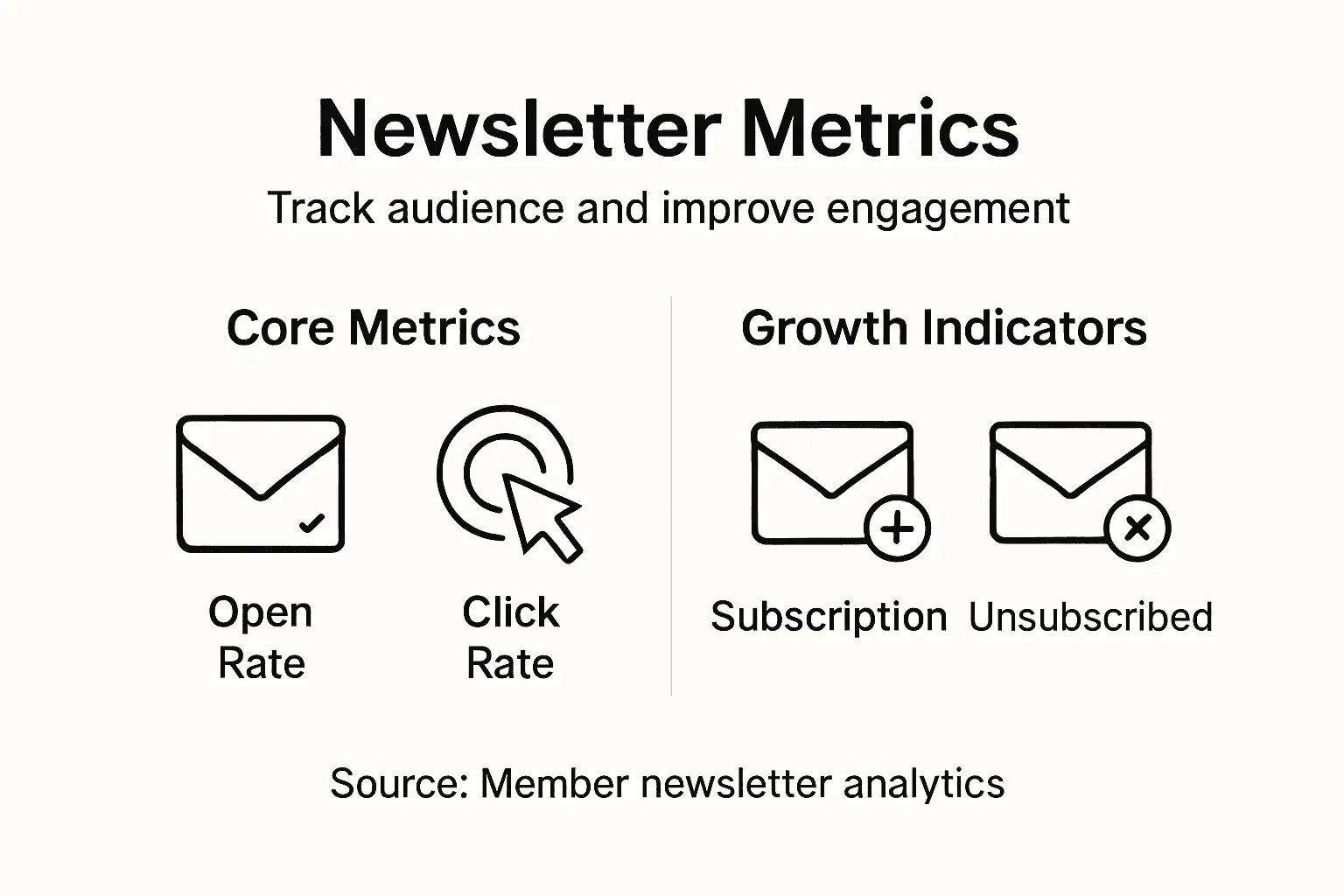
This table presents common newsletter performance metrics and why each is important:
| Metric | What It Measures | Why It Matters |
|---|---|---|
| Open Rate | Percentage of emails opened | Gauges subject line effectiveness |
| Click-through Rate | Number clicking links inside | Reveals content and CTA relevance |
| Subscriber Growth | Change in audience size | Indicates member interest and retention |
| Engagement Time | Average time spent reading | Shows content attractiveness |
Develop a systematic approach to analysing newsletter performance by establishing regular review cycles. Create comprehensive reports that not only showcase raw metrics but also provide qualitative insights from member feedback. Consider implementing segmentation strategies that allow you to understand different member groups’ preferences, tailoring content more precisely. Remember that refinement is an iterative process continuous small adjustments can lead to significant improvements in member engagement over time.
Pro tip: Establish a quarterly newsletter performance review where you critically analyse metrics alongside member feedback to identify clear areas for strategic enhancement.
Elevate Your Member Engagement with Seamless Newsletter Management
Creating newsletters that truly engage your members involves overcoming challenges like content relevance, timing, and personalised communication. The article highlights common pain points such as tailoring content to segmented audiences, managing subscriber lists effectively, and analysing performance metrics to refine your strategy. These complex tasks can drain your team’s time and resources, potentially limiting your organisation’s growth and member satisfaction.
Colossus Systems offers a powerful solution to meet these needs by uniting member management, targeted email marketing, and detailed analytics all within one intuitive platform. Our system empowers you to design customised newsletters that reflect your brand, segment your contacts with ease, schedule communications at optimal times, and track engagement with actionable insights. This comprehensive approach ensures your newsletters are not just sent but truly connect with your audience to inspire participation and loyalty.
Discover how our platform can streamline your newsletter creation process and enhance your member relationships today. Contact us to explore tailored solutions that amplify your communication strategy or learn more about our email marketing capabilities and member management tools.
Ready to transform your newsletter strategy and boost engagement? Reach out now to experience how Colossus Systems can help your organisation grow with effective, data-driven member communications.
Frequently Asked Questions
How do I define the objectives for my newsletter?
To define your newsletter objectives, clearly outline what you want to achieve. Consider specific goals such as informing members about events, sharing industry insights, or increasing engagement. Write down your objectives to provide a focused direction for your content.
What factors should I consider when selecting a newsletter platform?
When selecting a newsletter platform, consider subscriber management, template customisation, and analytics tracking. Choose a platform that aligns with your organisation’s communication goals and provides features that support your content strategy, such as budget-friendly pricing and ease of use.
How can I design a newsletter template that captivates my audience?
Design a captivating newsletter template by developing a content calendar and ensuring a clean layout. Use consistent typography, strategic imagery, and prioritise readability. Assess your design choices against your brand identity to maintain a professional appearance.
What types of content should I include in my newsletter?
Include diverse content segments in your newsletter, such as member spotlights, event announcements, and industry insights. This variety keeps your communication engaging and ensures you meet the interests and needs of your members. Plan your content based on the preferences of your audience personas.
How do I monitor the performance of my newsletter?
Monitor your newsletter’s performance by tracking key metrics such as open rates and click-through rates. Regularly analyse these metrics to understand audience engagement and adjust your content strategy accordingly. Set a timeline for reviewing these metrics, such as every quarter, to refine your approach.
What steps can I take to ensure my newsletter is error-free before sending it?
Before sending your newsletter, conduct comprehensive testing for formatting, typos, and broken links. Create a checklist that includes all technical checks to ensure a polished final product, aiming to complete these checks at least a day before your scheduled send time.