What is a professional association federation, and how does it work?

A professional association federation is an umbrella organisation whose members are professional associations, not individual practitioners. It exists to coordinate, represent, and set shared standards for the associations that belong to it. The International Federation of Purchasing and Supply Management (IFPSM) is a working example: dozens of national procurement associations sit under one federation that harmonises standards and speaks for the profession internationally.
- Federation members are organisations, not people.
- Federations coordinate, advocate, and set broad standards rather than manage day-to-day membership.
- IFPSM shows the model in practice: national associations, one federated voice.
Key takeaways
A professional association federation coordinates member associations through shared standards, advocacy, and consensus governance rather than direct control over individuals.
| Point | Details |
|---|---|
| Members are organisations | A federation’s members are associations, not individual professionals, unlike a standard professional association. |
| Consensus drives governance | Federations build agreement across members rather than dictating policy, per ASAE’s analysis of federated structures. |
| IFPSM shows the model | IFPSM coordinates national procurement associations through shared standards, accreditation, and events. |
| Slow decisions are the trade-off | Federations sacrifice speed for legitimacy, since every member association gets a voice. |
| Platforms ease coordination | Tools like Colossus’s membership features help federations manage member associations, events, and training centrally. |
Table of Contents
- What is the difference between an association, a federation, and a confederation?
- How is a federation structured, and who can join?
- What do professional federations do for their members?
- What are the benefits of professional association federations?
- How does IFPSM illustrate federation membership in practice?
- How do federations govern themselves and reach agreement?
- What are the limitations of federated structures?
- Should your association join a federation, and what does that mean for members?
- How do membership platforms help federations coordinate members?
- Why federations still matter
- A practical next step for federations and their member associations
- Frequently asked questions
- Sources
What is the difference between an association, a federation, and a confederation?
Confusing these three terms is common, and the confusion has practical consequences for governance and voting rights.
- A professional association furthers a profession and represents individual practitioners directly. According to Wikipedia’s overview of professional associations, these bodies typically set qualifications and maintain standards for the people who join them.
- A federation coordinates other organisations rather than individuals. Its “members” are associations, and its authority comes from what those associations agree to delegate upward, as the Association Management Centre explains in its comparison of the two structures.
- A confederation goes a step further, often binding members to a shared constitution with more centralised authority, though many bodies calling themselves confederations still operate on a consensus basis.
The practical upshot: in a federation, voting power sits with associations, not individuals, and day-to-day certification and local training usually stay with the member association rather than the federation itself.
How is a federation structured, and who can join?
Most federations run on a lean secretariat supported by a council of member representatives and a handful of technical committees. A president or chair, often elected on rotation, leads the executive alongside a small permanent staff who handle communications, events, and standards work between meetings.
Membership usually falls into a few categories:
- Full members get voting rights and a seat on the council, typically one national association per country or sector.
- Affiliate members access resources and events but carry limited or no voting power.
- Observer members attend meetings and monitor developments without formal voting rights, often as a step before full membership.
Dues are generally set per association rather than per individual, scaled to the size or revenue of the member organisation. Criteria for joining usually require the applicant to already be a recognised, functioning association in its own jurisdiction.
What do professional federations do for their members?
Federations exist to do collectively what individual associations struggle to do alone, particularly across borders.
- Advocacy, representing the profession to international bodies, regulators, and governments where a single national association would have limited reach.
- Standards development, producing shared codes of conduct, competency frameworks, or qualification benchmarks that member associations can adopt locally.
- Conferences and knowledge exchange, running congresses and training that pool expertise no single association could fund alone.
- Cross-border accreditation, helping a qualification earned in one country gain recognition in another.
Large federations typically offer accreditation and standards that improve cross-border professional recognition for the practitioners their member associations represent.
Pro Tip: If you’re assessing whether a federation is worth joining, ask what it centralises versus what it leaves to members. The strongest federations are clear about the split rather than vague about who owns what.
What are the benefits of professional association federations?
The return on federation membership shows up at two levels: the association’s and the individual professional’s.
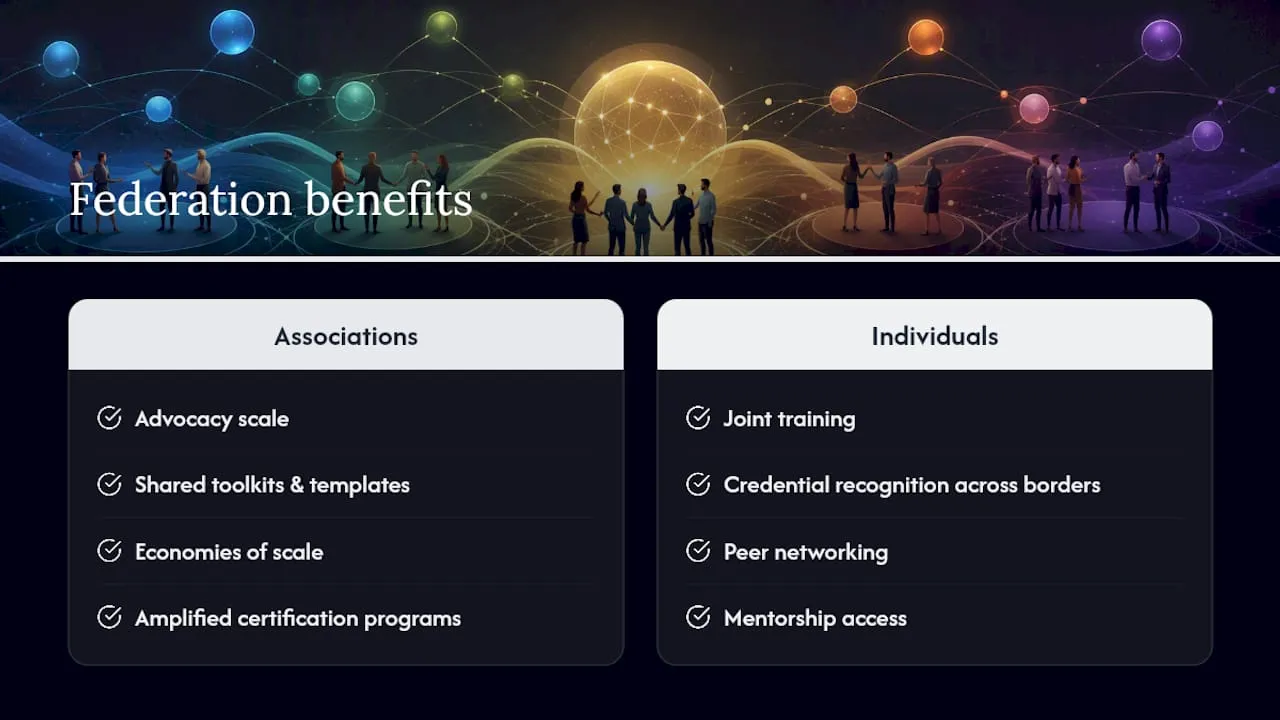
Associations gain scale in advocacy, shared toolkits, and economies of scale they couldn’t build alone. Individual professionals benefit indirectly, through joint training, credential recognition that travels across borders, and networking with peers in other countries. Research on membership value shows that active involvement in umbrella organisations improves member outcomes and can raise productivity for individuals who use the shared tools and templates a federation provides. Separately, ASAE’s research on association value points to networking, mentorship, and certification as the benefits federations tend to amplify most.
How does IFPSM illustrate federation membership in practice?
IFPSM was founded to give national procurement and supply management associations a single international voice, and its structure maps neatly onto the definitions above.
- Its members are national associations, not individual buyers or supply chain professionals.
- It runs standards, accreditation, and events that member associations can plug into rather than build themselves.
- It coordinates international collaboration between associations that would otherwise have no formal link to each other.
- Membership rules follow the federation model closely: an association joins, gains voting rights proportional to its status, and gains access to shared resources.
The result is a working case study of what a federation does when the theory meets a real profession.
How do federations govern themselves and reach agreement?
Consensus, not command, is how most federations actually function.
- Voting arrangements vary. Some federations use one member, one vote, giving small national associations equal weight to large ones. Others weight votes by membership size or dues paid, which shifts influence toward bigger associations.
- Statutes and membership agreements set the boundaries. These documents define what the federation can decide centrally and what stays with member associations, usually covering fees, representation, and dispute procedures.
- Dispute resolution leans on negotiation over enforcement. Federated structures generally lack the power to compel a member association to comply, so successful federations build consensus rather than dictate policy, preserving each member’s local autonomy while still moving as a bloc when it matters.
What are the limitations of federated structures?
Federations trade speed for legitimacy, and that trade-off has real costs.
- Slow decision making, since consensus among many independent associations takes longer than a single organisation deciding alone.
- Tension between unity and autonomy, as members resist ceding control even where central coordination would help.
- Funding strain, because federations depend on member dues and have little independent revenue.
- Diversity of interests, when associations from different countries or sectors pull in different policy directions, making shared positions harder to agree.
None of this makes federations weak. It makes them slower by design, which is the price of keeping every member association’s voice in the room.
Should your association join a federation, and what does that mean for members?
An association should consider federation membership when its goals outgrow what it can achieve alone, cross-border recognition, international advocacy, or access to shared standards being the usual triggers.
- Expect ongoing commitments, including annual dues, attendance at council meetings, and some alignment with federation-wide policy positions.
- Governance participation isn’t optional in practice. Full membership usually means a genuine seat at the table, with the responsibilities that come with a vote.
- Individual members benefit second-hand. A practitioner doesn’t join the federation directly, but gains from whatever training, credential recognition, or networking the federation makes available through their own association.
The decision usually comes down to whether the association’s ambitions have outgrown its national reach.
How do membership platforms help federations coordinate members?
Coordinating dozens of member associations across countries, each with its own events calendar and training programme, is an administrative problem as much as a governance one. A shared platform for membership management gives a federation secretariat one place to track association contacts, dues, and engagement instead of chasing spreadsheets from every member.
- Central CRM keeps records of member associations, their representatives, and communication history in one system rather than scattered inboxes.
- Event management handles registration for congresses and conferences that pull attendees from multiple countries at once.
- Learning portals deliver shared training and professional development that a federation can offer once, centrally, instead of each association building its own.
- Consolidated payments simplify dues collection across currencies and member types.
Pro Tip: A federation secretariat juggling manual dues tracking across a dozen countries is usually the first sign it’s outgrown spreadsheets and needs a proper system.
Why federations still matter
Federations aren’t relics of pre-digital professional life. They remain one of the few structures that let a fragmented profession speak with one voice internationally, without asking any single association to give up its independence. If you lead an association weighing federation membership, start by reviewing its statutes and asking what governance seat you’d actually hold.
A practical next step for federations and their member associations
Colossus gives federation secretariats one system for the job that spreadsheets and shared inboxes handle badly: tracking member associations, running joint events, and delivering shared training without three separate tools fighting each other.

Where a federation’s own statutes govern who gets a vote, a platform like Colossus handles the operational load underneath, member records, event registration for congresses, learning portals for shared training, and consolidated payment collection across currencies. It doesn’t replace governance decisions; it clears the administrative weight off the people making them. If your secretariat is still juggling member data across spreadsheets and separate event tools, take a look at Colossus’s membership management features or get in touch through the contact page to see what a consolidated system would look like for your federation.
Frequently asked questions
What is a professional association federation? A professional association federation is an umbrella body whose members are professional associations rather than individual practitioners. It coordinates advocacy, standards, and shared services across those member associations.
How does a federation work day to day? A small secretariat and elected council run shared functions like standards development and international events, while member associations keep control of local certification and day-to-day services for their own practitioners.
What are the main types of professional associations and federations? Structures range from single national associations representing individuals, to federations coordinating multiple associations, to confederations with tighter, more centralised authority over members.
Why do professional federations matter for individual members? Individuals don’t join a federation directly, but they benefit through their own association’s access to shared training, cross-border credential recognition, and international networking that a single national body couldn’t offer alone.
Is IFPSM a good example of how a federation operates? Yes. IFPSM coordinates national procurement and supply management associations through shared standards, accreditation, and international events, showing the federation model working in a specific profession.
Sources
- SHRM — membership value / benefits / ROI report
- Professional association — Wikipedia
- ASAE commentary — are federated association structures becoming obsolete?