Nonprofit Charitable Solicitation Licenses: Donor Link Risk

A charitable solicitation licence is state-issued authority that permits a nonprofit to ask the public for donations within that state’s borders. The general rule of thumb is simple: if you are soliciting a state’s residents, whether through mail, a website, or a fundraising event, you likely need to register there before you ask. Because the details vary by state, we always recommend checking with the relevant regulator before launching a campaign.
TL;DR:
- Around 40 U.S. states require registration before solicitation, while fees, revenue thresholds, and renewal schedules vary; some exempt smaller charities below state set limits.
- Peer to peer fundraising pages and supporter shared links can trigger registration where donors live, even when staff never contacted that state directly.
- Exemptions often require proof, such as bylaws, membership rules, or an IRS determination letter; ask the regulator whether a claim or notice filing is needed.
- Request proof of third party fundraisers’ state licensing and keep it on file, because hiring professional fundraisers can bring disclosure and filing obligations.
- Renewal periods range from annual to multiyear, so track deadlines by state and retain donor records, campaign documents, and solicitor agreements.
Table of Contents
- What counts as a charitable solicitation?
- When is registration actually required?
- Who is commonly exempt from registration?
- How do you register and stay compliant?
- Common pitfalls that lead to enforcement action
- How membership platforms support ongoing compliance
- Why compliance is a fundraising asset, not just a formality
- Keep your records and renewals organised with Colossus Systems
- FAQ
- Sources
What counts as a charitable solicitation?
A solicitation is any request for a charitable contribution aimed at the public, and the definition is broader than most nonprofit leaders expect. It is not limited to a letter asking for a cheque. State statutes typically capture:
- Direct mail, phone calls, and email appeals sent to residents of a state
- Website donate buttons, social media appeals, and crowdfunding campaigns
- In-person events, galas, and door-to-door collections
- Third-party fundraisers acting on an organisation’s behalf
Peer-to-peer and volunteer-created fundraising pages are often treated as solicitations in the donor’s jurisdiction, which catches many organisations off guard. A supporter in another state who shares a fundraising link and collects donations from their own network can, in the eyes of that state’s regulator, trigger a registration obligation for the charity, even though no staff member ever contacted that state directly.
When is registration actually required?
Roughly 40 U.S. states have enacted charitable solicitation statutes, and most require a charity to register before it begins soliciting residents. That single figure explains why a seemingly local campaign can create obligations well beyond a nonprofit’s home state.
Around 40 U.S. states require registration before solicitation begins, according to the IRS, which means most charities soliciting nationally need a multi-state compliance plan rather than a single filing.
Common triggers for registration include:
- Soliciting residents of a state, regardless of where the charity is based
- Crossing a state-specific revenue threshold from contributions
- Using paid solicitors or professional fundraising counsel
Timelines matter as much as triggers. Registration generally needs to happen before solicitation starts, and renewal periods range from annual to multiyear depending on the state. Fees and thresholds differ widely, and some states exempt smaller charities below a set revenue level.
Jurisdictional rules can also shift with little warning. In Australia, for example, Service NSW rules changing from 1 April 2026 mean charities registered with the Australian Charities and Not-for-profits Commission will generally be taken to hold a fundraising authority in New South Wales automatically, while non-ACNC entities raising more than $15,000 in a financial year must still apply directly. It is a useful reminder that official state or territory pages, not general assumptions, are the only reliable source for current rules.
Who is commonly exempt from registration?
Not every organisation needs to register, but exemptions are narrower than many assume and almost always require supporting paperwork. Common categories include:
- Charities with low annual receipts, often below a state-set dollar threshold
- Organisations that solicit only from their own members, rather than the general public
- Religious organisations and certain affiliated entities
- Specific educational institutions or veterans’ organisations named in state statute
Claiming an exemption is rarely a matter of simply deciding you qualify. Maryland, for instance, requires registration prior to commencing solicitations, and its exemptions are narrowly defined, often requiring bylaws, membership rules, or an IRS determination letter to prove eligibility. The safest approach is to contact the state regulator directly, describe the planned activity, and ask whether a formal exemption claim or notice filing is needed before fundraising begins.
How do you register and stay compliant?
Once you know a state requires registration, the process is largely document-driven. Gather these before starting an application:
- IRS determination letter confirming tax-exempt status
- Articles of incorporation and current bylaws
- Recent financial statements, including a Form 990 where applicable
- A list of current officers and directors
- Details of any paid solicitors or fundraising counsel involved in the campaign
Next, identify the correct regulator, often an attorney general’s office, secretary of state, or a dedicated charities bureau, and confirm the exact form and filing fee for your situation. Financial schedules typically ask for contribution totals and programme spending, so keep your bookkeeping aligned with the state’s reporting categories rather than reconciling everything at filing time.
Renewals follow their own clock, so track expiry dates per state rather than assuming one annual review covers every jurisdiction. Good record-keeping, donor records, solicitor agreements, and campaign documentation, makes renewal far less painful than starting from scratch each year. Our guide to nonprofit compliance requirements covers how these obligations ripple into broader governance practices.
Where a third-party fundraiser is involved, request proof of their own state licensing and keep it on file, since engaging professional fundraisers can mean inheriting their disclosure and filing obligations.
Pro Tip: Build a simple spreadsheet tracking each state’s registration expiry date, fee, and required form, so renewals never sneak up on your finance team.
Common pitfalls that lead to enforcement action
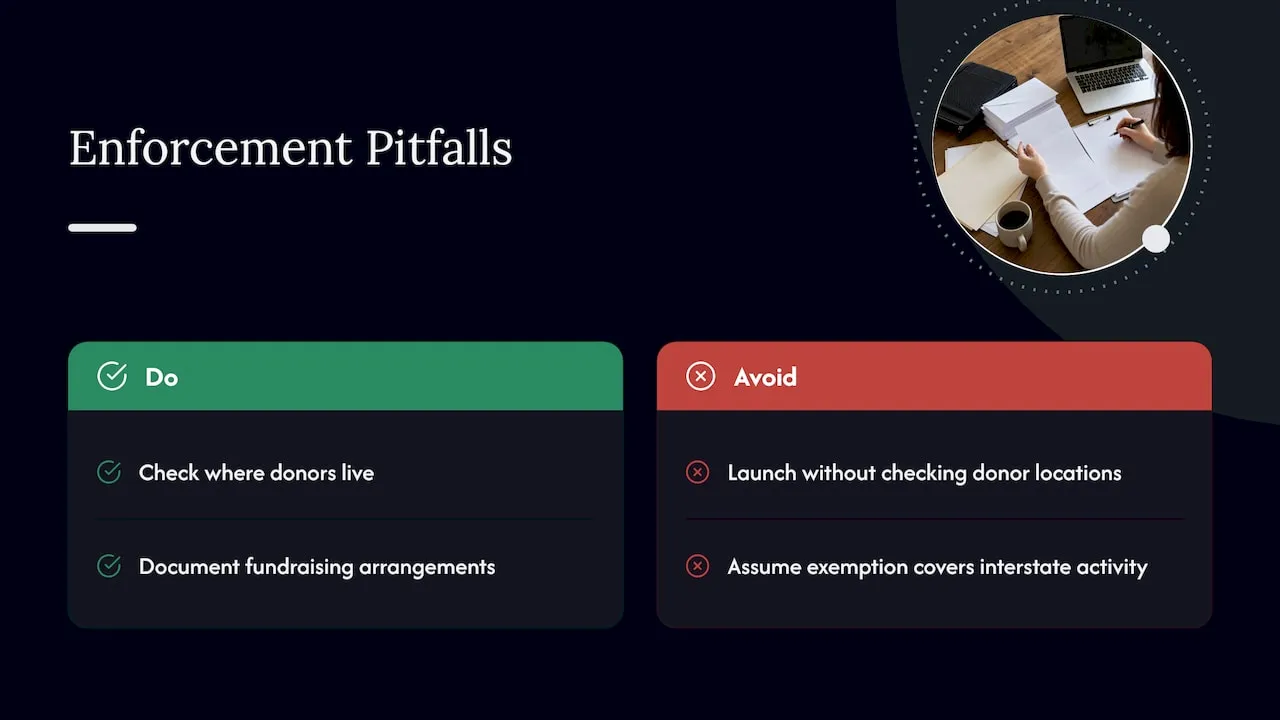
The most frequent mistake is launching an online campaign without checking where donors actually live. Website donate buttons and peer-to-peer pages are routinely treated as solicitations in the donor’s own state, which means a single viral share can create obligations in states a charity never intended to target.
Other common errors include assuming a home-state exemption automatically covers interstate activity, and failing to document volunteer or third-party fundraising arrangements. Consequences for non-compliance range from fines and stop-solicitation orders to lasting reputational damage with donors and regulators alike.
How membership platforms support ongoing compliance
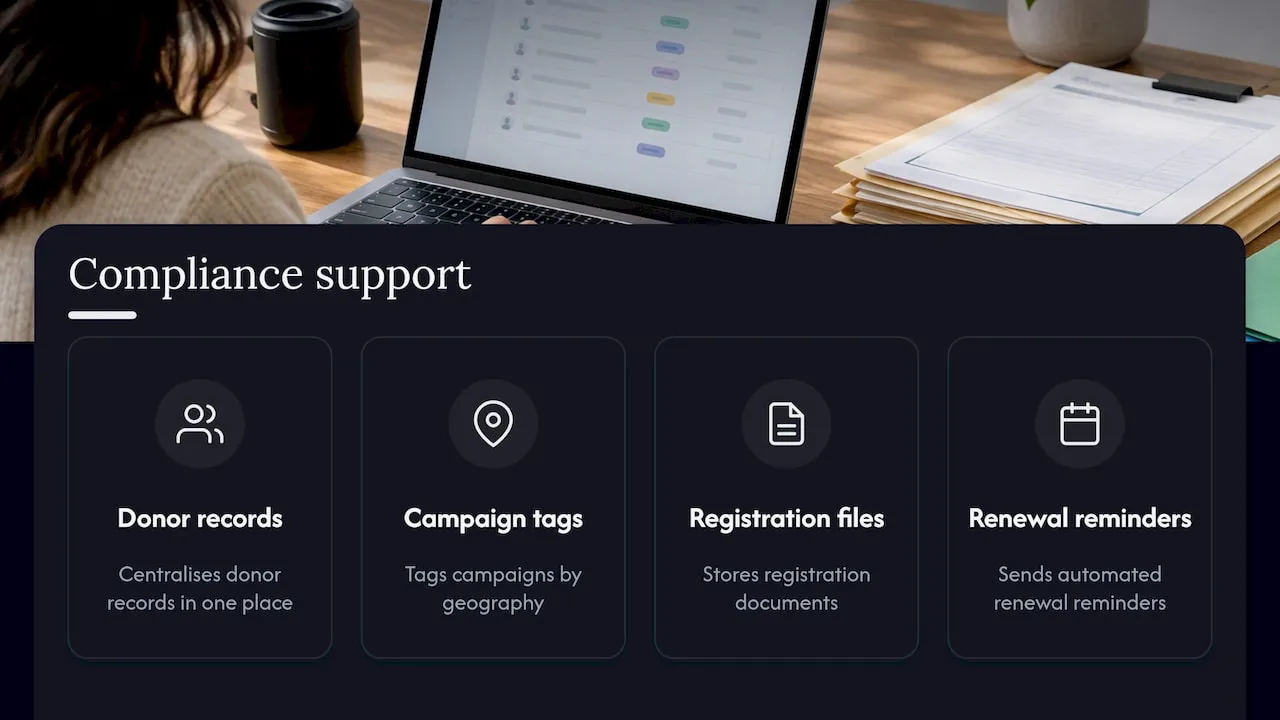
Staying compliant is largely an administrative challenge: knowing where donors live, where campaigns have run, and when renewals fall due. Membership and event platforms can help by centralising donor records, tagging campaigns by geography, storing registration documents in one place, and sending automated renewal reminders.
Membership platforms that combine membership management, event and payment integration, CRM, and reporting in one system can give organisations a single operational view of where supporters are based and when a filing deadline approaches. That operational clarity supports compliance work, but it does not replace legal judgement. Pairing these tools with advice from counsel or your state regulator remains the right approach for jurisdiction-specific questions. Our piece on building a nonprofit technology stack looks at how these tools fit together in practice.
Why compliance is a fundraising asset, not just a formality
Staying current with solicitation registration protects more than a charity’s legal standing. It protects donor trust, avoids mid-campaign interruptions, and gives boards and finance teams a cleaner picture of organisational risk. Treat registration as part of fundraising strategy, not paperwork bolted on afterwards, and consult your state regulator or legal counsel whenever a new channel or jurisdiction raises a question you cannot answer with confidence.
— Rob
Keep your records and renewals organised with Colossus Systems
Chasing registration documents across spreadsheets, email threads, and shared drives adds friction right when your team needs to move fastest. We bring donor and member records, event registration, payment integrations, document storage, and reporting into one place, so preparing a renewal or pulling a donor list by state takes minutes rather than days.
- Centralised donor and member records with campaign tagging
- Built-in payment integrations for cleaner financial reconciliation
- Document storage for IRS letters, bylaws, and state filings
- Automated reminders so renewal deadlines do not slip past you
Our Membership Management Software and CRM work together to keep this information current, with plans from £349 per month depending on your organisation’s size. If you would like to see how it fits your workflow, get in touch with our team for a walkthrough.
FAQ
Can I start a charity without registering?
You can typically form and incorporate a charity without a solicitation licence, but most states require registration before you actually ask the public for donations. Forming the organisation and soliciting funds are separate steps with separate requirements.
What counts as a charitable organization?
A charitable organisation is generally a nonprofit entity organised for purposes such as education, religion, relief of the poor, or other public benefit, often holding tax-exempt status from the IRS. State solicitation statutes usually apply this definition when deciding who must register to fundraise.
Why would someone set up a not-for-profit organisation?
Nonprofit structures let founders pursue a charitable, educational, or community mission without distributing profits to owners, often alongside tax-exempt status and public donation eligibility. Many also choose this structure to access grants that are restricted to nonprofit entities.
Do you need a licence to collect donations?
In most states that have enacted charitable solicitation statutes, yes, a licence or registration is required before collecting donations from the public, with exemptions available for specific categories such as small charities or member-only solicitations. Confirming the exact requirement means checking the regulator in each state where you plan to solicit, since exemptions are narrowly defined and vary by state.
How do digital fundraising campaigns affect registration?
Online donate buttons, crowdfunding pages, and peer-to-peer campaigns are commonly treated as solicitations wherever the donor is located, not just where the charity is based. This means a single online campaign can create registration obligations in multiple states depending on where supporters actually give.
Sources
For state-specific forms and current thresholds, go directly to official sources rather than general guides. The National Association of State Charity Officials publishes guidance encouraging charities to consult state portals and legal counsel, since there is no single national rule. For planning digital outreach alongside your registration work, this Ontario nonprofit digital marketing checklist is a practical companion resource.
- Apply for an authority to fundraise | Service NSW
- Charitable solicitation - initial state registration | Internal Revenue Service
- Registering a charity | Maryland Secretary of State
- Charitable solicitation registration — what nonprofits need to know before they begin fundraising | Wolters Kluwer