Unlock membership growth with data analytics

TL;DR:
- Effective membership analytics focus on asking the right questions and taking informed actions.
- Progression through descriptive, diagnostic, predictive, and prescriptive analytics enhances decision-making.
- Success depends on organizational discipline, data quality, targeted metrics, and fostering a data-driven culture.
Tracking more data is not the same as understanding your members. Many membership organisations invest heavily in dashboards and reporting tools, only to find themselves drowning in figures that never translate into action. The real opportunity lies not in collecting more data points, but in asking sharper questions and choosing the right analytical approaches. This article walks you through a practical roadmap for turning raw membership data into meaningful engagement strategies, improved retention rates, and more efficient operations. Whether you lead a professional association, a nonprofit, or a trade body, these principles apply directly to your situation.
Table of Contents
- Understanding the four types of membership analytics
- Choosing the right metrics: Avoiding common pitfalls
- From insight to action: Driving engagement and retention
- Integrating analytics tools and fostering a data-driven culture
- Our perspective: Where most membership analytics initiatives go wrong
- Take your membership analytics further with expert solutions
- Frequently asked questions
Key Takeaways
| Point | Details |
|---|---|
| Focus on actionable metrics | Tracking fewer, meaningful metrics leads to better outcomes for member engagement and retention. |
| Progress through analytics maturity | Move from basic descriptions to predictive and prescriptive insights for lasting improvement. |
| Prioritise data quality and member feedback | High-quality data and qualitative insights offer a complete picture for decision-making. |
| Transform insight into intervention | Use analytics to drive segmentation, auto-renewal, and real-time feedback for measurable impact. |
| Embed data-driven culture | Sustained results come from integrating tools, routines, and leadership support for analytics adoption. |
Understanding the four types of membership analytics
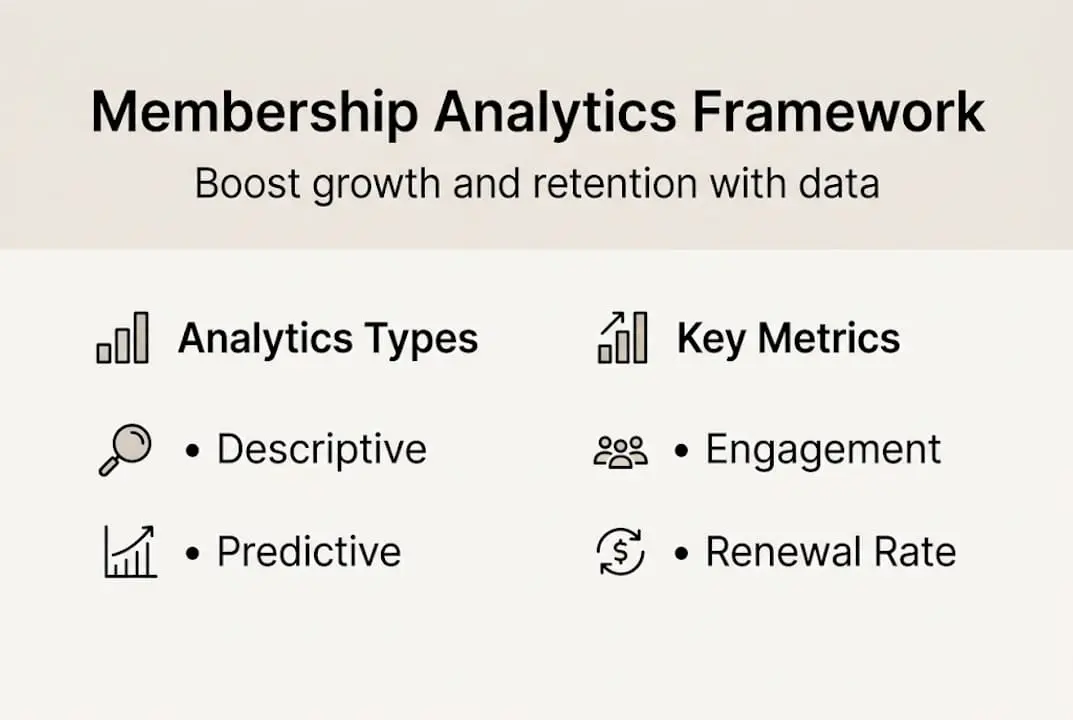
Having set the stage, let’s break down the analytics framework that guides actionable data use. Not all analytics serve the same purpose. The four analytics types progress sequentially: descriptive tells you what happened, diagnostic explains why it happened, predictive anticipates what will happen next, and prescriptive recommends what to do about it. Each stage builds on the previous one, and your organisation’s analytics maturity determines how far along this journey you can travel.
Understanding where your organisation sits within this framework is the first critical step. Most membership bodies begin at the descriptive level, looking at event attendance figures, renewal rates, and email open rates. This is valuable, but it is only the beginning. Our data analytics guide outlines why moving beyond description is essential for sustainable growth.
Here is how each type applies specifically to membership organisations:
| Analytics type | Question answered | Membership example |
|---|---|---|
| Descriptive | What happened? | Renewal rate dropped 8% this quarter |
| Diagnostic | Why did it happen? | Early-career members disengaged after year two |
| Predictive | What will happen? | 200 members likely to lapse in the next 90 days |
| Prescriptive | What should we do? | Send targeted re-engagement emails to at-risk segment |
Progressing through these levels requires both technical capability and organisational readiness. Think of analytics maturity as a scale: organisations at the lower end react to what has already happened, while those at the higher end shape future outcomes proactively.
To accelerate your progression, focus on these foundational steps:
- Audit your current data sources, including CRM records, event registrations, and payment histories
- Standardise data entry across teams to reduce gaps and inconsistencies
- Define two or three core questions you want analytics to answer before choosing any tool
- Build diagnostic capability by linking behavioural data to outcome metrics
- Invest in staff training so that insights can be acted upon, not just generated
Sound membership management basics always underpin effective analytics. Without clean, consistent data flowing through your systems, even the most sophisticated tools will produce unreliable results. Start with solid foundations, then layer in more advanced analytical capability over time.
Choosing the right metrics: Avoiding common pitfalls
Now that we understand analytics types, it is crucial to avoid common mistakes when choosing what to track. The metrics you select define the questions you can answer. Choose poorly, and your analytics programme will generate noise rather than signal. Choose wisely, and every data point becomes a decision-making tool.

One of the most widespread errors is over-tracking. Common data analysis mistakes include building dashboards with dozens of metrics that nobody uses, calculating scores without any plan for acting on them, and allowing poor data quality to distort findings. Confirmation bias is particularly damaging: when leaders seek out data that supports existing assumptions rather than testing those assumptions against evidence, analytics becomes a rubber stamp rather than a genuine guide.
Another frequent pitfall is focusing entirely on quantitative data while ignoring the qualitative dimension. Numbers tell you what is happening; member interviews, surveys, and open-ended feedback tell you why. Both are essential. An organisation that notices a drop in event attendance but never asks members why they stopped coming will cycle through interventions without ever solving the underlying problem.
“The organisations that succeed with analytics are not those with the most data. They are the ones who ask the most precise questions and act on the answers with discipline.”
To select meaningful metrics, consider this approach:
- Tie every metric to a strategic goal, such as retention, revenue, or engagement depth
- Limit your primary dashboard to no more than eight key indicators
- Pair quantitative scores with member feedback loops to capture qualitative context
- Review your metric set quarterly and retire those that no longer drive decisions
- Prioritise data quality over data volume; a clean dataset of 500 records outperforms a messy dataset of 5,000
Protecting the integrity of your data also matters enormously. Our guidance on member data security explains how to handle member information responsibly, which in turn ensures that your analytics are based on trustworthy inputs. A dashboard case study from a business intelligence consultancy illustrates how organisations that rationalised their metrics saw faster, more confident decision-making across teams.
Pro Tip: Before adding any new metric to your dashboard, ask a single question: “If this number changes, will we know exactly what action to take?” If the answer is no, do not track it yet. Build the action pathway first, then introduce the metric.
From insight to action: Driving engagement and retention
With clear metrics in place, let’s see how analytics drive practical improvement in member engagement and retention. Generating insight is only half the task. The other half is translating that insight into interventions that actually change member behaviour and strengthen organisational outcomes.
Auto-renewal programmes, when implemented correctly, boost retention rates by 10 to 15 percentage points. That is a significant gain, achievable without increasing your marketing spend. Similarly, segmentation allows you to tailor your engagement approach based on what you know about different groups of members. Early-career professionals respond to different content and benefits than senior executives. Real-time feedback, rather than annual satisfaction surveys, allows you to catch disengagement before it becomes lapsing.
Here is a structured process for moving from insight to action:
- Identify your at-risk segment using predictive analytics to flag members showing early signs of disengagement, such as reduced event attendance or email non-response
- Design a targeted intervention that addresses the likely cause of disengagement for that specific segment
- Automate the delivery of the intervention through your CRM or email platform so it triggers without manual effort
- Measure the response rate and compare it against a control group to validate the intervention’s effectiveness
- Refine and repeat based on what the data tells you about each intervention’s impact
The table below illustrates how different member segments respond to different engagement strategies:
| Member segment | Common disengagement signal | Recommended intervention |
|---|---|---|
| Early-career members | Low event attendance after year one | Peer networking events, mentoring access |
| Mid-career professionals | Declining content downloads | Role-specific webinars, career resources |
| Senior executives | Low forum participation | Exclusive roundtables, leadership spotlights |
| Lapsed members | No renewal within 30 days of expiry | Personalised re-engagement email sequence |
Our guide on automating member renewals details how to set up these trigger-based workflows without requiring large amounts of manual oversight. The result is a retention system that operates continuously in the background, freeing your team to focus on higher-value activities.
A nonprofit membership case demonstrates that organisations combining segmentation with automated communication saw measurable improvements in both renewal rates and event participation within six months. The key was not the technology itself, but the discipline of acting on insights consistently. Our resources on engagement software strategies and CRM retention practices provide further practical guidance for building this kind of systematic approach.
Retention is not a campaign. It is a continuous process built on regular listening, precise intervention, and honest measurement of what works.
Integrating analytics tools and fostering a data-driven culture
Beyond intervention tactics, lasting impact requires integrating the right tools and nurturing a culture of data-driven decision-making. Technology alone does not produce results. People do, when they have the right tools, the right training, and a leadership environment that values evidence over instinct.
Choosing analytics tools for your organisation requires a clear-eyed assessment of your current capability and your near-term goals. A small association with limited technical resource will benefit more from a well-configured CRM with built-in reporting than from a standalone business intelligence platform requiring specialist knowledge. Conversely, a large professional body managing tens of thousands of members may need more sophisticated tools to handle segmentation and predictive modelling at scale. Insights from data analytics for auditing show how tool choice fundamentally shapes the quality and speed of decision-making.
When evaluating tools, consider these factors:
- Integration capability: Does the tool connect seamlessly with your membership database, CRM, and event management system?
- Ease of use: Can non-technical staff generate and interpret reports without specialist support?
- Scalability: Will the tool still serve your needs if your membership doubles in three years?
- Data governance features: Does it support role-based access and audit trails for data security compliance?
- Vendor support: Is ongoing training and technical assistance available as part of the subscription?
Fostering a data-driven culture is arguably harder than choosing the right tool. Many organisations find that analytics initiatives stall because staff are uncertain how to interpret data, or because senior leaders do not consistently model data-driven decision-making. Our perspective on digital transformation addresses this challenge directly: culture change requires sustained leadership commitment, not just a one-time investment in software.
Pro Tip: Establish a monthly “data review” meeting where team leads present one insight from the previous month and one action they took as a result. This simple ritual reinforces the connection between data and decision-making across the whole organisation.
Building routines around data is what separates organisations that sustain analytics improvements from those that see initial gains erode over time. Schedule regular reporting cycles, assign clear ownership for each metric, and celebrate decisions that were improved by data rather than just decisions that turned out well. Over time, these habits become part of how your organisation operates, rather than a project that competes for attention with day-to-day tasks.
Our perspective: Where most membership analytics initiatives go wrong
Having covered practical frameworks and tools, we want to share a candid perspective on what most organisations miss when applying membership analytics.
The most common failure is not technical. It is behavioural. Organisations invest in platforms, configure dashboards, and then continue making decisions the same way they always did. Data becomes decoration rather than direction. In our view, the single biggest predictor of analytics success is not the sophistication of the tools but the organisation’s willingness to act on uncomfortable findings.
Many membership bodies also confuse activity with insight. Tracking twenty metrics feels productive. Acting decisively on two or three feels risky. But the organisations that genuinely improve member outcomes are almost always the ones who choose fewer, sharper metrics and follow through with consistent interventions. Less truly is more when your goal is action rather than reporting.
Organisational inertia is the silent killer of analytics projects. When data reveals that a flagship programme is underperforming, or that a particular member segment is systematically disengaged, the instinct is often to question the data rather than the programme. Building the habit of trusting and acting on evidence requires leadership courage, not just analytical capability.
Our guidance on member engagement strategies consistently reinforces a simple principle: start with a question, not a dashboard. Define what decision you need to make, identify the minimum data required to make it confidently, and act. Review the outcome. Refine the approach. That cycle, repeated consistently, is what analytics success actually looks like in membership organisations.
Take your membership analytics further with expert solutions
If you are ready to move from theory to real impact, the right technology can make all the difference. At Colossus Systems, we have built a platform specifically for membership organisations that want to operationalise analytics without adding complexity to their workflows.
Our membership software features integrate CRM, event management, email marketing, and reporting into a single environment, so your data flows cleanly across every function. With our event management tools, you can track engagement at every touchpoint and use that data to refine future programming. Our CRM solutions make segmentation and automated interventions straightforward, even for teams without dedicated data analysts. We are here to help your organisation move confidently from insight to action.
Frequently asked questions
What are the first steps for membership organisations to begin using data analytics?
Start by identifying key metrics aligned with member engagement and retention goals, then map your current data sources before choosing a suitable analytics tool. Progressing through the four analytics types sequentially ensures you build analytical maturity at a pace your organisation can sustain.
How can analytics improve member retention?
Analytics can identify behaviour patterns, segmentation opportunities, and intervention points. Strategies like auto-renewal boost retention by 10 to 15%, and targeted communications based on member segments consistently outperform generic outreach.
What common mistakes should membership leaders avoid when analysing data?
Avoid tracking too many metrics, relying on poor data quality, and neglecting to act on insights. Over-tracking leads to unused dashboards and decision paralysis; focus instead on meaningful, actionable data tied to specific strategic goals.
Is qualitative data important for membership analytics?
Yes, qualitative data such as surveys and member interviews uncover the why behind member behaviours and complement quantitative metrics. Ignoring qualitative context means you may identify a problem accurately but misdiagnose its cause entirely.