Streamline member events with best booking platforms 2026

Membership organisations juggle complex event portfolios, from annual conferences to regional workshops, yet fragmented booking tools scatter attendee data across spreadsheets and disconnected databases. This operational chaos frustrates leaders who need unified visibility into member engagement while wasting hours on manual reconciliation. Specialised event booking platforms designed for membership organisations integrate event management with member databases, automating workflows and consolidating insights to transform event delivery and strengthen community connections.
Table of Contents
- Core Functionalities Of Event Booking Platforms For Membership Organisations
- Cost And Pricing Models: Understanding Fees And Subscription Options
- Hybrid And Virtual Event Support: Meeting Modern Member Expectations
- Security And Data Privacy Considerations In Event Booking Platforms
- Common Misconceptions About Event Booking Platforms
- Proof Of Impact And Case Studies
- How To Choose The Right Event Booking Platform: A Decision Framework
- Discover Colossus Systems Event Management Solutions
- Frequently Asked Questions
Key takeaways
| Point | Details |
|---|---|
| Integrated platforms reduce manual work | Platforms cut manual data entry by 70% and event management time by 40%. |
| Pricing structures impact total costs | Subscription models often outperform per-ticket fees as event volumes grow. |
| Hybrid capabilities expand reach | Modern platforms unify virtual and onsite attendance tracking for broader member participation. |
| Security compliance builds trust | PCI DSS and SOC 2 certifications protect sensitive member transactions and data. |
| Strategic evaluation drives success | Assessing features, pricing, and integration compatibility ensures optimal platform selection. |
Core functionalities of event booking platforms for membership organisations
Membership organisations require event booking platforms that seamlessly connect with existing member databases to eliminate duplicate data entry and maintain accurate attendance records. The right platform pulls member information directly into registration forms, pre-populating details and updating profiles automatically after each event interaction.
Secure payment processing forms the backbone of trustworthy event transactions. Platforms supporting PCI DSS compliance protect member payment data through encrypted connections and tokenisation, whilst transparent processing fees help organisations budget accurately. Automated communication workflows send personalised invitations, timely reminders, and post-event follow-ups without manual intervention, keeping members engaged throughout the event lifecycle.
Custom branding capabilities let organisations maintain visual identity across registration pages, confirmation emails, and attendee portals. White-label options remove platform branding entirely, presenting a cohesive organisational face to members. Portal customisation extends this control, allowing tailored navigation, content placement, and member-specific views that reflect organisational hierarchy or membership tiers.
Key platform functionalities include:
- Membership database synchronisation for real-time attendee tracking
- Multi-event calendars supporting recurring programmes and one-off gatherings
- Flexible pricing tiers accommodating member discounts and early-bird rates
- Attendance verification through QR codes or mobile check-in apps
- Post-event survey distribution and response aggregation
Pro Tip: Test membership management software features during trial periods by running a small internal event first, validating data flows and automation triggers before launching member-facing registrations.
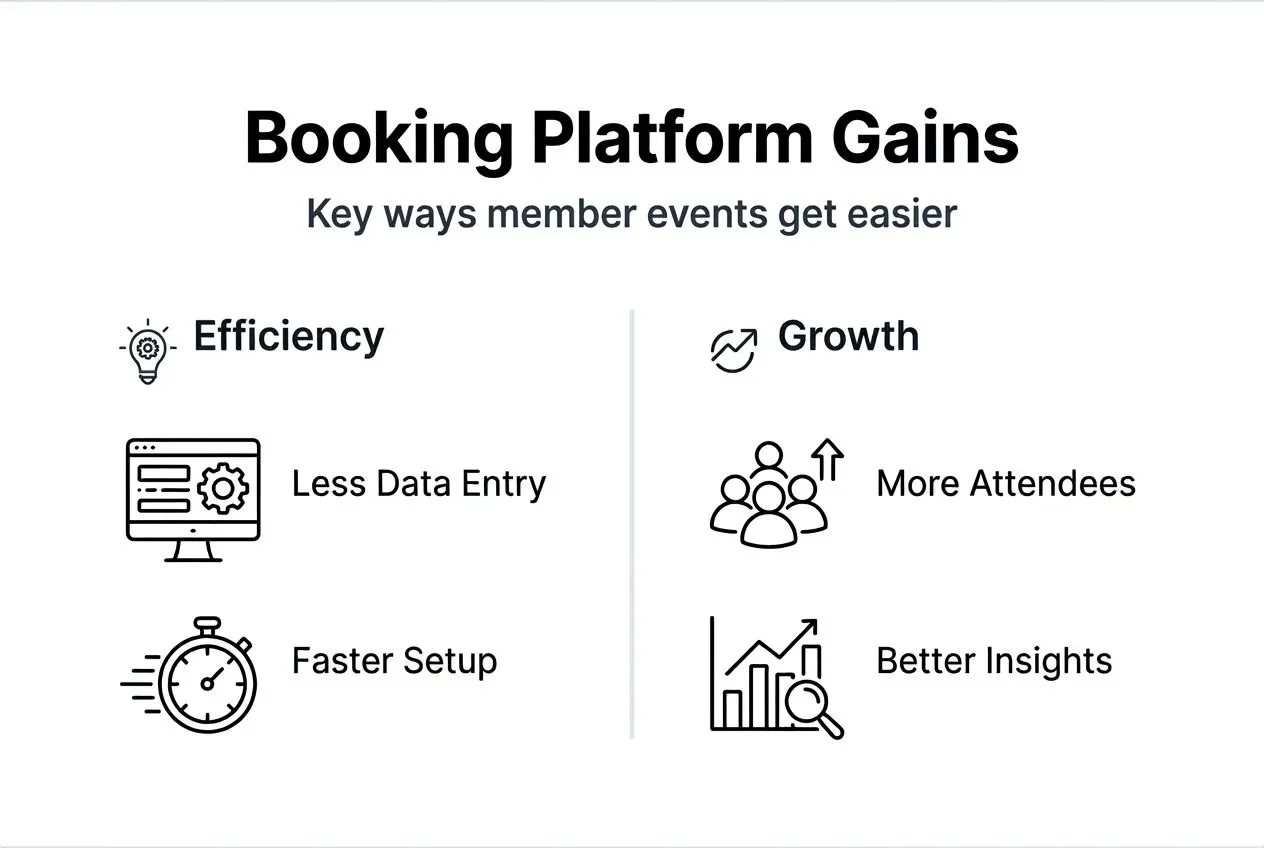
Integrated platforms reduce manual data entry by up to 70% and cut event management time by 40% in membership organisations. This efficiency gain frees staff to focus on strategic member engagement rather than administrative reconciliation. Platforms offering robust event management ticketing website capabilities centralise operations whilst maintaining flexibility for diverse event formats.
Cost and pricing models: understanding fees and subscription options
Event booking platforms employ varied pricing structures that significantly impact total event costs over time. Per-ticket percentage fees typically range from 3% to 6% of ticket price, creating variable costs that scale directly with attendance. Whilst this model suits organisations hosting occasional small events, high-volume programmes accumulate substantial fees that erode event revenue.

Flat-fee subscription plans charge monthly or annual rates regardless of ticket sales, making them economically advantageous as event frequency and attendance grow. Organisations running multiple events monthly often recover subscription costs within the first few registrations, with subsequent events incurring no additional platform fees. This predictability simplifies budget forecasting and protects profit margins during peak event seasons.
Blended pricing models combine base subscription fees with reduced per-ticket percentages, attempting to balance fixed and variable costs. These structures require careful analysis of projected event calendars and expected attendance to determine true cost-effectiveness. Hidden costs such as payment gateway fees, premium feature charges, or overage penalties for exceeding subscriber limits can unexpectedly inflate budgets.
| Pricing model | Best for | Typical cost range | Break-even point |
|---|---|---|---|
| Per-ticket percentage | Occasional small events | 3-6% per ticket | N/A |
| Flat subscription | High-volume programmes | £50-£300 monthly | 15-25 tickets monthly |
| Blended model | Mixed event portfolios | £30 base + 2-3% | 30-40 tickets monthly |
| Enterprise custom | Large organisations | Negotiated annually | Varies by volume |
Long-term scaling considerations matter when evaluating pricing. Organisations anticipating membership growth should prioritise platforms offering tiered subscriptions that accommodate expanding event portfolios without punitive upgrade fees. Reviewing membership management software features alongside pricing helps align platform capabilities with budgetary constraints.
Pro Tip: Calculate total annual platform costs using your previous year’s event data, factoring in all ticket sales, anticipated growth, and potential premium features to identify which pricing model truly minimises expenses.
Subscription models often become more cost-effective as event sizes grow due to fixed fees amortised over many attendees. This economic advantage compounds when organisations host regular member gatherings, training sessions, and networking events throughout the year.
Hybrid and virtual event support: meeting modern member expectations
Membership organisations increasingly serve geographically dispersed members who expect flexible attendance options matching their schedules and preferences. Hybrid event capabilities unify in-person and virtual experiences through integrated platforms managing both attendance streams simultaneously. Livestreaming technology broadcasts onsite sessions to remote participants whilst tracking virtual attendance metrics alongside physical check-ins.
Modern platforms offer unified dashboards merging virtual engagement data with onsite participation records, revealing comprehensive attendance patterns and member preferences. This consolidated view helps organisational leaders understand which members consistently attend remotely versus those preferring physical presence, informing future event planning and venue decisions. Analytics track virtual session duration, chat participation, and poll responses alongside traditional attendance metrics.
Robust hybrid support enables wider member participation by removing geographic and scheduling barriers. Members unable to travel can still access keynote presentations, workshops, and networking opportunities through virtual channels. Recording capabilities extend event value beyond live sessions, allowing time-shifted viewing and creating evergreen content libraries for ongoing member education.
Essential hybrid event features include:
- Dual registration paths accommodating virtual and onsite attendees
- Livestreaming integration with platforms like Zoom or Microsoft Teams
- Interactive tools enabling virtual attendees to participate in polls and Q&A sessions
- Unified attendance reporting combining physical and digital metrics
- On-demand recording access for post-event viewing
Platforms supporting virtual event planning platforms capabilities provide technical infrastructure for seamless hybrid delivery. Successful hybrid event planning successful engagements requires careful coordination of technology, content delivery, and attendee experience across both channels. Implementing hybrid meeting tips member engagement strategies ensures remote participants feel equally valued as onsite attendees.
| Platform capability | In-person focus | Hybrid native | Virtual only |
|---|---|---|---|
| Physical check-in | Excellent | Excellent | N/A |
| Livestreaming integration | Limited | Excellent | Excellent |
| Unified reporting | Manual merge | Automatic | Virtual only |
| Interactive virtual tools | None | Moderate | Excellent |
| Recording management | External | Integrated | Integrated |
Choosing platforms with native hybrid support eliminates the complexity of integrating separate virtual and physical event tools, reducing technical failures and improving attendee experiences across both channels.
Security and data privacy considerations in event booking platforms
Membership organisations handle sensitive member information including payment details, contact data, and attendance histories that require rigorous protection. Event booking platforms must demonstrate compliance with established security standards to safeguard this information and maintain member trust. PCI DSS certification ensures platforms meet payment card industry requirements for secure transaction processing, whilst SOC 2 Type II audits verify comprehensive data security controls.
Data encryption protocols protect information both in transit and at rest, preventing unauthorised access during transmission or storage. Transport Layer Security encrypts connections between member browsers and platform servers, whilst database encryption secures stored information. Privacy policies transparently outlining data collection, usage, and retention practices help organisations assess compliance with regional data protection regulations affecting North American operations.
Regular third-party security audits and penetration testing demonstrate platform commitment to identifying and addressing vulnerabilities proactively. Platforms publishing audit results and security certifications publicly signal transparency and accountability. Access controls limiting staff permissions to member data based on role requirements reduce insider threat risks and support compliance with privacy principles.
Critical security features include:
- Multi-factor authentication protecting administrative accounts
- Automated security patch deployment maintaining current defences
- Data backup and disaster recovery capabilities ensuring business continuity
- Audit logs tracking all data access and modifications for accountability
- GDPR and privacy framework compliance supporting international operations
Pro Tip: Request security documentation during platform evaluation, including recent audit reports and incident response procedures, to verify claims and assess risk management maturity.
“Security compliance isn’t optional for membership organisations holding member trust. Platforms lacking current PCI DSS and SOC 2 certifications expose organisations to data breaches, regulatory penalties, and reputational damage that can devastate member confidence and retention.”
Transparent security practices differentiate professional membership software security platforms from inadequate solutions. Organisations should verify compliance documentation rather than accepting marketing claims at face value.
Common misconceptions about event booking platforms
Membership leaders frequently assume cheaper per-ticket fees automatically reduce total event costs, overlooking how pricing structures interact with event volumes and frequencies. A platform charging 3% per ticket appears economical for occasional events but becomes expensive when hosting dozens of gatherings annually. Conversely, subscription platforms with higher upfront costs often deliver lower total expenses across multiple events.
The allure of ‘free’ platforms frequently masks hidden limitations and costs that emerge during actual usage. Free tiers typically restrict attendee numbers, remove branding customisation, lack automation features, or charge premium rates for payment processing. These constraints force organisations to upgrade or supplement with additional tools, negating initial savings and fragmenting data across systems.
Not all platforms integrate seamlessly with existing membership databases and association management systems. Legacy platforms may require manual CSV exports and imports, recreating the data silos that integrated solutions promise to eliminate. Organisations must verify API availability, supported integrations, and data synchronisation capabilities before committing to platforms claiming integration support.
Event booking software extends far beyond basic registration forms. Modern platforms encompass:
- Automated email marketing campaigns nurturing pre-event excitement and post-event engagement
- Advanced reporting and analytics revealing attendance trends and member preferences
- Mobile applications enabling onsite check-in and real-time attendance tracking
- Session scheduling tools managing multi-track conferences and workshop rotations
- Networking features facilitating member connections before, during, and after events
- Sponsor management capabilities tracking exhibitor participation and revenue
Subscription models often become more cost-effective as event sizes grow due to fixed fees amortised over many attendees. Organisations hosting regular member events should calculate annual platform costs across all events rather than evaluating individual event expenses in isolation. Understanding these event platform misconceptions prevents costly selection errors.
Proof of impact and case studies
Real-world implementations demonstrate measurable benefits when membership organisations adopt integrated event booking platforms. Case studies show 35% growth in event attendance and 20% increase in member renewals using integrated platforms with automated workflows. These improvements stem from streamlined registration experiences reducing friction for busy members and personalised communication maintaining engagement throughout membership lifecycles.
Attendance growth results from multiple platform capabilities working synergistically. Simplified registration processes remove barriers discouraging participation, whilst automated reminder sequences reduce no-show rates. Member-specific pricing and early-bird discounts incentivise prompt registrations, whilst waitlist management captures latent demand when popular events reach capacity. Post-event surveys gather feedback informing continuous improvement of future programmes.
Improved member renewal rates link directly to enhanced engagement through well-executed events. Members attending multiple organisational events annually develop stronger connections to the community and perceive greater membership value. Integrated platforms tracking attendance histories enable personalised outreach highlighting relevant upcoming events, creating positive engagement cycles that strengthen retention.
Quantifiable operational benefits include:
- 40% reduction in event planning time through workflow automation
- 70% decrease in manual data entry eliminating duplicate member records
- 25% improvement in staff productivity focusing on strategic rather than administrative tasks
- 15% increase in event revenue through optimised pricing and reduced no-shows
Empirical data from membership software case studies supports choosing integrated platforms for sustainable organisational growth. Organisations achieving these results share common characteristics: strategic platform selection aligned with organisational needs, thorough staff training ensuring effective utilisation, and consistent measurement of key performance indicators guiding continuous optimisation.
Success metrics extend beyond attendance numbers to encompass member satisfaction scores, event net promoter scores, and year-over-year engagement trend analysis. These comprehensive measurements reveal platform impact on overall organisational health and member experience quality.
How to choose the right event booking platform: a decision framework
Selecting an optimal event booking platform requires systematic evaluation balancing current needs with future growth trajectories. Begin by documenting existing pain points in event management workflows, identifying where manual processes, data fragmentation, or member friction create inefficiencies. Survey staff managing events and members attending them to gather comprehensive perspectives on improvement priorities.
Identify essential features aligned with your organisation’s event portfolio:
- List all event types hosted annually, from small committee meetings to large conferences
- Determine required attendance capacities and concurrent event support needs
- Specify integration requirements with existing membership databases and financial systems
- Clarify automation priorities for communication workflows and reporting
- Define security and compliance standards based on member data sensitivity
Evaluate pricing models against projected event calendars extending three to five years forward. Calculate total annual costs under different platforms using realistic attendance estimates and event frequencies. Factor in anticipated membership growth and programme expansion when projecting future needs. Platforms offering flexible scaling without punitive upgrade fees accommodate organisational evolution better than rigid tier structures.
| Evaluation criteria | Weight | Platform A | Platform B | Platform C |
|---|---|---|---|---|
| Core features match | 30% | Excellent | Good | Excellent |
| Pricing competitiveness | 25% | Good | Excellent | Fair |
| Integration capabilities | 20% | Excellent | Fair | Good |
| Security compliance | 15% | Excellent | Excellent | Good |
| User experience | 10% | Good | Good | Excellent |
Verify security compliance by requesting current certification documentation rather than accepting marketing claims. Platforms should readily provide PCI DSS attestations, SOC 2 reports, and privacy policy details. Assess integration capabilities through technical documentation and reference calls with organisations using similar technology stacks to your own.
Pilot shortlisted platforms through trial periods or single-event tests before committing to long-term contracts. Run parallel processes using both existing tools and trial platforms to validate data accuracy and workflow efficiency. Gather feedback from administrative staff and member attendees to assess real-world usability and satisfaction.
Pro Tip: Create a scoring matrix weighting evaluation criteria by importance to your organisation, then rate each platform objectively to identify clear winners rather than relying on subjective impressions.
Reviewing membership management software features alongside event-specific capabilities ensures comprehensive platform assessment. Strategic selection decisions balance immediate operational needs with long-term organisational objectives, positioning membership organisations for sustained growth and enhanced member engagement.
Discover colossus systems event management solutions
Managing membership events shouldn’t require juggling disconnected tools and manual workflows. Colossus Systems integrates event planning, registration, and member engagement within a unified platform designed specifically for membership organisations seeking operational efficiency and enhanced member experiences.
Our automated workflows eliminate repetitive administrative tasks, freeing your team to focus on creating memorable member experiences. Secure payment processing, customisable branding, and comprehensive analytics provide the control and insights modern organisations require. Whether hosting intimate workshops or large annual conferences, our scalable solutions adapt to your evolving needs.
Explore how membership management software features streamline operations beyond events. Our event management software handles registration complexity whilst our CRM software maintains member relationships throughout their lifecycle. Contact Colossus Systems today to schedule a personalised demonstration and discuss pricing tailored to your organisation’s unique requirements.
Frequently asked questions
What are event booking platforms for membership organisations?
Event booking platforms are software solutions integrating registration, payment processing, communication automation, and membership database management specifically for associations and nonprofits. These platforms streamline event operations whilst maintaining connections to broader member engagement systems, improving efficiency and attendee experiences.
How do pricing models affect event booking costs?
Per-ticket percentage fees accumulate quickly on large or frequent events, increasing total annual costs substantially. Subscription plans with flat monthly fees typically reduce per-ticket expenses as event volume grows, offering better value for organisations hosting regular member gatherings. Understanding these models prevents unexpected budget overruns.
Can event booking platforms handle hybrid events effectively?
Modern platforms designed for membership organisations offer integrated virtual and onsite event management through unified dashboards. Features include livestreaming integration, dual registration paths, interactive virtual tools, and combined attendance reporting. This hybrid support expands member accessibility whilst maintaining consistent engagement tracking.
What security features should I look for in an event booking platform?
Prioritise platforms holding current PCI DSS and SOC 2 Type II certifications demonstrating payment security and comprehensive data protection. Encryption protocols, transparent privacy policies, multi-factor authentication, and regular third-party audits are essential. These security features protect member data whilst building trust and ensuring regulatory compliance.
How do I select the best event booking platform for my organisation?
Begin by assessing current event management pain points and documenting organisational needs across event types and volumes. Compare platforms evaluating essential features, pricing structures, integration capabilities, and security compliance. Pilot shortlisted solutions through trial periods testing real workflows before committing to ensure platforms genuinely fit your operational requirements and member expectations.