Strategic Planning for Associations: Driving Growth

Most british and Canadian associations recognize that without a clear strategic plan, even the best intentions can result in missed opportunities and declining engagement. For executive directors facing rapid digital change, robust strategies are essential to make informed decisions and adapt to shifting member expectations. Discover how integrating digital tools, data analytics, and global best practices can strengthen member connections and help your association thrive in an increasingly complex operational environment.
Table of Contents
- Core Definition And Strategic Concepts
- Major Types And Planning Models
- Member-Centric Approaches In Practice
- Integrating Digital Tools And Analytics
- Leadership Roles And Governance Responsibilities
- Common Pitfalls And How To Avoid Them
Key Takeaways
| Point | Details |
|---|---|
| Strategic Planning Process | Organisations should adopt a systematic approach to strategic planning that includes environmental scanning, strategy formulation, implementation, and ongoing evaluation. |
| Member-Centric Focus | Integrating member experiences into strategic decision-making enhances engagement and responsiveness to member needs. |
| Utilisation of Digital Tools | Leveraging digital analytics and management systems is essential for informed decision-making and effective member communication. |
| Leadership and Governance | Effective leadership must prioritise ethical governance and inclusive decision-making to foster member trust and organisational integrity. |
Core Definition and Strategic Concepts
Strategic planning for associations represents a systematic approach to defining an organisation’s direction, making informed decisions about resource allocation, and proactively responding to shifting operational environments. At its core, strategic planning transcends traditional operational management by creating a comprehensive roadmap that aligns organisational capabilities with external opportunities and challenges.
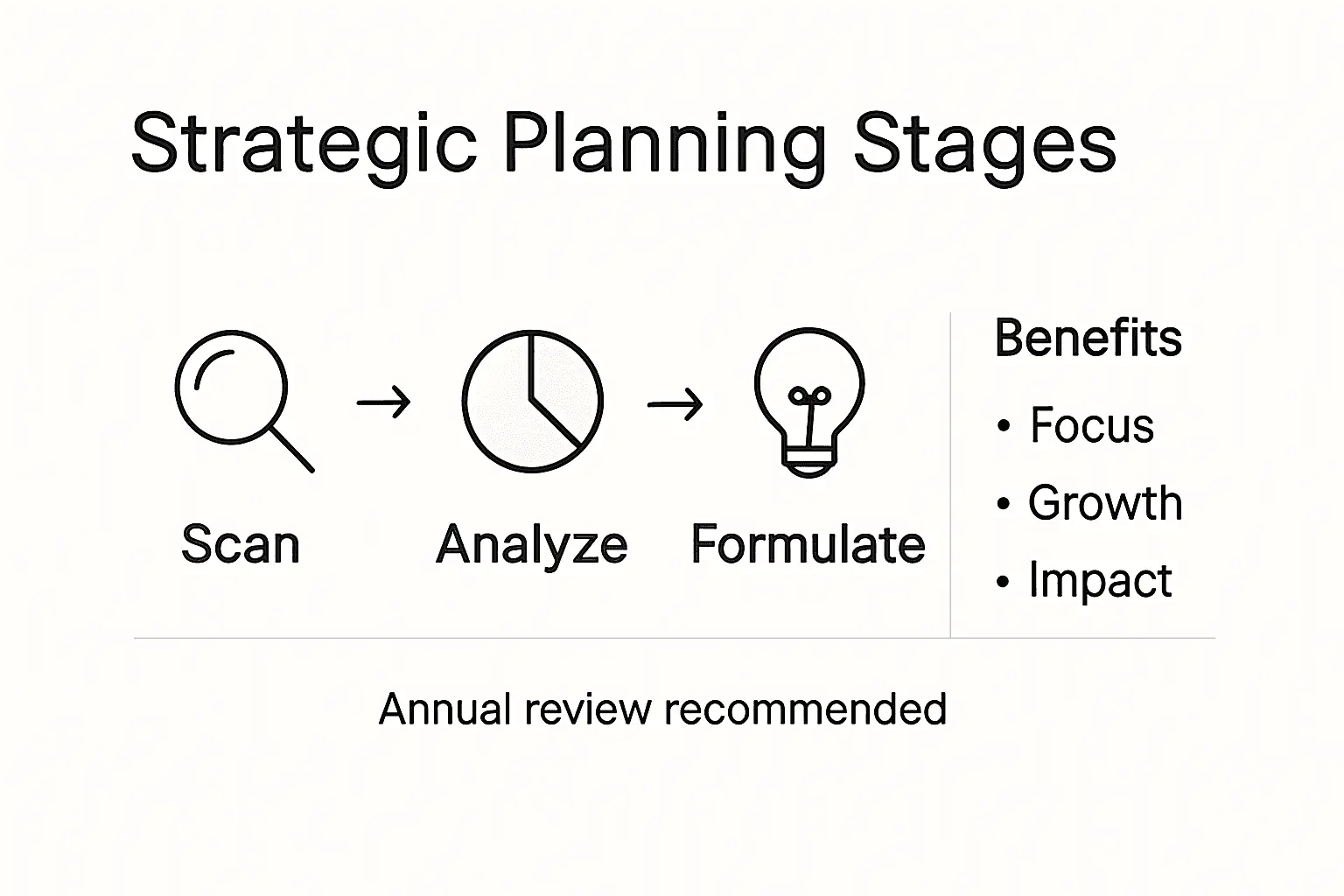
The fundamental strategic planning process typically encompasses several critical stages: environmental scanning, strategic analysis, strategy formulation, implementation, and continuous evaluation. Associations must develop strategic leadership capabilities that enable flexible yet structured approaches to navigating complex membership landscapes. This requires deep understanding of both internal organisational dynamics and external market conditions.
Successful strategic planning for associations involves integrating multiple interconnected elements. Key dimensions include:
- Membership value proposition development
- Alignment of organisational mission with strategic objectives
- Performance measurement and accountability frameworks
- Adaptive capacity to respond to technological and market shifts
- Resource optimisation and sustainable growth strategies
Pro tip: Conduct an annual strategic review that involves representative stakeholders from across your organisation to ensure comprehensive insights and collective commitment to strategic directions.
Major Types and Planning Models
Strategic planning models provide structured frameworks that enable associations to develop comprehensive, adaptable strategies for organisational growth. Different strategic planning approaches offer unique methodologies for analysing organisational capabilities, market conditions, and potential trajectories, allowing leadership teams to create nuanced, context-specific strategic roadmaps.
Some prominent strategic planning models include:
- SWOT Analysis: Evaluating Strengths, Weaknesses, Opportunities, and Threats
- Balanced Scorecard: Integrating financial and non-financial performance metrics
- Scenario Planning: Developing multiple potential future scenarios to enhance organisational resilience
- Goal-Based Planning: Establishing clear, measurable objectives aligned with organisational mission
- Stakeholder-Driven Models: Incorporating diverse perspectives from membership base and external partners
Effective strategic planning requires understanding that no single model provides a universal solution. Organisations must select and adapt planning frameworks that align with their unique operational context, membership dynamics, and strategic aspirations. Successful implementation involves continuous assessment, flexible adaptation, and robust stakeholder engagement.

Here’s a comparison of popular strategic planning models commonly used by associations:
| Model | Core Focus | When to Use |
|---|---|---|
| SWOT Analysis | Assessing current position | Early-stage planning and assessment |
| Balanced Scorecard | Performance measurement | Tracking ongoing strategic outcomes |
| Scenario Planning | Exploring future uncertainties | Preparing for multiple contingencies |
| Goal-Based Planning | Defining objectives and milestones | Setting clear, measurable priorities |
| Stakeholder-Driven | Inclusive engagement | Addressing diverse member interests |
Pro tip: Create a customised strategic planning model by combining elements from multiple frameworks to address your association’s specific contextual requirements and strategic objectives.
Member-Centric Approaches in Practice
Member-centric strategic planning transforms traditional organisational approaches by placing member experiences and needs at the core of decision-making processes. Effective community building strategies require a holistic understanding of member motivations, expectations, and potential engagement pathways, enabling associations to create more responsive and dynamic organisational frameworks.
Key components of a member-centric approach include:
- Deep understanding of member demographic profiles
- Personalised communication and engagement strategies
- Continuous feedback mechanisms and listening channels
- Tailored value propositions that address specific member needs
- Transparent and inclusive decision-making processes
Successful implementation demands robust digital communication strategies that facilitate meaningful interactions across multiple platforms. Associations must leverage technology to create seamless, intuitive experiences that make members feel valued, heard, and actively connected to the organisation’s mission and objectives.
Pro tip: Develop a comprehensive member persona mapping exercise to systematically categorise and understand the diverse needs, motivations, and communication preferences within your membership ecosystem.
Integrating Digital Tools and Analytics
Digital transformation has become a critical imperative for associations seeking to enhance operational effectiveness and member engagement. Data-driven decision-making strategies enable organisations to transform raw member information into actionable insights that drive strategic planning and organisational growth.
Key digital integration strategies include:
- Implementing comprehensive association management systems
- Leveraging advanced analytics platforms
- Creating unified member data repositories
- Developing real-time reporting dashboards
- Integrating multichannel communication technologies
Successful digital tool integration requires a holistic approach that goes beyond technological implementation. Associations must develop robust digital engagement frameworks that align technological capabilities with organisational objectives, creating seamless experiences that provide meaningful value to members while generating strategic intelligence for leadership teams.
The following table highlights how digital tools enhance strategic planning outcomes:
| Digital Tool | Strategic Benefit | Example Impact |
|---|---|---|
| Analytics Platforms | Informed decision-making | Identify engagement patterns |
| Member Data Repositories | Centralised knowledge management | More targeted communication campaigns |
| Real-Time Dashboards | Immediate performance insights | Quickly address emerging challenges |
| Multichannel Communication | Consistent member engagement | Higher event participation rates |
Pro tip: Conduct a comprehensive digital maturity assessment to identify gaps between your current technological infrastructure and strategic organisational requirements, enabling targeted and purposeful digital transformation initiatives.
Leadership Roles and Governance Responsibilities
Effective leadership in associations requires a sophisticated understanding of governance principles that extend far beyond traditional management approaches. Ethical leadership principles are fundamental in creating organisational cultures that balance strategic vision with institutional integrity and member trust.
Key leadership responsibilities in governance include:
- Establishing clear strategic direction
- Ensuring financial accountability and transparency
- Developing robust risk management frameworks
- Maintaining organisational compliance with regulatory standards
- Fostering inclusive decision-making processes
- Protecting member interests and organisational mission
Nonprofit leadership skills demand a multifaceted approach that integrates strategic thinking, emotional intelligence, and adaptive capabilities. Governance structures must evolve to create dynamic environments that respond effectively to changing member needs, technological disruptions, and complex organisational challenges.
Pro tip: Implement a systematic leadership development programme that rotates board members through different governance roles, ensuring continuous learning and preventing institutional knowledge stagnation.
Common Pitfalls and How to Avoid Them
Strategic planning for associations can often become derailed by predictable yet complex challenges that undermine organisational effectiveness. Strategic planning pitfalls frequently emerge when organisations approach strategic development without comprehensive understanding and systemic thinking.
Key strategic planning pitfalls include:
- Planning in isolation without stakeholder engagement
- Prioritising theoretical perfection over practical implementation
- Failing to establish clear accountability mechanisms
- Ignoring realistic capacity and resource constraints
- Treating strategic planning as a one-time event rather than continuous process
- Resisting necessary transformational changes
Association strategic approaches must transcend incremental thinking by embracing bold, member-centric transformations. Successful organisations cultivate adaptive strategies that balance structured planning with flexibility, ensuring they can respond dynamically to emerging challenges and opportunities while maintaining core organisational values.
Pro tip: Develop a quarterly strategic review process that includes systematic feedback collection from members, allowing continuous refinement of strategic objectives and immediate course correction.
Transform Your Association’s Strategic Planning with Colossus Systems
The journey of strategic planning for associations involves overcoming the challenges of aligning mission, member engagement, and resource optimisation while embracing adaptive strategies and member-centric approaches. If you find it difficult to integrate multiple planning models or to leverage data-driven insights for continuous evaluation and flexible implementation, you are not alone. Organisations often struggle with creating personalised communication streams, maintaining transparent decision-making, and deploying technology that truly enhances member experience and drives sustainable growth.
With Colossus Systems’ comprehensive SaaS platform, you can streamline your member management, event planning, and digital communication into a unified system designed specifically to address these pain points. Our platform empowers your association to build robust member personas, execute targeted marketing campaigns, and utilise advanced analytics to inform strategic decisions in real time. By combining intuitive CRM, virtual training tools, and secure e-commerce functionalities, Colossus Systems supports the seamless execution of your strategic roadmap while enhancing member engagement and organisational resilience.
Get started today and see how our tailored solutions can transform your association’s strategic planning process.

Ready to elevate your association’s strategic approach and member outcomes? Contact our team now at Colossus Systems Contact to explore how we can customise a solution for your unique needs. Discover more about strategic leadership development here and unlock digital communication best practices here. Don’t wait to drive growth and innovation within your organisation.
Frequently Asked Questions
What is strategic planning for associations?
Strategic planning for associations is a systematic approach to defining an organisation’s direction, making informed decisions about resource allocation, and responding proactively to changing operational environments.
What are the key stages involved in the strategic planning process?
The key stages typically include environmental scanning, strategic analysis, strategy formulation, implementation, and continuous evaluation of the strategies in place.
How can associations develop a member-centric approach in their strategic planning?
Associations can adopt a member-centric approach by deeply understanding member needs, employing personalised communication strategies, creating feedback mechanisms, and ensuring transparent decision-making processes.
What common pitfalls should associations avoid in strategic planning?
Common pitfalls include planning in isolation without stakeholder engagement, focusing on theoretical perfection over practical implementation, not establishing accountability mechanisms, and treating strategic planning as a one-time event rather than a continuous process.