What Is Organizational Growth? Complete Overview

Nearly 90 percent of organizations report that growth is their top priority, yet many struggle to define what real progress means. For membership organizations, understanding the true nature of organizational growth goes far beyond bigger budgets and more members. Clarifying its purpose helps leaders focus on strategies that build lasting value, maximizing both performance and impact. Unpacking the essentials of growth sets the stage for smarter decisions and sustainable advancement in a competitive world.
Table of Contents
- Defining Organizational Growth And Its Purpose
- Main Types Of Organizational Growth Models
- Key Drivers And Mechanisms Of Growth
- Measuring And Sustaining Successful Growth
- Common Obstacles And How To Avoid Them
Key Takeaways
| Point | Details |
|---|---|
| Holistic Growth Approach | Successful organizational growth requires balancing quantitative metrics with qualitative strategies, focusing on both numerical outcomes and intangible assets such as talent development. |
| Adaptable Growth Models | Organizations should leverage customizable growth models to navigate their unique developmental pathways and foster sustainable advancement. |
| Key Growth Drivers | Essential drivers of growth include strategic innovation, human capital development, and operational efficiency, emphasizing the need for internal adaptability and learning. |
| Mitigating Growth Obstacles | A proactive approach to overcoming common challenges involves fostering a culture of innovation, maintaining communication, and being adaptable to change. |
Defining Organizational Growth and Its Purpose
At its core, organizational growth represents a strategic progression where entities systematically expand their operational capabilities, performance metrics, and overall impact. According to bwjournal.org, organizational growth encompasses the tangible outcomes reflecting an organization’s efficiency across multiple domains including corporate image, core competencies, and financial performance.
Growth is not merely about increasing size, but about developing sophisticated mechanisms that enhance an organization’s strategic positioning. Academic research highlights that growth can be measured through multiple dimensions such as membership expansion, employment levels, and structural transformations that influence organizational behaviour and capabilities.
Key dimensions of organizational growth typically include:
- Financial performance improvements
- Membership or workforce expansion
- Enhanced operational efficiency
- Strategic capability development
- Market reputation and brand positioning
Successful organizational growth requires a holistic approach that balances quantitative expansion with qualitative developmental strategies. This means organizations must simultaneously focus on numerical metrics like revenue and headcount while also investing in critical intangible assets such as talent development, innovation capacity, and adaptive organizational culture.
By understanding growth as a multifaceted concept, membership organizations can create robust frameworks that support sustainable, strategic advancement across multiple interconnected domains.

Main Types of Organizational Growth Models
Organizational growth models provide strategic frameworks that help membership organizations understand and navigate their developmental pathways. These models offer structured approaches to conceptualizing how entities evolve, expand, and transform over time.
Systemic Growth Models represent sophisticated approaches to organizational development. Wikipedia highlights the OSTO System Model as a prime example, which comprehends organizations as living systems through a cybernetic lens. This model maps organizational interactions through closed-loop systems, emphasizing interconnectedness and adaptive capabilities.
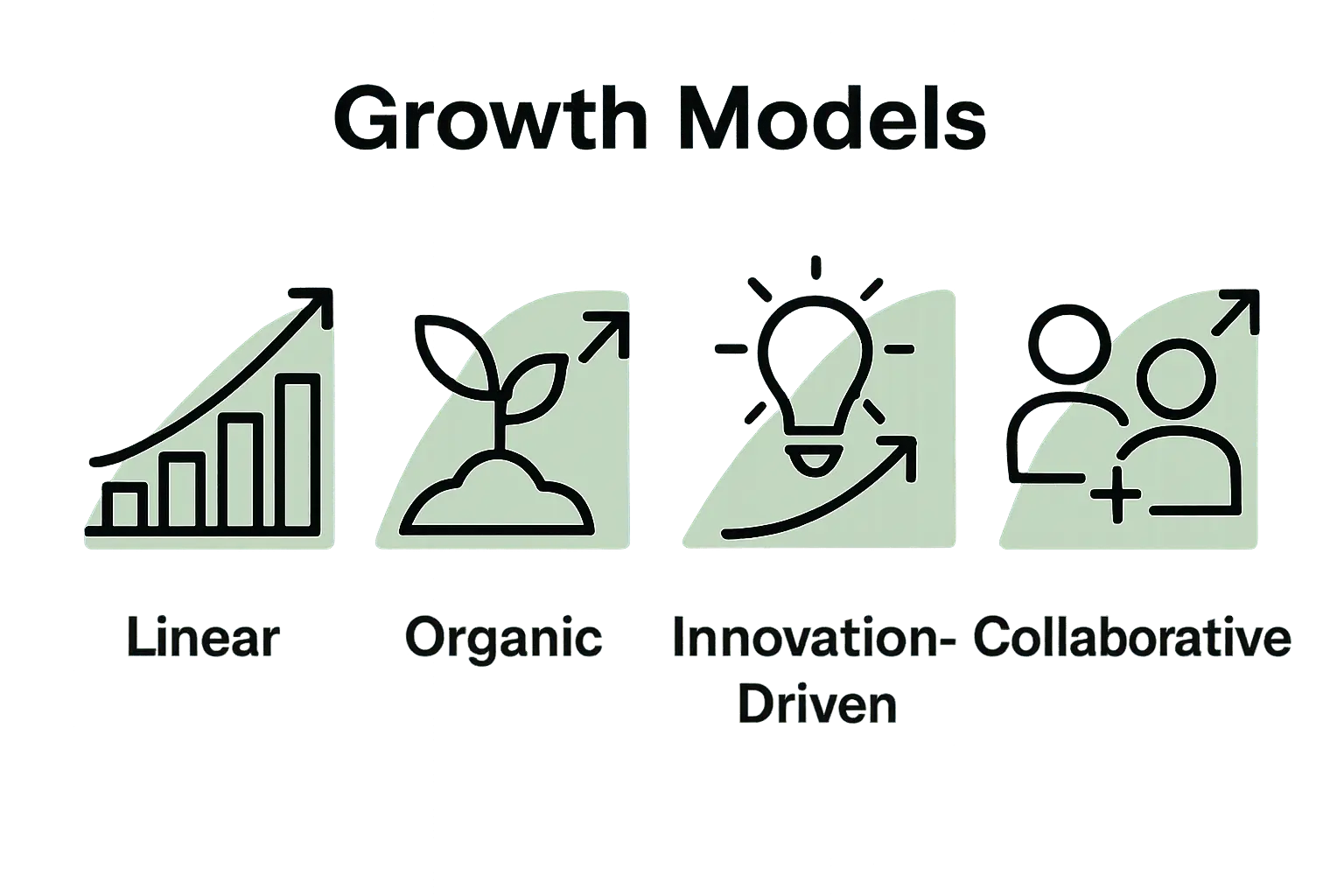
Key organizational growth models include:
- Linear Growth Model: Sequential, predictable expansion stages
- Organic Growth Model: Natural, evolutionary development
- Innovation-Driven Growth Model: Emphasizing technological and strategic transformation
- Collaborative Growth Model: Focusing on strategic partnerships and ecosystem development
Wikipedia’s triple helix model provides another compelling perspective, illustrating how interactions between academia, industry, and government can drive economic and social development. This model demonstrates that organizational growth is not just internal but deeply interconnected with broader institutional ecosystems.
Successful organizations recognize that growth models are not one-size-fits-all prescriptions. Instead, they represent flexible frameworks that can be customized to an organization’s unique context, strategic objectives, and operational dynamics. By understanding these models, membership organizations can develop more nuanced, adaptive strategies for sustainable advancement.
For organizations seeking to implement these growth models effectively, developing a robust organizational culture becomes a critical foundational step in supporting strategic expansion and transformation.
Key Drivers and Mechanisms of Growth
Organizational growth emerges through a complex interplay of strategic mechanisms and external influences that propel entities beyond their current operational boundaries. Understanding these key drivers requires a multifaceted approach that examines both internal capabilities and external environmental dynamics.
Wikipedia’s sociological theory of diffusion provides critical insights into how innovations spread through social groups and organizations. This perspective reveals that growth is not just about implementing new strategies, but about creating adaptive mechanisms that enable rapid knowledge transfer and innovative adoption across organizational ecosystems.
Key drivers of organizational growth typically encompass:
- Strategic innovation and technological advancement
- Human capital development
- Market expansion and diversification
- Financial resource optimization
- Operational efficiency improvements
- Adaptive leadership and organizational learning
The Bass diffusion model offers another fascinating lens, explaining how current adopters and potential adopters interact to accelerate organizational transformation. This model demonstrates that growth mechanisms are fundamentally about understanding interaction dynamics between existing organizational capabilities and emerging opportunities.
Successful growth requires organizations to cultivate a dynamic capability framework that balances strategic planning with responsive adaptability. This means developing robust internal systems that can quickly interpret market signals, experiment with new approaches, and rapidly scale successful initiatives.
For membership organizations seeking sustainable advancement, developing a robust organizational culture becomes the foundational mechanism that enables these complex growth dynamics.
Measuring and Sustaining Successful Growth
Organizational growth measurement requires a comprehensive approach that goes beyond simple numerical metrics, demanding nuanced analysis of multiple performance dimensions. Understanding and tracking growth requires sophisticated frameworks that capture both tangible and intangible organizational achievements.
IJAAR research highlights two fundamental quantitative measures of organizational growth: sales growth and employment growth. Sales growth tracks revenue increases over specific periods, while employment growth monitors workforce expansion as a critical indicator of organizational development.
Key measurement dimensions include:
- Financial performance metrics
- Workforce capability development
- Market share expansion
- Operational efficiency improvements
- Member engagement and retention rates
- Innovation and adaptability indicators
Granthaalayah publication emphasizes that organizational growth is fundamentally driven by internal resource capabilities, particularly human and managerial resources. This perspective underscores that sustainable growth is not just about external metrics but about developing robust internal ecosystems that can consistently generate value.
Successful organizations recognize that sustainable growth requires continuous learning, strategic adaptability, and a holistic approach to performance management. This means creating feedback loops, investing in talent development, and maintaining flexibility in strategic planning.
For membership organizations seeking structured guidance, growing your memberships sustainably provides critical strategic insights into long-term organizational advancement.
Common Obstacles and How to Avoid Them
Organizational growth is rarely a smooth journey, with numerous potential obstacles that can derail even the most well-planned strategic initiatives. Understanding these challenges is the first critical step in developing robust mitigation strategies that protect an organization’s developmental trajectory.
Abacademies research highlights that structural growth challenges often emerge from internal system complexities. These include intricate managerial role definitions, communication bottlenecks, and ineffective reporting mechanisms that can significantly impede organizational progress.
Common growth obstacles include:
- Rigid organizational hierarchies
- Insufficient talent development programs
- Poor communication infrastructure
- Limited technological adaptability
- Resistance to change management
- Inconsistent strategic alignment
- Financial resource constraints
HRMARS publication emphasizes that organizational development must simultaneously address both economic and social dimensions. This holistic approach recognizes that sustainable growth requires understanding the physical and mental attributes of individuals within the organization.
Successful organizations proactively develop adaptive resilience by creating flexible frameworks that anticipate and quickly respond to potential growth barriers. This involves continuous learning, maintaining open communication channels, and fostering a culture of innovation and strategic flexibility.
For membership organizations looking to navigate these challenges strategically, growing your memberships sustainably offers comprehensive insights into overcoming common developmental obstacles.
Accelerate Your Organizational Growth with Colossus Systems
Understanding the complexity of organizational growth means recognising the key challenges membership organisations face every day. From enhancing operational efficiency to expanding member engagement and overcoming structural hurdles, your goal is to build sustainable growth through innovation, strong culture, and strategic adaptability. With increasing demands such as managing event registrations, optimising communications, and driving revenue, having an integrated platform tailored for your unique needs is essential.
Take control of your organisation’s development by leveraging Colossus Systems. Our platform offers customised member management, intuitive event planning, powerful CRM, and secure online transactions all designed to support your growth journey. Avoid common pitfalls like poor communication infrastructure and inefficient processes by adopting a solution that brings your teams and members closer together. Ready to transform your membership organisation into a thriving, adaptive community? Connect with us today at Contact Colossus Systems and discover how our tools can help you grow memberships sustainably, streamline operations, and engage your audience effectively.
Frequently Asked Questions
What is organizational growth?
Organizational growth refers to the strategic progression of an entity that expands its operational capabilities, efficiency, and overall impact across various dimensions such as financial performance, workforce expansion, and market positioning.
What are the different types of organizational growth models?
There are several models of organizational growth including the Linear Growth Model, Organic Growth Model, Innovation-Driven Growth Model, and Collaborative Growth Model, each providing a unique framework for understanding organizational evolution and expansion.
What are the key drivers of organizational growth?
Key drivers of organizational growth include strategic innovation, human capital development, operational efficiency, market expansion, financial resource optimization, and adaptive leadership that fosters learning and growth within the organization.
How can organizations measure successful growth?
Organizations can measure successful growth through various metrics such as sales and employment growth, financial performance indicators, market share expansion, operational efficiency improvements, and member engagement and retention rates.