Strategic event management for membership organisations

TL;DR:
- Strategic event management aligns planning, execution, and evaluation with organizational goals to boost member engagement and retention. It involves setting measurable objectives, implementing risk management tools, designing engagement frameworks, and conducting multi-wave post-event evaluations for long-term impact. Effective measurement and integrated planning are crucial, as most organizations focus on activity volumes rather than member outcomes.
Strategic event management is the structured process of planning, executing, and evaluating events to produce measurable member engagement and demonstrable organisational value. For membership-based organisations, this goes well beyond logistics. It means connecting every event decision to retention targets, renewal rates, and long-term member satisfaction. The industry increasingly recognises this shift, with associations and nonprofits moving away from attendance-only metrics toward data-driven frameworks that track behavioural change across the full member lifecycle. Tools like the Copenhagen Risk Navigator, post-event survey sequences, and measurable objectives frameworks are now central to how professional event planners approach their craft.
What is strategic event management and why does it matter?

Strategic event management is defined as the deliberate alignment of event planning, execution, and evaluation with specific organisational goals. The standard industry term for this practice is event strategy, and it sits at the intersection of project management, member engagement, and performance measurement. For membership organisations, the stakes are high. Events are often the single largest touchpoint in the member experience, and poorly planned ones erode trust faster than almost any other factor.
The shift toward event strategy as a core discipline reflects a broader recognition that events must justify their budgets. Organisations that treat events as standalone activities, rather than components of a member lifecycle, consistently underperform on retention and renewal. Measuring member engagement as part of a lifecycle, rather than a one-off event, increases strategic value and informs longer-term membership growth. That single insight separates organisations that grow through events from those that simply run them.
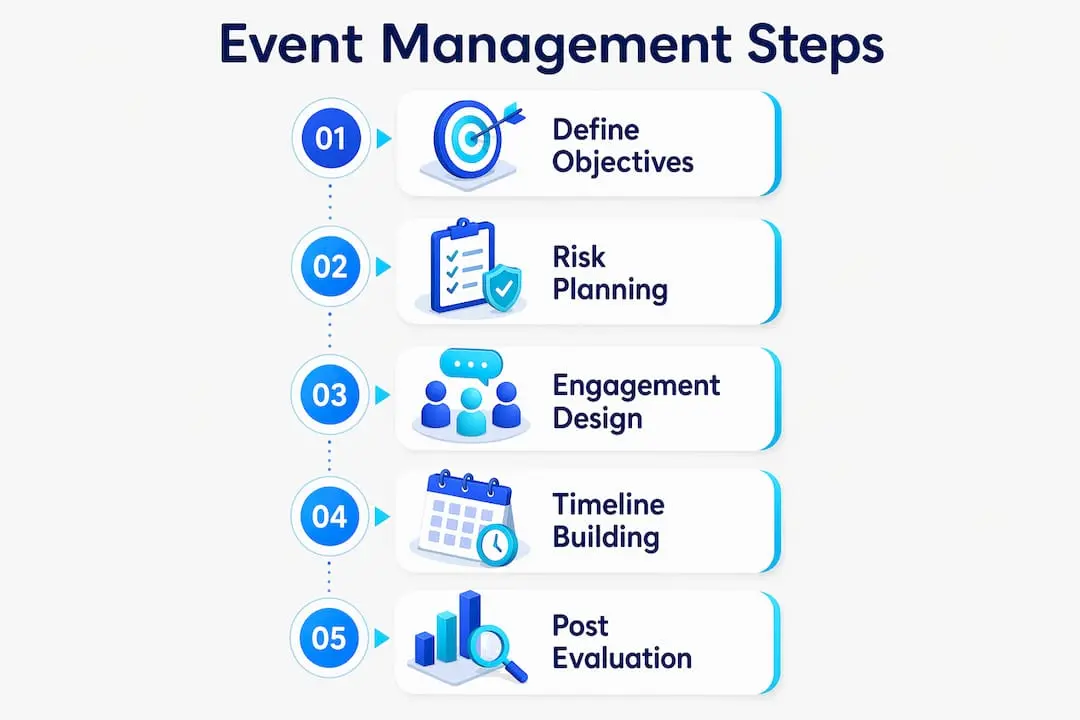
How do you set measurable objectives for strategic events?
Effective event objectives are measurable and include a number, a timeline, and a defined target audience. A vague objective like “increase engagement” gives your team nothing to work with. A precise one, such as “achieve 75% session attendance among lapsed members within a two-day annual conference,” creates accountability and a clear measurement path.
Objectives must connect directly to business outcomes, not just attendance figures. For membership organisations, the most relevant outcomes include:
- Retention rate improvement: Track whether event attendees renew at a higher rate than non-attendees in the 90 days following the event.
- Lead quality tagging: Use registration flows to segment members by engagement tier, so post-event follow-up is targeted rather than generic.
- Renewal conversion: Measure how many members who attended a specific session subsequently upgraded their membership tier.
- New member referrals: Record how many existing members brought a guest, and whether that guest converted within 30 days.
Embedding measurement within the event experience itself is the key distinction between reactive and proactive event planning strategy. Registration forms, session check-ins, and post-session polls all generate data that would otherwise require separate surveys to collect.
Pro Tip: Align your event objectives directly with your organisation’s annual membership engagement strategy. If your organisation’s goal is to reduce churn by 10% this year, at least one event objective should map to that target explicitly.
What risk management tools work best for event planning?
Risk management in event planning is a strategic capability, not a compliance exercise. FERMA defines it as a function integrated throughout planning and execution, rather than a defensive checklist completed after something goes wrong. For membership event planners, this reframing changes how you allocate time and resources across the event lifecycle.
The Copenhagen Risk Navigator offers 14 validated risk management tools covering the entire event lifecycle. It is open-source, free for global business events professionals, and includes a five-step quick-start guide designed for teams without dedicated risk specialists. That makes it one of the most accessible frameworks available for associations and nonprofits operating with lean planning teams.
| Risk management stage | Key focus areas | Copenhagen Risk Navigator support |
|---|---|---|
| Strategic planning | Objective alignment, stakeholder risk appetite | Risk appetite and context tools |
| Operational planning | Venue, supplier, and logistics risk | Supplier assessment and contingency tools |
| Execution | On-site incident response, communication | Live risk monitoring checklists |
| Post-event review | Lessons learned, risk register update | Debrief and evaluation templates |
Pro Tip: If your team is new to formal risk management, start with the five-step quick-start guide in the Copenhagen Risk Navigator before attempting the full toolkit. Build the habit of risk thinking first, then add complexity as your team matures.
How do you design an engagement framework for member events?
The “people, place, purpose” framework aligns event strategy with intentional member participation through spatial design and programme focus. It treats engagement not as an outcome to hope for, but as a condition to design into the event environment itself. This distinction matters enormously for membership organisations, where passive attendance produces little loyalty value.
Applying this framework in practice means making deliberate decisions across three dimensions:
- People: Curate the attendee mix to include a balance of long-standing members, newer joiners, and prospective members. Structured networking formats, such as facilitated roundtables or hosted introductions, produce more meaningful connections than open networking alone.
- Place: Use central hubs, such as a dedicated networking lounge or a shared resource station, to anchor engagement and draw members away from passive seating. Physical and virtual spatial design both apply here, including breakout room structures in hybrid formats.
- Purpose: Every session, workshop, and social activity should connect explicitly to a member benefit. When attendees understand why they are in the room and what they will leave with, participation rates and satisfaction scores both rise.
Linking your engagement framework to event marketing ideas tailored for membership groups amplifies pre-event anticipation and drives higher registration quality. Members who arrive knowing what to expect engage more deeply than those who attend out of habit.
How do you build a strategic event planning timeline?
Mapping critical path dependencies backward from the event date is the single most effective technique for avoiding scheduling failures in complex event planning. The critical path identifies which decisions must be made before others can proceed. Venue selection, for example, unlocks catering, AV, and capacity planning. Delaying it by three weeks does not cost three weeks. It costs three weeks plus all the downstream delays it triggers.
For events planned 12 or more months in advance, front-load governance and strategic decisions in the first quarter. Confirm your objectives, secure your venue, and lock in your headline speakers or facilitators before moving into operational planning. This sequence protects your budget and prevents the costly renegotiations that follow when strategic decisions are made too late.
When timelines are compressed, the approach changes. Event leaders confirm that decisiveness under tight timelines is more valuable than exhaustive exploration. On a six-week timeline, the priority is:
- Secure venue, guest count, and production in the first 48 hours.
- Confirm the programme structure and key speakers within the first week.
- Launch registration and marketing no later than week two.
- Complete all supplier confirmations by week four.
- Conduct a full run-through with AV and technical teams at least 48 hours before the event.
A structured post-event review completed within five working days should close every event cycle. It covers objectives assessment, budget reconciliation, process review, and vendor performance. Completing it quickly preserves institutional memory and feeds directly into the planning timeline for your next event.
What does effective post-event evaluation look like?
Post-event surveys sent within 24 hours produce the best response rates. Response rates drop significantly after 48 hours as attendees lose their emotional connection to the experience. For membership organisations, that emotional window is also when members are most likely to articulate what genuinely moved them, which is the data that improves future events most.
A multi-wave evaluation approach produces far richer insight than a single post-event survey:
- Wave 1 (within 24 hours): Capture immediate reaction using Net Promoter Score, session satisfaction ratings, and two or three open-ended questions about highlights and improvements.
- Wave 2 (30 days post-event): Measure behaviour change. Did members act on what they learned? Did they connect with other attendees? Did they explore membership upgrade options?
- Wave 3 (3 to 6 months post-event): Assess longer-term impact on retention, renewal, and referral behaviour.
Linking attendee responses across all three waves using persistent attendee IDs prevents data loss between events and enables tracking of long-term impact. Without this linkage, you are measuring three separate snapshots rather than a continuous member journey.
Post-event reporting should include technical performance data alongside the standard attendance and satisfaction metrics. AV quality and streaming statistics reveal factors that affect event success but are routinely overlooked in summary reports. Including them supports accountability and gives hybrid event teams the evidence they need to improve technical delivery.
Pro Tip: Share a one-page summary of post-event findings with your full planning team within three working days of the event. Translating raw data into a decision-ready narrative, rather than circulating a data dump, supports stakeholder communication and makes budget justification far easier at your next board meeting.
Key takeaways
Effective strategic event management requires measurable objectives, integrated risk planning, engagement-by-design frameworks, and multi-wave post-event evaluation to deliver consistent membership growth.
| Point | Details |
|---|---|
| Define measurable objectives | Use a number, timeline, and target audience to make every event objective specific and trackable. |
| Integrate risk management early | Embed risk planning from the strategic phase, not as a last-minute compliance step before the event. |
| Design engagement deliberately | Apply the people, place, purpose framework to create conditions for active member participation. |
| Map critical path dependencies | Work backward from the event date to identify which decisions unlock all downstream planning tasks. |
| Use multi-wave evaluation | Send surveys at 24 hours, 30 days, and 3 to 6 months to measure both reaction and lasting behavioural change. |
Why I think most membership organisations are measuring the wrong things
After years of working with associations and nonprofits on their event programmes, the pattern I see most often is this: organisations invest heavily in running events and almost nothing in measuring them properly. They count heads, collect a satisfaction score, and move on. That is not evaluation. It is confirmation bias with a spreadsheet.
The organisations that genuinely grow through events are the ones that connect event data to membership outcomes. They know whether attendees renew at higher rates. They know which sessions correlate with membership upgrades. They treat each event as a data point in a longer member relationship, not a standalone production to be judged on the day.
The risk management piece also tends to be undervalued until something goes wrong. I have seen well-planned events derailed by supplier failures that a basic risk register would have flagged months earlier. The Copenhagen Risk Navigator exists precisely because this gap is widespread, and the fact that it is free removes the last reasonable excuse for ignoring it.
The honest truth is that boosting member engagement through events is not primarily a creative challenge. It is a measurement and planning challenge. Get those two things right, and the creative elements tend to follow.
— Rob
How Colossus supports your event planning strategy
Colossus is built specifically for membership organisations that need event planning, member management, and engagement tracking to work together in one place. Our event management software handles registration, attendee tracking, and post-event reporting within the same platform that manages your member records, so you never lose the connection between event participation and membership outcomes. Our membership management features keep member profiles linked to event history, making multi-wave evaluation and lifecycle tracking straightforward rather than a manual data exercise. If your current tools require you to stitch together spreadsheets after every event, we can change that.
FAQ
What is strategic event management?
Strategic event management is the process of planning, executing, and evaluating events with defined, measurable objectives tied to organisational goals. For membership organisations, this means connecting event outcomes directly to member retention, renewal, and engagement metrics.
How do you measure the success of a member event?
Success is measured across multiple waves: immediate satisfaction within 24 hours, behavioural change at 30 days, and longer-term impact on retention and renewal at 3 to 6 months. Using persistent attendee IDs to link responses across waves produces the most accurate picture of event impact.
What is the people, place, purpose framework?
The people, place, purpose framework is an engagement design approach that aligns spatial design, attendee mix, and programme focus to create conditions for active member participation. Central hubs and structured networking formats are practical applications of this framework.
How far in advance should strategic event planning begin?
For complex member events, governance and strategic decisions should be confirmed 6 to 12 months in advance. On compressed timelines, venue, guest count, and production should be secured within the first 48 hours to protect all downstream planning tasks.
What should a post-event report include?
A post-event report should cover objectives assessment, budget reconciliation, process review, vendor performance, and technical performance data such as AV quality and streaming statistics. Completing this review within five working days preserves institutional memory and supports continuous improvement.