Starting an online boutique: UK membership org guide

If you run a membership organisation and want to launch an online boutique, start by registering your business structure with HMRC or Companies House, then check whether your projected turnover will exceed the £90,000 VAT threshold within 12 months. Your three immediate next actions are:
- Register your business — sole trader via HMRC Self Assessment, or limited company via Companies House (note the updated identity verification requirements effective February 2026).
- Reserve your domain and confirm your e-commerce platform supports member account linking and UK-compliant payment processing.
- Set up a PCI-compliant payment gateway that handles member accounts, recurring payments, and VAT-inclusive pricing from day one.
For a low-risk pilot or side project, starting as a sole trader is the lighter route. If your organisation expects external investment or significant liability exposure, incorporate before you take the first order.
Table of Contents
- What must you do before you accept the first order?
- How do UK business structures and tax obligations compare?
- Which selling model suits your organisation, and what will it cost?
- What should you look for in a platform and payment provider?
- What are your legal obligations as a UK online seller?
- How should you handle inventory, fulfilment, and pricing?
- How do you plan a 30/60/90 day launch for member audiences?
- When does integrating your tech stack make sense?
- Key takeaways
- What membership organisations actually get wrong at launch
- Colossus brings member commerce and events into one place
- Useful sources and further reading
What must you do before you accept the first order?
- Register with HMRC (sole trader) or Companies House (limited company) and open a dedicated UK business bank account.
- Monitor your rolling 12-month taxable turnover against the £90,000 VAT threshold; know that the 30-day trigger applies the moment you expect to exceed it.
- Draft your terms and conditions, privacy and cookie policy, and a returns and cancellation policy that satisfies the Consumer Contracts Regulations 2013.
- Display your legal business name, physical address, email, and Companies House number (if applicable) permanently on your site, as required by the E-Commerce Regulations 2002.
- Set up a PCI-compliant payment gateway and run accessibility checks on your checkout pages.
- Assign a named owner for fulfilment, customer service, and member communications before you go live.
Pro Tip: Run a full test purchase as a member before launch — including a refund request. If the refund workflow breaks, fix it before real members experience it.
How do UK business structures and tax obligations compare?
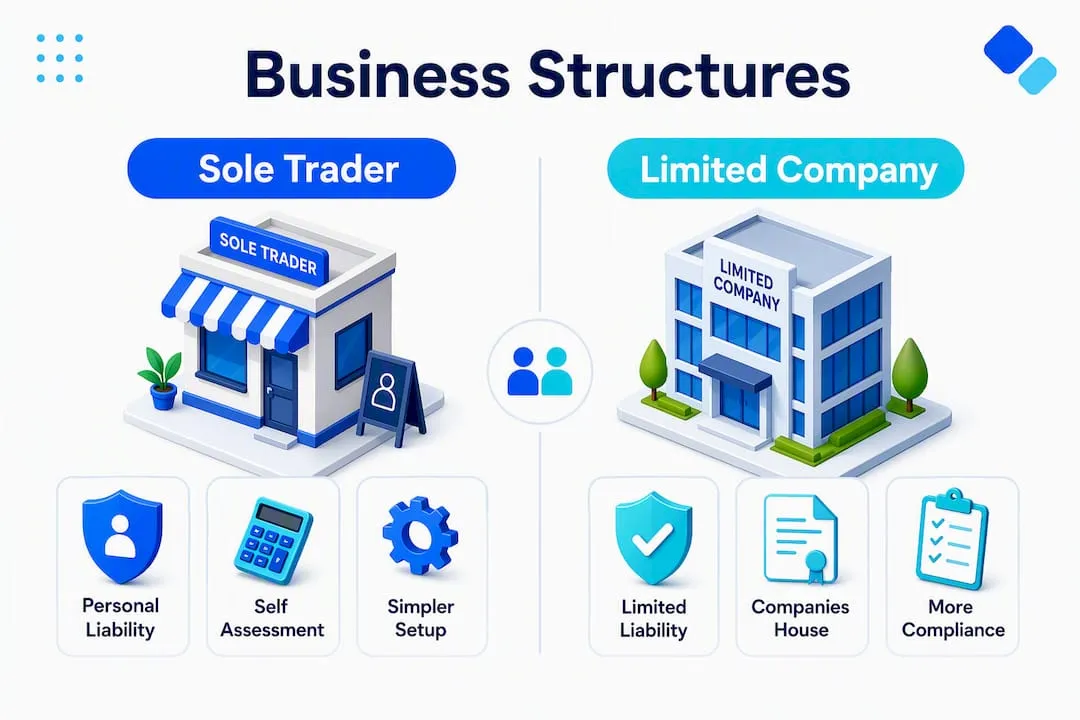
Sole trader vs limited company
The core difference is personal liability. As a sole trader, your personal assets are exposed to business debts. A limited company is a separate legal entity, so liability is generally capped at share capital. For membership organisations piloting a boutique, the sole trader route is administratively lighter and perfectly adequate at low revenue. Many advisers recommend incorporating once annual profits approach £50,000–£60,000, or when external investment is on the table.
Administrative obligations
| Obligation | Sole trader | Limited company |
|---|---|---|
| Registration | HMRC Self Assessment | Companies House + HMRC |
| Annual filing | Self Assessment tax return | Accounts, confirmation statement, corporation tax return |
| Identity verification | National Insurance number | Enhanced ID checks (from February 2026) |
| Tax on profits | Income tax + Class 4 NICs | Corporation tax; dividends or PAYE for directors |
| Liability | Unlimited personal liability | Limited to share capital |
Switching structures later carries a cost: transferring a sole trader business into a limited company can trigger Capital Gains Tax unless incorporation relief under TCGA 1992 s162 applies. Many founders time the transfer to a new tax year to simplify accounting.
VAT: the £90,000 threshold
The VAT registration threshold for 2026/27 is £90,000 on a rolling 12-month basis. If you expect to exceed it in the next 30 days, you must register immediately — not at your next accounting period. The deregistration threshold sits at £88,000.
A common mistake is treating the threshold as an annual target. It is assessed continuously. Voluntary registration can make sense if your members are VAT-registered organisations that can reclaim the tax, but it adds quarterly Making Tax Digital obligations from day one. Consult an accountant before registering voluntarily.
Which selling model suits your organisation, and what will it cost?
Three models compared
| Model | Typical launch time | Estimated startup cost | Best for |
|---|---|---|---|
| Dropshipping | 2–4 weeks | — | Testing demand with minimal risk |
| Wholesale / stock | weeks | — | Organisations with storage and event kiosks |
| Private label | months | — | High-margin branded merchandise |

Launch timelines differ significantly by model: dropshipping can go live in weeks, while private label requires supplier lead times, sampling, and packaging design before a single unit ships. For membership organisations, wholesale often hits the sweet spot — you control stock for events, can bundle products with registrations, and avoid the quality uncertainty of dropshipping.
Startup costs across all models should budget for platform fees, initial stock or samples, product photography, packaging, and fulfilment setup. Always request VAT invoices from suppliers and confirm their returns policy aligns with your own obligations to members.
Pro Tip: Use your next flagship event as a live product-market test. Limit initial stock, sell at the event, gather direct member feedback, then scale online once you know what sells.
What should you look for in a platform and payment provider?
Choosing the right platform for a membership organisation means more than picking the cheapest monthly plan. Prioritise these capabilities:
- Member account linking — members should log in once and see their exclusive pricing, order history, and event registrations in a single view.
- Event registration integration — the platform should connect product availability to event sign-ups, enabling bundled purchases at checkout.
- Inventory control — real-time stock visibility prevents overselling at events or during member-only drops.
- UK-friendly payments — confirm the gateway supports GBP, handles VAT-inclusive pricing, and processes refunds and chargebacks within UK timelines.
- Recurring payment support — useful for membership bundles that combine a subscription with a product allocation.
- PCI compliance — the gateway must be PCI DSS compliant; never store raw card data on your own servers.
For platform guidance specific to membership organisations, the best websites to set up an online store resource covers feature sets and expected timelines by business model.
Pro Tip: Before launch, complete a full test of the member checkout flow — add a product, apply a member discount, pay, then request a refund. Verify that VAT is displayed correctly at every stage.
What are your legal obligations as a UK online seller?
UK consumer law applies online exactly as it does in a physical shop. The Consumer Contracts Regulations 2013 require you to provide clear pre-contract information before a customer completes a purchase. Failing to do so can extend their cancellation rights and trigger mandatory refund obligations.
Every product page and checkout must display: your business identity and contact details; the total price including VAT and delivery charges; cancellation rights and the returns process; who bears the cost of return postage; and your complaint-handling procedure. Omitting any of these items is a breach of the Regulations.
The Consumer Rights Act 2015 adds that goods must be as described, of satisfactory quality, and fit for purpose. For membership organisations, this matters especially when selling branded merchandise — a product described as “official” must genuinely be so.
On data protection: collect only the member data you need, obtain clear cookie consent, link to a GDPR-compliant privacy policy, and never store payment card data outside a PCI-compliant gateway. Your nonprofit compliance obligations extend to the online shop the moment you take the first payment.
How should you handle inventory, fulfilment, and pricing?
Fulfilment options
- In-house fulfilment — suits small volumes and event kiosks; requires storage space and staff time.
- Third-party fulfilment (3PL) — hands off pick, pack, and dispatch; adds per-unit cost but scales without warehouse investment.
- Hybrid — keep event stock in-house, route online orders through a 3PL.
Returns workflow
- Customer requests return within 14 days of receipt (statutory minimum under the Consumer Contracts Regulations).
- You confirm receipt of the return request within one working day.
- Refund is issued within 14 days of receiving the goods back, or proof of return.
- Clearly state in your policy who pays return postage; if you do not, the default obligation falls to you.
Pricing formula
A workable formula: Cost price ÷ (1 − target margin) + VAT + shipping + platform fee per unit = minimum selling price. Apply a member discount on top of this floor, not below it, to protect margin.
Pro Tip: Tie limited-stock drops to event registration confirmations. Members who register for an event receive a 48-hour early-access window. This creates urgency without discounting.
How do you plan a 30/60/90 day launch for member audiences?
- Days 1–30 (soft launch): Go live for members only. Send a segmented email preview to your most engaged members with an exclusive early-access discount. Track conversion rate and average order value from day one.
- Days 31–60 (event-linked launch): Tie the public launch to a flagship event. Bundle products with event registrations. Use email marketing tactics proven for member audiences — segmented previews, event-based bundles, and post-event follow-up sequences.
- Days 61–90 (optimise): Review return rate, refund timeline compliance, and repeat purchase rate among members. Adjust inventory levels and pricing based on real sales data.
Pro Tip: Event registrations are your highest-intent audience. A short email to registrants 72 hours before an event, featuring event-exclusive merchandise, consistently outperforms general promotional sends.
When does integrating your tech stack make sense?
A disconnected tech stack creates manual reconciliation work that grows with every event. The integration checklist for a membership boutique:
- Single member record — one source of truth for member status, purchase history, and event attendance.
- Event registration sync — product availability and member discounts update automatically when a member registers.
- Unified payment handling — one gateway processes membership fees, event tickets, and product purchases.
- Automated fulfilment triggers — an event registration can automatically queue a merchandise pack for dispatch.
- Data export for accounting — VAT returns and sales reports pull from one system, not three spreadsheets.
Integration approaches compared
| Approach | Effort | Risk | Best for |
|---|---|---|---|
| Separate tools, manual sync | Low setup | High reconciliation error | Very small organisations |
| API/webhook integration | Medium setup | Medium, needs maintenance | Organisations with developer resource |
| Unified platform | Low ongoing | Low | Organisations prioritising efficiency |
When Colossus is a natural fit: organisations that want member management, event registration, CRM, and an online store operating from a single member record. The membership software features built for nonprofits and charities address exactly this consolidation need.
Pro Tip: Before committing to any integration, export a sample of your member data and test it against the platform’s import format. Data mismatches discovered post-launch are far more expensive to fix than pre-launch.
Key takeaways
Starting an online boutique for a membership organisation requires legal registration, VAT awareness, and a member-first checkout flow before you take a single order.
| Point | Details |
|---|---|
| Register and check VAT first | Register with HMRC or Companies House and monitor the £90,000 rolling threshold from day one. |
| Match the model to your capacity | Dropshipping launches in weeks; wholesale suits event-driven organisations; private label takes months. |
| Legal compliance is non-negotiable | Display all pre-contract information required by the Consumer Contracts Regulations 2013 on every product page. |
| Tie launches to member events | Use fundraising outreach tactics to drive early-access sales and validate product-market fit before scaling stock. |
| Colossus unifies the stack | Colossus brings member management, event registration, CRM, and e-commerce into one platform, reducing manual reconciliation. |
What membership organisations actually get wrong at launch
The most consistent mistake is underestimating the cost and complexity of returns. Organisations that launch a boutique alongside a major event often discover that a 10–15% return rate on event merchandise creates a refund backlog that manual processes cannot handle. The Consumer Contracts Regulations give members 14 days to initiate a return; if your workflow is not built before launch, you will breach that timeline.
The second pitfall is treating the member checkout as an afterthought. A member who has to create a separate account, re-enter their details, and lose their event discount at checkout will abandon the purchase. Test the full member journey — login, discount application, payment, confirmation email — before you open to anyone.
The practical lesson: use your first event as a controlled test, not a full commercial launch. Limit stock, observe the fulfilment and returns process under real conditions, and fix the gaps before you scale. Organisations that do this consistently report faster growth and fewer compliance issues in the months that follow.
Colossus brings member commerce and events into one place
Running a membership boutique across disconnected tools means duplicated member records, manual discount reconciliation, and event stock that does not sync with registrations. Colossus addresses this directly: member-exclusive product launches, event merchandise tied to registration confirmations, and bundled membership-plus-product purchases all operate from a single member record.
With Colossus, your payment processing, event registration, CRM, and online store share one data layer. Automated fulfilment triggers fire when a member registers for an event. Member discounts apply at checkout without manual intervention. Built-in communications mean your post-purchase and post-event sequences run without a separate email platform.
For organisations managing economic uncertainty alongside a new revenue stream, the reduction in manual work is material. See the full feature set at Colossus membership management, or explore the event management product to see how event registration and merchandise integrate in practice.
Useful sources and further reading
- GOV.UK: Register for VAT — the authoritative starting point for VAT registration, scheme selection, and the rolling 12-month threshold test.
- Companies House: fee and process changes from February 2026 — current incorporation fees and identity verification requirements.
- Consumer Contracts (Information, Cancellation and Additional Charges) Regulations 2013 — the statutory basis for pre-contract information and cancellation rights.
- Consumer Rights Act 2015 — goods and services standards for online sellers.
- Electronic Commerce (EC Directive) Regulations 2002 — mandatory business information requirements for e-commerce sites.
- FSB: 14 e-commerce laws and legal requirements — a practical checklist from the Federation of Small Businesses covering accessibility, data protection, and consumer law.
- Capital Gains Tax incorporation relief — relevant if you plan to transfer a sole trader business into a limited company.
For VAT queries, incorporation decisions, and consumer rights questions specific to your organisation, consult a qualified accountant or solicitor. The VAT registration threshold for 2026/27 remains £90,000; confirm the current figure with HMRC before making registration decisions.
This article provides general information only and does not constitute legal, tax, or financial advice. Confirm current rules with GOV.UK or a qualified professional for your specific situation.