School Mentoring for Leaders: Quality Shapes Two Months of Progress
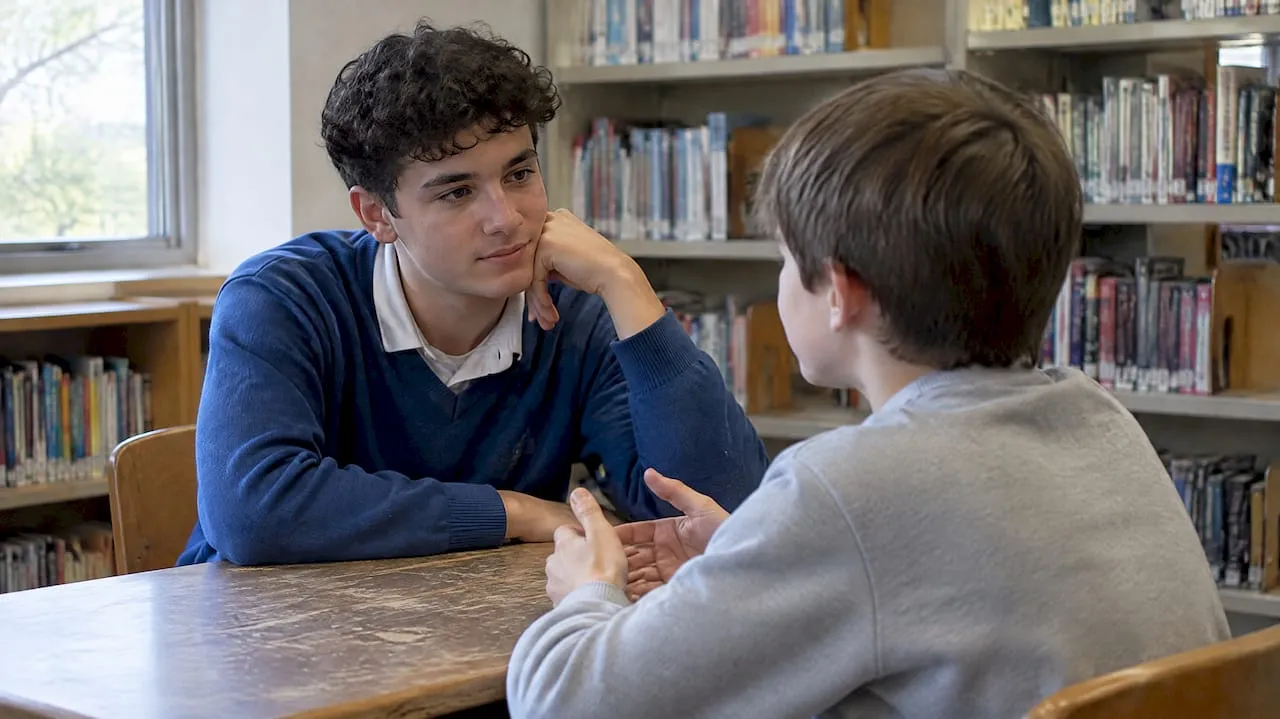
School mentoring programmes support pupils’ academic progress, social and emotional growth, confidence and longer-term opportunities, though the gains are real but modest rather than transformative. The Education Endowment Foundation finds that pupils typically make around two months’ additional progress, usually through regular meetings, with stronger results when the relationship is close and goal-focused. Tools like Colossus Systems can help schools and trusts keep that structure consistent as a programme grows.
TL;DR:
- Pair relationship building with concrete, goal focused activities; closeness and structured work together predict stronger academic, behavioral, and social emotional gains than socializing alone.
- Mentoring delivered at school is easiest to supervise and run affordably; peer mentoring supports inclusion but needs training, while community models require more coordination.
- Programmes need trained mentors, scheduled coordinator supervision, weekly meetings, documented logs, and planned closure; weak continuity or unexplained endings can undermine trust and results.
- Prioritize disadvantaged pupils and those with fewer adult supports at home, then track participation, attendance, behavior, and connectedness rather than expecting first term attainment gains.
Table of Contents
- Benefits and outcomes: academic, social-emotional, attendance and long-term opportunities
- Types of mentoring models and how they differ
- What the research says: evidence, effect sizes and the mechanisms that matter
- Core components of effective mentoring programmes
- How to start, run and evaluate a school mentoring programme
- Mentorship, diversity and inclusion in schools
- Integrating mentoring with the curriculum and school life
- Integrating mentoring into whole-school practice
- FAQ
- Sources
- Strengthen your mentoring programme with the right tools
Benefits and outcomes: academic, social-emotional, attendance and long-term opportunities
Mentoring touches more than grades. The headline figure from the EEF is an average of two months’ additional progress for pupils involved in a mentoring programme, compared with similar peers who are not. That average hides real variation: a well-run programme with trained mentors and clear goals tends to outperform a loosely supervised one, and the EEF is clear that the impact is small relative to the moderate cost of running a programme properly.
An average of two months’ additional progress a year is the EEF’s headline finding, and it holds across a range of mentoring models rather than one specific format.
Beyond attainment, schools and families report a consistent pattern of softer but meaningful shifts:
- Pupils often describe feeling more confident and more connected to their school once they have a consistent adult or near-peer checking in on them.
- Some schools see fewer behaviour or discipline referrals among mentored pupils, alongside steadier attendance.
- Research into informal mentoring by school staff has linked these relationships to higher college attendance and more years of schooling for some groups, according to NBER-based analysis.
- Disadvantaged pupils and those with fewer adult supports at home appear to benefit most, which is a strong argument for targeting limited mentoring capacity thoughtfully.
A regular meeting that pairs an adult or older student with a younger one around a specific goal such as reading fluency or homework completion, is often enough to shift engagement patterns well before it shows up in test scores.
Types of mentoring models and how they differ
Not every school needs the same format, and matching the model to the aim matters more than picking the “best” one in the abstract.
- School-based mentoring happens on-site, usually for an hour a week during term time, and is generally the easiest to supervise and the most affordable to run at scale.
- Peer or near-peer mentoring pairs older pupils with younger ones, builds leadership skills in the mentors themselves, and works well for inclusivity goals, though it needs extra training since young mentors have less life experience to draw on.
- Community-based mentoring takes place outside school, often with more contact time and deeper relationships, but it carries higher coordination costs and relies on external partners.
- Informal or natural mentoring grows organically between pupils and teachers, coaches or counsellors, and tends to depend heavily on whether a school’s culture actively encourages those relationships to form.
Schools chasing academic recovery often lean towards structured school-based models with explicit goals, while those prioritising belonging and inclusion may get more from peer mentoring or by nurturing informal relationships already present in staff-pupil interactions.
What the research says: evidence, effect sizes and the mechanisms that matter
The EEF’s synthesis puts mentoring’s average effect on attainment at two months’ additional progress, categorised as a small positive impact for a moderate cost. That average is a useful planning benchmark, not a guarantee, because the studies behind it show wide variation depending on how programmes are run.
Relationship closeness combined with goal-setting produces the strongest results, according to a national study of school-based mentoring, which found that mentee-reported relationship quality and mentor use of structured, instrumental activities together predicted the largest academic, behavioural and social-emotional gains. Mentors who only socialised, without working towards any goal, saw weaker results than those who balanced warmth with purpose.
A few patterns recur across the evidence base:
- Programmes that pair relationship-building with concrete activities, rather than one or the other, consistently outperform single-focus approaches.
- Long-run data from informal mentoring by school staff points to increased college attendance for some pupils, a signal that effects can outlast the programme itself, per NBER-based findings.
- Mentor turnover, short programme duration and weak follow-up all erode impact, meaning dosage and continuity matter as much as the initial match.
None of this suggests mentoring is a fix on its own. It works as one part of a pupil support system, not a substitute for teaching or pastoral care.
Core components of effective mentoring programmes
Practitioner guidance from MENTOR’s resource library converges on a consistent set of structural features that separate programmes with staying power from those that fizzle after a term. Building these in from the start costs more up front but protects the gains schools are trying to create.
- Recruit with realistic expectations. Messaging to prospective mentors should describe the time commitment and the skills needed honestly, so matches are not abandoned once the novelty fades.
- Train before matching. Pre-match sessions should cover boundaries, role clarity, goal-setting, how to give feedback and safeguarding procedures specific to the school.
- Supervise on a schedule. Regular check-ins with a named coordinator, documented meeting logs and a route for mentors to flag concerns keep quality visible rather than assumed.
- Design for consistency. Weekly meetings are the most common cadence, and programmes should aim for sustained engagement rather than a short burst.
- Plan the ending. A planned closure process, with clear rules on rematching if a pair cannot continue, avoids pupils experiencing an unexplained loss of their mentor.
- Resource it properly. Coordinator time, training costs and ongoing supervision are not optional extras: the EEF notes that under-resourcing undermines fidelity and threatens both outcomes and match continuity.
Pro Tip: Treat the early stage of any match as a trial period, with a scheduled coordinator check-in, so a mismatch can be corrected early rather than left to drift.
Our guide to mentoring programme best practices goes further into recruitment and training checklists that apply equally well inside a school setting.
How to start, run and evaluate a school mentoring programme
Building a mentoring programme from scratch, or tightening an existing one, follows a fairly predictable sequence.
- Set clear aims and measurable outcomes before recruiting anyone: decide whether you are targeting attendance, behaviour referrals, pupil self-report scales or an attainment proxy such as homework completion.
- Recruit and screen mentors against criteria that match your aims, whether that means subject-confident adults, trained near-peers or community volunteers.
- Run pre-match training, covering safeguarding, boundaries and goal-setting, then match pairs with a clear rationale rather than convenience.
- Schedule regular meetings and log them, with mentor check-ins and periodic contact with parents or form tutors to catch problems early.
- Track a handful of simple metrics: participation fidelity, attendance or behaviour trends, and short self-reported measures of connectedness, rather than trying to prove attainment gains in the first term.
- Budget for sustainability, including coordinator time and links to wider pastoral support, so the programme survives staff turnover and funding cycles.
A platform that logs meetings, tracks attendance patterns and keeps parent communication in one place removes a lot of the administrative drag that causes well-intentioned programmes to lose momentum after the first term; our piece on student achievement tracking for nonprofits covers the monitoring side in more detail.
Mentorship, diversity and inclusion in schools
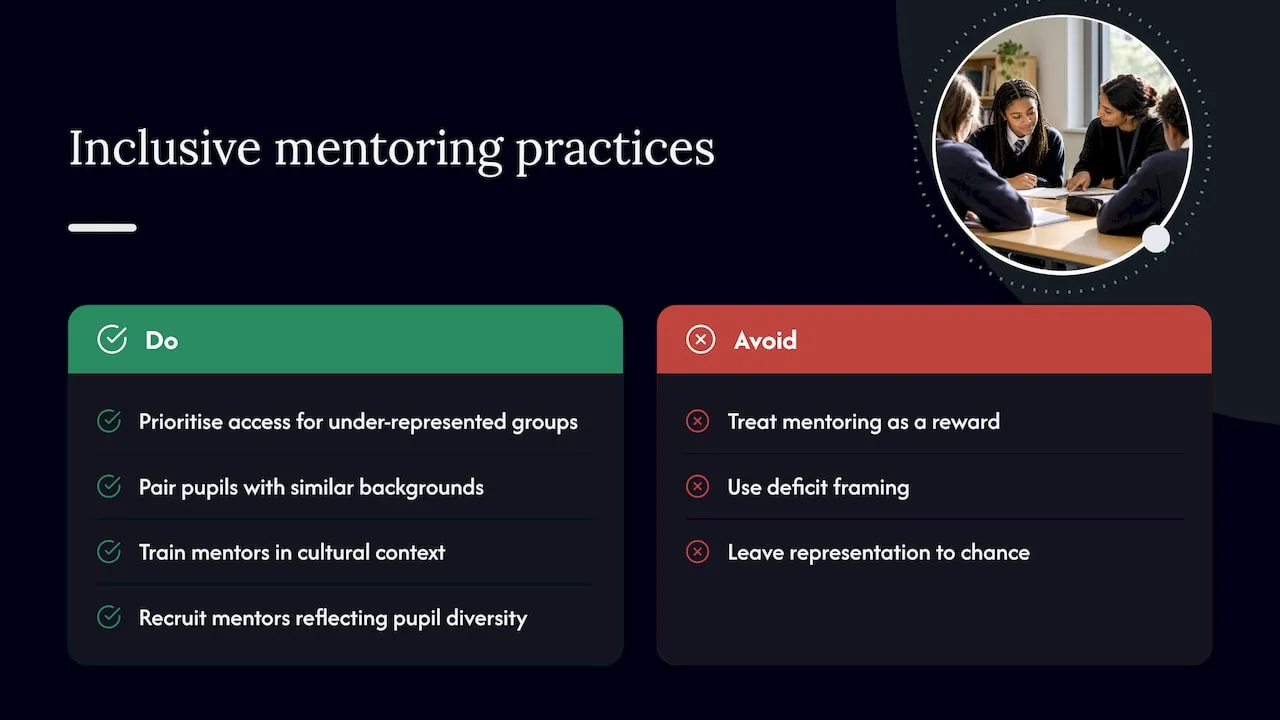
Mentoring can be a direct lever for equity when it is targeted deliberately rather than offered as a generic enrichment activity. Pupils from disadvantaged backgrounds, those with fewer adult role models outside school, and pupils from under-represented groups often have the most to gain from a consistent, trusted relationship with a mentor, which is one reason the evidence base points towards prioritising access rather than treating mentoring as a reward for pupils already doing well.
Peer and near-peer mentoring in particular can widen representation: pairing pupils with mentors who share similar backgrounds, languages or experiences tends to build trust faster and can give pupils a visible example of what is possible for someone like them. Schools serving pupils with English as an additional language, pupils in care, or pupils from communities under-represented in higher education or certain career paths can use mentoring to open doors that classroom teaching alone does not reach.
Inclusion also depends on how mentors are trained. A mentor who understands cultural context, avoids deficit framing and is coached to recognise their own blind spots will build stronger relationships with pupils from different backgrounds than one who is not. Programme coordinators should actively recruit a mentor pool that reflects the diversity of the pupils being served, rather than leaving representation to chance. Done well, mentoring becomes one of the more practical tools a school has for narrowing opportunity gaps, not just an add-on pastoral activity.
Integrating mentoring with the curriculum and school life
Mentoring works best when it is woven into the rhythm of the school day rather than bolted on as an extracurricular extra that competes for pupils’ time. Linking mentoring goals to specific curriculum targets, such as using a weekly session to work on a reading intervention or a maths catch-up goal, gives mentors a concrete focus and gives teachers a reason to share progress data with the mentoring coordinator.
Timetabling matters more than it might seem. Schools that protect a regular slot, whether during form time, an extended lunch or a dedicated enrichment period, see more consistent attendance at sessions than those relying on pupils and mentors to find time informally. Pairing mentoring with existing pastoral structures, such as form tutor check-ins or transition programmes for pupils moving between key stages, also avoids creating a parallel system that pupil support staff have to manage separately.
Extracurricular clubs, sports teams and peer leadership roles offer natural entry points for near-peer mentoring, since older pupils already in leadership positions can take on structured mentoring duties with relatively little extra training. Where schools use a central system to manage clubs, events and pupil records, adding mentoring logs to that same system keeps everything visible to the staff who need it rather than scattered across spreadsheets and informal notes.
Integrating mentoring into whole-school practice
Mentoring works when school leaders treat it as a complement to teaching and pastoral care, not a replacement for either. The evidence supports modest, specific gains, not a turnaround story, and leaders who promise more than that to staff or parents set the programme up to disappoint.
The part that worries me most is what happens when a match ends badly or unexpectedly. A pupil who loses a mentor without warning can come away more guarded than before they started, which is why training and supervision deserve at least as much attention as recruitment. Build for the long term, measure honestly, and the average progress can be a useful starting point for further support, rather than a guaranteed outcome.
— Rob
FAQ
What is the primary purpose of mentoring in schools?
The primary purpose is to pair a pupil with a consistent, trusted adult or near-peer who supports their academic progress, confidence and sense of belonging at school. Programmes typically combine relationship-building with goal-focused activities, since research shows this combination produces the strongest outcomes.
What are the 5 C’s of mentoring?
Definitions vary across organisations, but common versions centre on qualities such as caring, competence, character, confidence and connection between mentor and mentee. These are not a single fixed standard, so schools should check which framework a specific programme or provider is using before adopting the term.
What does it mean to have a mentor in school?
Having a mentor in school usually means meeting regularly with an adult or older pupil who offers guidance, encouragement and support towards specific goals. The relationship is distinct from teaching, since mentors typically focus on confidence, habits and connectedness rather than curriculum delivery.
How much academic progress can mentoring realistically produce?
On average, pupils in mentoring programmes make around two months’ additional progress compared with similar peers, according to the EEF. This is a small but consistent effect, and it tends to be larger when the programme includes trained mentors, clear goals and regular supervision.
What should schools check before choosing a mentoring model?
Schools should match the model to their aim: school-based mentoring suits academic support and easier supervision, while peer or community-based mentoring can suit belonging and leadership goals. It is also worth checking that any model includes mentor training, supervision and a planned closure process, since these features are consistently linked to stronger outcomes.
Sources
For school leaders wanting to go deeper, the EEF mentoring toolkit entry is the best starting point for headline effect sizes and cost considerations. The national study on relationship closeness is worth reading in full for anyone designing mentor training, since it explains why combining relationship-building with structured activities outperforms either approach alone. For implementation checklists covering recruitment, training and supervision, the practitioner chapter from MENTOR offers practical detail that translates well into a school context, and families curious about how to support a child’s learning alongside a mentoring relationship may find Team Genius Squad’s piece on parent involvement a useful companion read.
- Mentoring | EEF
- Finding the Sweet Spot: Investigating the Effects of Relationship Closeness and Instrumental Activities in School‐based Mentoring - PMC
- Evidencebasedmentoring
- Mentoring
Strengthen your mentoring programme with the right tools
Running mentoring well means keeping track of matches, meeting logs, mentor training records and parent communication without it all living in separate spreadsheets. We built our membership and engagement platform to bring those pieces together, so coordinators can manage programme information in one place. 
Our membership management software gives schools and trusts a way to manage programme information, while our CRM tools help organise communication as a programme grows. For schools working with outside partners, such as community health or referral services like WellCheck’s case management tools, having a central system makes it easier to coordinate when a mentee needs support beyond what the school can offer directly.
Current prices are on our pricing page. If you would like to see whether our platform fits how your school or trust runs mentoring, get in touch and we can walk through the setup together.