4 Career Payoffs of Alumni Networks and How Institutions Capture Them

An alumni network is a structured community of former students, staff and graduates that an institution organises to sustain lifelong connection, and its chief role is simple: it converts shared history into practical value, careers, mentorship and funding, for both members and the institution itself. BU Questrom frames these networks as trusted relationship assets, while platforms like Colossus exist precisely to help institutions run them properly.
TL;DR:
- Alumni networks are most effective when supported by structured platforms that manage contact data, events, and engagement tracking; without this, they remain passive mailing lists.
- Referral-based hiring, driven by alumni connections, significantly outperforms cold applications because of shared trust and credibility built through shared education.
- Alumni networks boost career advancement through hidden job opportunities, mentorship-to sponsorship pipelines, and geographic relocation cues based on alumni presence.
- Engagement in alumni activities correlates strongly with increased donations, valuable feedback, and successful boomerang hiring, making continuous participation strategic for institutions.
- Regular, small-scale interactions and consistent communication outperform sporadic events, emphasizing that alumni networking functions better as a habit rather than a one-time activity.
Table of Contents
- The role of alumni networks explained: core functions and structure
- How alumni networks turn connection into opportunity
- What alumni networks actually deliver for your career
- Why institutions invest heavily in alumni relations
- Building a network that actually sustains itself
- Measuring what your alumni programme actually achieves
- How Colossus and Rob approach alumni engagement
- Treat alumni networking as a habit, not an event
- Sources
The role of alumni networks explained: core functions and structure
Strip away the branding and every alumni network is built from the same handful of parts. A directory identifies who is out there and what they do now. Regional or industry chapters group people by geography or profession. Events, both in person and virtual, create reasons to reconnect. Mentoring programmes pair experienced graduates with newer ones. Communications, newsletters, portals, social groups, keep the whole thing alive between events.
Most institutions run this through a dedicated alumni office, often working alongside volunteer committees who lead regional chapters or affinity groups. The office handles infrastructure and strategy; volunteers supply local energy and credibility. This division of labour matters because paid staff alone rarely have the bandwidth to organise fifty city chapters, but volunteers alone rarely have the tools or data to do it consistently.
Typical member benefits fall into three buckets:
- Career support: job boards, referral schemes, resume reviews and interview coaching.
- Financial perks: insurance discounts, retail partnerships, library or gym access.
- Lifelong learning: guest lectures, professional certificate courses and continuing education credits.
None of this happens by accident. It requires a system, usually a membership platform, that can hold contact records, manage event registration and track who actually engages versus who just receives emails. Without that infrastructure, an alumni network becomes a mailing list with a nostalgic newsletter, not a functioning asset. Almabase’s guide to alumni network building makes the same point: online directories only pay off when paired with active, structured programming.
How alumni networks turn connection into opportunity
The mechanism behind alumni networking is not mystery, it is sociology. Mark Granovetter’s classic “strength of weak ties” idea explains why alumni contacts matter more than most people expect. Close friends tend to know what you already know. Acquaintances, the people you graduated alongside but never worked with directly, sit in different circles entirely, which means they surface job openings, introductions and information your closer contacts simply do not have.
Alumni networks are essentially machines for manufacturing useful weak ties at scale.
That is why referral pipelines built through alumni connections convert so well. A referral from a fellow graduate carries built-in credibility: shared curriculum, shared standards, sometimes a shared professor. Hiring managers trust that signal, which shortens the path from application to offer. Poets&Quants’ reporting on alumni networks notes that referral-driven hiring consistently outperforms cold applications, a pattern that holds across most industries.
Mentoring adds a second layer on top of referrals: skill transfer and confidence.
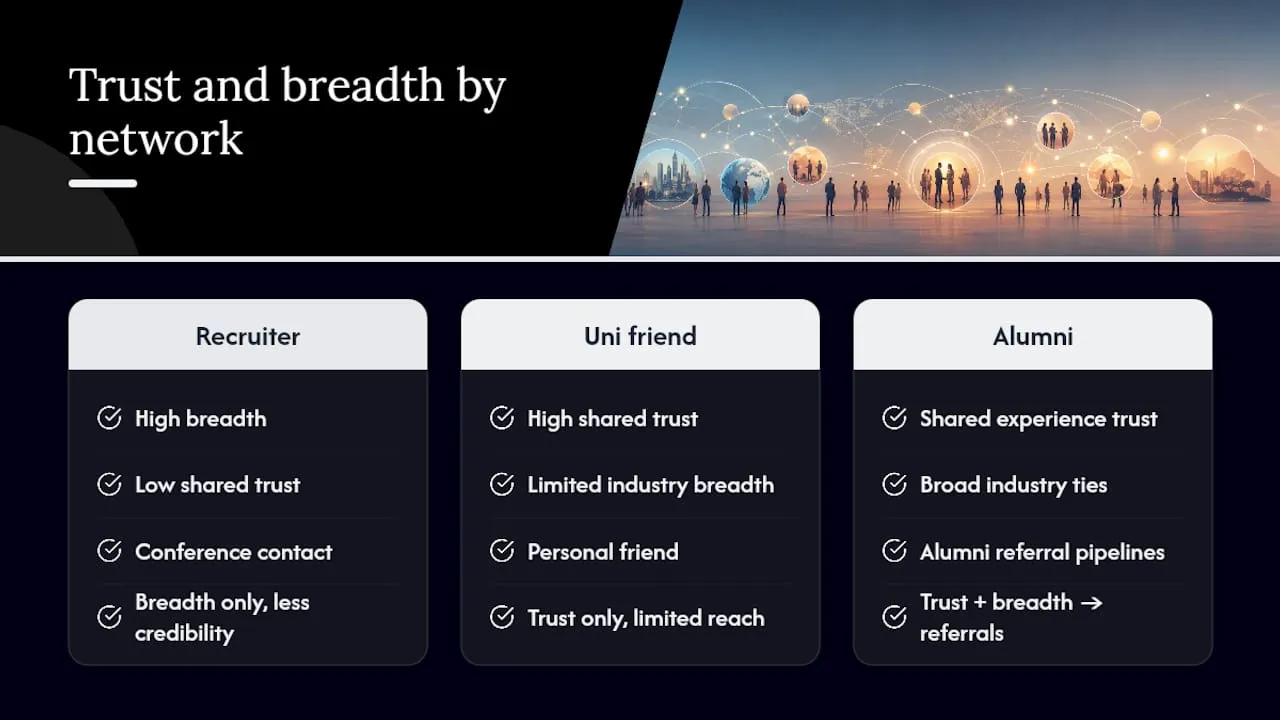
Alumni networks combine the trust of shared experience with the breadth of diverse industry ties, functioning like a trusted career insight source that few other networks can match.
That combination, trust plus breadth, is what separates alumni networks from generic professional networking. A recruiter you met at a conference has breadth but no shared trust. A university friend has trust but often limited breadth. An alumni network gives you both at once.
The gap between potential and reality is stark. A Strada-Gallup survey found that a small minority of graduates rated their alumni network as helpful or very helpful in their job search. That single figure explains why so many institutions are rebuilding their approach rather than assuming the network runs itself.
Modern platforms close that gap by matching people algorithmically, surfacing shared industries or locations, and prompting outreach that would otherwise never happen. Matchmaking software does not replace the sociology, it just removes the friction that used to stop weak ties from ever connecting in the first place.
What alumni networks actually deliver for your career
For individual members, the benefits cluster around four practical areas, and they compound over a career rather than paying off once.
- Hidden job access. Many roles never reach public job boards; alumni networks and referral schemes surface these openings first, and BU Questrom’s research on alumni relationship value backs the pattern of referral-based hiring outperforming open applications.
- Mentorship with teeth. The best mentoring relationships go beyond generic advice into sponsorship, where a senior alum actively vouches for you internally, opens doors, and puts their own credibility behind your candidacy.
- Geographic mobility. New Berkeley research on job seekers and alumni clustering found that people who lose their jobs are more likely to relocate to cities with a larger presence of alumni from their own institution. The network effectively signals where opportunity and familiarity overlap.
- Continuing education and peer learning. Alumni events, guest lectures and certificate programmes let members keep developing skills long after graduation, often at reduced cost or free of charge.
Pro Tip: Don’t wait for a job search to activate your alumni network. Message two or three graduates a year in roles you find interesting, just to ask how they got there. By the time you actually need a referral, you’ll have a warm relationship instead of a cold introduction.
The distinction between mentorship and sponsorship matters more than most guides admit. A mentor tells you what they think. A sponsor puts their name on the line for you in a meeting you’re not even in. Alumni networks are one of the few structures where that second, rarer form of support happens organically, because sponsors need a credible reason to vouch for someone, and shared alma mater provides exactly that.
Why institutions invest heavily in alumni relations
Institutions don’t run alumni programmes out of sentiment. They run them because engagement correlates directly with the things institutions need most: money, reputation and talent.
The pattern practitioner data consistently shows is that alumni who stay engaged, through events, mentoring, volunteering, are also the alumni most likely to donate, and to donate repeatedly. Almabase’s alumni network guide describes engaged alumni as stronger advocates who donate more and provide practical support well beyond a single gift. Fundraising teams know this, which is why donor cultivation strategies almost always start with engagement, not an ask.
Beyond fundraising, alumni networks deliver institutional value in several other ways:
- Recruitment and reputation. Prospective students trust graduate testimony more than marketing copy; alumni advocacy in their own professional circles shapes an institution’s standing more than any campaign.
- Board and advisory input. Alumni frequently sit on advisory boards, bringing industry perspective that faculty and administrators may lack.
- Programme feedback. Graduates who’ve entered the workforce can tell an institution exactly where the curriculum fell short, feedback that’s harder to get from current students.
- Boomerang hiring. Corporate alumni programmes now function as talent pipelines, with organisations rehiring former staff who left on good terms.
The World Economic Forum’s analysis of corporate alumni programmes describes exactly this shift, from simple contact registries to strategic assets that support boomerang hires and ongoing feedback loops. The logic transfers cleanly to universities and associations: an alumni base that stays connected is a standing resource, not a static archive.
Building a network that actually sustains itself
Most alumni programmes fail not from lack of effort but from lack of structure. The fix starts with segmentation, not events.
Group alumni by career stage, industry and geography before designing programming. A recent graduate wants job leads and mentorship; someone twenty years out wants board opportunities and giving options. Serving both groups identical content wastes the interest of at least one.
From there, build a core programme blueprint:
- Mentorship, structured, not ad hoc, with onboarding for both mentor and mentee.
- Regional chapters, giving geographically clustered alumni a local reason to gather.
- Career services, resume support, referral schemes and job boards kept current.
- Signature events, an annual reunion or conference that anchors the calendar.
Digital infrastructure decides whether any of this scales. A platform needs to run directories, manage event registration, handle CRM data and send targeted communications, without forcing staff to stitch together five disconnected tools. Colossus builds exactly this kind of unified system for membership organisations, letting alumni offices manage directories, events and outreach from one place instead of juggling spreadsheets. Understanding how to structure alumni engagement strategies properly from the start saves years of retrofitting later.
Data privacy deserves a plain mention here: alumni records include contact details, employment history and giving records, so consent-based communication and clear data retention policies aren’t optional extras, they’re the baseline for keeping trust intact.
Pro Tip: Build a simple volunteer ladder, welcome ambassador, chapter lead, board member, so engaged alumni have a visible next step rather than hitting a ceiling after one volunteer stint.
Recognition and stewardship close the loop. Thank volunteers publicly, report back on what their contributions achieved, and keep governance light enough that decisions don’t stall in committee.
Measuring what your alumni programme actually achieves
Numbers convince budget committees; stories convince everyone else. The strongest impact reports use both.
A short list of core KPIs covers most of what matters:
| Metric | What it tells you |
|---|---|
| Participation rate | Share of alumni engaging with any programme in a given year |
| Referrals-to-hire | How often alumni referrals convert into actual employment |
| Donations per active alum | Whether engagement is translating into financial support |
| Event satisfaction | Direct feedback on programme quality |
| Portal or platform activity | Ongoing digital engagement between events |
Quantitative tracking only tells half the story. Employer feedback on how alumni hires perform, and testimonials from graduates about mentorship or referrals that changed their trajectory, give programme leaders the qualitative evidence that boards and donors respond to. Given that only 9% of graduates in the Strada-Gallup survey found their network genuinely helpful, measurement isn’t a vanity exercise, it’s how institutions catch underperformance before it becomes chronic disengagement.
Set a baseline in year one, then compare cohorts over time rather than judging a single year in isolation. A programme that looks flat annually might be improving steadily once measured against the graduating class it actually serves.
How Colossus and Rob approach alumni engagement
Colossus builds membership management software with alumni offices specifically in mind: directories that stay current, event registration that handles everything from regional meetups to full conferences, CRM tools that track engagement history, and analytics that turn participation data into a real report rather than a guess. Automation handles the repetitive work, registration confirmations, reminder emails, renewal notices, so alumni staff spend their time on relationships instead of data entry.
Rob, who writes on membership strategy and engagement for Colossus, focuses on how organisations turn scattered volunteer effort into repeatable programming. His analysis draws on how associations and institutions structure retention, event strategy and digital engagement at scale.
The practical value shows up in specifics: automated event registration that removes manual sign-up chasing, searchable directories that make alumni matchmaking possible without a spreadsheet, and reporting dashboards that answer the “did this work?” question without weeks of manual data pulling.
Treat alumni networking as a habit, not an event
Most people, and most institutions, treat alumni engagement as something that happens once a year at a reunion. That’s backwards. The graduates who get the most out of their networks are the ones who send a handful of messages a year, show up to one or two events, and stay visible without waiting for a crisis to reconnect. Consistency beats intensity here, always.
If you’re reading this as an individual, the first useful action is small: log into your institution’s alumni portal today and update your profile, then message one person whose career path interests you. If you’re reading this from inside an institution, request a working session with your alumni relations team about what your current engagement strategy is actually measuring, versus what it should be.
Either way, the network only works if someone uses it. Waiting for the network to work on your behalf is the single most common reason it doesn’t.
— Rob
Institutions ready to move beyond spreadsheets and disconnected tools can explore how Colossus’s membership management features bring directories, event registration and CRM into one system, or look specifically at the event management tools built to handle everything from a small regional mixer to a full alumni conference. For teams focused on deepening individual relationships at scale, the CRM software tracks engagement history so no graduate falls through the cracks between one reunion and the next. Individuals looking for guidance on reaching out to alumni contacts directly may also find TopCollegeCoach’s outreach guidance useful for framing that first conversation.
Sources
- Let’s tap the real power of college alumni | Forbes
- The power of alumni networks in today’s changing economic landscape | BU Questrom
- The power of corporate alumni networks | World Economic Forum
- Alumni networks shape where people live and work after job loss | Berkeley
- Guide to building a strong alumni network | Almabase