Membership site benefits: boost engagement by 80–95%

TL;DR:
- Investing in retention is more cost-effective than acquiring new members.
- Effective membership sites centralize data, automate processes, and foster community engagement.
- Ongoing iteration and personalized onboarding improve member retention and loyalty.
Acquiring a new member can cost 7 to 10 times more than retaining an existing one. That single fact should reshape how every membership organisation allocates its time, budget, and energy. Yet many leaders still pour resources into acquisition campaigns while their current members quietly disengage. This guide cuts through the noise and explains the real benefits of membership sites, how to use them strategically, and the practical steps you can take right now to improve retention, streamline operations, and build a genuinely engaged community. Whether you lead an association, a charity, or a professional body, the insights here are directly applicable.
Table of Contents
- Why membership sites matter for organisations
- Core benefits of well-managed membership sites
- Mechanics of engagement: the retention advantage
- Practical steps to maximise your membership site benefits
- The hidden power of membership sites: what most overlook
- Ready to unlock more from your membership site?
- Frequently asked questions
Key Takeaways
| Point | Details |
|---|---|
| Retention is more cost effective | Keeping members is far cheaper than acquiring new ones so a focus on retention delivers better ROI. |
| Engagement drives loyalty | Personalised, automated member experiences lead to higher satisfaction and longer-term relationships. |
| Data empowers improvement | Tracking key engagement metrics helps organisations adapt and boost their membership site’s value. |
| Onboarding sets the tone | Strong onboarding and member success paths in the first 90 days are critical for retention. |
Why membership sites matter for organisations
There is a persistent myth that membership sites are only viable for large organisations with dedicated IT teams and generous budgets. That simply is not true. Modern membership platforms are accessible, scalable, and designed for organisations of every size. A small professional association with 200 members can benefit just as meaningfully as a national charity with 20,000.
Another common misconception is that a membership site is just a password-protected webpage. In reality, a well-built membership site functions as the operational backbone of your organisation. It centralises member data, automates routine communications, facilitates event registration, and creates a space where members genuinely want to spend time.
The strategic value of this model is significant:
- Recurring revenue: Membership fees provide predictable income that supports long-term planning and investment.
- Centralised data: All member information lives in one place, making reporting and decision-making far more reliable.
- Community building: Exclusive content, forums, and events create a sense of belonging that keeps members engaged.
- Operational efficiency: Automating renewals, communications, and payments reduces administrative burden considerably.
Organisations that extend their membership site’s reach into areas like benefits for charities often discover that the platform does far more than manage data. It becomes a tool for mission delivery.
“Acquiring a new member costs 7 to 10 times more than retaining an existing one. Organisations that fail to invest in retention are effectively leaving significant value on the table.”
One insight that often surprises leaders is the importance of the first 21 days of a new member’s journey. Research consistently shows that habits formed during this early window determine whether a member becomes a long-term advocate or quietly lapses. Building structured engagement into those first three weeks is one of the highest-return activities your organisation can undertake. This means automated welcome sequences, early access to key resources, and prompt personal outreach from staff or volunteers.
Core benefits of well-managed membership sites
With the broader value established, let us look at the practical, quantifiable benefits organisations can expect when they manage their membership site effectively.
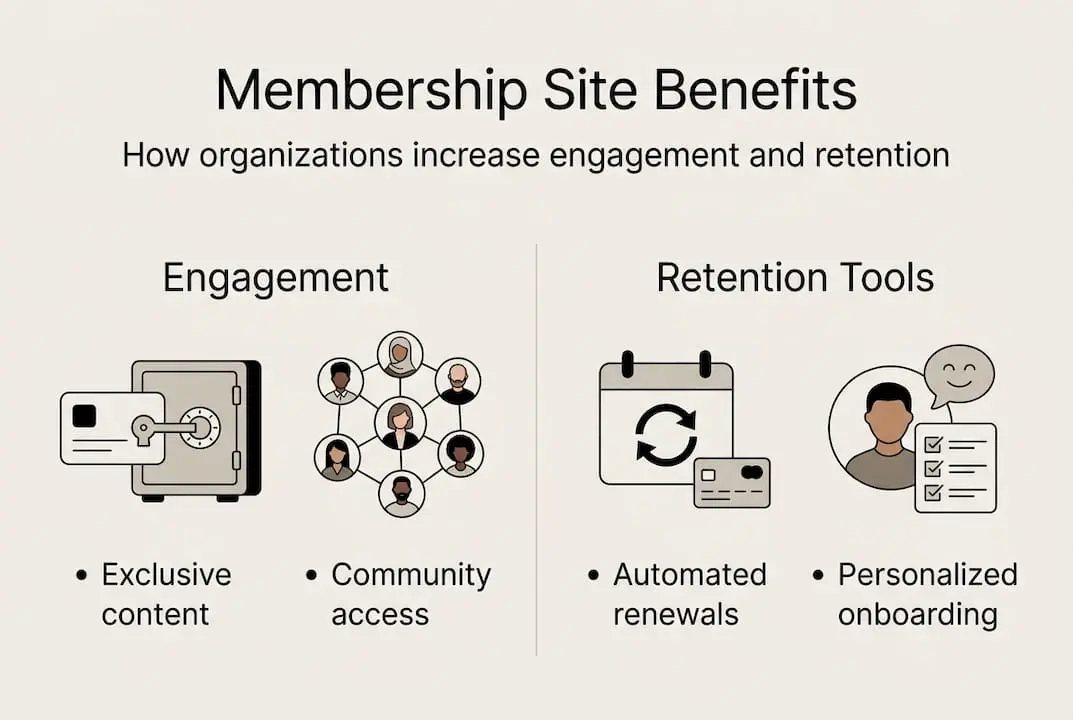
1. Predictable revenue and financial stability Subscription-based membership fees smooth out the peaks and troughs that plague event-only or donation-dependent organisations. When you know your baseline income months in advance, budgeting becomes a strategic exercise rather than a guessing game.
2. Deeper member engagement through exclusive content Members who access resources, training, webinars, and peer networks through your site have more reasons to stay. Exclusivity creates perceived value. When members feel they are receiving something genuinely useful, renewal becomes an easy decision.
3. Operational efficiency through automation Manual membership management is time-consuming and error-prone. Automating renewals, payment reminders, and onboarding sequences frees your team to focus on higher-value work. Learning how to boost retention with onboarding is one of the most impactful operational changes you can make.
4. Data-driven decision-making A membership site generates rich behavioural data. Which content do members access most? When do engagement levels drop? Which events drive the highest attendance? Understanding the core features explained by your platform helps you interpret this data and act on it confidently.
5. Improved renewal rates Well-run membership sites achieve retention rates of 80 to 95 percent. That benchmark is not aspirational; it is achievable with the right systems and consistent attention.

| Benefit area | Without a membership site | With a membership site |
|---|---|---|
| Revenue predictability | Low, event-dependent | High, subscription-based |
| Member data quality | Fragmented, inconsistent | Centralised, accurate |
| Communication efficiency | Manual, time-intensive | Automated, targeted |
| Engagement visibility | Limited | Real-time analytics |
| Renewal process | Ad hoc, easy to miss | Automated, consistent |
Pro Tip: Set up automated renewal reminders at 60, 30, and 7 days before a membership expires. This three-touch approach consistently outperforms single-reminder strategies and reduces last-minute lapses significantly.
Mechanics of engagement: the retention advantage
To fully realise these benefits, it is worth breaking down the specific mechanics that drive engagement and reduce churn. The evidence is clear: the first 90 days are where most retention battles are won or lost. Members who do not engage meaningfully within that window are far more likely to lapse at renewal.
This is where personalisation and automation become your strongest tools. A personalised communication pathway does not mean writing individual emails to every new member. It means using your platform to send the right message, at the right time, based on where each member is in their journey.
Here is what an effective automated onboarding sequence looks like in practice:
- Day 1: Automated welcome email with login credentials, a short video introduction, and links to the three most valuable resources.
- Day 7: A check-in message highlighting upcoming events and inviting the member to join a relevant community group.
- Day 21: A personalised nudge based on what the member has accessed, with suggestions for next steps.
- Day 60: A satisfaction prompt asking for feedback and signposting renewal benefits.
- Day 90: A progress summary celebrating what the member has achieved and previewing what is coming next.
| Onboarding approach | Time investment | Consistency | Personalisation | Retention impact |
|---|---|---|---|---|
| Manual onboarding | High | Variable | Limited | Moderate |
| Automated onboarding | Low (after setup) | Consistent | Scalable | High |
Measuring success is equally important. Tracking engagement metrics such as login frequency, content access rates, and event attendance gives you an accurate picture of member health. A member who has not logged in for 45 days is at risk. A member who attends every webinar and downloads resources regularly is a strong renewal candidate.
You can also use engagement scores to segment your membership and tailor communications accordingly. High-engagement members might receive invitations to advisory panels or ambassador programmes. Lower-engagement members might receive targeted re-engagement campaigns with a clear value proposition.
For practical frameworks you can apply immediately, reviewing proven retention strategies gives you a structured starting point. The goal is to move from reactive management, where you only notice lapsed members after the fact, to proactive engagement, where you identify at-risk members early and intervene effectively.
The key to onboarding new members successfully is treating the process as an experience rather than an administrative task. Members remember how they felt in those first weeks. Make it welcoming, structured, and genuinely useful.
Practical steps to maximise your membership site benefits
Having explored the why and the how, the next step is applying these principles to your own organisation. Here is a practical framework for getting started.
Audit your current member journey Walk through your membership site as a new member would. Is the onboarding process clear? Are the most valuable resources easy to find? Does the communication feel personal or generic? Identifying friction points is the first step to removing them.
Implement automation for onboarding and renewals If your team is still sending welcome emails manually or chasing renewals via spreadsheet, that needs to change. Automation is not about removing the human touch; it is about ensuring that no member falls through the cracks. Reviewing management basics for success can help you identify which processes to automate first.
Promote habit-forming behaviours in the first 21 days Encourage new members to log in daily during their first three weeks. Gamification elements such as progress bars, badges, or completion checklists make this engaging rather than obligatory. The habits formed early are the ones that persist.
Review engagement data regularly Schedule a monthly review of your key engagement metrics. Track metrics like logins and content access rates to identify trends before they become problems. A sudden drop in average login frequency across your membership is a signal worth investigating immediately.
Create member feedback loops Surveys, polls, and direct outreach give members a voice and give you actionable intelligence. Members who feel heard are significantly more likely to renew. Keep surveys short, act on the results visibly, and communicate back to members what you have changed as a result of their input.
Pro Tip: Use your platform’s segmentation tools to send targeted re-engagement campaigns to members who have not logged in for 30 days or more. A simple, friendly message asking what they need can recover a surprising number of at-risk memberships.
For organisations exploring how technology can amplify these efforts, understanding engagement software benefits provides a clear picture of what modern platforms make possible.
- Conduct a quarterly member journey audit to identify and resolve friction points.
- Automate at least three key touchpoints: welcome, mid-journey check-in, and renewal reminder.
- Use engagement data to segment members and personalise communications at scale.
- Build a feedback loop that closes the circle between member input and organisational action.
The hidden power of membership sites: what most overlook
Here is something we have observed consistently across the organisations we work with: most leaders treat their membership site as a set-it-and-forget-it tool. They invest in the initial setup, launch with enthusiasm, and then allow the platform to run on autopilot indefinitely. The results are predictably average.
The organisations that see extraordinary returns treat their membership site as a living, evolving member experience. They experiment with content formats, test different onboarding sequences, and use their analytics to make informed changes every quarter. They do not wait for renewal season to think about engagement.
The real power surfaces when you stop managing your site and start designing it around your members’ goals. Exploring advance retention thinking reveals that the most successful organisations continuously iterate, treating every data point as an opportunity to improve. Leaders who adopt this mindset create communities where members feel genuinely valued, and that loyalty is extraordinarily difficult for any competitor to replicate.
Ready to unlock more from your membership site?
If you are serious about putting these insights into action, the next step is straightforward. Colossus Systems brings together the tools you need to manage, engage, and grow your membership in one unified platform.
From automated onboarding and renewal workflows to advanced analytics and event management, our platform is built specifically for membership organisations. You can explore management features to see the full range of tools available, review our event management solutions for seamless event registration and delivery, or discover how our CRM integration options can centralise your member relationships and power more targeted communications. The organisations achieving 80 to 95 percent retention rates are not doing it manually. Let us show you how.
Frequently asked questions
What is a membership site and who should use one?
A membership site is an online platform offering exclusive content or services to registered members, ideal for associations, charities, and professional bodies seeking steady engagement and reliable revenue.
How do membership sites help boost member retention?
Membership sites boost retention by automating onboarding, encouraging early habit-building and engagement, and making the member experience consistently rewarding from day one.
What is the typical retention rate for successful membership sites?
The best-run membership sites achieve retention rates of 80 to 95 percent, a benchmark that is achievable with structured onboarding and consistent engagement practices.
What are the key features that make a membership site effective?
Key features include automated onboarding workflows, content personalisation, integrated payment collection, and member analytics that surface engagement trends in real time.
Recommended
- Integrating Your Website into a Membership CRM to Enhance Engagement |CS
- Membership Software for Societies and Clubs | Colossus Systems
- Improving Member Engagement: Proven Strategies for 2025|CS
- Online Event Platforms: Boosting Membership Engagement|CS
- How content hubs boost engagement: 60% conversion lift