90–180 day pilot: Colossus member engagement software for associations

Some membership organisations prefer an all-in-one platform that unifies member management, events, LMS and CRM in one configurable system rather than stitching tools together. Organisations that want a community-first experience should look at Hivebrite or Mighty Networks; those needing deep learning management should weigh iMIS; and groups wanting a lightweight AMS can start with Join It.
TL;DR:
- Integration capability is critical; select platforms that unify AMS, LMS, community, and events data around a consistent member ID to improve retention.
- Prioritize native integrations over extensive customizations, and verify exactly which systems and data fields are covered to avoid overpromising “full” integration.
- Conduct a focused pilot with clear success metrics within 90 to 180 days, ensuring a consistent member ID, documented consent, and field mapping across systems.
- For small associations, lightweight options like Join It or simple AMS may suffice, but large, complex groups benefit from platforms like iMIS or Colossus Systems offering deep reporting and broad integrations.
- Ensure vendors provide clear data security, encryption standards, data ownership rights, and support regional compliance rules, especially for international members.
Table of Contents
- Shortlist and side-by-side comparison of platforms
- Selection criteria that influence retention and renewals
- Pilot and implementation checklist (90-180 day plan)
- Colossus Systems: how the platform addresses common association needs
- Security and data privacy considerations
- Total cost of ownership including hidden and ongoing costs
- Support and training options provided by vendors
- Scalability and future-proofing capabilities
- User adoption strategies and change management
- Compliance with industry-specific regulations
- Procurement cautions and governance recommendations
- Colossus Systems: next steps and contact
- FAQ
- Sources
Shortlist and side-by-side comparison of platforms
Thirteen platforms dominate the conversation around member engagement software, and each serves a slightly different job. Colossus Systems positions itself as the unified option: member management, events, a learning portal, CRM and e-commerce sit inside one configurable system, with tiered plans that scale from small associations to large enterprises.
Higher Logic Thrive leans into community and marketing automation for larger associations that need tight integration between discussion forums and campaign tools. Clowder focuses on mobile-first engagement and event support, which suits organisations whose members interact mostly through a conference app. Tradewing builds community and networking features around professional events, while Join It strips membership administration down to a simple sign-up and payment workflow for smaller groups that do not need a learning portal or CRM.
iMIS serves large, complex associations that need broad integration and detailed reporting, a strength reflected in sector benchmarking from the 2026 Membership Performance Benchmark Report. MemberLeap offers a balanced, straightforward feature set for mid-sized associations watching their budget. Hivebrite and Mighty Networks both centre on paid community and course monetisation, useful for alumni networks or organisations selling access to content. Circle appeals to creators who want a tidy community and course experience with developer-friendly integrations. Discord and Slack, built for real-time chat rather than membership administration, suit informal peer networks that want low-latency conversation without a renewal or events system attached. Bettermode blends moderation tools with member experience features for organisations that need firmer control over community conduct.
| Platform | Best for | Primary use case | Integration strength | Customisation | Pricing model | Standout feature |
|---|---|---|---|---|---|---|
| Colossus Systems | Associations wanting one unified vendor | All-in-one: community, events, LMS, CRM | AMS, LMS, community, events, payments | High, configurable workflows | Tiered plans (Core to Enterprise) | Integrated suite across member lifecycle |
| Higher Logic Thrive | Large associations prioritising marketing | Community plus marketing automation | Community and marketing systems | Moderate | Tiered | Community and automation integration |
| Clowder | Event-centric, mobile-first groups | Events and mobile engagement | Event platforms | Moderate | Tiered | Mobile app and event features |
| Tradewing | Professional networking events | Community and event connection | Event and networking tools | Moderate | Tiered | Networking-focused community |
| Join It | Small organisations, simple admin | Lightweight AMS and payments | Payment gateways | Low | Per-member | Low administrative overhead |
| iMIS | Large, complex associations | Enterprise AMS with reporting | Broad ecosystem integrations | High | Licence-based | Enterprise reporting depth |
| MemberLeap | Mid-sized associations on a budget | Membership, community, events | AMS-level integrations | Moderate | Tiered | Balanced features at accessible pricing |
| Hivebrite | Alumni and paid networks | Community and monetisation | Community platforms | High | Tiered | Monetisation and alumni tools |
| Mighty Networks | Paid community and course sellers | Community plus courses | Course and payment tools | Moderate | Tiered | Course and community bundling |
| Circle | Creators building community and LMS | Community with course content | Developer-friendly integrations | High | Tiered | Clean UX, integration flexibility |
| Discord | Informal peer communities | Real-time chat and voice | Limited AMS integration | Low | Free or tiered | Low-latency chat and voice |
| Bettermode | Groups needing moderation control | Community moderation and engagement | Community integrations | Moderate | Tiered | Moderation and member experience tools |
| Slack | Internal or informal team communication | Real-time messaging | Workplace tool integrations | Low | Tiered | Channel-based messaging |
Security note: vendors in this category typically publish statements on data protection, encrypted payment handling and access controls. Confirm these in writing before signing, since membership data often includes payment details and personal information that carry regulatory weight.
Integration note: check whether a platform connects natively to your AMS, LMS, community tool and events system, or whether data has to be exported and rejoined manually, a gap that sector briefing data flags as a persistent cause of measurement failure.
Selection criteria that influence retention and renewals
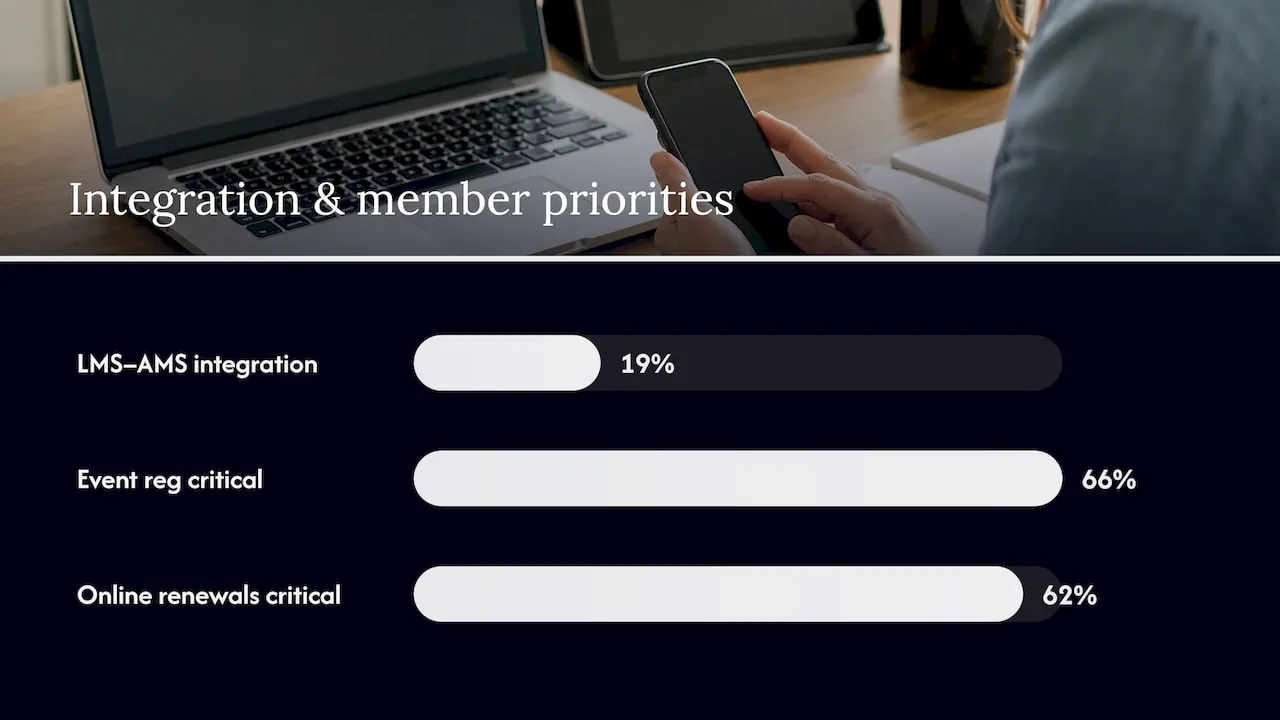
Integration capability should carry the most weight in any shortlist. Sector briefing research found that LMS integration with AMS records sits at around 19%, leaving most organisations unable to see a complete picture of how a member learns, attends and renews. Prioritise platforms that unify AMS, community and LMS data around one consistent member ID before worrying about add-on features.
An engagement score built from leading indicators (course completion, forum replies, event registration) will flag at-risk members well before a lagging indicator like a missed renewal shows up. Practitioner guidance suggests predictive models built on 12 to 24 months of behavioural and renewal data can identify at-risk members 90 to 180 days ahead of lapse, giving staff time to intervene.
Mobile access and low-friction self-service matter more than most procurement teams assume. A sector report on association technology found that 66% of members rate online event registration as critical and 62% say the same about online renewals and account updates. A platform with a clunky mobile experience will suppress exactly the self-service behaviours that engagement scoring depends on.
- Prioritise native integration with your existing AMS, LMS and community tools over a longer feature list.
- Weigh customisation against ongoing maintenance: heavily customised workflows often need dedicated admin time to keep current.
- Treat vendor claims of “full integration” as a red flag unless they name the specific systems and data fields covered.
Pro Tip: Start your engagement score with six to ten behaviours you can already measure, rather than waiting for a perfect data warehouse.
Pilot and implementation checklist (90-180 day plan)
A focused pilot beats a full rollout for proving value quickly. Pick one priority cohort, such as a single chapter or membership tier, and define two or three success metrics before you touch the software.
- Confirm a consistent member ID across your AMS, community platform, LMS and events system so records join cleanly.
- Document consent and data-sharing permissions for the cohort before importing any personal data.
- Map fields between systems (renewal date, attendance, course completion) rather than assuming automatic matching.
- Train a small group of staff and a handful of member volunteers before wider rollout.
- Set a reporting cadence (weekly during the pilot, monthly after) so leadership sees progress without waiting for a final report.
Practitioner guidance recommends starting with two to three integrated systems and building a consolidated member-level dataset from exported records, rather than attempting a full replatform on day one.
Colossus Systems: how the platform addresses common association needs
This platform brings member management, events, a learning portal, CRM and e-commerce into one configurable system, available across multiple tiers with an optional licence for added users. That structure lets associations unify the AMS, LMS, community and events data that engagement scoring depends on, without the manual exports that slow down smaller teams.
- Multiple tiers scale the platform from small associations to large, multi-chapter organisations.
- Payment gateways support event registration, membership renewals and e-commerce within one workflow.
- Sales pipelines and event registration flows can be customised to fit operational needs.
- An additional licence option lets organisations add staff or volunteer access without moving tiers.
Security and data privacy considerations
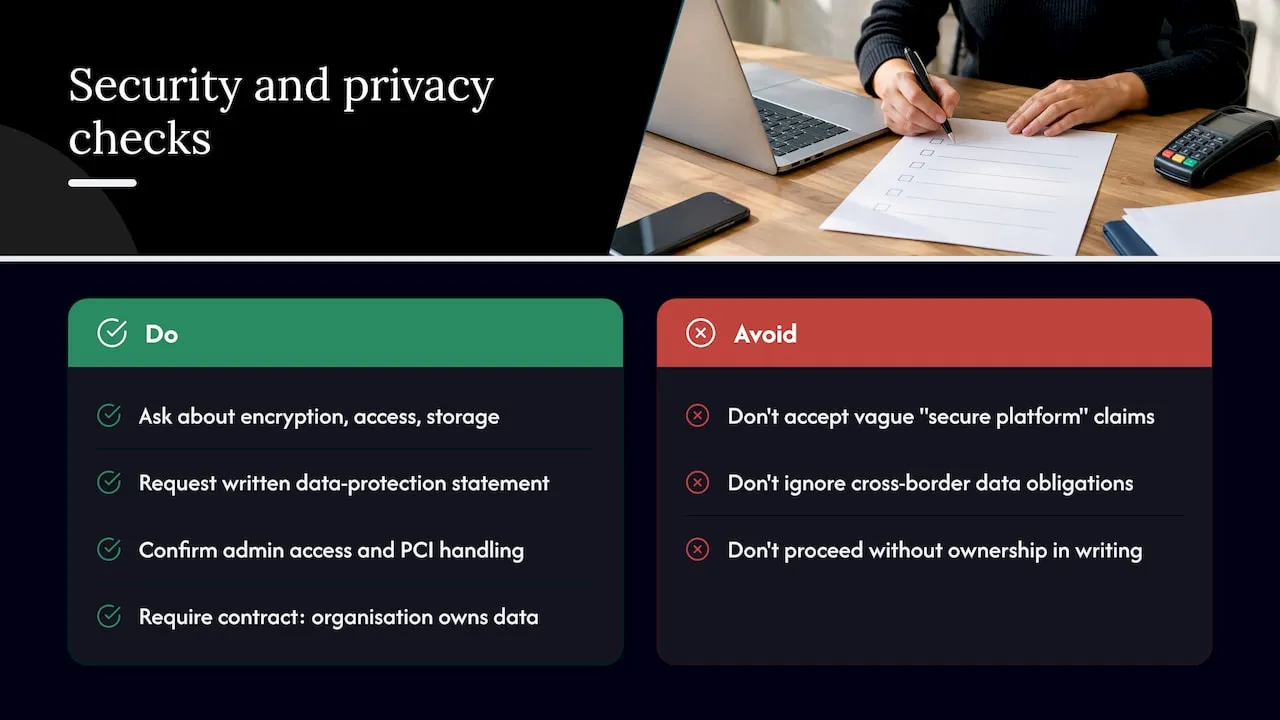
Membership platforms hold sensitive data: payment details, personal identifiers and sometimes health or professional licensing information. Any vendor shortlist should include a direct question about encryption standards, access controls and where data is physically stored, since the answer affects both compliance exposure and member trust.
Ask vendors for a written statement on data protection rather than relying on a general “secure platform” claim. Confirm how payment processing is handled, whether gateways are PCI compliant, and who has administrative access to personal records inside the platform. Organisations handling data from members in multiple countries should also confirm how the vendor supports regional data protection obligations, since requirements differ by jurisdiction and the vendor’s answer should be specific to where your members are based.
Data ownership is a separate question from data security. Confirm in the contract that your organisation retains ownership of member data and can export it in a usable format if you ever change providers. A vendor that cannot answer this clearly in writing is a procurement red flag regardless of how polished its interface looks.
Total cost of ownership including hidden and ongoing costs
The published subscription fee is rarely the full cost. Budget separately for data migration, staff training time, custom integration work and any contributor or seat-based licences that sit outside the core plan. Colossus Systems, for example, lists its Core, Growth, Scale and Enterprise tiers alongside a contributor licence from £29 per month, which covers additional staff access beyond the base plan.
Ongoing costs tend to include payment processing fees, storage for growing event and learning content, and the admin time needed to maintain customised workflows. A heavily customised setup can look cheap at signature and expensive a year later once maintenance hours are counted. Ask any vendor for a breakdown of what is included in the base price versus billed separately before comparing headline numbers across the shortlist.
Renewal-year costs also deserve attention. Some platforms increase per-member or per-seat fees as your membership grows, which changes the economics for organisations expecting expansion. Build a three-year cost projection rather than comparing only the first-year quote.
Support and training options provided by vendors
Onboarding quality varies sharply across this category, and it shapes how quickly a pilot produces usable results. Ask each vendor what onboarding actually includes: a guided setup call, a dedicated implementation manager, self-service documentation, or some combination of the three.
Training needs differ by team size. A small association may need a single structured onboarding session for two or three staff, while a large, multi-chapter organisation may need role-based training across membership, events and learning teams. Confirm whether training is included in the subscription price or billed as a separate service, since this is a common source of unexpected cost.
Ongoing support matters as much as onboarding. Ask about response times for support tickets, whether a dedicated account manager is included at your tier, and how the vendor handles feature requests or integration issues that surface after go-live. A platform that handles onboarding well but offers thin ongoing support will show its limits once the pilot ends and daily use begins.
Scalability and future-proofing capabilities
A platform that suits a 500-member association may buckle under a 20,000-member one, so scalability deserves a direct test during evaluation. Ask vendors how their pricing and performance change as membership, event volume or content library size grows, rather than assuming the platform scales linearly.
Tiered pricing structures give a visible path for growth: an organisation can move up tiers as its needs expand rather than renegotiating a custom contract each time. Confirm what changes at each tier beyond price, since some platforms gate essential integration features behind higher tiers.
Future-proofing also means checking how often the vendor ships new integrations and whether the platform’s API supports connections to tools you might adopt later. A platform that only integrates with today’s stack risks becoming another silo in two years’ time.
User adoption strategies and change management
Software adoption fails more often from change management gaps than from technical faults. Staff need a clear reason to use a new system daily, and members need the new experience to be easier than whatever they used before, not just different.
Start adoption with the staff who will use the platform most, rather than rolling it out to everyone simultaneously. A small group that becomes genuinely proficient can support colleagues during wider rollout far better than a one-off training session for the whole team.
For members, lead with the self-service features they already want: online renewals and event registration, which sector survey data shows the majority rate as critical. If the new portal makes those two tasks faster, adoption tends to follow without heavy promotion. Communicate the change in plain terms, show members what is different, and keep the old process available briefly during transition to avoid a hard cutover that frustrates less tech-confident members.
Compliance with industry-specific regulations
Membership organisations sit under varied regulatory obligations depending on sector and location: data protection rules for storing personal information, payment card industry standards for processing dues and event fees, and sometimes sector-specific requirements for professional bodies that issue certifications or continuing education credits.
Confirm that any platform you shortlist supports the specific compliance obligations your organisation carries, rather than assuming general “compliant” language covers your case. A professional association issuing continuing education credits, for example, may need the LMS component to produce auditable completion records, a need reflected in how continuing education partners structure their member affiliate programmes.
Payment handling is the most universal compliance point: confirm the platform’s payment gateway meets the card industry standards relevant to your market before processing any dues or event fees through it. Where your members span multiple countries, ask the vendor directly how the platform supports the data protection rules in each relevant jurisdiction, since this varies by region and a generic answer is not sufficient grounds for compliance sign-off.
Procurement cautions and governance recommendations
The most common procurement mistake is letting departments buy point solutions in isolation, which recreates the data silos that make engagement measurement unreliable in the first place. Present the board with leading indicators, not just renewal totals, since behavioural signals surface problems months before renewal figures do. Insist on contract clauses covering integration scope, data ownership and onboarding service levels before signing.
— Rob
Colossus Systems: next steps and contact
Colossus Systems gives associations one configurable platform for membership, events, learning and CRM instead of several disconnected tools, which is the practical advantage this article has argued for throughout.
Review the Core, Growth, Scale and Enterprise plans to find the tier that fits your membership size, or get in touch to talk through your pilot scope before you commit.
FAQ
What is the best software for membership management?
The right choice depends on organisation size and priorities: Colossus Systems suits associations wanting one unified platform for membership, events, LMS and CRM, while iMIS suits large, complex organisations needing deep enterprise reporting. Smaller groups with simple needs often do well with a lighter AMS such as Join It.
What is the best employee engagement software for associations?
Member engagement software and employee engagement software solve different problems: the former manages external member relationships, renewals and community, while the latter focuses on internal staff morale and feedback. Associations evaluating member-facing tools should look at platforms like Colossus Systems, Hivebrite or iMIS rather than internal HR engagement tools.
What is membership engagement?
Membership engagement describes how actively members participate in an organisation’s community, events, learning content and renewal behaviour. It is typically measured through a mix of leading indicators, such as event registration and course completion, and lagging indicators like renewal rate.
What are the best community engagement platforms for associations?
Hivebrite and Mighty Networks lead on community and monetisation features, Circle suits creators pairing community with course content, and Bettermode focuses on moderation alongside engagement. Associations wanting community features bundled with full membership management and CRM typically choose an all-in-one platform like Colossus Systems instead.
How do I measure member engagement effectively?
Effective measurement combines leading indicators, such as course completion and forum activity, with lagging indicators like renewal rate, rather than relying on renewal data alone. Practitioner guidance recommends building a simple engagement score from six to ten tracked behaviours before attempting anything more complex.
Sources
- Maximizing Member Engagement: Strategies for Active Participation - Knecht Strategies
- Tech success for associations (sector report) - PWSA
- Membership sector briefing - Intercloud9
- 2026 Membership Performance Benchmark Report by iMIS