Grant Writing Tips Reviewers Reward: 48 Hour Rule for Nonprofit Teams

Read the funding announcement before you write a single sentence, and shape every section of your proposal to its exact scoring criteria. That one habit separates funded applications from rejected ones more reliably than talent or budget size. Give yourself several weeks, submit early, and lean on the standards set by bodies like the NIH and Grants, plus tools like Colossus, to build the evidence reviewers expect.
TL;DR:
- Matching the budget line for each activity and securing all attachments early reduces errors and prevents administrative rejection.
- Clarifying objectives with specific, measurable, and time-bound goals ensures reviewers can easily score progress and success.
- Engaging external pre-readers early in the process helps identify logical gaps and strengthens the proposal before submission.
- Tailoring the proposal language to reflect each funder’s priorities and priorities enhances alignment and competitive scoring.
- Using a centralized data system like Colossus streamlines evidence collection, making evaluation and reporting more efficient.
Table of Contents
- Grant writing tips that make the biggest difference first
- How do you choose the right funder and read the NOFO properly?
- Building a project plan for the application itself
- Writing SMART objectives that reviewers can actually score
- Designing methods and an evaluation plan reviewers trust
- Constructing a budget that proves you can deliver
- Writing for reviewers, not for yourself
- Attachments, letters of support, and admin documents
- The last 72 hours: your final submission checklist
- Why early feedback and pre-reads change outcomes
- Defining impact and using preliminary data well
- Common mistakes that sink otherwise strong proposals
- Tailoring the proposal to what this funder actually wants
- Persuasive storytelling that still respects the evidence
- Keeping every section clear and concise
- Revising and proofreading before you submit
- Handling rejection and strengthening your next application
- Making grant writing repeatable across a team
- Let Colossus handle the evidence reviewers ask for
- Where to check the details before you submit
- Sources
Grant writing tips that make the biggest difference first
Reviewers rarely read your proposal twice. Most work through 50 to 100 applications in a single cycle, according to NIH guidance, which means clarity and structure win over cleverness almost every time. The checklist below orders actions by impact, not by when they happen chronologically in your process.
- Start early and build a realistic timeline. Grant writing under pressure produces weaker narratives and sloppier budgets. Give yourself at least six to eight weeks for a mid-size application.
- Treat the NOFO as your rubric, not background reading. Map every section of your proposal directly to the funder’s stated review criteria, in the order they list them.
- Write SMART objectives and a sharp executive summary. Reviewers should understand your project’s purpose within the first two paragraphs.
- Match your budget to your narrative, line for line. If you claim three staff members will run a programme, the budget needs three salaries that add up correctly.
- Budget for evaluation. Most funders now expect 10 to 15% of total costs allocated to measuring outcomes, per GrantMetric’s guidance.
- Collect attachments and letters of support weeks in advance. Partners and finance officers are slow. Chase them early.
- Submit at least 48 hours before the deadline. Portal failures are common and rarely excused, according to Grants.
None of these steps are difficult individually. What trips up most first-time applicants is sequencing. Writing the narrative before confirming eligibility, or building the budget before finalising activities, creates rework that eats the weeks you needed for polishing.
How do you choose the right funder and read the NOFO properly?
Fit matters more than ambition. A perfectly written proposal to the wrong funder still fails, so confirm alignment before you invest real hours.
- Check the funder’s past award history. If they have never funded organisations your size or your sector, ask why you’d be the exception.
- Confirm your eligibility against every stated criterion, not just the obvious ones like location or tax status.
- Extract the scoring criteria and required attachments directly from the NOFO or FOA text; treat it as a literal checklist rather than a general guide.
- Contact the programme officer before you write, not after you’re stuck. Ask about priorities, likely award size, and whether your project idea fits this cycle.
- Watch for deal-breakers: a funder that explicitly excludes your activity type, a deadline that’s genuinely impossible to hit with quality work, or a required match you cannot provide.
Programme officers exist to help you avoid wasting their time and yours. A five-minute call often reveals whether your concept fits before you draft a single page.
Building a project plan for the application itself
Grant writing is a project, and it needs the same discipline you’d apply to any deadline-driven deliverable. Foundation applications with simpler formats might need three to four weeks of lead time; federal applications with logic models, multiple attachments, and detailed budgets often need eight to twelve.
- Assign clear roles: a narrative lead, a budget lead, an attachments owner, and at least one pre-reader who wasn’t involved in drafting.
- Build a month-by-month or week-by-week timeline, working backwards from the deadline.
- If the NOFO requires a logic model, build it early. It shapes how your narrative and evaluation plan need to connect.
- Leave a submission buffer of at least 48 hours for technical issues on the funder’s portal.
Pro Tip: Book your pre-reader’s time on the calendar before you start writing, not after the draft is done. A pre-reader with three days’ notice gives you better feedback than one you ambush the night before submission.
Writing SMART objectives that reviewers can actually score
Vague goals cost points. “Improve literacy outcomes” tells a reviewer nothing they can measure. The NIH’s guidance on SMART objectives (Specific, Measurable, Achievable, Relevant, Time-bound) exists precisely because reviewers need concrete numeric targets to score consistently.
- Write two to three objectives per programme goal. More than that dilutes focus; fewer often signals you haven’t thought through your outcomes.
- Place your objectives near the front of the narrative, ideally within the Specific Aims or executive summary, and echo the same numbers again in your evaluation section.
- Every objective needs a baseline, a target, and a timeframe. Skip any one of the three and reviewers will flag it.
- Avoid words like “enhance”, “support”, or “strengthen” without a number attached. Reviewers read these as evasion, not ambition.
Objectives that survive scrutiny are boring in the best way: specific, checkable, and unambiguous.
Designing methods and an evaluation plan reviewers trust
Feasibility is what separates an exciting idea from a fundable one. Your methods section needs to show reviewers exactly who does what, when, and how you’ll know if it worked.
- Name evidence-based practices where they exist, and explicitly justify any adaptation you’ve made to fit your population or context.
- Separate process measures (did you deliver what you said you would) from outcome measures (did it change anything).
- State your success thresholds before you collect data, not after. “We consider this successful if 70% of participants complete the programme” is a threshold; “participants will benefit” is not.
- Use a logic model to make the chain from inputs to activities to outputs to outcomes explicit, particularly when the NOFO requires one.
| Measure type | What it tracks | Example instrument |
|---|---|---|
| Process | Delivery and reach | Attendance logs, session counts |
| Outcome | Change in participants | Pre/post assessments, surveys |
| Fidelity | Adherence to the model | Facilitator checklists |
Funders increasingly weight the evaluation plan as heavily as the programme design itself, a shift worth taking seriously rather than treating evaluation as an afterthought section.
Constructing a budget that proves you can deliver
Your budget is the part reviewers cross-check hardest, because arithmetic errors reveal sloppiness faster than prose ever does. Build every line item from the narrative itself. If a paragraph describes a part-time coordinator, the budget should show that person’s FTE, salary, and the maths behind it.
- Personnel: show FTE percentage multiplied by annual salary, not a lump figure that requires the reviewer to trust you.
- Travel, consultants, and supplies: itemise rather than bundling into vague categories like “programme costs”.
- Indirect costs: state your negotiated rate or the funder’s allowed de minimis rate, and apply it consistently.
- Evaluation: budget 10 to 15% of total costs, matching GrantMetric’s recommended range, and show it as a distinct line rather than folding it into “other”.
- If matching or non-federal match is required, confirm the source of those funds in writing before you submit, not after award notification.
Run one final pass comparing every number in the budget narrative against the spreadsheet total. Mismatches here are one of the fastest ways to lose reviewer confidence.
Writing for reviewers, not for yourself
Reviewers are frequently generalists working across a broad portfolio, not specialists in your particular field. Writing that assumes deep domain knowledge loses points, even when the underlying work is excellent.
- Keep sentences to 20 words or fewer where possible; academic writing guidance from Harvard Catalyst consistently links shorter sentences to better reviewer comprehension.
- Structure headings to mirror the NOFO’s own criteria order, so scoring feels effortless rather than like a scavenger hunt.
- Bold key facts and numbers so a tired reviewer skimming page nine still catches your main points.
- Run at least one independent pre-read, then read the whole narrative aloud before final submission.
Pro Tip: If a sentence needs a semicolon to hold itself together, split it. Reviewers reading their sixtieth proposal that week will thank you.
Formatting errors, wrong margins, missing page numbers, exceeding page limits, are entirely avoidable and entirely common. Check the NOFO’s formatting rules twice.
Attachments, letters of support, and admin documents
- Gather standard attachments early: IRS determination letters, audited financials, organisational charts, and board lists.
- Request letters of support that state concrete commitments, staff time, referral numbers, in-kind space, rather than generic praise. Congressional research on federal proposals flags vague letters as a recurring weakness reviewers notice immediately.
- Confirm your financial documents are current; an expired audit or an outdated 501©(3) letter can trigger administrative rejection.
- Name files exactly as the NOFO instructs, including capitalisation and required abbreviations.
The last 72 hours: your final submission checklist
- Cross-check every NOFO requirement against your final document set, line by line.
- Confirm your budget totals match the figures quoted in your executive summary and narrative.
- Verify every attachment is present, signed, and named correctly.
- Submit at least 48 hours ahead of the deadline; Grants.gov guidance treats technical portal failure as a non-excusable cause of rejection.
- Save a timestamped confirmation receipt the moment your submission goes through.
Missing formatting or a forgotten attachment remains one of the most common reasons applications get rejected before a reviewer ever reads them, according to NIH’s administrative review guidance. Nearly all of these failures are preventable with a clean final pass.
Why early feedback and pre-reads change outcomes
The single cheapest improvement you can make to any proposal is asking someone else to read your Specific Aims or concept note before you’ve written the full narrative. Logical gaps that feel obvious to an outside reader are often invisible to the person who’s been living inside the project for weeks.
Research on federal grant proposals points to iterative writing with early external feedback as one of the most effective ways to catch structural problems while they’re still cheap to fix. Waiting until the draft is “finished” to seek feedback means any major issue, a weak theory of change, an evaluation plan that doesn’t match your objectives, requires rebuilding sections you thought were done.
Build at least two feedback checkpoints into your timeline: one after the concept note or Specific Aims stage, and one after the full first draft. Choose pre-readers who weren’t involved in writing, ideally someone unfamiliar with your specific programme. If they can’t follow your logic without your added explanation, neither can the reviewer.
Ask pre-readers a narrow set of questions rather than “what do you think”: Is the problem statement convincing? Do the objectives match the methods? Does the budget make sense given what you’ve described? Vague feedback requests get vague answers.
Defining impact and using preliminary data well
Significance sections fail most often because they describe a problem in general terms without connecting it to what your specific project will change. Reviewers want scale (how many people, how severe the gap) alongside a clear line to your proposed activities.
Where you have preliminary data, even from a small pilot or a single prior cohort, use it. Preliminary data tells reviewers you’ve already tested part of your approach and it didn’t collapse on contact with reality.
If you genuinely have no preliminary data, lean on published research or comparable programme results to establish that your approach has precedent. Naming the evidence base, and being honest about where your project innovates rather than replicates, builds more trust than vague claims of novelty.
Significance and impact sections should answer three questions in sequence: why does this problem matter now, what happens if nothing changes, and specifically how does your project change that trajectory. Skipping straight to the third question without grounding the first two is a common weakness reviewers flag repeatedly.
Common mistakes that sink otherwise strong proposals
Most rejected proposals aren’t rejected for lack of a good idea. They’re rejected for preventable execution errors.
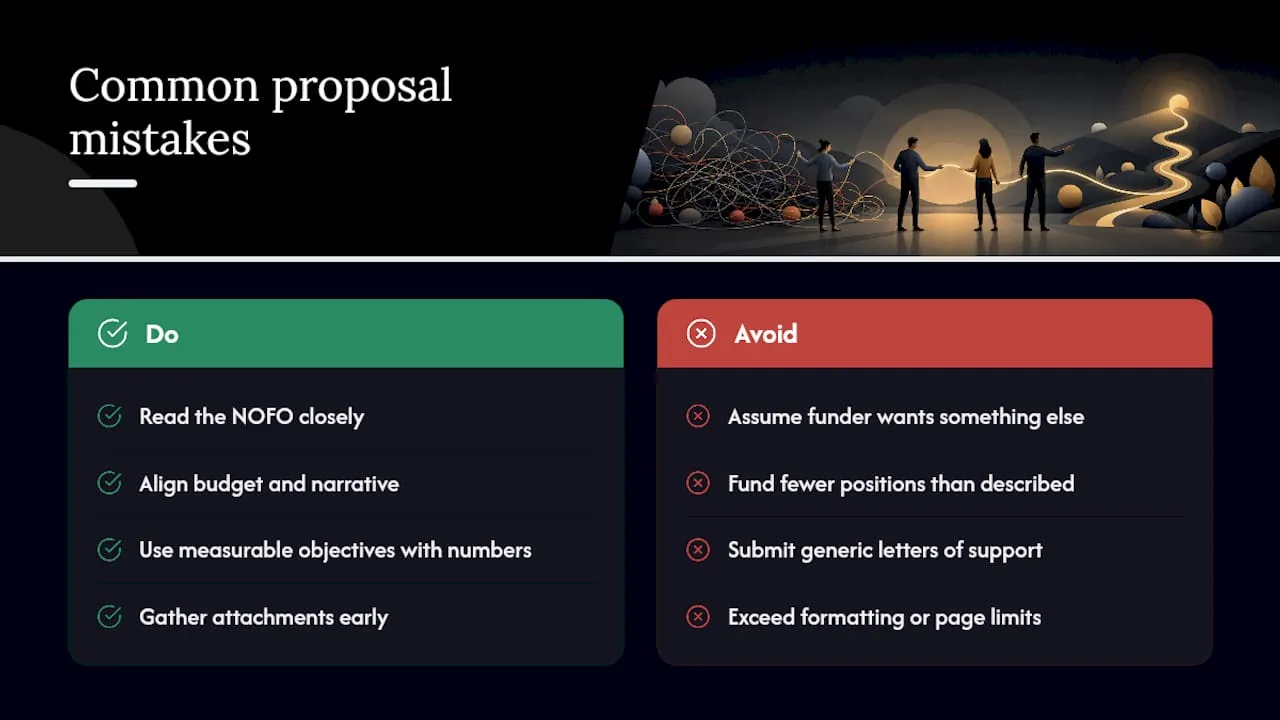
The most frequent mistake is misreading the NOFO, addressing what you assume the funder wants rather than what they’ve explicitly asked for. A close second is budget-narrative mismatch: describing four staff positions in the text and funding three in the spreadsheet. Vague objectives without numbers cost points reliably, as do letters of support that read as generic form letters rather than specific commitments.
Formatting failures, exceeding page limits, wrong font size, missing required sections, cause administrative rejection before a reviewer even opens the narrative, a fact NIH’s own review guidance states plainly. Waiting until the final week to gather attachments is another recurring failure point; letters of support and financial documents take longer to secure than most applicants expect.
Finally, watch for scope creep in the narrative, promising outcomes your budget and timeline can’t realistically support. Reviewers who’ve read dozens of proposals spot inflated claims quickly, and an overpromised project reads as a red flag rather than a strength.
Tailoring the proposal to what this funder actually wants
A strong proposal rewritten for the wrong funder is still a weak submission. Funders publish their priorities directly in the NOFO, in their strategic plans, and often in previously funded project summaries, and the applications that score best echo that language back deliberately.
Read at least two or three previously funded summaries from the same funder if they’re published. Note the language they use for success, the scale of projects they typically fund, and whether they favour innovation or proven models. If a funder’s materials repeatedly emphasise “sustainability” or “community-driven design”, those exact concepts need visible space in your narrative, not just implied support.
Resist the temptation to submit the same proposal to five funders with only the logo changed. Reviewers at each organisation know their own priorities intimately, and generic language reads as generic immediately. Adjust framing, emphasis, and even which outcomes you lead with, based on what each specific funder has stated matters most to them.
Persuasive storytelling that still respects the evidence
The strongest proposals pair a specific, human anecdote with hard data, never one without the other. A single sentence describing a real participant’s situation, without naming them if privacy requires it, makes abstract statistics land differently than numbers alone ever could.
Structure your narrative arc deliberately: establish the problem concretely, introduce your organisation’s credibility to address it, then walk through your solution with the specificity you’ve built into your methods section. Avoid burying your strongest evidence in the middle of a paragraph; reviewers skim, and your best data point deserves its own sentence.
Storytelling in a grant proposal isn’t decoration. It’s the mechanism that makes a reviewer, who’s read forty other proposals that week, remember yours specifically when scoring time comes.
Keeping every section clear and concise
Clarity is a discipline you apply during editing, not something you achieve on a first draft. Cut every sentence that doesn’t add new information, and read each paragraph asking whether a reviewer unfamiliar with your field would follow it on one read.
Favour active voice over passive constructions; “our team will deliver 12 workshops” reads faster than “12 workshops will be delivered by our team”. Cut qualifying phrases like “in order to” and “it is important to note”, they add length without adding meaning. If a paragraph exceeds six or seven sentences, check whether it’s actually covering two ideas that deserve separate paragraphs.
Revising and proofreading before you submit
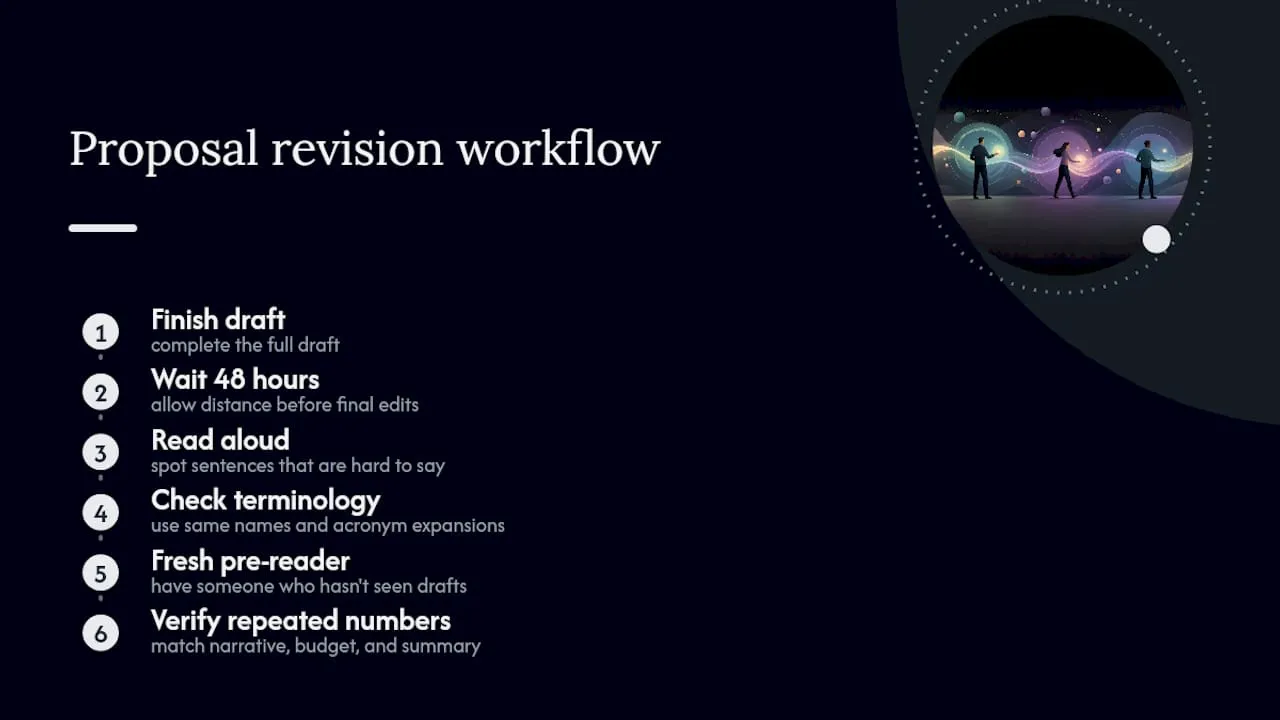
Editing a grant proposal well requires distance you don’t have the day you finish drafting. Build in at least 48 hours between finishing your draft and doing your final edit pass, longer if your timeline allows it.
Read the narrative aloud; sentences that are hard to say aloud are usually hard to read too. Check that your terminology stays consistent throughout, the same programme name, the same acronym expansion, used the same way in every section. Have at least one pre-reader check the document who hasn’t seen any previous draft, since fresh eyes catch logic gaps that familiarity hides. Finally, verify every number that appears more than once, in the narrative, the budget, and the executive summary, matches exactly everywhere it’s stated.
Handling rejection and strengthening your next application
Rejection is the norm in grant writing, not the exception, and treating a declined application as data rather than failure is what separates applicants who eventually win funding from those who give up after one try.
Request reviewer feedback whenever the funder offers it; even brief scoring notes reveal which section lost you the most points. If methods scored low, that’s where your next revision needs the most work, not a uniform polish across every section. Keep a running document of lessons from each submission: which funders responded well to which framing, which attachments took longest to gather, which objectives reviewers questioned. That record turns each rejection into faster, sharper work on the next application, rather than starting from zero each time.
Making grant writing repeatable across a team
Grant writing gets easier once it stops being a solo scramble against a deadline. Rob runs proposal work as short sprints: a week for the concept note, a scheduled pre-read, then a focused push on methods and budget together, since those two sections need to agree with each other line by line.
Templates earn their place for structural elements, org history, staffing bios, standard attachments, but the needs statement and evaluation plan deserve bespoke writing every time; funders notice recycled language fastest in exactly those sections. Bring in a freelance writer or evaluator when the internal team lacks bandwidth or evaluation expertise, not as a default. After every submission, win or lose, log what took longest and what reviewers asked, because that record is what makes the next proposal faster.
— Rob
Let Colossus handle the evidence reviewers ask for
Most of the sections above depend on data you should already be collecting: participant outcomes, attendance patterns, and programme reach. Colossus gives membership organisations and nonprofits a single place to gather that evidence, so writing your needs statement and evaluation plan means pulling a report rather than reconstructing numbers from scattered spreadsheets.
The CRM tools track participant demographics and referral patterns that feed directly into your significance section, while the event management features log attendance and activity data you can cite as preliminary results in your next application. Because everything lives in one system, building the dashboards that support your budget justification and outcome reporting takes a fraction of the time it does when data sits across four different tools. Check the full feature set to see what your team could have running before your next deadline.
Where to check the details before you submit
Confirm every rule against the primary source: your funder’s NOFO or FOA page, Grants.gov’s submission guidance, Harvard Catalyst’s writing resources, and, for hands-on templates, GrantMetric’s proposal guidance or a partner training resource like REED Charitable Foundation’s literacy programme.
Sources
- General grant writing tips | NIH
- Writing and communication resources | Harvard Catalyst
- Grants
- How to write a grant proposal | GrantMetric