Stop Losing Members: Debit Card 3D Secure for Membership Payments

3D Secure is an authentication protocol that verifies you’re really you during online debit or credit card payments, not just someone who has typed in the right card number. It can stop unauthorised transactions before they complete, and often shifts liability for authenticated purchases onto the card issuer rather than the merchant. Modern EMV 3DS is mostly invisible, only interrupting checkout when the transaction looks genuinely risky.
TL;DR:
- Ensuring high-quality device and customer data input into the ACS reduces unnecessary challenges and false declines, especially for recurring and high-value transactions.
- Supporting multiple authentication channels like push notifications and app-based verification helps mitigate failures caused by SMS OTP issues, particularly abroad.
- Properly tuning risk settings and monitoring challenge rates alongside fraud and conversion metrics enhances security without sacrificing customer experience.
- Confirming that your payment gateway supports EMV 3DS version 2.2 or higher is crucial for balancing security, low friction, and regulatory compliance.
- Cross-border transactions and privacy tools can cause genuine customers to face unnecessary challenges, so offering alternative verification options is essential.
Table of Contents
- How debit card 3D Secure actually works behind the scenes
- What changed with EMV 3DS and why it matters for debit cards
- What do cardholders see when 3D Secure kicks in?
- Why does 3D Secure matter for merchant fraud and chargebacks?
- How merchants actually implement EMV 3DS
- Where 3D Secure still falls short
- How Colossus approaches 3D Secure for membership payments
- Where to read the primary standards
- What actually matters here, and what gets overstated
- Sources
How debit card 3D Secure actually works behind the scenes
Every 3D Secure transaction runs across three separate domains, and understanding them explains why the process sometimes feels instant and sometimes doesn’t.
The merchant/acquirer domain covers the shop and its bank. The issuer domain covers your bank, specifically the Access Control Server (ACS), which makes the authentication decision on the card issuer’s behalf. Between them sits the interoperability domain, run by the card networks and built on EMVCo specifications, which passes messages back and forth so the other two domains can actually talk to each other.
Here’s roughly what happens once you hit “pay”:
- The merchant’s checkout page, via its Merchant Plug-In (MPI), sends a directory server lookup to check whether your card is enrolled in 3D Secure.
- Transaction and device data, things like your basket value, billing address, device fingerprint and browsing history with that merchant, gets passed to the issuer’s ACS.
- The ACS scores the risk. Low-risk transactions get waved through with no interruption. Higher-risk ones trigger a challenge, an extra verification step.
- The result flows back through the network to the merchant, who then sends the transaction for standard authorisation.
That final step matters: 3D Secure authentication happens before authorisation, not instead of it. A transaction can pass 3D Secure and still get declined for insufficient funds, and the two systems shouldn’t be confused.
What changed with EMV 3DS and why it matters for debit cards
The original 3DS1 protocol relied on static passwords entered into clunky pop-ups, a system that frustrated cardholders and pushed many to abandon their baskets entirely. EMV 3DS, now widely known as 3DS2, replaced that with something far more capable.
- It exchanges roughly ten times more data points between merchant and issuer, letting the ACS make sharper risk decisions instead of guessing.
- It works natively inside mobile apps, not just browsers, which matters given how much shopping now happens on a phone.
- It supports biometric and app-based authentication instead of forcing everyone through a password field.
- It aligns with Strong Customer Authentication (SCA) requirements under European PSD2 rules, giving merchants a built-in path to regulatory compliance.
EMVCo’s own guidance recommends running version 2.2 or higher for the best mix of security and low friction, and it’s worth checking your gateway or acquirer supports the current spec rather than an older 2.0 build. The practical payoff for debit card issuers and merchants is fewer abandoned baskets: EMV 3DS reduces unnecessary challenges precisely because it has better data to work with, which is the single biggest improvement over the original protocol.
What do cardholders see when 3D Secure kicks in?
Most of the time, nothing. A frictionless flow means the ACS is confident enough in the risk signals that it approves the transaction silently, no pop-up, no delay. A challenge flow appears when something looks unusual: a new device, an unfamiliar billing address, an unusually large purchase, or simply the first time you’ve bought from that merchant.
When a challenge does appear, you’ll typically see one of these:
- An SMS one-time password (OTP) sent to your registered mobile number.
- An emailed verification code.
- A push notification straight to your banking app, often approved with a fingerprint or face scan.
- In some cases, a security question set up when you registered your card.
Whichever method appears, never share an OTP or app approval code with a merchant or a third party, even if they claim it’s needed to “verify” your order. Legitimate checkouts never ask you to read a code back to them.
Most debit cards are 3D Secure enabled by default the moment your bank issues them, since the issuer runs the ACS at their end rather than the cardholder configuring anything. If challenges aren’t arriving, check that your mobile number and email are current in your banking app, and confirm your banking app’s notifications aren’t being silently blocked by your phone’s settings.
Pro Tip: If a challenge keeps failing on one particular site, try switching from SMS OTP to app-based push authentication in your banking app’s settings. SMS delivery is the least reliable channel of the three, especially abroad.
Why does 3D Secure matter for merchant fraud and chargebacks?
Authenticated transactions carry materially lower fraud rates than non-authenticated ones, according to Visa’s own network data, and that gap is the entire commercial case for running EMV 3DS on debit card checkout.
The bigger structural benefit is the liability shift. When a transaction is successfully authenticated through 3D Secure, responsibility for certain types of fraud-related chargebacks generally moves from the merchant to the card issuer. That doesn’t eliminate disputes, but it changes who absorbs the cost when a stolen card slips through.
Merchants running 3DS should track four numbers, not just one:
- Fraud rate, the percentage of transactions later reported as unauthorised.
- Authorisation approval rate, since poorly tuned risk rules can drag this down unnecessarily.
- Challenge rate, how often genuine customers get interrupted.
- Checkout conversion, because a security layer that scares off paying customers isn’t actually working.
Chasing fraud reduction while ignoring conversion is a common mistake, and reducing unauthorised debit card transactions works best when it’s measured alongside checkout completion, not instead of it.
How merchants actually implement EMV 3DS
Three integration routes exist, each with a different balance of control and effort.
- Gateway plugin or hosted checkout. Your payment gateway handles the 3DS Server and ACS communication for you. This is the fastest route and suits most small e-commerce and membership sites.
- Direct MPI/3DS Server integration. You run your own 3DS Server component and connect directly to directory servers. This gives more control over the data sent but demands genuine payments engineering resource.
- A hybrid approach, using a hosted solution for standard checkout but custom fields for high-value or recurring transactions.
Whichever route you choose, the data you send determines how often genuine customers get frictionless approval versus an unwanted challenge. At minimum, pass device information, basket contents, shipping address, and returning-customer history to the ACS. EMVCo’s specification is explicit that inconsistent or missing device fingerprinting data is one of the biggest drivers of avoidable challenges and false declines.
Before going live, test both frictionless and challenge paths in your gateway’s sandbox, confirm your fallback flow if the ACS times out, and agree monitoring thresholds with your acquirer so a spike in declines gets flagged quickly rather than discovered a week later in a revenue report.
Pro Tip: Ask your acquirer for a monthly breakdown of challenge rate by card network. Visa and Mastercard Identity Check often behave differently on the same traffic, and that gap tells you where your data quality needs work.
Where 3D Secure still falls short
No fraud system is frictionless for every customer, and 3D Secure has real, documented weak points worth planning around rather than ignoring.
- SMS-based OTPs can fail for customers travelling abroad or on roaming numbers, causing false declines on entirely legitimate purchases.
- Customers without a smartphone or reliable signal have fewer authentication options than app-based users, raising accessibility concerns.
- Inconsistent device or browser data (common with privacy browsers or ad blockers) can push low-risk customers into unnecessary challenges.
- Cross-border transactions sometimes hit issuer risk rules tuned for domestic patterns, triggering declines that have nothing to do with actual fraud.
The practical fix is offering more than one authentication channel wherever your gateway allows it, writing plain checkout instructions so customers aren’t confused mid-challenge, and reviewing your decline data monthly to spot patterns worth escalating to your acquirer.
How Colossus approaches 3D Secure for membership payments
Membership organisations process a different mix of payments than a typical shop, recurring dues, one-off donations, event tickets, and each carries its own fraud profile. Getting 3D Secure right means choosing a PCI-compliant gateway, enabling EMV 3DS support at that gateway level, and testing challenge flows before asking members to rely on them.
For administrators setting this up, a short checklist helps:
- Confirm your payment gateway explicitly supports EMV 3DS, not just legacy 3DS1.
- Test the challenge flow on a card that reliably triggers one, don’t assume frictionless success means everything works.
- Check recurring subscription payments handle re-authentication correctly when a card or risk profile changes.
- Review PCI compliance responsibilities with your gateway provider before launch, not after.
Colossus Systems supports secure payment handling across membership management workflows, including dues, event fees and donations, built around this same PCI-aware approach.
Where to read the primary standards
For technical implementation detail, EMVCo’s 3-D Secure specification is the authoritative source. Merchants weighing feature and conversion impact should read Visa’s own guidance directly. For cardholder-facing questions about OTPs and one-time codes, Smartmanagement’s explainer covers the mechanics clearly.
What actually matters here, and what gets overstated
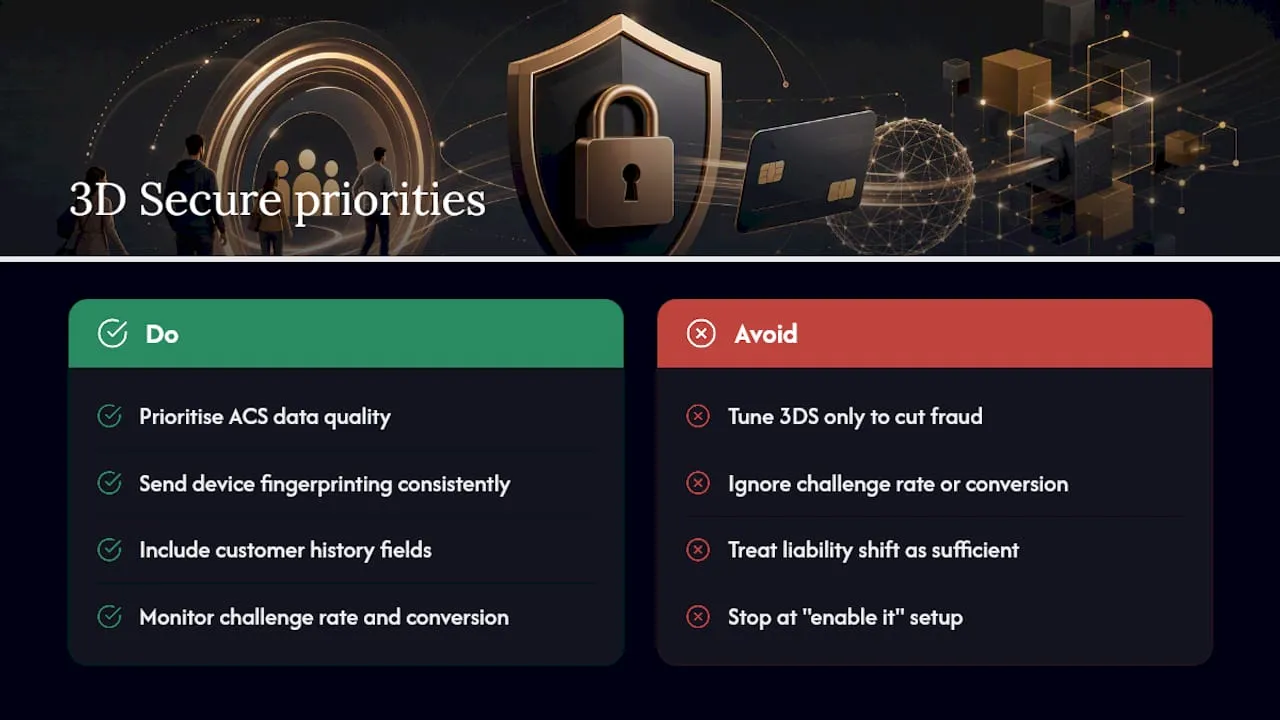
The conventional advice on 3D Secure treats it as a fraud silver bullet, install it and chargebacks disappear. That’s not quite right, and the data on false declines proves it. A merchant who tunes 3D Secure purely to minimise fraud rate, without watching challenge rate and conversion in parallel, will often trade a small fraud reduction for a much larger loss in legitimate sales. That trade rarely gets discussed in setup guides, which tend to stop at “enable it and you’re protected.”
What I’d prioritise first, for a membership organisation especially, is data quality into the ACS: consistent device fingerprinting and customer history fields, because that’s what actually determines whether your genuine members sail through frictionlessly or get stuck on an SMS code that never arrives. The liability shift is valuable, but it’s a consolation prize if your checkout is quietly losing members to failed challenges every month. Get the data feeding the risk engine right, and the fraud protection follows almost automatically. Chase the protection first and the friction problem never gets solved.
— Rob