Database management for associations: a practical guide

Effective database management for associations means centralising your membership and operational data so every team member works from the same accurate, up-to-date source. When done well, it directly supports member retention, targeted communications, and sound financial reporting. When done poorly, the consequences are tangible: lapsed memberships go unnoticed, event registrations clash with billing records, and leadership makes decisions based on reports nobody fully trusts. Unlike a for-profit business managing customer transactions, your association handles a far wider mix of data types, including membership tiers, event attendance, sponsorship relationships, volunteer records, and committee activity. Each data type carries its own governance requirements.
Why does this matter so much for associations specifically?
- Member relationships are long-term and multi-dimensional, requiring richer data profiles than a simple customer record.
- Renewal cycles, subscription tiers, and lapsed-member re-engagement all depend on accurate, timely data.
- UK associations must comply with GDPR, meaning data security and access controls are legal obligations, not optional extras.
- Reporting to boards and funders requires reliable, auditable data that spreadsheets rarely provide at scale.
- Centralising member data supports targeted marketing, strengthening both recruitment and retention.
How to assess your association’s unique database needs
Before evaluating any software, your organisation needs a clear picture of what it actually requires. Associations vary enormously: a trade body with 5,000 corporate members has fundamentally different data needs from a regional professional network with 400 individual members. Size, membership model, engagement patterns, and integration requirements all shape the right approach.
Effective data governance rests on four core pillars: data quality, data ownership, data management, and data security. Working through each pillar before you select a system forces the right conversations. Who owns a member record when it spans both the membership and finance teams? What counts as an “active member” for reporting purposes? These definitions matter more than any software feature.
Associations often treat AMS selection as a purely technical decision, handing it to IT rather than aligning it with strategic goals. Leadership should define mission and operational priorities before considering software features. The technology serves the strategy, not the other way around.
Pro Tip: Involve a cross-functional team in your needs assessment. Finance, events, communications, and membership staff all interact with your data differently. A cross-functional task force combining IT and business leadership produces data definitions and governance rules that actually reflect how your organisation operates.
Critical considerations before selecting any system:
- Current data volume and projected membership growth over three to five years.
- Integration requirements with existing tools such as email platforms, learning management systems, and payment gateways.
- Staff technical capability and the level of training your team will realistically complete.
- Data ownership structure: centralised control versus distributed access for staff and members.
- GDPR compliance obligations, including consent management and data retention policies.
- Reporting needs: what decisions does leadership need data to support, and how frequently?
What types of database systems work for associations?
Not every association needs the same solution, and understanding the options prevents costly mistakes.
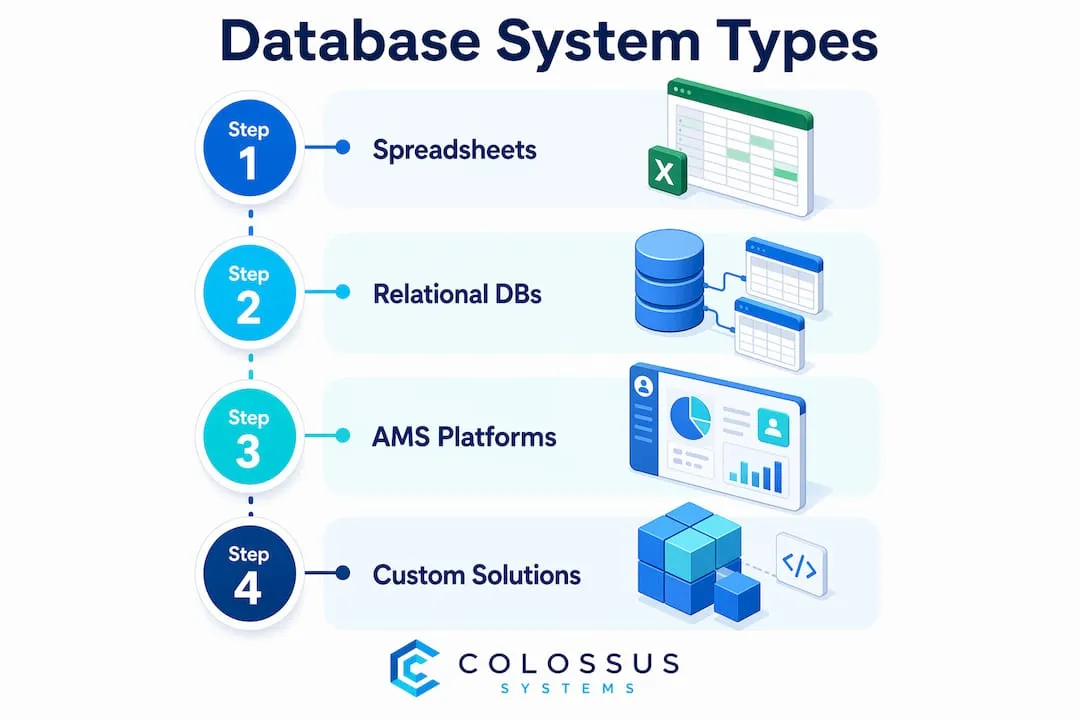
Spreadsheets are where most small associations start. Tools like Microsoft Excel or Google Sheets are accessible and free, but they break down quickly. Version control is a constant headache, concurrent editing creates conflicts, and there is no audit trail. Once your membership exceeds a few hundred records, or you need to link events data to member profiles, spreadsheets become a liability rather than an asset.

Generic relational database management systems such as Microsoft SQL Server or PostgreSQL offer far greater power. They handle complex queries, enforce data integrity, and scale well. The drawback for most associations is the technical overhead: you need database administrators to build and maintain them, and they offer no out-of-the-box membership functionality. They suit organisations with dedicated IT resource and highly specific data requirements.
Association Management Systems (AMS) are purpose-built platforms that combine a membership database with operational tools for events, communications, dues collection, and reporting. They represent the most practical choice for the majority of UK associations because they are designed around the workflows your team already follows.
| Option | Scalability | Integration | Technical overhead | Association fit |
|---|---|---|---|---|
| Spreadsheets | Low | None | Minimal | Small, early-stage only |
| Generic DBMS | High | Custom-built | High | Specialist IT teams |
| AMS platform | High | Built-in | Low to medium | Most associations |
Key points to carry forward:
- Spreadsheets are a starting point, not a long-term solution for membership data.
- Generic database systems require significant technical investment to adapt for association use.
- AMS platforms automate dues collection, event registration, and member data access, reducing operational burden considerably.
- The right choice depends on your membership size, IT resource, and integration requirements.
What features should you prioritise in membership database software?
The feature list for any AMS can run to dozens of items. Focus on the capabilities that directly affect your members’ experience and your team’s daily workload.
Centralised member profiles are the foundation. Every interaction, renewal, event registration, and communication preference should live in a single record. Without this, your team wastes time reconciling data across systems and members receive inconsistent communications.
Automated renewal processing removes one of the most labour-intensive tasks in membership management. The system should send renewal reminders, process payments, and update membership status without manual intervention. This alone reduces administrative overhead and catches lapsed members before they quietly disappear.

Event registration tracking linked directly to member profiles gives you a complete picture of engagement. When event attendance data sits in a separate spreadsheet, you lose the ability to identify your most active members or spot those who have disengaged.
Reporting and analytics tools turn raw data into decisions. Your system should generate membership trend reports, financial summaries, and event performance data without requiring a database administrator to write custom queries.
Integration of disparate systems such as learning management systems, communication platforms, and membership databases is a business requirement, not a luxury. When these systems cannot exchange data reliably, manual workarounds introduce errors and slow your team down.
Top features to demand from any membership database solution:
- Centralised, searchable member profiles with full engagement history.
- Automated renewal workflows with configurable reminder sequences.
- Event registration and attendance tracking integrated with member records.
- GDPR-compliant consent management and data retention controls.
- Role-based access controls to protect sensitive financial and personal data.
- Built-in reporting with exportable formats for board and funder reporting.
- Payment gateway integration for dues, event fees, and merchandise.
- API connectivity to link with email marketing, accounting, and CRM tools.
Data point: Integrating marketing and communication tools within an AMS directly enhances member engagement by enabling personalised, timely outreach based on live membership data.
Best practices for managing member data effectively
Good data management is not a one-time project. It is an ongoing discipline that your whole team needs to own.
Data hygiene is your first priority. Regular audits, removing duplicates, and validating contact information improve data accuracy and boost outreach effectiveness. Clean data means your team trusts the reports they pull, and your communications actually reach the people they are meant for. Schedule a database audit at least twice a year, not just when something goes wrong.
Data migration deserves careful planning. The data audit is the greatest bottleneck during any migration, and migrating only active and recent data avoids performance issues and keeps your new system relevant from day one. Archive legacy records separately rather than importing everything wholesale. A bloated database with years of inactive records slows queries, inflates storage costs, and makes reporting harder.
User training determines whether your investment pays off. The best system in the world underperforms if your team uses it inconsistently. Build training into your implementation plan, not as an afterthought. Establish clear data entry procedures and make sure every staff member who touches the database understands the rules for creating, updating, and retiring records.
Pro Tip: Avoid the temptation to migrate every historical record into your new system. Importing years of inactive or incomplete data creates immediate performance issues and makes your database harder to trust. Archive old records separately and start your new system with clean, current data.
Efficiency note: Clean, well-governed data enables leadership to make decisions based on facts rather than assumptions, and gives your communications team the confidence to act on what the data shows.
Practical best practices for your association:
- Conduct a full data audit before any migration or system change.
- Establish written data entry procedures and share them with all relevant staff.
- Assign clear data ownership: who enters, updates, and retires each record type.
- Remove or archive duplicate and inactive records on a regular schedule.
- Use your AMS reporting tools to monitor data quality, not just membership numbers.
- Build centralised supporter data practices into your annual planning cycle.
- Review GDPR consent records at least annually to stay compliant.
How Colossus supports associations with a unified management platform
Colossus is built specifically for membership-based organisations that need more than a basic contact database. The platform brings together membership management, event planning, CRM, email marketing, virtual training, and e-commerce within a single environment, so your data stays connected across every function your association runs.
Where many associations struggle with data fragmentation, Colossus addresses the problem at the architecture level. Member profiles, event registrations, renewal histories, and communication records all live in one place. Your team stops reconciling spreadsheets and starts acting on reliable data. The association membership software is designed to grow with your organisation, whether you manage hundreds of members or tens of thousands.
Key capabilities Colossus delivers for associations:
- Centralised member profiles with full engagement, renewal, and event history.
- Automated membership renewal workflows with configurable payment processing.
- Event registration and virtual training management linked directly to member records.
- Built-in CRM tools for tracking relationships, communications, and pipeline activity.
- Email marketing with segmentation based on live membership data.
- E-commerce functionality for dues, merchandise, and event ticketing.
- Role-based access controls and data security aligned with UK compliance requirements.
- Analytics and reporting dashboards for board reporting and strategic planning.
| Capability | Association benefit |
|---|---|
| Unified member profiles | Single source of truth across all teams |
| Automated renewals | Reduces manual workload and lapsed-member risk |
| Integrated event management | Links attendance data directly to member records |
| CRM and marketing tools | Enables targeted, personalised member communications |
| Analytics dashboards | Supports evidence-based decisions for leadership |
| GDPR-aligned data controls | Meets UK legal obligations without custom development |
Colossus also provides implementation support and ongoing training, so your team is not left to figure out a complex system alone. The platform’s features are designed to be configured around your association’s specific workflows, not the other way around. For associations considering a move from spreadsheets or a legacy AMS, Colossus offers a structured migration pathway that keeps your data intact and your operations running throughout the transition.
Ready to see what a purpose-built platform can do for your association? Explore Colossus features and find out how your organisation can manage membership data with confidence.
Key takeaways
Effective database management for associations requires centralised data, clear governance, and a purpose-built system aligned with your organisation’s strategic goals.
| Point | Details |
|---|---|
| Centralise your data | All member, event, and financial records should live in one system to prevent reconciliation errors. |
| Govern before you select software | Define data ownership, quality standards, and access rules before evaluating any platform. |
| Prioritise data hygiene | Regular audits and duplicate removal keep reports trustworthy and outreach effective. |
| Plan migration carefully | Migrate only active, recent data and archive legacy records separately to avoid performance issues. |
| Choose an AMS built for associations | Purpose-built platforms reduce operational burden and connect membership data across all functions. |