Automating member renewals for higher retention and efficiency

TL;DR:
- Manual renewal processes cause revenue loss and staff burnout, automation increases retention rates.
- Key automation components include triggers, staged retries, portals, and engagement scoring.
- Successful retention relies on combining automation with personal member engagement and continuous improvement.
Every year, membership organisations lose significant revenue not because their value proposition is weak, but because their renewal process is. Manual follow-ups, generic email blasts, and spreadsheet-based tracking create gaps that members quietly slip through. Automation lifts retention rates by 10-15% and has saved staff up to 12 hours per week. This guide walks you through why automation matters now, what an effective system looks like, and how to build workflows that keep members engaged long after their renewal date passes.
Table of Contents
- Why automating member renewals matters now
- The building blocks of automated renewals
- From renewal reminders to re-engagement workflows
- Best practices, metrics, and continuous improvement
- A fresh perspective: What most membership leaders overlook in automation
- Next steps: Streamline your member renewals with the right tools
- Frequently asked questions
Key Takeaways
| Point | Details |
|---|---|
| Automation boosts retention | Automated renewals in member organisations raise retention by 10–15% and cut admin time. |
| Beyond reminders | Effective automation uses personalisation and re-engagement—not just reminders—to keep members. |
| Measure and optimise | Track renewal data and continuously improve workflows for the best results. |
| Handle exceptions smartly | Design automation to manage failed payments, proration, and make opt-out simple for trust. |
Why automating member renewals matters now
Manual renewal processes are costly in ways that rarely appear on a single report. Staff time spent chasing payments, sending individual reminders, and manually updating records adds up fast. Meanwhile, members who feel undervalued or simply forget to renew quietly disappear. The financial impact is real, but so is the operational strain on your team.
Research consistently shows the gap between organisations that automate and those that rely on manual touchpoints. 52% of membership lapses are caused by disengagement, whilst 24% happen simply because members forget to renew. That means the vast majority of lapsed members were not necessarily unhappy. They were just not reached at the right moment, in the right way.
Key insight: One FEDESSA case study showed retention rising from 85% to 94% after implementing automated renewal workflows. That nine-point gain translates directly into recurring revenue and reduced acquisition costs.
Reminders alone fail because they treat every member the same. A long-standing member who attends every event has different renewal triggers than someone who has not logged in for four months. Without automation, your team cannot segment, personalise, or time outreach effectively at scale.
Here is what poor renewal processes cost your organisation:
- Lost revenue from avoidable lapses that would have converted with a timely nudge
- Admin burnout as staff chase overdue payments and update records manually
- Inconsistent member experience when communication is delayed or generic
- Missed early-renewal opportunities that smooth out your cash flow
- Data gaps that prevent you from identifying at-risk members before they leave
Focusing on improving member engagement alongside your renewal workflows creates a compounding effect. Members who feel connected to your organisation renew earlier, at higher rates, and with less prompting. That is the real business case for automation.
Now that we know manual processes are not enough, let us look at what effective automation involves.
The building blocks of automated renewals
An automated renewal system is not a single tool. It is a set of interconnected components, each solving a specific problem in the renewal journey. Understanding what each element does helps you build a system that handles edge cases gracefully rather than breaking under pressure.
Core components every system needs:
- Auto-renew triggers that initiate the renewal process based on membership expiry dates, removing the need for manual tracking
- Staged payment retries that attempt failed transactions multiple times before escalating to member communication
- Member-facing renewal portals where members can update payment details, review their tier, and confirm their renewal independently
- Grace period management that keeps accounts active during short lapses whilst the system continues outreach
- Engagement scoring that flags members showing low activity so your team can intervene before renewal becomes a crisis
| Feature | Retention impact | Complexity to implement |
|---|---|---|
| Auto-renew with email confirmation | High | Low |
| Staged payment retries | High | Medium |
| Member self-service portal | Medium to high | Medium |
| Grace period lockout rules | Medium | Low |
| AI-based engagement scoring | Very high | High |
Edge cases such as failed payments, mid-cycle plan changes requiring proration, easy opt-out, and grace period rules are where most systems either shine or fail. Getting these right protects both your revenue and your member relationships.
Good membership database strategies underpin all of this. If your member data is fragmented or outdated, even the best automation will produce poor results. Clean data is not optional. It is the foundation.
The shift from generic reminders to truly personalised outreach depends on AI-based behavioural scoring that analyses how members interact with your content, events, and communications. Platforms built for streamlining membership dues can apply these signals automatically, reducing the manual effort needed to identify who needs attention.

Pro Tip: Always provide a visible, frictionless opt-out route and display transparent billing terms at every renewal touchpoint. Members who trust your billing process are far more likely to stay long-term, even if they occasionally pause.
Understanding the components, let us see what makes automation truly effective in practice.
From renewal reminders to re-engagement workflows
There is a meaningful difference between a renewal reminder and a re-engagement workflow. A reminder says, “Your membership is expiring.” A re-engagement workflow says, “Here is the value you have received, here is what you would miss, and here is how easy it is to stay.”
The performance gap between these two approaches is significant. Personalised data such as tenure, recent activity, and event attendance produces far better renewal outcomes than generic copy sent to your entire membership list.
Triggers that should activate your re-engagement workflows:
- Member has not logged into your portal in 60 or more days before renewal
- Attendance at events has dropped compared to the previous membership period
- Payment method on file is approaching expiry
- Member is entering a defined renewal window, typically 60, 30, and 7 days out
- A payment attempt has failed and no updated details have been provided
A/B testing is where many organisations find their biggest efficiency gains. Testing subject lines, send times, and the specific value propositions highlighted in renewal emails can lift open rates meaningfully. One organisation testing two subject lines across segments found a 23% difference in open rates, which translated directly into earlier renewals and reduced churn.
Using engagement software that integrates behavioural data with your renewal communications closes the gap between what you know about a member and what you say to them. Tracking member engagement metrics consistently gives you the evidence to refine your workflows over time rather than guessing.
Pro Tip: Set up an AI scoring threshold that automatically flags members whose engagement score drops below a defined level 90 days before renewal. Assign a team member to reach out personally to those in the top-risk bracket. Automation handles volume; personal contact closes the gap for members on the fence.
Tailoring the right workflow is crucial, but how do you measure and sustain the results?
Best practices, metrics, and continuous improvement
Knowing your renewal automation is working requires more than a rough sense of how many members came back. Tracking specific metrics by segment gives you the granular insight needed to optimise over time.
Metrics every membership leader should track:
- Overall renewal rate by membership tier and region
- Early renewal rate as a percentage of total renewals, indicating strong engagement
- Churn rate month on month and year on year by segment
- Admin hours saved per renewal cycle compared to previous manual processes
- Failed payment recovery rate showing how often staged retries or member updates succeed
- Email open and click-through rates for each stage of your renewal workflow
Good retention sits at 85-90%, whilst excellent performance is above 90%. Segmenting these benchmarks by tier and region reveals where your automation is working and where it needs refinement.
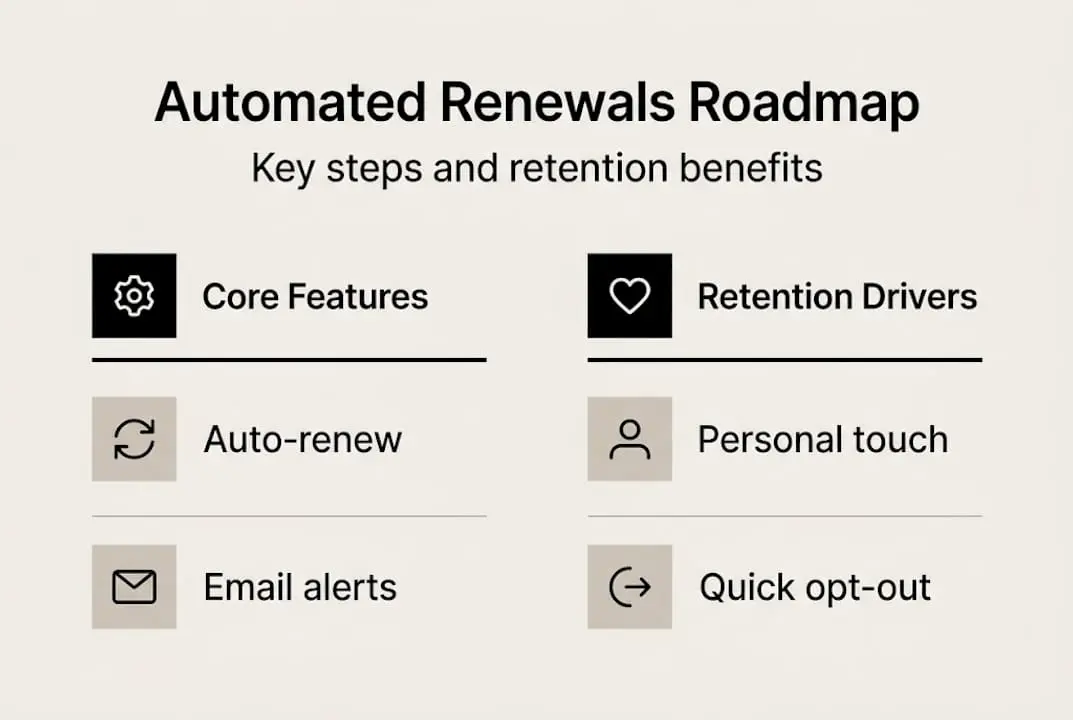
Continuous improvement means regularly revisiting three things. First, your opt-in and opt-out friction. If members struggle to manage their own renewal preferences, frustration builds and trust erodes. Second, your messaging sequences. What worked in 2024 may not resonate in 2026 as member expectations evolve. Third, your payment handling. As card brands update retry rules, your staged retry logic should keep pace.
A/B testing is not a one-off activity. Build it into your renewal calendar so that every cycle generates usable data for the next. Even small improvements in renewal rate compound significantly across a large membership base. Understanding membership management basics helps leaders frame these improvements within a broader operational strategy, rather than treating automation as a standalone fix.
Pairing your renewal data with proven engagement strategies creates a feedback loop. Engaged members renew more readily, and renewal data tells you which engagement activities drive the strongest loyalty.
Having explored measurement and improvement, let us share what most leaders miss when automating member renewals.
A fresh perspective: What most membership leaders overlook in automation
Here is an uncomfortable truth most automation vendors will not tell you. Switching on auto-renew does not solve a retention problem. It delays it.
Organisations that rely on automation to substitute for genuine value delivery tend to see short-term retention gains followed by a plateau or decline. Members renew once, twice, and then, when the friction of cancelling feels lower than the perceived benefit of staying, they leave anyway.
The organisations that achieve sustained retention above 90% treat automation as the mechanism that creates space for human connection, not the replacement for it. Automated workflows free up staff time. The best leaders redirect that time into personal outreach, member recognition, and community-building activities that no algorithm can replicate.
This is why sustainable membership growth depends on iterating after launch, not just before it. The organisations winning at retention in 2026 are those that review their workflows quarterly, test new touchpoints, and use automation data to have better conversations with their members, not fewer.
Automate the process. Humanise the relationship.
Next steps: Streamline your member renewals with the right tools
Ready to transform your membership renewal workflow? The difference between organisations that struggle with renewals and those that consistently hit above 90% retention often comes down to having the right platform in place.
Our membership automation features are built specifically for membership organisations that need to automate renewals, manage payments, and personalise member communication without adding complexity to their operations. From staged payment retries to engagement scoring and self-service portals, we give your team the tools to retain more members with less manual effort. Our CRM software connects your renewal data with your broader member relationships, so every touchpoint is informed and timely. Get in touch with our team today to book a demonstration and see how Colossus Systems can help your organisation grow.
Frequently asked questions
How much staff time can automation save for member renewals?
Organisations have reported saving 12-15 hours per week when switching to automated renewal systems, freeing teams to focus on strategic engagement rather than administrative follow-up.
What is a good membership renewal retention rate?
A good retention rate sits above 85%, whilst anything above 90% is considered excellent performance for membership organisations.
Does automation increase member retention?
Yes, introducing automation typically lifts retention by 10-15% in most organisations, particularly when paired with personalised re-engagement workflows.
What happens if a member’s payment fails during auto-renewal?
Best practice is to use staged payment retries and prompt members to update their payment details via a secure self-service portal before any account lockout is applied.