Why membership pricing psychology matters for growth

Membership pricing psychology matters because how you present a price changes what a prospective member believes it is worth, and that belief drives acquisition, retention and lifetime value far more than the number itself. Harvard Business School’s review of psychological pricing tactics confirms that left-digit bias, the tendency to read $99 as meaningfully cheaper than $100, still shifts perception even when the true gap is a single cent, though its strength depends on your category and positioning.
Two things to test this week:
- Show your annual price before the monthly one on your pricing page, so the annual figure becomes the reference point.
- Track sign-up conversion and 30-day retention separately, so a pricing tweak that boosts sign-ups doesn’t quietly hide a churn problem.
Key Takeaways
Membership pricing psychology matters because it shapes perceived value, and perceived value, not the listed price, determines acquisition, retention and lifetime value.
| Point | Details |
|---|---|
| Lead with anchors | Show the higher reference price before the discounted or monthly rate to set the value frame. |
| Match pricing style to brand | Use charm pricing for accessible tiers, rounded prestige pricing for outcome-led premium offers. |
| Measure beyond sign-ups | Track 30 and 90-day retention and LTV, not just conversion, before calling a test a win. |
| Keep scarcity honest | Real capacity limits and clear billing terms protect trust while still creating urgency. |
| Treat pricing as a system | Combine tier design, psychology and reliable billing infrastructure rather than tweaking one number. |
Table of Contents
- Why membership pricing psychology matters to your revenue
- Core psychological principles behind membership pricing
- How to apply pricing psychology to your membership model
- Testing pricing changes: what to measure and when
- Staying ethical: where persuasion ends and manipulation begins
- A practical checklist for your next pricing experiment
- What the research gets right, and where it stops short
- FAQ: membership pricing psychology
- Sources
Why membership pricing psychology matters to your revenue
Perceived value, not the raw fee, decides whether a visitor converts. When a prospect reads “£29/month” without context, their brain has no anchor to judge it against, so it defaults to comparing it with whatever else they’ve recently paid for something similar. Membership organisations that reframe price around outcomes, rather than features, tend to see fewer stalled checkouts, because pricing behaves like storytelling: the moments right before payment matter more than the digits on the page.
Retention responds to different psychological levers. Commitment devices, such as annual billing or milestone unlocks, exploit the endowment effect: once a member has invested time building a profile, a training record or a community reputation, the fee for staying feels smaller relative to what they’d lose by leaving.
Watch these KPIs when you change pricing psychology, not just price:
- Conversion rate — should rise as friction from unclear value drops.
- Churn — should hold steady or fall if the change reinforces commitment.
- Lifetime value (LTV) — the real scoreboard; a cheaper entry price only wins if LTV improves.
- Average revenue per member and upgrade rate — tell you whether tier psychology is working.
Core psychological principles behind membership pricing
Most membership pricing decisions get made on gut feel, but the underlying biases are well documented and testable. Here are the five that matter most.
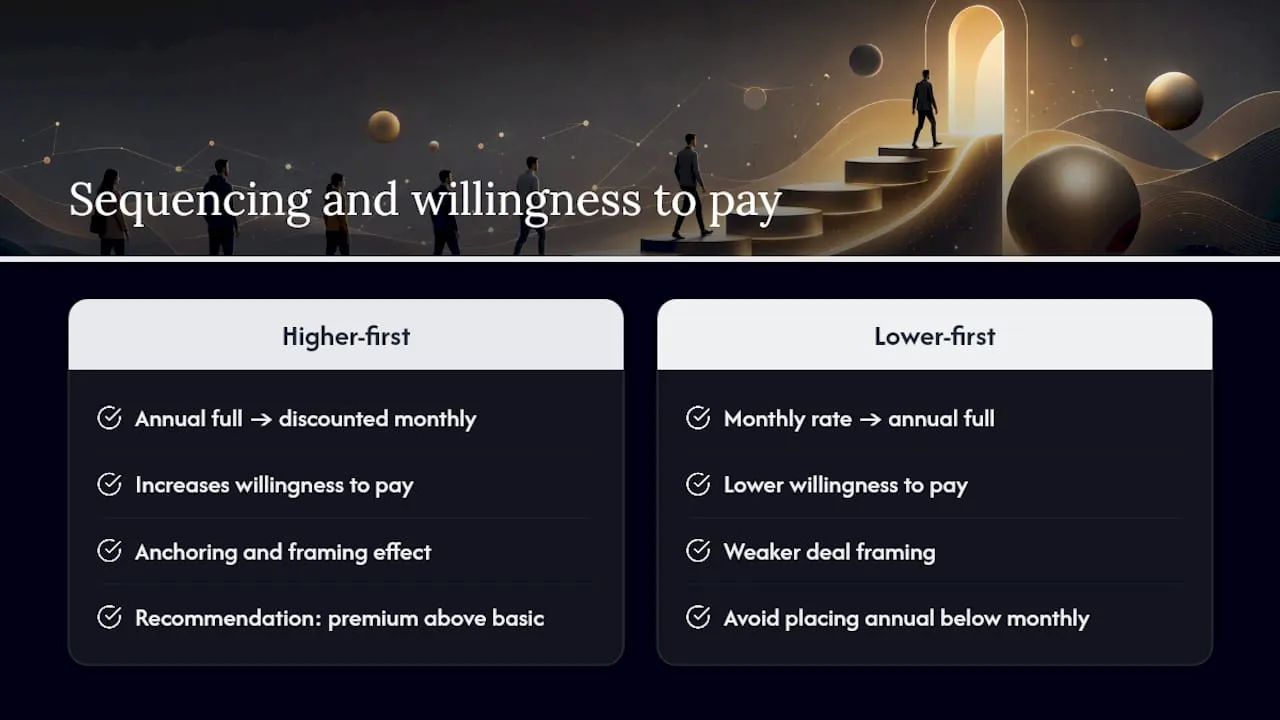
Anchoring and framing. Showing a higher reference price first, say, the “full retail” annual cost, before revealing a discounted or monthly rate makes the eventual number look like a deal. Research on presenting prices in descending order confirms this ordering effect on Wikipedia’s overview of psychological pricing: higher-first sequencing increases willingness to pay because the first number sets the frame everything else is judged against. For a membership site, that means listing your premium annual tier above your basic monthly one, not below it.
Left-digit bias, or charm pricing. Endings like £49 instead of £50 exploit how people read numbers left to right and round down mentally. It works reliably for consumer-facing, value-oriented offers, but a systematic review of nine-ending prices found the effect varies by category and brand positioning. A premium professional association selling credibility may do better with a rounded £500 than a charm-priced £499.
Scarcity and urgency. Capped founding-member cohorts, timed launch pricing and “seats remaining” counters all tap the same instinct: people value what they might lose access to. This only works if the scarcity is real; a “limited offer” that reappears every month trains members to ignore it.

Endowment effect and loss aversion. A free trial or early-access period creates a sense of ownership before payment is even required, so cancelling starts to feel like a loss rather than avoiding a cost. This is why time-boxed trials tend to outperform indefinite free tiers for eventual conversion to paid membership.
Decoy effect and tier architecture. A three-tier structure where the middle option is deliberately positioned between a stripped-down basic plan and an inflated premium plan nudges most buyers toward the middle, the classic Goldilocks pattern. The premium tier doesn’t need many buyers; it exists partly to make the middle tier look reasonable.
System 1 thinking, the fast, intuitive judgement described in dual-process psychology, is what these tactics exploit. Members rarely calculate value line by line; they react to the frame you give them.
How to apply pricing psychology to your membership model
Turning principles into a working pricing page takes a structured approach. Here’s a practical sequence:
- Build three tiers, not two. A basic, standard and premium structure lets the standard tier act as the natural default, especially when its feature list looks noticeably fuller than basic without matching premium’s full price.
- Anchor before you discount. Display the undiscounted or annual-equivalent price first, then reveal the actual rate members will pay, following the ordering logic that membership pricing guides recommend for launches.
- Choose charm or prestige pricing deliberately. Use £29 for accessible, high-volume tiers; use rounded figures like £750 when the offer is outcome-driven and credibility matters more than perceived bargain value.
- Signal scarcity honestly. Founding-member pricing tied to a genuine capacity limit, not an evergreen “limited time” banner, protects trust while still creating urgency.
- Use trials that build ownership. A 14 or 30-day time-boxed trial with a milestone (a completed profile, an attended event) creates more attachment than an open-ended freemium tier.
Presentation details compound these effects. Put the biggest perceived saving near the price, not buried in fine print. Order plans left to right from smallest to largest commitment, and describe benefits before cost on every tier card, so members read value before they read the number. Colossus’s guide on setting membership fees that retain members covers how to balance these presentation choices against long-term affordability.
Testing pricing changes: what to measure and when
Treat every pricing change as an experiment, not a guess. Randomise which visitors see which price presentation, not which price they pay, since testing actual price differences across live members raises fairness and legal complications most organisations want to avoid.
- Run A/B tests on presentation, not raw price: ordering, framing, tier layout and copy around savings.
- Track short-term signals fast: conversion rate, add-to-cart or trial starts, usually visible within one to two weeks.
- Track medium-term signals slower: 7 to 90-day retention, churn and LTV, which need a full billing cycle or two before they’re reliable.
- Set a minimum sample threshold before you conclude anything. Small membership sites should let tests run several weeks rather than days to avoid reacting to noise.
| What to watch | Why it matters |
|---|---|
| Conversion rate | Shows whether the new framing removes friction at sign-up |
| Trial-to-paid rate | Reveals whether endowment tactics are converting attachment into payment |
| 30/90-day churn | Confirms whether the change helped retention or just front-loaded sign-ups |
| LTV per cohort | The real measure of whether a pricing change was worth making |
Pro Tip: A pricing change that spikes sign-ups in week one but raises 60-day churn is not a win, it’s a trade-off. Always hold your KPI dashboard open for a full billing cycle before declaring success.
Staying ethical: where persuasion ends and manipulation begins
Persuasive pricing psychology respects one rule: every claim behind it has to be true. Genuine scarcity, honestly worded savings and clear billing terms build trust; fabricated countdown timers, overstated “was” prices and vague auto-renewal language destroy it.
- Do use real capacity limits, transparent annual-versus-monthly comparisons and clear trial-end dates.
- Don’t misstate how many seats are left, bury recurring fees in small print, or make cancellation harder than sign-up.
- Honour grandfathering for existing members when you raise prices; nothing erodes trust faster than a loyal member discovering a new joiner pays less for the same tier.
Common mistakes that make pricing psychology backfire
- Using charm pricing (£499) for a premium, outcome-led brand where a rounded £500 signals more credibility.
- Letting a weak middle tier look worse than basic, which drags upgrades down instead of up.
- Running tests for days instead of weeks, capturing a conversion bump while missing the churn it caused.
A practical checklist for your next pricing experiment
- Define the hypothesis, segment and sample size before touching the pricing page; write down which KPI is primary and which are secondary.
- Implement the variant, then check data integrity daily for the first week, tracking events aren’t misfiring.
- Run to your pre-set sample or time window, then measure acquisition alongside 30 and 90-day retention and LTV.
- Decide to roll forward, iterate or roll back based on the full picture, not the first week’s numbers.
Billing cadence matters here: Colossus customers often find that failed card retries and dunning sequences distort observed churn, so separate voluntary cancellations from payment failures before you judge a test. The guide on membership pricing as a system makes the same point: pricing, psychology and billing infrastructure succeed or fail together.
Colossus was built around this reality. Its platform combines membership management, tiered billing and CRM-level segmentation, so pricing experiments run against real retention data instead of guesswork. When you’re testing whether a decoy tier lifts upgrades or a founding-member offer improves 90-day retention, the features built into Colossus let you track cohort behaviour without stitching together three separate tools. Organisations running events or training as part of membership value can also connect pricing tests directly to event management, since premium tiers often hinge on access to those experiences. For teams comparing how other platforms structure pricing pages, it’s worth reading this independent comparison of membership platform pricing before settling on your own tier architecture.
What the research gets right, and where it stops short
Most advice on pricing psychology treats it as a bag of tricks: add a 9, add a countdown, add a decoy tier. The research doesn’t actually support that shortcut. Left-digit bias and nine-ending prices work inconsistently across categories, which means the tactic that lifted conversion for a fitness membership can flop for a professional association selling prestige.
The conventional advice underweights time. Most organisations judge a pricing change by its first two weeks, exactly the window where sign-up psychology is loudest and churn psychology hasn’t spoken yet. A test that looks like a win in week two can be a retention problem by week twelve.
If you take one thing from this, prioritise the value-communication gap over the price itself. When a prospect says a membership is too expensive, the underlying issue is usually unclear value, not the number on the page. Fix the framing before you fix the fee. Test presentation relentlessly, but measure retention just as hard as you measure conversion, or you’ll optimise your way into a leakier membership base.
FAQ: membership pricing psychology
Why does pricing psychology matter more for memberships than one-off purchases? Because a membership is a repeated decision. Every renewal re-tests the member’s perception of value, so the psychology has to hold up over months, not just at checkout.
Does charm pricing always work for membership tiers? No. Its effect depends on category and brand positioning, and premium, outcome-focused memberships often perform better with rounded, prestige-style pricing.
How long should a pricing test run before I trust the result? Long enough to capture at least one full billing cycle, so short-term sign-up gains don’t mask a medium-term retention loss.
Is using scarcity in membership pricing manipulative? Only if it’s dishonest. Genuine capacity limits and real founding-member windows are legitimate; fabricated countdowns and vague “limited spots” claims erode trust.
Sources
- Psychological pricing tactics to fight the inflation blues | Working Knowledge (Harvard Library)
- The psychology of pricing | Psychology Today
- Academic study summarising effects of nine-ending prices | ScienceDirect
- Membership pricing guide: Models, psychology and examples (NewZenler)