0.6% Annual Demand Edge: Member Demographics Matter to Leaders

Member demographics determine which needs your organisation must serve, which markets will expand or contract, and whose lived experience shapes the decisions you make. Leaders who treat demographic data as a planning input, not an afterthought, can adjust product mix, engagement channels, and leadership pipelines before competitors notice the shift. Ignore it, and you plan for a membership that no longer exists.
TL;DR:
- Goldman Sachs estimates a 0.6 percentage point annual demand advantage for sectors aligned with favorable demographic trends, making shrinking core cohorts a planning risk.
- Use situational life events for acquisition offers and cohort values for ongoing engagement; service quality and engagement predict renewal better than demographics alone.
- Combine demographic data with tenure and engagement signals, then track acquisition, retention, engagement depth, and lifetime value by cohort before making organizationwide changes.
- Pair cohort reports with member interviews or advisory council feedback, since age or ethnicity alone can hide cultural and socioeconomic differences that shape service needs.
- Collect only demographic details you can justify, explain their use to members, limit internal access, and check local privacy rules before expanding collection.
Table of Contents
- How demographics shape who gets heard in strategy decisions
- Situational needs versus demographic cohort needs: what to use when
- Using demographic forecasts to spot tailwinds and headwinds
- Turning member demographic data into strategy
- Measuring impact and avoiding common pitfalls
- Case studies demonstrating the impact of member demographics on strategic outcomes
- Cultural and socioeconomic factors within demographic groups
- Ethical considerations and privacy concerns when using member demographic data
- Integrating qualitative insight with demographic data
- Author perspective: treating demographics as strategic soil
- How Colossus Systems helps leaders act on member demographics
- FAQ
- Sources
How demographics shape who gets heard in strategy decisions
Membership composition does more than describe who belongs. It shapes which voices sit in the room when priorities get set. Sector benchmarking shows workforce diversity often declines at senior levels, even in organisations whose general workforce mirrors local population patterns. The people making strategic calls can end up less representative than the membership they serve, and that gap narrows the range of needs leaders even think to consider.
This matters because lived experience steers product, service, and policy choices in ways data alone cannot. A leadership team without parents of young members may underinvest in family-oriented programming. A board without younger multicultural voices may miss where growth is actually happening.
The consequences compound over time:
- Recruitment pipelines that mirror existing leadership tend to reproduce the same blind spots
- Retention suffers when members sense their priorities are invisible to decision-makers
- Leadership development programmes that ignore representation gaps leave the next generation of decision-makers no more diverse than the current one
Fixing this starts with naming the gap. Before committing to a new offer or channel, ask whose experience informed the decision and whose did not. Our member segmentation techniques resource covers how to surface those gaps using existing engagement data.
Situational needs versus demographic cohort needs: what to use when
Not every member need is permanent, and treating a temporary trigger as a lasting trait wastes effort. Leaders get the best results when they separate two categories and act on each differently.
- Situational needs arise from a moment in someone’s life: a new job, a house move, a child starting school. These are short-term and functional, and they make excellent acquisition hooks. A limited-time offer tied to a life event converts well because it meets someone exactly where they are.
- Demographic cohort needs reflect longer-running values tied to generation, culture, or background. These shape how someone wants to be engaged over years, not weeks, and they matter most for retention and long-term loyalty.
- The decision rule is straightforward: use situational triggers to design acquisition campaigns and limited-time offers, and use cohort values to design the ongoing member journey, community tone, and governance structure.
A study of over 4,100 members found that perceived service quality and engagement predicted renewal more strongly than demographic variables alone. That does not make demographics irrelevant. It means situational and behavioural signals often do the heavier lifting for retention, while demographic cohort data is better suited to shaping the longer strategic direction: what you build, not just when you pitch it.
Using demographic forecasts to spot tailwinds and headwinds
Demographic forecasts tell you where demand is heading years before the shift shows up in your renewal numbers. Three signals matter most: age cohort growth or decline, multicultural population trends, and migration patterns between urban and suburban areas.
Goldman Sachs research quantifies the scale of this effect: sectors aligned with favourable demographic trends see a 0.6 percentage point annual demand advantage over sectors facing unfavourable ones, driven by developed economies adding roughly 4 million retirees a year while core consumer cohorts aged 35 to 55 shrink.
A 0.6 percentage point annual demand gap separates sectors riding demographic tailwinds from those fighting headwinds, according to Goldman Sachs research. Compounded over a decade, that gap reshapes which organisations grow and which stagnate.
Tailwinds and headwinds rarely announce themselves. Filene Research Institute case studies show multicultural population growth concentrated in younger cohorts offers a sustainable growth path for organisations that invest early in bilingual staffing and culturally competent service, while organisations anchored to an ageing core demographic face a shrinking base unless they diversify.
To plug these signals into planning cycles, build them into:
- Product roadmap reviews, flagging offers built for a shrinking cohort
- Sales and operations planning, with density or age-share thresholds that trigger a resourcing review
- Investment decisions, weighting new programmes toward growing cohorts rather than historical membership mix
Turning member demographic data into strategy
Good demographic strategy starts with combining data sources, not collecting more of one. Demographics alone can mislead; pairing them with engagement metrics and tenure prevents false conclusions about what is actually driving renewal or churn.
A workable approach:
- Blend demographic data with behavioural signals (login frequency, event attendance, renewal history) before drawing conclusions
- Segment members by situational triggers for acquisition and by demographic values for long-term journey design
- Set a reporting cadence (quarterly works for most organisations) and task an advisory council with reviewing whether leadership decisions reflect the membership’s actual composition
- Tie leadership-pipeline targets to representation gaps identified in your data
Pro Tip: Review your top three strategic decisions from the last year and check whether the data behind them included tenure and engagement, not demographics alone.
An integrated platform removes much of the manual work here. When member records, event attendance, and communication history sit in one system rather than scattered across spreadsheets, segmentation by cohort takes minutes instead of weeks, and reporting on cohort-level KPIs becomes a standing dashboard rather than a quarterly scramble.
Measuring impact and avoiding common pitfalls
Track cohort acquisition rate, retention by segment, engagement depth, and lifetime value by cohort. These four give leaders a clear read on whether demographic-aware changes are working.
Validate assumptions with simple cohort comparisons or phased rollouts before committing organisation-wide.
- Watch for tokenistic changes that signal inclusion without substance
- Avoid mistaking correlation for causation when a cohort’s behaviour shifts
- Break down data silos between membership, events, and CRM systems before drawing conclusions
Our guide to member engagement metrics covers how to build these measures into a regular reporting rhythm.
Case studies demonstrating the impact of member demographics on strategic outcomes
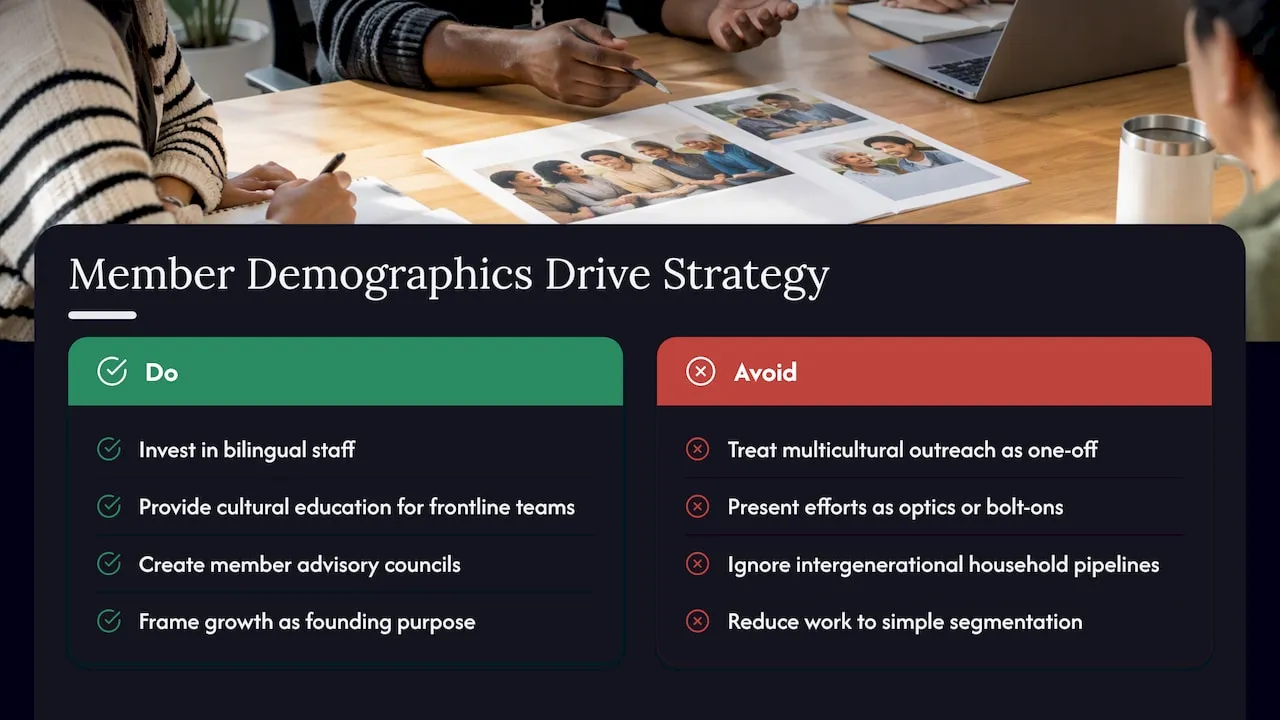
Organisations that treat multicultural growth as core strategy, rather than a side initiative, tend to see it pay off over years, not quarters. Filene’s research into membership organisations found that younger multicultural members frequently open accounts or memberships for their children first, seeding a household relationship that compounds over a generation. Organisations that invested in bilingual staff, cultural education for frontline teams, and member advisory councils, as emphasized in the importance of intergenerational church matters for lifelong faith, were better positioned to capture that compounding effect than those that treated multicultural outreach as a one-off marketing push.
Framing the investment matters as much as the investment itself. Filene’s case studies found that presenting multicultural growth as a return to an organisation’s founding purpose, rather than a new initiative bolted on for optics, made it far easier to secure board and staff buy-in.
Separately, experimental research published in Marketing Letters found that simply communicating membership diversity increased people’s interest in joining a community, and for individuals who already valued diversity, it also increased their ongoing engagement after joining. Large-scale experiments across European samples found this effect held without a detectable drag on overall engagement, suggesting that visible diversity signalling can serve acquisition and retention simultaneously when paired with a clearly stated community purpose.
The common thread across these outcomes: demographic insight translated into a strategic story, not just a segmentation exercise, is what moved the numbers.
Cultural and socioeconomic factors within demographic groups
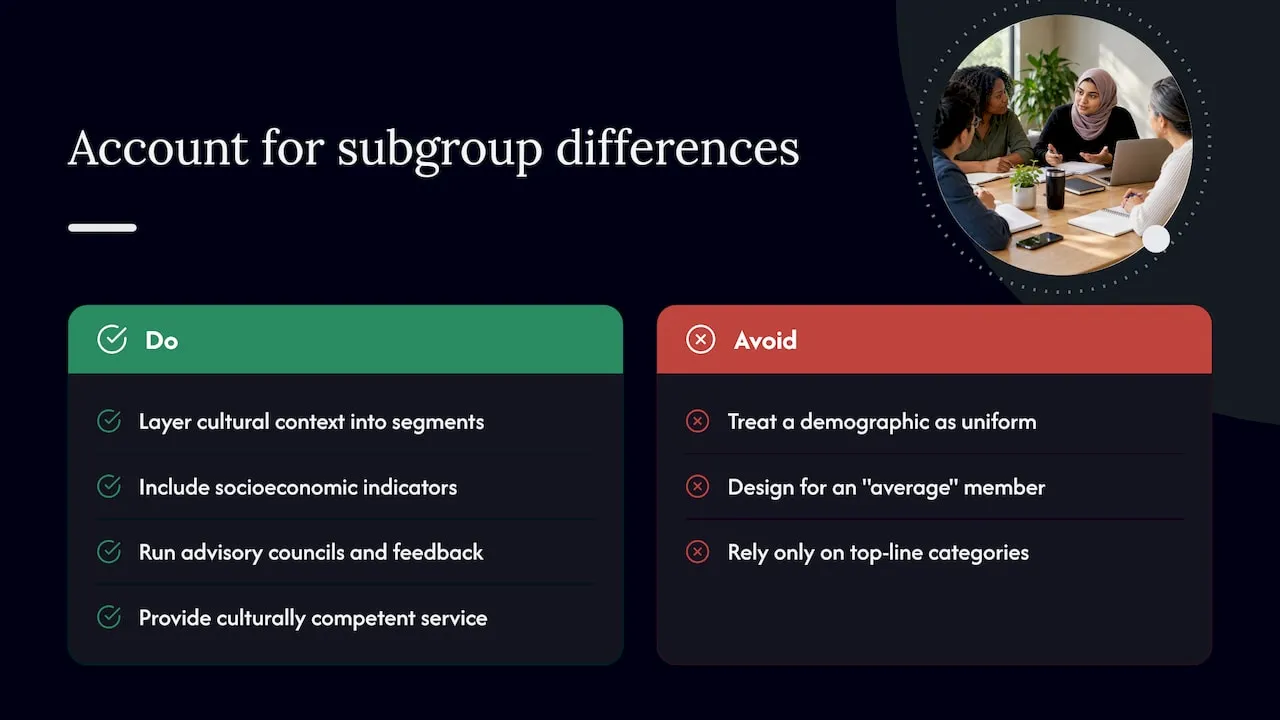
Treating a demographic label as a single, uniform group is one of the fastest ways to misread your membership. Age, ethnicity, or generation describe a starting point, not a complete picture. Within any cohort, cultural background and socioeconomic position shape what people actually want from membership, how much time or money they can commit, and which channels they trust.
Two members in the same age bracket might have entirely different priorities depending on whether they are early in their career with tight finances or established with disposable income to spend on premium programming. A cultural subgroup within a broader demographic category may prioritise community events over digital-first engagement, or the reverse, depending on tradition and local context.
This is why the Filene research on multicultural growth emphasises culturally competent service rather than generic demographic targeting. Bilingual staffing and cultural education address specific barriers that a broad age or income segment alone would never surface.
Strategy built only on top-line demographic categories risks designing for an average member who does not exist. Layering in socioeconomic indicators and cultural context, even informally through advisory councils or member feedback sessions, catches the variation that pure demographic segmentation misses. This is also where situational needs reassert themselves: a cultural subgroup’s socioeconomic position often determines which situational triggers (a job change, a family event) matter most to them, reinforcing why cohort and situational data work best together rather than as substitutes for each other.
Ethical considerations and privacy concerns when using member demographic data
Collecting demographic data carries responsibility that goes beyond compliance. Members share age, ethnicity, income bracket, or family status with the expectation that it improves their experience, not that it becomes a tool for exclusion or unwanted profiling.
A few principles reduce the risk:
- Collect only what strategy genuinely requires; a field you cannot justify using is a field you should not be asking for
- Be transparent with members about why demographic data is collected and how it shapes programming decisions
- Restrict access to demographic fields on a need-to-know basis within your organisation, separate from general engagement data
- Review data retention periods regularly, and delete fields that no longer serve an active strategic purpose
Privacy rules vary significantly by jurisdiction, and what counts as acceptable demographic collection in one country can be restricted or prohibited in another. Leaders operating across borders should treat local privacy law as the floor, not the ceiling, and consult a privacy professional familiar with the relevant jurisdiction before expanding data collection.
The ethical risk runs in both directions. Collecting too little demographic data leaves organisations blind to representation gaps and unable to serve growing cohorts well. Collecting too much, or using it carelessly, erodes member trust and can expose an organisation to legal risk. The safest path treats demographic data as a tool for designing better service, reviewed by an advisory body, rather than a dataset to be mined for every possible use.
Integrating qualitative insight with demographic data
Demographic numbers tell you what changed. They rarely tell you why. A cohort’s engagement might dip for reasons no spreadsheet captures: a change in life circumstances, a cultural event that shifted priorities, or a service that quietly stopped matching expectations.
This is where qualitative input earns its place alongside the data. Advisory councils, member interviews, and open-text survey responses surface the reasoning behind a demographic trend, turning a number into a decision leaders can act on with confidence. A retention dip in a specific age cohort might look identical on a dashboard whether the cause is pricing, scheduling, or a shift in what that cohort values. Only a conversation with actual members distinguishes between them.
Organisations that pair demographic segmentation with structured qualitative review, rather than treating a dashboard as the final word, tend to make fewer wrong calls. The qualitative layer also catches what the earlier section on cultural and socioeconomic variation flags: two members in the same demographic bucket can have different stories, and only direct feedback reveals which story is driving the trend you are seeing in the data.
Build this into your reporting cadence rather than treating it as a one-off research project. A quarterly review that pairs the cohort dashboard with a handful of member conversations costs little and catches far more than either source alone.
Author perspective: treating demographics as strategic soil
I think of demographics less as a segmentation tool and more as the soil a strategy grows in. You can plant the right programme in the wrong soil and watch it struggle for reasons that have nothing to do with the idea itself. Get the soil right, and ordinary ideas tend to take root.
My honest recommendation to leaders: build a standing habit of demographic review, not a one-off audit. Make it someone’s explicit job to track cohort shifts against your membership base, and tie leadership development targets to closing representation gaps, not just filling seats.
Cross-functional accountability matters more than any single dashboard. When marketing, programming, and leadership all answer to the same demographic picture, decisions stop contradicting each other. Our engaging younger members guide is a good next step for leaders ready to put this into practice.
— Rob
How Colossus Systems helps leaders act on member demographics
Acting on demographic insight is hard when membership records, event data, and communication history sit in three different systems. We built Colossus Systems to centralise that data in one place, so segmentation by cohort, situational trigger, or engagement pattern takes minutes rather than a cross-departmental data pull.
Within our platform, leaders can:
- Build member segments by demographic and behavioural data without exporting spreadsheets between systems
- Automate reporting on cohort-level KPIs like retention and engagement depth
- Run targeted event and communication campaigns through our integrated CRM and event management tools
Our plans start at £349 per month for Core, scaling through Growth, Scale, and Enterprise tiers as your organisation grows. Visit our pricing page to find the right fit for your membership size.
FAQ
Why do member demographics matter for strategic planning?
Member demographics shape which needs, markets, and growth opportunities matter most, because they reveal which cohorts are expanding, which are shrinking, and whose lived experience is informing your decisions. Goldman Sachs research found sectors aligned with favourable demographic trends see a 0.6 percentage point annual demand advantage over those facing unfavourable shifts.
What is the difference between situational and demographic needs?
Situational needs come from a temporary life event, such as a job change or house move, and work well for short-term acquisition offers. Demographic cohort needs reflect longer-running generational or cultural values that shape ongoing engagement and retention over years rather than weeks.
Can demographic data alone predict member retention?
Not reliably on its own. A study of over 4,100 members found perceived service quality and engagement predicted renewal more strongly than demographic variables, so leaders should pair demographic data with behavioural signals like tenure and engagement depth.
Does communicating membership diversity actually increase engagement?
Experimental research published in Marketing Letters found that communicating membership diversity increased interest in joining, and for diversity-oriented individuals, it also increased ongoing engagement after joining, without a detectable drag on overall engagement.
How can a membership platform support demographic-aware strategy?
A platform that centralises membership, event, and communication data in one system makes it faster to segment cohorts and report on demographic-linked KPIs without manually combining spreadsheets. Our Colossus Systems features page details the segmentation and reporting tools available across plans.
Sources
- GS SUSTAIN: How aging and declining populations will drive product and company demand | Goldman Sachs
- Situational versus demographic needs for members | Wiley
- Growing through diversity: using data to reach young multicultural members | Filene Research Institute
- The power of diversity in online communities | Marketing Letters