Membership churn explained: reduce attrition in 2026

What is membership churn, and how do you calculate it?
Membership churn is the rate at which members cancel or fail to renew within a given period, expressed as a percentage of your total membership base. It is the single most telling metric for the financial health of any membership organisation, because every member who leaves takes their subscription revenue, their network, and their future referrals with them.
There are two distinct types of churn worth separating from the outset:
- Voluntary churn: a member actively chooses to cancel, typically because they feel disconnected, cannot articulate the value they receive, or believe their needs have changed.
- Involuntary churn: the member never intended to leave. Failed payments, expired cards, and lapsed direct debits quietly remove people who would have renewed without a second thought.
Research confirms that involuntary churn is far more common than most organisations realise, and it is almost entirely preventable with the right payment recovery processes in place.
Calculating your churn rate is straightforward:
Monthly churn rate = (Members who cancelled this month ÷ Members at start of month) × 100
Annual churn rate = (Total cancellations in 12 months ÷ Average members over 12 months) × 100
The compounding effect is where organisations get caught out. A single-digit monthly churn rate can result in losing a substantial portion of your membership base annually. You are essentially replacing half your members just to stand still.
The primary causes of membership attrition cluster around a few consistent themes:
- Lack of meaningful engagement or perceived value
- Poor or absent onboarding after joining
- Feeling invisible or socially disconnected within the community
- Confusion about available benefits
- Payment failures going unaddressed
How does your churn rate compare to UK membership benchmarks?
Knowing your churn rate is only useful when you can place it in context. The average annual churn rate for subscription-based membership sites sits at approximately 6.7%. For many UK associations and professional bodies, a low annual churn rate is considered healthy, while significantly higher rates indicate retention challenges.
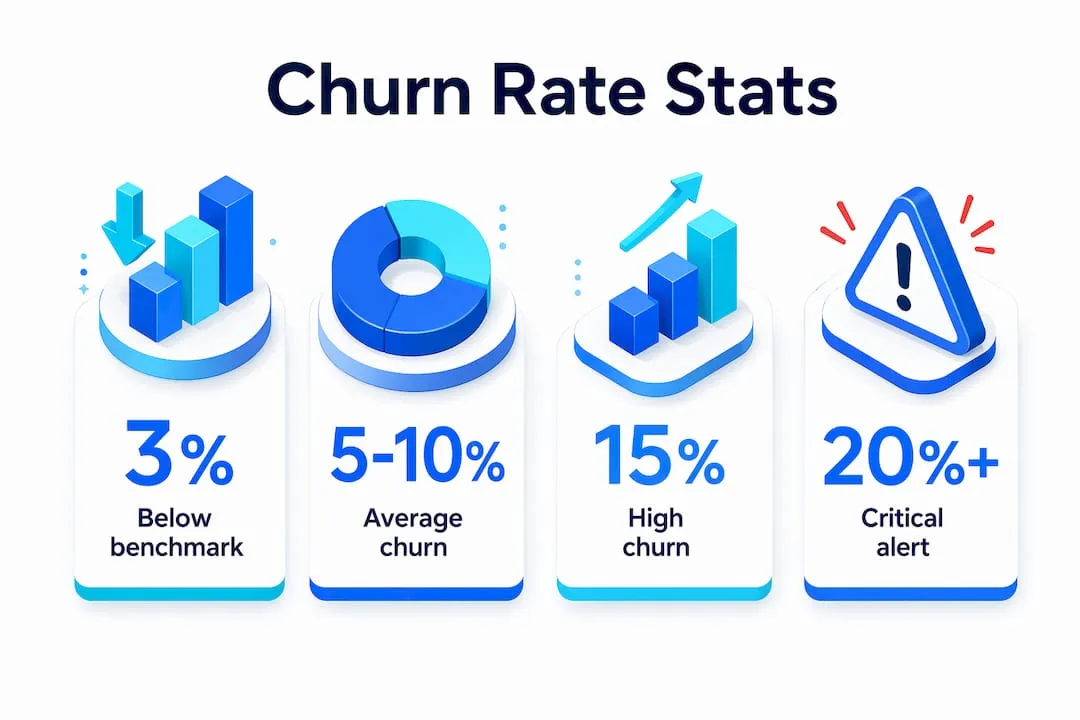
| Churn rate band | What it signals | Typical action required |
|---|---|---|
| Below 5% annually | Strong retention performance | Maintain and refine engagement programmes |
| 5% annually | Room for improvement | Audit onboarding and engagement touchpoints |
| Above 6.7% annually | Urgent concern | Immediate structural retention intervention |

The compounding maths deserves attention. A higher monthly churn rate can lead to losing more than half the membership base annually, whereas lower monthly churn rates correspond to notably fewer annual losses. That gap represents a substantial difference in the recruitment budget required just to maintain membership numbers, before any growth is possible.
Re-engaging a lapsed member tends to cost several times more than maintaining active engagement with current members. For UK organisations with constrained budgets, that ratio makes a compelling case for investing in retention before acquisition.
How to analyse your membership churn rate effectively
Raw churn figures tell you that members are leaving. Segmented analysis tells you why and who, which is where genuine intervention becomes possible.
Start by splitting your churn data along two axes: new versus long-term members, and voluntary versus involuntary. New members who churn within their first 60 days almost always point to an onboarding failure. Long-term members who suddenly disengage often signal a shift in perceived value or a life change that your communication has not addressed.
Digital activity is your earliest warning signal. Monitoring logins, email open rates, and event attendance allows you to build engagement scores that flag at-risk members well before their renewal date arrives. A member who has not logged in for 90 days and has ignored recent emails is a high-priority re-engagement target, not a renewal-season problem.
Key signals to track in your churn analysis:
- Declining portal logins: a member logging in less frequently is reducing their connection to your community.
- Unopened emails: falling open rates across a segment suggest your content is losing relevance for that group.
- Zero benefit usage: members inactive for 90 days with no engaged benefits are at high risk of non-renewal.
- Missed events: a previously active member who stops attending signals a shift in perceived value.
- No peer connections: members without meaningful relationships in your community have little reason to stay.
Pro Tip: Assign each member a single engagement score by combining login frequency, email engagement, event attendance, and benefit usage. A score that drops below your defined threshold should automatically trigger a personalised re-engagement sequence, not a generic renewal reminder.
Proven strategies to reduce membership churn in your organisation
Reducing attrition requires deliberate action across the full membership lifecycle, not just at renewal time. The following steps address the highest-leverage points.
-
Build a structured 90-day onboarding programme. Members who complete a proper onboarding sequence are significantly more likely to renew in their first year than those who receive only a welcome email. Map out clear actions for weeks one through twelve.
-
Facilitate three meaningful connections in the first 30 days. Members who make multiple meaningful connections early on have a much higher retention rate than those who make none. Peer introductions, small group calls, and mentoring pairings all count.
-
Segment your communications by tenure. A first-year member needs guidance on getting started. A five-year member needs recognition and deeper involvement opportunities. Sending the same message to both is a missed opportunity. Segmented, personalised communication directly improves renewal likelihood.
-
Create an early warning system for disengagement. Members often stop engaging well in advance of their official cancellation date. Automated alerts at 7, 14, and 21 days of inactivity, followed by escalating outreach, catch drift before it becomes departure.
-
Address involuntary churn with payment recovery tools. Automated card-update reminders, retry logic, and dunning sequences recover members who never intended to leave. This is often the fastest win available to any membership team.
-
Re-onboard long-term members who go quiet. A lapsed long-term member deserves the same structured attention as a new joiner. A curated reminder of underused benefits, delivered personally, outperforms any generic “we miss you” campaign.
-
Use exit surveys to recover members at the point of cancellation. Offering a pause option or a brief conversation at the cancellation stage can recover a meaningful proportion of members who were on the fence. Exit data also reveals patterns that improve future retention strategy.
For a deeper look at improving member engagement across the full membership cycle, Colossus has published practical guidance tailored to UK associations.
What research reveals about why members really leave
The most persistent myth in membership management is that price drives churn. Research shows that 78% of members quit for reasons entirely unrelated to cost. Isolation, value confusion, and a poor start are the real culprits.
The “drift away” pattern is the most common and the most preventable. Members do not typically storm out after a bad experience. They quietly reduce their activity over six to eight weeks, and by the time the renewal notice arrives, the decision is already made. The “silent exit” described in Associations Now captures this precisely: the emotional departure happens long before the administrative one.
Social belonging sits at the heart of retention. Members who feel seen, connected, and valued within their community renew almost automatically. Those who feel invisible, even when the content and benefits are objectively good, leave without complaint. Nearly half of members who do not renew cite lack of engagement as a primary reason, which points directly to the quality of human connection your organisation facilitates, not the quality of your content library.
Pro Tip: Audit the behaviour of previously lapsed members to find their “point of no return.” Identify when their portal logins started declining and use that pattern to set your first automated engagement alert. Most organisations find the warning signs appeared six to eight weeks before cancellation.
Voluntary and involuntary churn require different recovery approaches. Voluntary churn responds to personalised outreach, value reminders, and peer connection. Involuntary churn responds to payment retry logic, card-update prompts, and proactive billing communication. Conflating the two leads to the wrong intervention at the wrong moment.
How UK membership organisations have reduced churn in practice
Concrete examples from UK membership contexts illustrate how these principles translate into measurable results.
A UK professional association that centralised its member portal, consolidating event registration, CPD tracking, and peer networking into a single hub, reported a marked reduction in early-year cancellations. The key change was not adding new benefits but making existing ones visible and easy to access. Members who previously churned within their first 60 days, citing confusion about how to get started, began completing onboarding milestones at a higher rate once the journey was clearly mapped.

A UK charity membership programme introduced tenure-based communication segments, sending tailored content to first-year members, mid-tenure members, and long-standing supporters separately. The first-year segment received a structured welcome sequence with explicit prompts to attend a local event or join an online group within the first month. Renewal rates for that cohort improved noticeably compared to the previous year’s undifferentiated approach.
A trade body facing high involuntary churn implemented automated payment retry logic and pre-expiry card-update reminders. A significant share of the members previously recorded as “cancelled” had simply experienced a payment failure with no follow-up. Recovering those members required no persuasion, only a functioning administrative process.
These examples share a common thread: the organisations that reduced attrition did so by making membership feel active, connected, and easy to navigate, not by discounting or adding features. For practical guidance on effective member onboarding that supports these outcomes, Colossus offers a detailed resource for UK associations.
Which tools help you track and manage membership churn?
Tracking churn effectively requires technology that connects member activity data across every touchpoint, not just renewal records.
Member management platforms sit at the centre of any churn-reduction technology stack. A purpose-built platform records dues payments, event registrations, course completions, email opens, and portal logins in one place, making it possible to build the engagement scores described earlier. Without this consolidated view, identifying at-risk members before renewal season is largely guesswork.
CRM software adds the relationship layer. When your CRM captures member tenure, communication history, and benefit usage alongside contact details, your team can segment outreach by risk level and personalise messages based on actual behaviour rather than assumptions. Colossus’s CRM tools are built specifically for membership organisations, connecting contact management with engagement data in a single environment.
Email marketing platforms integrated with your member database allow automated re-engagement sequences triggered by inactivity thresholds. The difference between a generic “we miss you” email and a personalised message referencing a specific unused benefit is significant; the latter performs considerably better at recovering drifting members.
Event management software contributes attendance data that feeds directly into engagement scoring. A member who stops attending events is displaying a measurable warning sign. Colossus’s event management tools connect attendance records to member profiles automatically, removing the manual data-entry step that causes many organisations to miss this signal entirely.
Analytics and reporting dashboards turn raw activity data into the churn risk indicators your team can act on. The goal is a single engagement score per member, updated regularly, that tells you at a glance who needs attention. Organisations that track engagement scores above 70% report renewal rates above 90%, while disengaged members renew at below 40%.
For a full view of how these capabilities work together, Colossus’s membership management features cover the complete toolkit UK associations need to move from reactive renewal chasing to proactive retention.
Managing membership churn proactively, rather than reacting at renewal time, is what separates growing organisations from those perpetually replacing the members they lose. Colossus brings member management, CRM, event tools, and engagement analytics into one platform so your team can act on the right signals at the right moment. Explore Colossus’s features to see how it supports retention at every stage of the membership lifecycle.
Key takeaways
Membership churn is a gradual process driven primarily by disengagement and isolation, not price, and organisations that intervene early with structured onboarding and personalised outreach consistently achieve the strongest renewal rates.
| Point | Details |
|---|---|
| Churn compounds fast | A 6% monthly churn rate eliminates over 50% of your membership base within a year. |
| Price is rarely the cause | 78% of members quit for reasons unrelated to cost, most commonly isolation or value confusion. |
| Early connections drive retention | Members making three or more meaningful connections within their first 30 days have substantially higher retention rates than those with one or none. The first-month connection threshold impacts retention rates by over 70 percentage points. |
| Onboarding is the highest lever | A structured 90-day onboarding makes members 2.5 times more likely to renew in year one. |
| Re-engagement costs more than retention | Reacquiring a lapsed member costs 3–5 times more than keeping an active one engaged. |