Association Audit Process: Continuous risk management and 4 controls

An association audit process is the ongoing internal work of keeping membership, event and financial records verifiable, reconciled and well controlled, so the organisation is ready for review at any time. Done properly, it delivers three things: documents an auditor can trust, membership and event revenue that matches the bank and the ledger, and internal controls with a visible paper trail. Guidance from Nonprofit Accounting Basics and the ICAEW frames this as a year-round discipline, not a scramble before year-end, and platforms like Colossus Systems are built with that discipline in mind.
TL;DR:
- Regular monthly reconciliations between platform reports, bank deposits, and the general ledger prevent the need for frantic year-end reconstructions.
- Segregation of duties should be maintained by assigning different control tasks to separate individuals, even in small associations, with documentation in minutes.
- Routine exports of receipts, registrations, and membership changes with transaction IDs, dates, and references are essential for reliable audit trails.
- Clear ownership of each control process by staff, managers, and trustees, supported by a written procedures manual, ensures accountability and preparedness.
- Continuous audit readiness reduces risks from staff turnover, increases board confidence, and streamlines internal controls, benefiting overall governance.
Table of Contents
- An at-a-glance overview of audit preparedness
- Core control areas auditors expect to see
- Using your SaaS platform to build a reliable audit trail
- Who owns each part of the process
- An action checklist your team can start this week
- Why audit readiness is really risk management
- How Colossus Systems supports an audit-ready process
- FAQ
- Sources
An at-a-glance overview of audit preparedness
Audit readiness breaks down into four phases your team can picture as a cycle rather than a one-off project. Treating it this way means nobody is caught out when a board member, funder or regulator asks for evidence.
- Ongoing housekeeping: file receipts, contracts and minutes into an audit-ready folder as they are created, not months later.
- Monthly reconciliations: match your membership and event platform’s income reports to bank deposits and the general ledger every month.
- Pre-audit compile: pull together the year’s tie-outs, policy documents and governance sign-offs before the auditor arrives.
- Handover: give auditors prepared reconciliations and a clear index of supporting documents rather than raw exports.
Each phase feeds the next. Skipping the monthly reconciliation step is the single biggest reason associations end up reconstructing a year’s transactions in a panic, according to Nonprofit Accounting Basics.
Core control areas auditors expect to see
Auditors look for evidence that no single person controls a transaction from start to finish. For a membership organisation, that means separating the person who records a renewal or event booking from the person who approves a refund and from the person who reconciles the bank account, as outlined by Nonprofit Accounting Basics.
- Segregation of duties: assign recording, approval and reconciliation to different people, even in a small team, by rotating a board member or senior volunteer into the approval step.
- Logical access controls: restrict who can edit membership records or process refunds inside your platform, and keep an audit log of changes.
- Document retention: maintain a written policy on how long invoices, contracts and correspondence are kept, and store them in one accessible folder.
- Fraud risk assessment: periodically test whether your controls actually catch irregularities, not just whether they exist on paper, as recommended in the Fraud Risk Management Guide
Pro Tip: Ask a trustee or independent volunteer to review one month’s disbursement log each quarter, even informally. It costs nothing and gives you a documented second pair of eyes.
Smaller associations without a large finance team can still achieve meaningful separation by giving a board sub-committee or volunteer oversight role, provided that review is recorded in minutes rather than left as an unwritten habit according to GOVERNANCE | Divergent Church.
Using your SaaS platform to build a reliable audit trail
Your membership and event platform holds most of the evidence an auditor will ask for, but only if you export and reconcile it routinely rather than trusting it will always be retrievable later. Guidance on document retention warns that some software licences restrict access to historical records once a contract lapses, so testing exports matters as much as creating them.
Run these exports on a fixed schedule:
- Payment receipts and refund logs, tied to transaction IDs.
- Event registration reports, including cancellations.
- Membership status changes (new, renewed, lapsed).
A practical tie-out includes date ranges, transaction IDs, payer names, amounts, bank reference numbers and a reconciler’s initials, which lets an auditor verify revenue recognition in minutes rather than hours, a format described in Fraud Magazine’s reporting on platform-to-ledger reconciliation.
Set up read-only access for auditors, keep timestamped change logs switched on, and test a full data restore at least once a year so you know your retention exports actually open and match your ledger. Our features page covers how reporting and payment integrations support this kind of tie-out in practice.
Who owns each part of the process
Audit readiness fails when everyone assumes someone else is responsible for it. A short role matrix removes that ambiguity and gives auditors a name against every control.
- Membership and events staff compile source documents and flag discrepancies as they arise.
- Finance staff or a treasurer perform monthly reconciliations between the platform, bank and ledger.
- A senior manager or finance lead signs off reconciliations before they are filed.
- Trustees or the board review controls periodically and retain ultimate accountability, even where day-to-day tasks are delegated, as the ICAEW makes clear.
A written financial procedures manual turns this matrix from an intention into audit evidence. Without one, as Nonprofit Accounting Basics notes, institutional knowledge walks out the door the day a key staff member leaves.
An action checklist your team can start this week
Break audit readiness into tasks with owners and deadlines, and it stops feeling like a once-a-year burden.
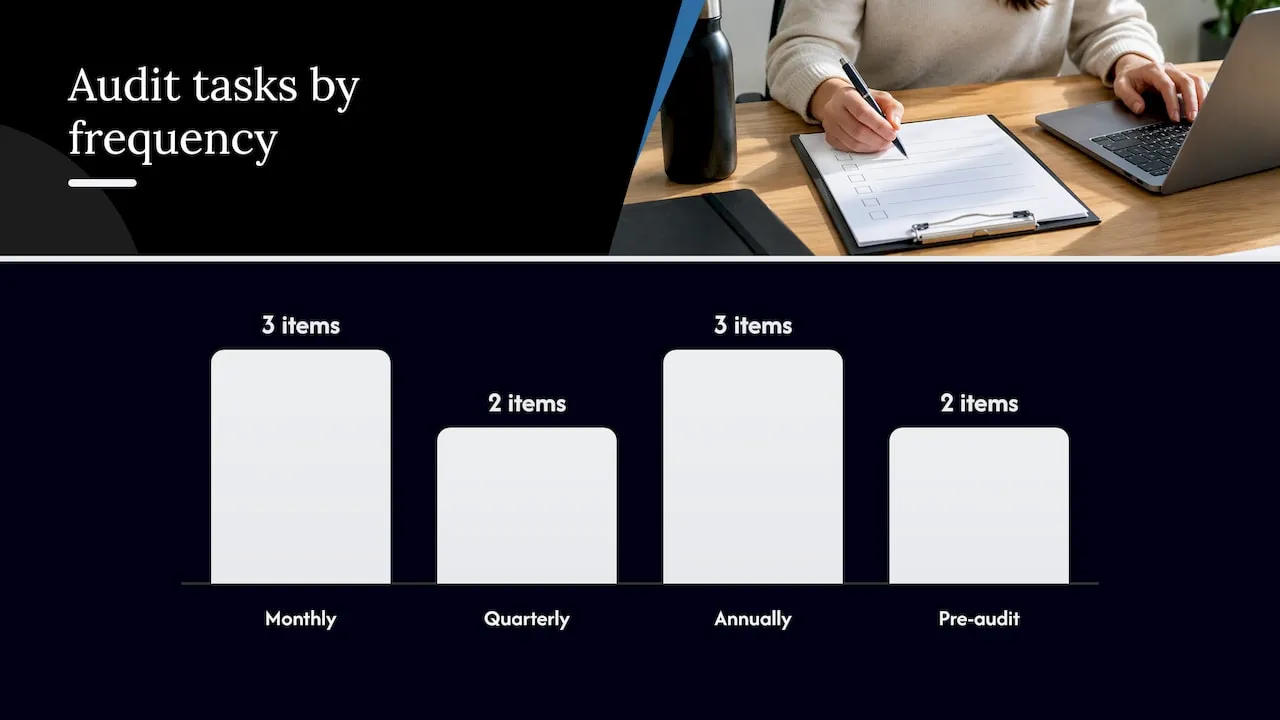
- Monthly: reconcile membership and event receipts against bank deposits, file new documents in the audit-prep folder, and review platform access logs.
- Quarterly: review written policies for gaps, and spot-check one disbursement cycle for unusual entries.
- Annually: run a fraud risk assessment, confirm record retention periods are being honoured, and test a data export restore.
- Pre-audit: assemble tie-outs, supporting invoices, board minutes and sign-offs into one pack, then schedule a short pre-meeting with your auditor to flag anything unusual in advance.
Pro Tip: Put task owners and due dates into your existing calendar or project tool rather than a separate audit spreadsheet. Checklists that live outside normal workflow tend to get forgotten.
Our database management guide for associations walks through keeping membership records clean enough that this checklist takes hours rather than days.
Why audit readiness is really risk management
The strongest argument for year-round audit preparation has nothing to do with the auditor. An evergreen audit-prep folder protects an association when a finance officer resigns mid-year, because the next person inherits documented processes instead of guesswork. The common failure is not fraud, it is a single undocumented habit sitting in one person’s head. Associations that fix this find board confidence and member trust rise alongside audit efficiency, because governance stops depending on any one individual.
— Rob
How Colossus Systems supports an audit-ready process
We built Colossus Systems around the same principle this article argues for: audit readiness should be continuous, not a once-a-year project. Our platform keeps membership, event and financial data in one place, so the reconciliations and tie-outs described above draw from a single source rather than three disconnected systems. Customisable workflows let you set approval steps that match your own segregation of duties, and integrated payment gateways mean every transaction carries the reference numbers a reconciler needs.
- Unified reporting across membership, events and finance removes the manual matching that causes tie-out errors.
- Configurable workflows let you assign recording, approval and reconciliation to different roles.
- Payment gateway integration keeps transaction IDs and bank references attached to every record.
| Plan | Price |
|---|---|
| Core | 349 GBP per month |
| Growth | 699 GBP per month |
| Scale | 1299 GBP per month |
| Enterprise | from 2500 GBP per month |
Full details sit on our pricing page, and our membership management software page covers how the reporting and workflow tools described here work together. If you want to see how it fits your own audit cycle, get in touch through our contact page to arrange a walkthrough.
FAQ
What does “audit-ready” mean for an association?
It means supporting documents, reconciliations and policy records are kept current all year, not assembled only when an audit is announced. Nonprofit Accounting Basics ties this state to lower administrative burden and faster audits.
How often should membership revenue be reconciled to the bank?
Monthly reconciliation is the standard recommendation, matching platform income reports against bank deposits and the general ledger before discrepancies accumulate. Waiting until year-end makes small errors much harder to trace.
Who is responsible for internal controls in an association?
Staff and managers carry out day-to-day controls, but trustees retain ultimate accountability even when tasks are delegated, according to ICAEW guidance. A clear role matrix and a written procedures manual make that accountability visible to auditors.
What should a pre-audit document pack include?
It should include reconciliation tie-outs, supporting invoices, board minutes and sign-offs, organised so an auditor can trace each transaction from source document to ledger entry. Scheduling a short pre-meeting with your auditor helps surface questions before the formal review starts.
Why do fraud risk assessments matter if controls already exist?
Having a control on paper does not guarantee it works in practice, so periodic fraud risk assessments test whether existing controls actually catch irregularities. The Fraud Risk Management Guide recommends this testing specifically where standard accounting controls were not designed with fraud detection in mind.
Sources
- Preparing for an Audit | Nonprofit Accounting Basics
- Updated guidance about internal financial controls | ICAEW
- Fraud Risk Management Guide, Second Edition (ACFE/COSO)