Prevent $50,000 Gift Surprises: Gift Acceptance Policy for Nonprofits

A gift acceptance policy is a board-approved document that sets out which donations your nonprofit will accept, who has authority to approve them, and how unusual or high-risk gifts get reviewed. Its headline purpose is straightforward: it protects your mission from gifts that carry hidden costs, legal exposure, or reputational risk, while giving staff clear rules so they never have to guess.
TL;DR:
- Gifts of real estate, closely held stock, or heavily restricted assets require detailed due diligence, valuation, and alignment with program restrictions before acceptance.
- Thresholds for committee review typically start around [$5,000 or above], with signed agreements usually required for gifts exceeding fifty thousand dollars.
- Operational details like forms and workflows should be kept separate from the board-approved policy, which should focus on principles and delegated authority.
- Policies need regular review every two to three years, with updates communicated to staff before new gifts are solicited to ensure compliance.
- Implementing automated CRM workflows and approval routing helps enforce gift acceptance rules consistently and maintains an audit trail for governance accountability.
Table of Contents
- What types of gifts does a gift acceptance policy cover?
- Why your organisation needs a gift acceptance policy
- Who approves gifts, and when do you need a signed agreement?
- How to create and operationalise a gift acceptance policy
- How should you handle tricky or non-standard gifts?
- What documentation and tax reporting does gift acceptance require?
- Maintaining and reviewing the policy
- Turning policy into practice with your systems
- A publisher’s perspective on getting boards to actually adopt this
- How Colossus helps put your gift acceptance policy into practice
- Sources
What types of gifts does a gift acceptance policy cover?
Your policy needs to name every asset type your organisation might realistically receive, because “we’ll figure it out when it happens” is exactly the gap that gets nonprofits into trouble. Most gift acceptance guidelines cover the following:
- Cash and cheques — the simplest category, usually accepted without committee review
- Marketable securities — publicly traded stocks and bonds, generally liquidated on receipt
- Real estate — land, buildings, or partial property interests, which almost always need extra diligence
- Tangible personal property — art, equipment, vehicles, or collectables
- Planned gifts — bequests, charitable trusts, and gift annuities
- Donor-advised fund grants — increasingly common, and worth their own clause given how differently they’re taxed and reported
Common exclusions include gifts that come with onerous upkeep costs (a building needing structural repairs, for instance), equipment that’s already outdated by the time it arrives, and anything conditional that conflicts with your mission or donor-influence rules. Gifts of closely held stock, mineral rights, or property with unclear title should automatically trigger extra diligence rather than a routine sign-off. The Markkula Center for Applied Ethics frames this well: a policy exists precisely so you can decline gifts with excessive restrictions, unclear provenance, or financial burdens that outweigh their value, without it feeling like a personal rejection of the donor.
Why your organisation needs a gift acceptance policy
Nonprofits without a written policy tend to make gift decisions reactively, which is where reputational, legal, and financial risk creeps in. A documented policy fixes that by giving staff objective refusal criteria instead of ad-hoc judgement calls under pressure from a major donor.
The benefits stack up quickly:
- Risk management — avoids gifts that expose the organisation to litigation, unfunded liabilities, or PR damage
- Operational clarity — staff know exactly what they can accept without escalation
- Donor relations — a documented policy depersonalises refusals, so declining a gift reads as procedure, not judgement
- Governance credibility — boards increasingly expect a written policy as a standard fiduciary control
The National Council of Nonprofits considers a written policy best practice specifically because it supports regulatory reporting alongside donor management. In the US, that reporting includes Form 990 Schedule M for noncash contributions, and organisations without clear internal rules for capturing gift details often scramble at filing time.
Who approves gifts, and when do you need a signed agreement?
Governance is where most policies either earn their keep or fall apart. Decision-making authority should scale with the complexity of the gift, not its dollar value alone; a modest cash gift needs none of the scrutiny a small parcel of land does.
A workable structure typically looks like this:
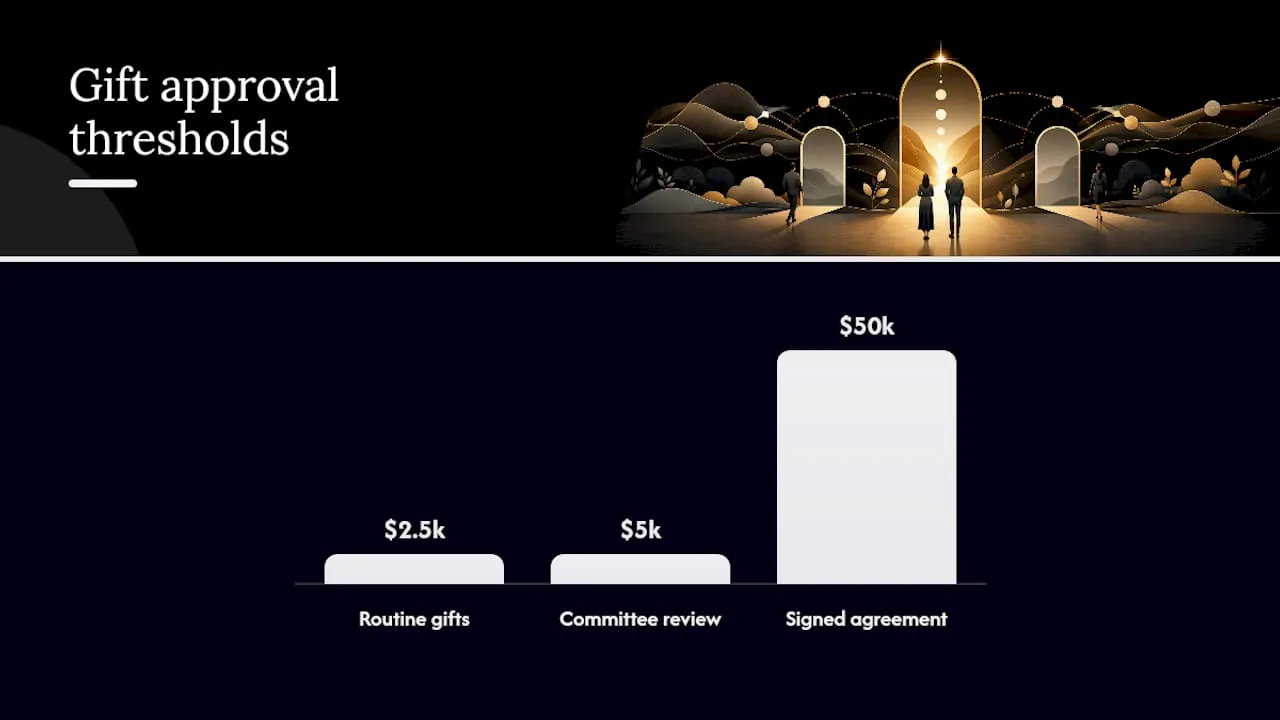
- Routine gifts (cash, marketable securities) get accepted under delegated staff authority, often the development director or finance lead.
- Non-marketable or complex assets (real estate, closely held stock, in-kind property) go to a gift acceptance committee for review, commonly at thresholds around $5,000 or above.
- Large gifts or those involving naming rights require both committee review and a signed gift agreement, with institutional practice often setting that threshold near fifty thousand dollars.
- Anything with legal ambiguity (title questions, restrictive conditions, potential conflicts of interest) goes to legal counsel before the committee even votes.
Finance should verify liquidity and valuation; legal should check title, tax exposure, and donor-imposed restrictions; stewardship should confirm the gift aligns with donor intent and existing agreements.
Pro Tip: Put threshold numbers in your procedures manual, not your board policy. Dollar figures need updating more often than governance principles do, and a policy that requires a full board vote every time you adjust a threshold will quietly stop getting updated.
How to create and operationalise a gift acceptance policy
The single most common mistake in drafting a gift acceptance policy is cramming operational detail into a document meant for board approval. Keep the policy itself short: a page or two stating principles, delegated authority, and the categories of gifts requiring extra review. Put the operational detail, forms, and step-by-step instructions in a separate staff procedures manual that can be updated without a board vote, a distinction the Charitable Gift Planners best-practice guide treats as foundational rather than optional.
A practical drafting sequence:
- Consult finance, legal, development, and programme leads on what gifts they’ve actually encountered in the past three years.
- Draft the board-level policy statement, covering purpose, scope, and delegated authority.
- Draft the companion procedures document with forms, workflows, and named approvers.
- Route both through legal review before the board vote.
- Adopt formally, minute the decision, and file both documents where staff can actually find them.
Sample clauses worth building in from day one:
- A refusal clause stating the board (or committee) may decline any gift inconsistent with mission or values.
- A return or redirection clause covering what happens if a restricted gift can no longer be honoured.
- A naming rights clause specifying approval levels and duration limits.
- A gift agreement requirement clause, triggered automatically above your chosen threshold.
How should you handle tricky or non-standard gifts?
Real estate, closely held stock, and heavily restricted gifts are where a gift acceptance policy actually earns its budget line. Each needs its own diligence path rather than a one-size-fits-all checklist.
For real estate, confirm clear title, check for environmental liabilities (a former petrol station donated “as-is” is a textbook cautionary tale), and estimate carrying costs before acceptance, not after. For in-kind gifts, weigh genuine programme use against disposal costs; equipment nobody can use isn’t a donation, it’s a storage bill. For closely held securities, get an independent valuation and confirm there’s a realistic path to liquidity, since illiquid stock can sit on your books for years. For restricted gifts and naming rights, negotiate the restriction’s wording before acceptance, and build in a sunset or renegotiation clause so a decades-old naming agreement doesn’t outlive its usefulness.
- Ask what it would cost to maintain, insure, or dispose of the asset
- Confirm the donor’s restriction doesn’t conflict with existing programme commitments
- Get valuation in writing before, not after, acceptance
- Route anything ambiguous to the gift acceptance committee rather than deciding solo
Pro Tip: When you do say no, frame it as policy, not preference: “our gift acceptance guidelines require committee review for property gifts, and this one doesn’t meet our current criteria” lands far better than an individual staff member owning the rejection.
What documentation and tax reporting does gift acceptance require?
Every accepted gift needs a paper trail, both for the donor’s tax position and your own compliance obligations. Donors need a contemporaneous written acknowledgement, and for noncash gifts, that record should describe the property rather than assign it a dollar value, since valuation is the donor’s responsibility.
In the US, the IRS requires Schedule M of Form 990 for organisations reporting significant noncash contributions, and donors claiming a deduction over $5,000 typically need an independent appraisal. Jurisdictions outside the US have their own equivalents, so check local charity regulator guidance rather than assuming US rules transfer directly.
- Acknowledge every gift in writing, promptly, with a description (not a valuation) for noncash items
- Identify in advance who is authorised to sign donor valuation forms like Form 8283
- Retain provenance records, especially for art, collectables, or property with a prior ownership history
- Keep gift files for at least as long as your jurisdiction’s audit window requires
Maintaining and reviewing the policy
A gift acceptance policy that never changes usually means nobody’s reading it. Review on a fixed cadence, typically every two to three years, with out-of-cycle reviews triggered by a new gift type, a near-miss with a problematic donation, or a change in tax law.
- Assign review ownership to the finance committee or governance committee, not an individual
- Require full board sign-off on policy changes, even minor wording updates
- Version each revision with a date and summary of what changed
- Communicate updates to development and finance staff before, not after, the next gift arrives
Turning policy into practice with your systems
A gift acceptance policy only works if the systems your team uses every day actually enforce it, rather than leaving compliance to memory. Mapping policy rules directly into your CRM, so that a gift above a set threshold automatically flags for committee review, closes the gap between what the document says and what actually happens at 4pm on a Friday.
- Map gift categories and thresholds to CRM fields so approval routing happens automatically
- Use payment gateway and reconciliation data to verify source of funds before a gift is logged as accepted
- Set automated alerts for gifts crossing committee-review thresholds
- Keep procedures aligned with system permissions, so only authorised staff can approve exceptions
Systems that preserve an audit trail matter more than most boards realise until someone asks, months later, why a particular gift was accepted. That’s a governance question your technology stack should be able to answer without anyone digging through email.
A publisher’s perspective on getting boards to actually adopt this
Most boards over-draft their gift acceptance policy and under-draft their procedures, which is backwards. Keep the policy to a page, delegate clearly, and get finance and legal involved before the first draft, not after the board asks awkward questions.
— Rob
How Colossus helps put your gift acceptance policy into practice
Writing the policy is the easy part; making sure every gift actually gets routed, checked, and logged the way the board intended is where most nonprofits struggle. Colossus gives you the CRM and workflow tools to build that routing directly into daily operations, so a gift above your committee threshold gets flagged automatically instead of relying on someone remembering the rule.

The CRM software lets you tag gift types, set approval workflows by threshold, and keep a complete audit trail tied to each donor record, which matters enormously when a board member or auditor asks how a specific decision was made months later. Combine that with integrated payment processing and you get reconciliation data that helps verify source of funds before a gift is ever marked accepted. If you’re mapping an existing policy into a working system, explore Colossus’s platform features or get in touch to talk through implementation for your organisation.
Sources
- Guide to ethical gift acceptance | Markkula Center for Applied Ethics
- Gift acceptance manual | University of Houston (updated 2025)
- Gift acceptance policies | National Council of Nonprofits
- Gift acceptance policy best practices | Charitable Gift Planners
- Noncash charitable contributions guidance | IRS (P1771)