Virtual community manager: the 2026 strategic guide

TL;DR:
- Effective virtual community managers now use AI to handle routine moderation while focusing on emotional intelligence and strategic oversight. They leverage data analytics and integrated systems to boost engagement, build resilience, and sustain community growth. Providing community managers with authority and access to member data leads to stronger retention and more active participation.
A virtual community manager is defined as the professional responsible for building, moderating, and growing an organisation’s online community to meet strategic goals. The role has moved far beyond posting schedules and comment replies. 73% of online communities were professionally managed in 2026, a 5% rise since 2024. That growth reflects a clear shift: organisations now treat online community management as a core function, not an afterthought. For membership bodies, associations, and educational institutions, the digital community strategist is the person who turns passive members into active participants and data into decisions.
What does a virtual community manager actually do?
The standard industry title is “online community manager,” though “virtual community manager” has become the common shorthand for professionals working entirely in digital spaces. The two terms describe the same role. What has changed is the scope of that role.

A remote community coordinator once spent most of their time on manual tasks: approving posts, removing spam, and drafting newsletters. Today, AI handles the bulk of that work. 88% of organisations now use AI in at least one business function, with community support among the top priorities. That frees the human manager to focus on what AI cannot do: read the emotional temperature of a group, mediate a sensitive conflict, or design a member experience that feels genuinely personal.
The result is a role built around what researchers call “communication orchestration.” AI handles routine moderation noise. The human manager steers overall community culture, sets the tone, and decides which conversations deserve direct attention. For associations managing thousands of members across multiple digital channels, this division of labour is not optional. It is the only way to maintain quality at scale.
How AI is reshaping virtual community engagement
AI tools now perform content filtering, sentiment analysis, and context detection across community platforms. That is a meaningful shift. A social media community manager at a professional association no longer needs to read every post to spot a brewing conflict. AI flags it. The manager then decides how to respond.
The practical benefits for membership organisations include:
- Automated moderation queues that surface only the posts requiring human judgement, reducing review time significantly
- Sentiment tracking across discussion threads, which alerts managers to drops in member satisfaction before they escalate
- Contextual tagging of member contributions, helping managers identify subject matter experts and potential volunteer leaders
- Behavioural pattern detection that highlights members at risk of disengagement, enabling timely outreach
Pro Tip: Set your AI moderation tool to flag posts with negative sentiment scores above a defined threshold, then review those flagged posts personally each morning. This keeps you informed without reading every comment.
The concept of communication orchestration is the clearest way to understand the modern role. The manager does not replace AI. The manager directs it, interprets its outputs, and applies human judgement where algorithms fall short. Complex conflict resolution, trust building, and community culture all require a person. AI provides the intelligence layer that makes that person more effective.
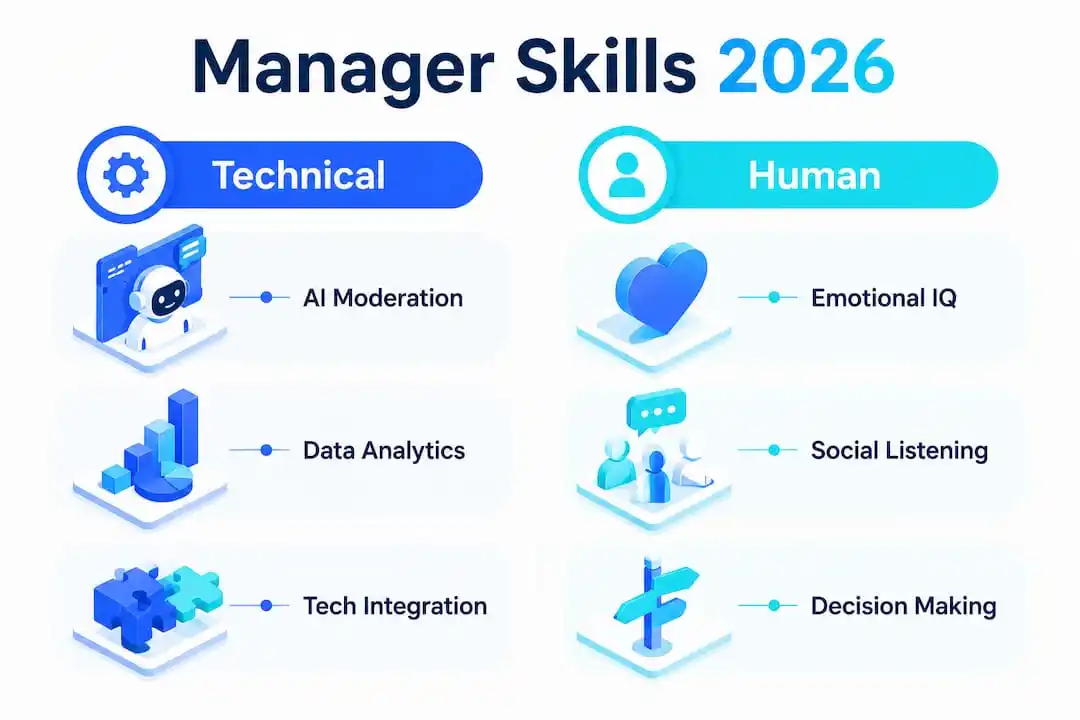
Key skills every online community manager needs in 2026
Effective virtual community engagement depends on a specific set of skills that go well beyond writing social media posts. The managers who deliver measurable results for their organisations combine data literacy with emotional intelligence.
-
Data analytics. Organisations that apply deep data analytics to community efforts see a 30% increase in member engagement. Reading behavioural signals, interpreting dashboards, and translating numbers into programme decisions is now a core competency.
-
Advanced social listening. This goes beyond monitoring mentions. Skilled managers track sentiment trends, identify emerging topics, and detect early warning signs of community friction or disengagement.
-
Emotional intelligence. Crisis management in a digital community requires the ability to de-escalate tension, acknowledge member concerns, and rebuild trust after a difficult incident. No algorithm does this well.
-
Decision intelligence. AI-driven decision intelligence enables managers to predict how specific community initiatives will influence broader organisational outcomes, from membership retention to event attendance.
-
Human-centric programme design. Effective community managers create live events, personalised support moments, and recognition rituals that AI cannot replicate. These touchpoints are what members remember and what keeps them renewing.
Pro Tip: Build a simple monthly report that connects community activity metrics, such as post volume, sentiment scores, and active member counts, directly to membership renewal rates. This makes the value of your community work visible to leadership.
The best online community managers treat their role as part analyst, part counsellor, and part programme director. Associations that invest in developing these skills in their community staff see stronger retention and more active member participation than those who treat the role as purely administrative.
How to build resilient virtual communities for membership organisations
Community decline is gradual and predictable. Moderator burnout and sudden platform policy shifts are the two most common causes of community death. Both are preventable with the right structure.
Distributing the moderation workload is the single most important resilience measure. A community that depends entirely on one person is one resignation away from collapse. Associations should build volunteer moderation teams, create clear onboarding processes for new moderators, and maintain a leadership succession plan that identifies the next person ready to step up.
Platform dependency is the second major risk. Resilient communities maintain secondary presences or email list backups so that a platform policy change does not erase years of relationship building overnight. This is not about abandoning your primary platform. It is about not being entirely at its mercy.
The risks of platform dependency extend further than most managers realise. Shifting trust and safety responsibilities from community managers to platform-controlled policies can increase toxicity and leave managers without the authority to protect their members. Your organisation’s community guidelines must exist independently of any platform’s terms of service.
Practical resilience measures for your community include:
- Distributed moderation: Train and empower a team of volunteer or paid moderators with clear guidelines and escalation paths
- Platform backup: Maintain an email list or secondary channel that members can migrate to if the primary platform changes its policies
- Community identity documentation: Write down your community’s values, rituals, and norms so they survive any personnel or platform change
- Leadership pipeline: Identify and mentor two or three members who could take on a moderation or leadership role within six months
Building vibrant online communities requires this kind of structural thinking, not just good content. The associations with the most engaged memberships treat their online spaces as long-term assets that need maintenance, succession planning, and risk management.
Integrating community management with your membership technology stack
A digital community strategist working in isolation from the organisation’s core systems cannot deliver their full potential. The most effective community management happens when the manager has direct access to member data, event history, and engagement records.
The concept of an engagement orchestration layer describes how modern membership platforms connect AMS (association management systems), CRM, LMS (learning management systems), and event tools into a single view of each member. AI-powered orchestration across these systems enables personalised, contextual, real-time outreach based on actual member behaviour rather than assumptions.
| System | Role in community management | Benefit to the manager |
|---|---|---|
| AMS | Tracks membership status and renewal dates | Identifies at-risk members for targeted outreach |
| CRM | Records all member interactions and preferences | Enables personalised communication at scale |
| LMS | Monitors course completion and learning activity | Connects learning engagement to community participation |
| Event platform | Manages registrations and attendance data | Links event participation to community activity patterns |
The gap between what organisations know about their members and how quickly they act on that knowledge is what practitioners call the Membership Operating Gap. Closing it requires the community manager to work directly within the technology stack, not alongside it. When your CRM flags that a member has not logged in for 60 days, the community manager should be the person who sends a personal message, not an automated email sequence.
Colossus brings these systems together in one platform, giving community managers a unified view of member behaviour across events, communications, and engagement channels. That operational coordination is what separates reactive community management from genuinely strategic work. For associations and educational institutions managing hundreds or thousands of members, this integration is the difference between guessing and knowing.
Key takeaways
The most effective virtual community manager combines AI-driven data intelligence with human empathy to build communities that survive platform changes, moderator turnover, and shifting member needs.
| Point | Details |
|---|---|
| The role is strategic, not administrative | Virtual community managers now lead communication orchestration, not just content moderation. |
| AI adoption is near-universal | 88% of organisations use AI in community functions; managers who direct AI tools outperform those who avoid them. |
| Data skills drive engagement | Organisations using deep analytics in community work see a 30% increase in member engagement. |
| Resilience requires structure | Distributed moderation and platform backups prevent the burnout and policy shifts that kill communities. |
| Integration multiplies impact | Connecting AMS, CRM, LMS, and event data gives managers the full member picture needed for timely, personalised outreach. |
The uncomfortable truth about community management in 2026
I have spent years watching membership organisations invest heavily in community platforms and then wonder why engagement plateaus after six months. The platform is never the problem. The problem is almost always that the community manager has been given a content calendar and a moderation queue, but no authority, no data access, and no seat at the leadership table.
The shift to AI-assisted moderation is genuinely significant. But I have seen organisations use it as an excuse to reduce investment in human community leadership rather than redirect it. That is a mistake. AI removes the low-value tasks. It does not replace the judgement, empathy, and relationship-building that make a community worth belonging to.
The resilience point is the one I feel most strongly about. Excluding community managers from trust and safety decisions, whether that exclusion comes from platform policies or internal org charts, is a structural risk that most associations have not fully reckoned with. Your community manager needs authority, not just responsibility.
My practical advice: treat your online community manager as a programme director, not a content producer. Give them access to your membership data. Include them in renewal strategy conversations. Build a moderation team around them so the community does not depend on a single person’s availability. The organisations that do this consistently report stronger member retention and more active participation than those that treat community management as a communications task.
The future of this role points toward greater integration with organisational strategy, not less. The managers who thrive will be the ones who can read data, lead people, and build systems that outlast any single platform or policy change.
— Rob
How Colossus supports your community management work
Managing a membership community well requires more than good intentions. It requires the right tools working together.
Colossus brings membership management, CRM, and event tools into a single platform, giving your community manager a unified view of every member’s activity, preferences, and engagement history. From tracking renewal risk to coordinating virtual events, Colossus removes the operational friction that slows down community work. Associations and educational institutions use Colossus to connect their member engagement data directly to outreach decisions, so no at-risk member falls through the gap. If you are ready to give your community manager the tools they need to work strategically, Colossus is built for exactly that.
FAQ
What is a virtual community manager?
A virtual community manager is the professional who builds, moderates, and grows an organisation’s online community to meet strategic goals. The role now includes data analysis, AI oversight, and member experience design, not just content moderation.
How is AI changing online community management?
AI handles routine tasks such as content filtering and sentiment analysis, freeing managers to focus on relationship building and strategic decisions. 88% of organisations now use AI in community support functions.
What skills does an effective online community manager need?
The core skills are data analytics, social listening, emotional intelligence, and decision intelligence. Managers also need the ability to design human-centric experiences such as live events and personalised support that AI cannot replicate.
How do you prevent a virtual community from dying?
Distribute the moderation workload across a team, maintain a leadership succession plan, and keep a platform backup such as an email list. Moderator burnout and platform policy shifts are the two leading causes of community decline.
Why should community managers have access to membership data?
Access to AMS, CRM, and event data allows community managers to identify disengaged members early and respond with personalised outreach. Without that data, community management is reactive rather than strategic.