Unlock efficiency with all-in-one nonprofit platforms

TL;DR:
- All-in-one nonprofit platforms unify core functions to eliminate data silos and improve efficiency.
- Successful adoption depends on culture change, dedicated ownership, and proper onboarding.
- They enhance fundraising and engagement through automation, targeted communication, and real-time analytics.
Many nonprofits are quietly haemorrhaging time and money on disconnected tools that were never designed to work together. A fundraising platform here, a spreadsheet-based membership list there, an email marketing tool that barely talks to either — the result is duplicated data, frustrated staff, and donors who feel like strangers every time they engage. All-in-one nonprofit platforms exist to solve precisely this problem, consolidating every core function into a single, coherent system. This guide explains what these platforms offer, how to evaluate them, and what it genuinely takes to make them work for your organisation.
Table of Contents
- What is an all-in-one nonprofit platform?
- Must-have features for effective nonprofit operations
- Comparing the leading all-in-one nonprofit platforms
- How all-in-one platforms enhance fundraising and engagement
- What most guides miss about all-in-one nonprofit platforms
- Next steps: find your all-in-one nonprofit solution
- Frequently asked questions
Key Takeaways
| Point | Details |
|---|---|
| Centralised efficiency | All-in-one platforms streamline nonprofit workflows and reduce manual duplication. |
| Feature fit is critical | The right tool depends on your organisation’s size, needs, and strategy. |
| Implementation matters | Successful adoption requires thoughtful training, not just technology investment. |
| Scalability vs. simplicity | Free tools offer quick wins but enterprise platforms unlock growth for complex needs. |
What is an all-in-one nonprofit platform?
An all-in-one nonprofit platform is a unified software solution that brings together the essential functions of running a membership organisation or charity under one roof. Rather than subscribing to five separate tools and paying for integrations that never quite work, your team manages fundraising, events, communications, and reporting from a single dashboard.
The distinction matters more than it might appear. Single-purpose tools are optimised for one task, but they create data silos. When your donor database cannot communicate with your event registration system, staff spend hours reconciling records manually. An integrated platform eliminates that friction entirely.
Most robust platforms include a core set of modules:
- Donor and member management: Centralised profiles that track giving history, engagement, and communication preferences
- Event management: Registration, ticketing, attendee tracking, and post-event reporting
- CRM (Constituent Relationship Management): Relationship tracking, pipeline management, and personalised outreach
- Email and marketing communications: Segmented campaigns, automated follow-ups, and engagement analytics
- Reporting and analytics: Real-time dashboards that surface the metrics that matter most
- E-commerce and payments: Secure online transactions for donations, memberships, and merchandise
It is worth clarifying one common source of confusion: the difference between an AMS and a CRM. AMS is ops-focused, CRM is engagement-focused, meaning an AMS (Association Management System) handles membership dues, renewals, and compliance, while a CRM centres on relationship building and donor stewardship. Many modern platforms blend both, which is precisely why evaluating what your organisation actually needs is so important.
Centralisation empowers both staff and volunteers by removing guesswork. When everyone works from the same data, decisions are faster and communications feel consistent. Exploring digital transformation for nonprofits helps frame why this shift is increasingly non-negotiable for organisations that want to scale. GovSignals nonprofit use cases also illustrate how data-driven approaches are reshaping the sector.
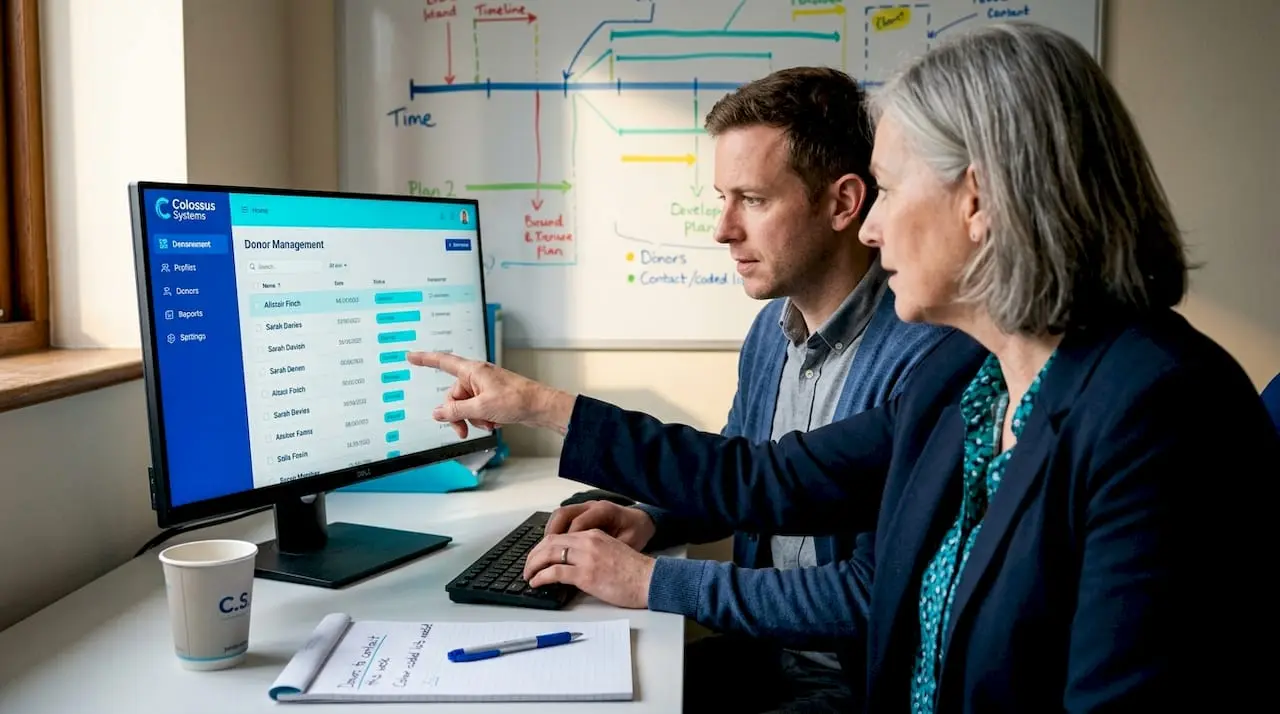
Pro Tip: Before selecting a platform, map every tool your team currently uses and identify where data is manually re-entered. Those manual touchpoints are your clearest indicators of where integration will save the most time.
Must-have features for effective nonprofit operations
Having established what all-in-one platforms are, it is worth being specific about what a best-in-class solution should actually deliver. Not every platform that calls itself “all-in-one” covers the full range of functions your organisation requires, and gaps become costly once you are already committed.
Here is a numbered checklist of questions to ask any platform provider before signing a contract:
- Does the platform manage both member records and donor records without requiring duplicate entry?
- Can you segment your audience for targeted email campaigns based on giving history, event attendance, or membership tier?
- Does the event registration module include automated reminders, waitlists, and post-event surveys?
- Is reporting customisable, or are you limited to pre-built dashboards?
- What automation tools are available for renewals, donation acknowledgements, and follow-up sequences?
- How does the platform handle payment processing, and what are the transaction fees?
- Is there an open API for connecting third-party tools if needed?
- What does onboarding and ongoing support look like?
Effective boosting member engagement depends on having communications and event tools that work in concert. Reviewing the key membership software features available on modern platforms gives you a clearer benchmark for evaluation.
| Feature | Salesforce Nonprofit Cloud | Blackbaud | Givebutter | Bloomerang |
|---|---|---|---|---|
| Donor management | Advanced | Advanced | Basic | Advanced |
| Event tools | Via add-ons | Built-in | Built-in | Limited |
| Email marketing | Via add-ons | Built-in | Built-in | Built-in |
| Reporting | Advanced AI | Strong | Basic | Strong |
| API / integrations | Extensive | Moderate | Limited | Moderate |
| Pricing model | Per-user ($60+/mo) | Custom enterprise | Free tier available | Subscription |
Pro Tip: Evaluate your platform needs not just for today, but for three years from now. A tool that fits your current team of five may become a bottleneck when your membership doubles. Factor in scalability from the outset, not as an afterthought.
Comparing the leading all-in-one nonprofit platforms
Now that you know what features to look for, it is useful to understand how the main market options actually compare in real-world conditions.
Salesforce Nonprofit Cloud is the enterprise standard. It offers flexible CRM with AI tools, including Einstein analytics, and is highly customisable across programmes and engagement functions. However, implementation costs typically start at £25,000 to £30,000 or more, and per-user pricing of $60 or above per month adds up quickly. This platform suits large, complex organisations with dedicated technical staff.
Blackbaud is a long-standing name in nonprofit technology, particularly strong in fundraising and financial management. It is powerful but similarly expensive, and its interface can feel dated compared to newer entrants. Mid-to-large organisations with established fundraising programmes tend to get the most value from it.
Givebutter sits at the other end of the spectrum. Free platforms like Givebutter offer a strong entry point for smaller charities, with built-in fundraising pages, event tools, and donor management. The limitations are real, though: payouts can require manual processing, and reporting capabilities are basic. It is an excellent starting point, not a long-term enterprise solution.
Bloomerang occupies a strong middle ground. It is a donor-focused retention leader with genuinely good reporting and engagement tracking, though it does require add-ons for full event and marketing functionality.
“Free platforms like Givebutter are excellent for entry-level needs but hit scale limits quickly. Enterprise solutions like Blackbaud and Salesforce are powerful and flexible, yet their complexity and cost mean smaller organisations often pay for capability they will never use.” — Nonprofit technology analysts
Here is a quick-reference guide for matching platform type to organisational stage:
- Small charities (under 1,000 members): Free or low-cost platforms like Givebutter; prioritise ease of use over features
- Growing organisations (1,000 to 10,000 members): Mid-market solutions like Bloomerang; balance affordability with scalability
- Large, complex nonprofits (10,000+ members or major donors): Enterprise platforms like Salesforce Nonprofit Cloud or Blackbaud; accept higher cost in exchange for flexibility
If your organisation is exploring free software for nonprofits as a starting point, understand its ceiling before committing. Meanwhile, fundraising strategies for nonprofits often point to integrated tools as a key driver of campaign performance. Some organisations also supplement digital fundraising with creative approaches like custom merchandise fundraising, which integrates well with e-commerce modules on all-in-one platforms.
How all-in-one platforms enhance fundraising and engagement
With the strengths and limitations of various platforms established, the more pressing question for most leaders is this: what does a real improvement in fundraising and engagement actually look like once you have an integrated platform in place?
The answer lies in the donor journey. When data flows freely between your CRM, email tool, and event management system, every touchpoint becomes an opportunity to deepen the relationship rather than repeat a clumsy introduction. Donors are not asked for information they have already provided. Their event attendance informs the next donation ask. Their giving history shapes the tone of every communication.
Here is how integrated platforms create measurable impact across five practical scenarios:
- Streamlined donor onboarding: When a new donor gives online, their profile is automatically created, a personalised acknowledgement is sent, and they are placed into the appropriate nurture sequence without any staff intervention.
- Targeted event invitations: Your platform segments members by interest or giving tier and sends tailored invitations, increasing attendance rates compared to generic bulk emails.
- Automated renewal campaigns: Membership renewals are triggered automatically, with escalating reminders and a personalised lapse message if a member does not renew within a set window.
- Real-time fundraising dashboards: Staff can see campaign performance live, enabling them to adjust messaging or tactics mid-campaign rather than waiting for a post-event report.
- Volunteer coordination: Integrated platforms track volunteer hours, preferences, and availability, making it simpler to match people to roles and acknowledge their contributions.
Digital fundraising strategies consistently highlight that the organisations achieving the strongest results are those that treat every interaction as part of a connected journey rather than a standalone event. Strong donor management best practices reinforce this, showing that retention improves significantly when communication is timely, relevant, and personalised. Proven engagement strategies from adjacent sectors also confirm that automation, when paired with genuine personalisation, drives far better results than volume-based outreach alone.
One common pitfall is worth naming plainly. Enterprise platforms like Blackbaud and Salesforce are powerful, but their complexity means that organisations sometimes implement them without fully configuring the automation and segmentation tools that generate the biggest gains. The platform’s potential goes unrealised because teams default to using it as a slightly more expensive spreadsheet.
Pro Tip: Identify three automation workflows you want running within the first 90 days of platform adoption. Automating donor acknowledgements, membership renewals, and event follow-ups alone can reclaim hours of staff time each week while improving the member experience significantly.
What most guides miss about all-in-one nonprofit platforms
Most platform guides focus almost entirely on features, pricing, and integration capabilities. They rarely address the factor that most often determines whether a platform investment succeeds or fails: people.
The “all-in-one” label can create a false sense of security. Organisations assume that once the platform is live, operations will improve automatically. In reality, technology reflects and amplifies whatever habits and processes your team already has. If those habits are disorganised, the platform will simply give you a more expensive way to be disorganised.
The most common failure pattern we observe is this: the platform is implemented, the team receives basic training, and within six weeks, staff have reverted to the legacy tools they find comfortable. The new system sits underused, its data incomplete, its automations untriggered. Leadership then questions the investment, not realising that the platform is not the problem.
Genuine adoption requires more than a go-live date. It requires a culture shift. Someone in your organisation needs to own the platform, not just administer it, but champion it. That person advocates for consistent usage, surfaces where the system can be configured better, and bridges the gap between what the technology can do and what the team is actually doing with it.
Customisability is also often harder than advertised. Highly configurable platforms give you options, but options require decisions, and decisions require expertise. Organisations without in-house technical capacity frequently find themselves paying for features they cannot set up without external support. This is not a reason to avoid customisable platforms, but it is a reason to budget honestly for implementation and ongoing configuration.
The most honest thing we can say is this: technology magnifies existing strengths. It does not substitute for strategic leadership. A well-funded, well-led organisation will see extraordinary results from an integrated platform. An organisation without clear goals or strong internal processes will find that the platform creates complexity without clarity. Strategic planning for nonprofits must precede platform selection, not follow it.
Next steps: find your all-in-one nonprofit solution
The path from fragmented tools to a unified, efficient operation is entirely achievable. The organisations that make this transition successfully share one thing in common: they choose a platform aligned to their actual needs, invest in proper onboarding, and commit to consistent usage across their teams.
At Colossus Systems, we build exactly this kind of platform for membership organisations, associations, and nonprofits that are ready to operate at a higher level. Our membership platform features bring together member management, event planning, and communications in one place. Our CRM software keeps every donor and member relationship organised and actionable. And our event management tools make planning, promoting, and running events far simpler than managing multiple standalone systems. If your organisation is ready to streamline operations and strengthen engagement, we would be glad to show you what is possible.
Frequently asked questions
Are all-in-one nonprofit platforms difficult to implement?
Implementation difficulty varies significantly by platform. Enterprise systems like Salesforce Nonprofit Cloud are highly customisable but require skilled staff and substantial upfront investment, while simpler platforms like Givebutter can be operational within days.
Can smaller charities benefit from all-in-one platforms or are they better for large organisations?
Smaller charities can benefit greatly, particularly from free entry-level platforms that provide donor management and event tools without the cost of enterprise solutions. Scalable options allow organisations to grow into more sophisticated functionality over time.
How do all-in-one platforms improve fundraising performance?
Integrated platforms connect donor data, campaign tools, and communications in one system, enabling personalised outreach, automated follow-ups, and real-time performance tracking that collectively improve both acquisition and retention.
Are customisable platforms always better?
Not necessarily. Highly customisable platforms like Salesforce Nonprofit Cloud offer significant flexibility but come with high implementation costs and require technical expertise to configure properly, which can be a burden for smaller teams with limited resources.
Recommended
- Best Email Marketing Service for Nonprofits – Top Comparison 2025|CS
- Membership Software for Societies and Clubs | Colossus Systems
- How to Boost Member Engagement and Why use Engagement Software|CS
- 7 Best Event Planning Websites for Nonprofits | Colossus Systems
- Community Ocean — Free Link in Bio Template | Linkflow
- For Non Profits – GovSignals