Secure 80% of Funds: Major Gift Fundraising for Nonprofit Teams

Major gift fundraising is the discipline of identifying, cultivating and securing high-value donations from individuals whose capacity and inclination place them well above your typical donor. It matters because a small number of these donors usually supply most of an organisation’s revenue, and the process that wins their support, built on relationships rather than transactions, is what funds capital campaigns, endowments and multi-year programmes that annual appeals alone cannot cover.
TL;DR:
- Setting a major gift threshold should be based on your organization’s recent giving data, typically at the top 1-5% or a fixed multiple of average gifts.
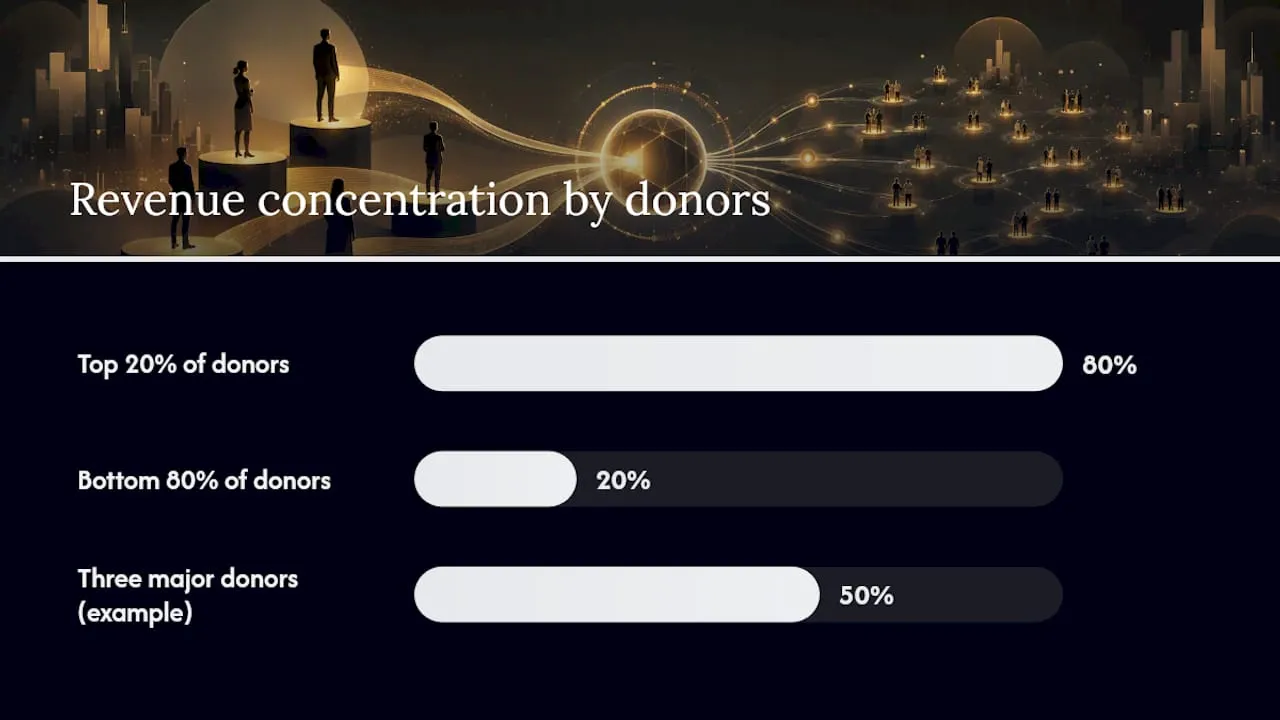
- Major gifts disproportionately fund capital campaigns and multi-year projects, with 80% of charitable revenue coming from the top 20% of donors.
- The five stages of major gift fundraising are identification, qualification, cultivation, solicitation, and stewardship, each requiring documented next steps and scheduled follow-ups.
- Building a successful major gift program necessitates clear roles, deliberate prospect segmentation, repeatable processes, and governance policies, rather than large team sizes.
- Implementing an integrated CRM and pipeline management system helps maintain prospects’ progress, automate tasks, and prevent relationship slip-ups across multiple stages.
Table of Contents
- What counts as a major gift and how do you set a threshold?
- Why do major gifts matter so much to organisational stability?
- What are the five stages of the major gift fundraising cycle?
- How do you build a major gift strategy from scratch?
- What metrics and portfolio benchmarks should you track?
- What tools and systems support repeatable major gift work?
- How can an integrated platform support each pipeline stage?
- What mistakes most often derail major gift programmes?
- A practitioner’s take on patience and discipline
- Where an integrated platform fits into your major gifts programme
- Sources
What counts as a major gift and how do you set a threshold?
There is no universal figure for what counts as a major gift. A £500 donation might be transformative for a community food bank, while a university capital campaign may reserve the label for gifts starting at £25,000. The threshold has to be relative to your donor file and your budget, not borrowed from a sector average.
The most reliable way to set one is to look at your own giving history rather than guess.
- Pull every gift from the last three years and rank them by size.
- Identify the natural break point where gifts start to look like outliers, often the top 1 to 5% of your file.
- Set your threshold at that percentile, or use a fixed multiplier of your average gift (commonly 10 to 20 times the median donation).
- Revisit the figure annually as your file grows and your average gift size shifts.
A small nonprofit with a £50 average gift might set its threshold at £1,000. A mid-sized regional charity might set it at £5,000. A large university or hospital foundation might start counting only above £25,000, reserving separate tiers for principal gifts in the six or seven figures. Whatever the number, it should also flag related giving vehicles worth watching, particularly donor-advised funds and planned or estate gifts, both of which frequently arrive at major gift scale even when the donor’s annual cash giving looks modest.
Why do major gifts matter so much to organisational stability?
The concentration of philanthropic revenue at the top of the donor file is not a marginal effect, it is the defining fact of nonprofit finance. Roughly 80% of charitable revenue originates from the top 20% of donors, which means the health of a major gifts programme, more than any other fundraising channel, determines whether an organisation can plan three years ahead or is stuck reacting quarter to quarter.
That concentration is precisely why major gifts fund the work annual appeals cannot. Capital campaigns, new buildings, endowment growth and multi-year programme commitments almost always trace back to a handful of transformational donors rather than a broad base of small gifts. Giving USA’s analysis confirms that individual giving continues to dominate total philanthropic revenue, and that very large gifts, often channelled through donor-advised funds or estates, account for a disproportionate share of the biggest commitments nonprofits receive.
The obvious risk is dependency. An organisation that draws half its budget from three donors is one lost relationship away from a funding crisis, and boards are right to ask about that exposure. The answer is not to avoid major gifts, it is to build stewardship discipline strong enough that those relationships deepen rather than lapse, and to keep a wide enough pipeline that no single gift can sink the budget if it doesn’t renew.
What are the five stages of the major gift fundraising cycle?
Every credible major gifts programme runs on the same underlying sequence: identification, qualification, cultivation, solicitation and stewardship. The ask itself, the moment most fundraisers dread and obsess over, is genuinely only the visible fraction of a process that can run for months or years before that conversation happens.
-
Identification. Screen your existing donor file, board connections and event attendee lists for capacity and affinity signals. Wealth screening tools help, but internal knowledge, who has hosted a table, who asks detailed questions about programme outcomes, often surfaces prospects screening tools miss. Ask board members directly for introductions; they hold networks your database cannot see.
-
Qualification. A discovery meeting exists to confirm two separate things: whether the prospect has the financial capacity you suspect, and whether they have genuine inclination toward your mission. Capacity without inclination is a dead end. Inclination without capacity means a smaller ask, not no ask. Document both honestly rather than assuming your first impression is correct.
-
Cultivation. This is where moves management becomes a daily discipline rather than a buzzword. Every meaningful touchpoint, a coffee, a site visit, an event invitation, should end with a documented next step and a scheduled follow-up date. Pace matters: rushing a six-figure prospect toward a solicitation within weeks of first contact almost always backfires, while letting a warm prospect go quiet for a year loses momentum you built deliberately.
-
Solicitation. Plan the ask before you make it. Decide who delivers it (often a peer donor or board member carries more weight than staff), the specific amount, the named purpose, and realistic timing for payment. Name a figure rather than asking an open-ended “what would you consider”, and be ready for objections about restriction, timing or recognition without treating them as rejection.
-
Stewardship. Stewardship begins the moment a gift is committed, not after the cheque clears. A prompt, specific acknowledgement, regular impact reporting tied to what the gift actually funded, and recognition calibrated to the donor’s preference all feed directly into whether that donor gives again, and at what level.
Pro Tip: Treat every cultivation contact as incomplete until it has a documented next move and a date attached. Fundraisers who skip this step are the ones who discover, six months later, that a promising prospect has quietly gone cold.
How do you build a major gift strategy from scratch?
A working programme needs five components in place before you make your first solicitation, and skipping any one of them tends to show up later as missed targets or burnt-out staff.
- Set a threshold and get internal agreement on it. Development, finance and the executive director should use the same number, otherwise your reporting will contradict itself.
- Assign clear roles. A designated major gift officer (even part-time in a small team), someone doing prospect research, and a defined channel for executive and board involvement.
- Design portfolios deliberately. Segment prospects by capacity and stage rather than handing every officer an undifferentiated list.
- Build repeatable processes. A qualification workflow, a cultivation plan template, and a stewardship calendar that runs on a schedule rather than staff memory.
- Put governance in place. A gift acceptance policy that defines what your organisation will and won’t accept, and an approval flow for gifts above a certain size, protects you from awkward surprises involving restricted funds or reputational risk.
None of this requires a large team. What it requires is that the five pieces exist in writing, get reviewed annually, and get used consistently rather than treated as a one-time planning exercise. Boards engage far more productively with a programme that has visible structure than with an ad hoc list of “people we should probably talk to.”
What metrics and portfolio benchmarks should you track?
A major gift officer’s day rarely looks like fundraising from the outside, it looks like calendar management, note-taking and follow-up emails. The actual job is holding a defined portfolio of prospects, moving each one deliberately through the pipeline, and reporting on that movement in terms leadership can act on.

Sector benchmarks give a useful sanity check on workload. Officers commonly manage between 75 and 150 active prospects at once, a range wide enough to reflect differences in gift size and cultivation intensity. An officer working seven-figure principal gifts should sit toward the smaller end; someone managing a broader base of five-figure prospects can reasonably hold more.
The metrics worth reporting monthly or quarterly are:
- Pipeline counts by stage. How many prospects sit in identification, qualification, cultivation and solicitation right now.
- Conversion rate. What percentage of qualified prospects move to a completed gift, and how long that typically takes.
- Average gift size. Tracked over time to catch whether your programme is trending toward larger or smaller commitments.
- Donor retention. The share of major donors who give again the following year, arguably the single clearest signal of whether stewardship is working.
Reporting these figures to a board in a simple pipeline snapshot, rather than a narrative summary, tends to generate far more useful board engagement than a written update ever does.
What tools and systems support repeatable major gift work?
A spreadsheet can carry a small pipeline for a while, but it breaks down fast once you are tracking moves, notes and deadlines across more than a handful of prospects. A CRM built for moves management is the minimum viable infrastructure for any programme past its first year.
- A CRM with task and pipeline tracking so every prospect has a visible stage, owner and next action.
- Wealth screening used carefully, cross-checked against your own relationship knowledge rather than trusted blindly, and applied with attention to donor privacy expectations.
- Integrated event and communication tools so cultivation touchpoints and personalised outreach are logged automatically rather than living in someone’s inbox.
- Payment processing built in, so a pledge or gift can be fulfilled without routing a major donor through a generic public donation form.
Small teams need the pipeline and task tracking above almost everything else. Larger programmes add wealth screening depth, segmentation and board-facing reporting layers on top of that same foundation.
How can an integrated platform support each pipeline stage?
Technology does not replace the relationship work described above, but the right platform removes the friction that causes fundraisers to lose track of it. A CRM built around pipelines lets you tag prospects by stage, assign custom fields for capacity and inclination notes, and trigger reminders when a move is overdue rather than relying on memory.
Event invitations and RSVPs feeding directly into donor records mean a cultivation dinner attendee is automatically logged with context for the next conversation, and integrated payment processing lets a solicited pledge be fulfilled without the donor navigating an anonymous public form.
None of this substitutes for the discovery meeting, the handwritten note, or the board member willing to make an introduction. It simply means the officer running twelve simultaneous relationships doesn’t lose the thread on any of them.
What mistakes most often derail major gift programmes?
Most failures in this discipline are process failures, not relationship failures. The fixes are usually fast to apply once you spot the pattern.
- Asking too soon. A first meeting is for qualification, not solicitation, rush it and you burn the relationship.
- Skipping stewardship after the gift lands. No acknowledgement or impact report within weeks signals the relationship mattered less than the cheque.
- Overloading the board. Ask for specific introductions and event appearances rather than open-ended “help us fundraise” requests.
- Running with no documented next move. Every interaction should end with a scheduled follow-up, otherwise prospects quietly go cold.
Small teams without dedicated major gift staff should not try to replicate a large programme’s headcount. Focus instead on tight prospect research on a shorter list, and disciplined stewardship on the donors you already have. That combination consistently outperforms a wide, unqualified list run by an overstretched team.
Pro Tip: If you only have capacity for one improvement this quarter, make it the post-gift acknowledgement timeline. A thank you sent within 48 hours, followed by a specific impact update within 90 days, does more for retention than almost anything else on this list.
A practitioner’s take on patience and discipline
What separates programmes that grow from programmes that stall is rarely talent, it is consistency. The fundraisers who succeed at this treat moves management as a daily habit, not a quarterly review exercise, and they resist the urge to rush a promising prospect toward an ask before the relationship can bear it.
Start smaller than you think you need to. Pick one threshold, one portfolio, one stewardship calendar, and run it properly before adding complexity.
— Rob
Where an integrated platform fits into your major gifts programme
Running a serious major gifts programme on spreadsheets and separate email tools means moves management lives in someone’s memory, not your system, and that’s where relationships quietly slip. Colossus gives fundraising teams a single CRM and pipeline where every prospect’s stage, notes and next move sit in one record instead of scattered across inboxes.
Cultivation events, personalised email follow-ups, and payment processing for pledges and fulfilled gifts all run through the same platform, so a donor who attends a cultivation dinner and later commits to a five-figure gift has that entire history in one place rather than three disconnected tools. For teams juggling event management alongside donor relationships, that consolidation saves the hours usually lost to manually reconciling attendee lists against the donor database.
If your major gifts programme is still tracked across spreadsheets and personal notes, book a look at how Colossus handles pipeline and stewardship tracking, and see whether it fits the way your team already works.
Sources
- Major Gift Solicitation: A Practical Guide for Fundraising | AFP Career Center
- The art of securing major gifts | Chronicle of Philanthropy playbook
- Giving USA: 5 takeaways from the 2024 report