Personalized member experiences: your 2026 guide

TL;DR:
- Personalized member experiences are crucial for boosting engagement and loyalty in membership organizations. Implementing effective personalization begins with clean data, strategic segmentation, and automated onboarding to generate behavioral insights for tailored interactions. AI-driven tools amplify engagement and foster a sense of digital belonging, transforming member retention strategies.
Personalized member experiences are defined as tailored interactions that align with each individual member’s preferences, behaviours, and life stage to increase satisfaction and long-term loyalty. 77% of consumers have chosen, recommended, or paid more for a brand that delivers personalized service. That figure alone tells you personalization is no longer a nice addition to your membership strategy. It is the strategy. The industry term for the most advanced form of this practice is hyper-personalization, which uses real-time data and AI to deliver context-aware, individual-level experiences at scale. This guide covers the tools, steps, and pitfalls every membership organisation leader needs to know in 2026.
What do personalized member experiences actually require?
Effective personalization starts with clean, centralised member data. Without it, every segmentation effort and AI tool you deploy will produce unreliable results. Your first task is to audit what data you currently hold, identify gaps, and establish a single source of truth across your CRM, member portal, and event management systems.
The three data categories that matter most are:
- Demographic data: Member type, tenure, location, and role within their organisation.
- Behavioural data: Login frequency, event attendance, content downloads, and community interaction.
- Attitudinal data: Survey responses, support tickets, and direct feedback from pulse surveys.
Behavioural data is the most predictive. Tracking logins and event attendance provides leading indicators of churn risk well before a member decides to lapse. Organisations that ignore this signal miss their best window to intervene.
Key tools for personalisation at scale
| Tool Category | Primary Function | Example Use Case |
|---|---|---|
| Member Portal | Central hub for personalised content delivery | Displaying role-specific resources on login |
| CRM System | Segmentation and communication management | Targeting renewal reminders by tenure |
| AI Orchestration Platform | Real-time journey personalisation | Recommending events based on past attendance |
| Survey Platform | Collecting actionable attitudinal data | Quarterly pulse surveys with 3–5 questions |
Response rates below 15% yield functionally useless survey data. Aim for above 40% by keeping pulse surveys short and asking only questions that will directly inform a decision.
Segment your membership at minimum by three variables: tenure, member type, and engagement level. A first-year individual member needs a completely different communication track than a five-year corporate member who attends every event. Treating them identically is the fastest route to disengagement.
Data governance matters here too. Members trust you with personal and professional information. Storing and using that data responsibly is not just a legal obligation under UK GDPR. It is a foundational data security requirement that underpins every personalisation effort you make.
Pro Tip: Start your personalisation programme with a simple automated onboarding sequence. The behavioural signals members generate in their first 90 days give you the segmentation data you need to personalise everything that follows.
How to implement personalized member experiences step by step
Delivering genuinely personalised journeys does not require a costly enterprise data overhaul. Foundational automated onboarding combined with a central member portal generates the behavioural signals you need to personalise at scale from day one.
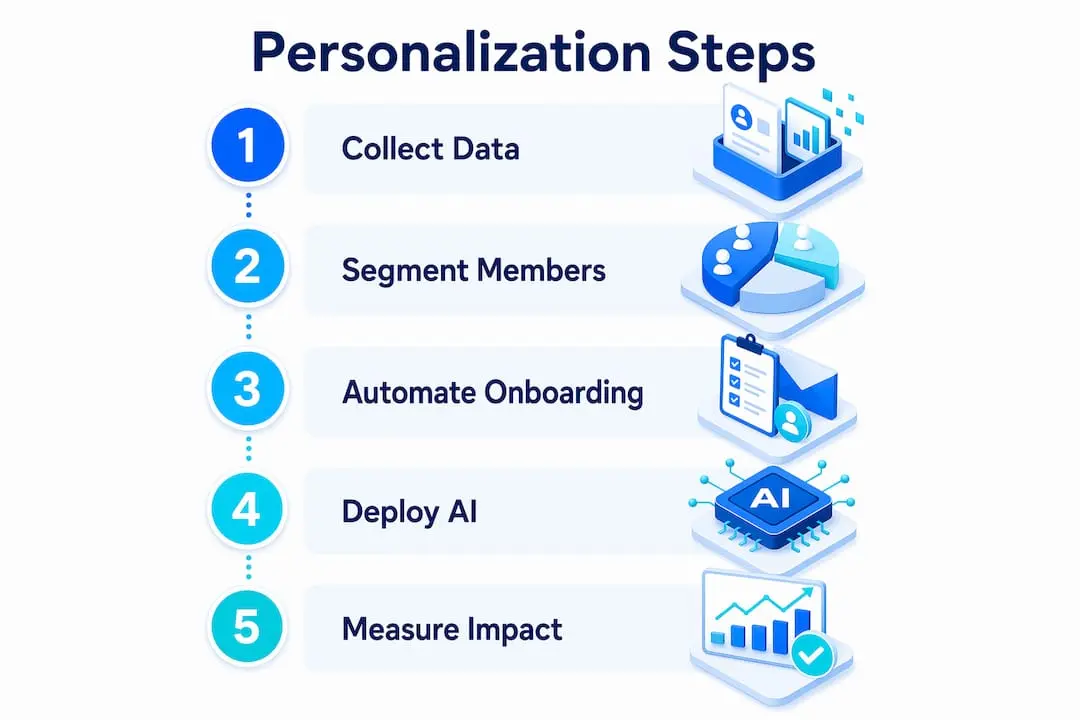
Follow this five-stage implementation framework:
- Collect: Deploy your member portal and CRM to capture behavioural data from the moment a member joins. Track logins, content views, event registrations, and purchases.
- Segment: Group members by tenure, type, and engagement level. Create at minimum three segments: new members (0–12 months), active members, and at-risk members showing declining engagement.
- Design journeys: Build a 30-60-90 day onboarding sequence for new members with personalised content at each stage. A new member in month one needs orientation. The same member in month three needs value reinforcement.
- Deliver: Use segmented communications tailored to each group. Segmented messages by lifecycle generate 2–3 times higher engagement than mass emails. The difference in open and click rates is not marginal. It is transformational.
- Measure and adapt: Track engagement metrics monthly. Adjust content, timing, and channel based on what the data shows.
Using AI to personalise at the individual level
AI moves personalisation from segment-level to individual-level. An AI orchestration platform analyses each member’s behaviour in real time and recommends the next best action, whether that is a relevant event, a training resource, or a renewal prompt timed to their engagement pattern.
The practical starting point for most organisations is AI-powered email personalisation. Your CRM sends different content to different members based on their recent activity, not just their segment. A member who attended three webinars last quarter receives a recommendation for your next advanced workshop. A member who has not logged in for 60 days receives a re-engagement sequence.
Behavioural engagement data predicts renewal risk 60–90 days before a lapse occurs. That window is your opportunity to intervene with a personalised offer, a direct outreach call, or a targeted piece of content that reminds the member of the value they are receiving.
Pro Tip: Set up automated alerts in your CRM when a member’s engagement score drops below a defined threshold. Assign those members to a human follow-up queue alongside your automated re-engagement sequence. The combination of technology and personal contact is far more effective than either alone.
Which mistakes undermine personalisation efforts?
Personalisation done poorly is worse than no personalisation at all. The most damaging mistake is what researchers call empathetic failure: presenting a member with a product or service recommendation that is completely irrelevant to their current situation. Hyper-personalization should reduce cognitive load and present helpful, context-aware paths. When it does the opposite, it signals that your organisation does not understand its members.
The most common pitfalls to avoid are:
- Asking ‘nice-to-know’ survey questions. Every question in a member survey must drive a specific decision. If you cannot name the action you will take based on the answer, remove the question. Feedback questions must drive decisions and be followed by concrete organisational actions.
- Failing to close the feedback loop. Most organisations fail to communicate what they did with survey results. Members who give feedback and hear nothing back are less likely to engage again. Publish a summary of what you heard and what you changed.
- Over-relying on technology. Automated journeys and AI recommendations are powerful. They are not a substitute for human relationships. Your most at-risk members often need a phone call, not another automated email.
- Ignoring privacy and consent. Using member data in ways they did not expect or consent to destroys trust rapidly. Be transparent about what you collect and why.
“True personalisation is a fiduciary role. You are presenting members with paths that serve their interests, not just paths that serve your revenue targets.”
How will AI and hyper-personalization shape member engagement?
AI-powered member journeys deliver 3–4 times higher engagement compared to standard personalisation approaches. That figure comes from leading credit unions that have deployed AI-driven personalisation at scale. The implication for membership organisations is clear: the gap between organisations using AI and those that are not will widen significantly through 2026 and beyond.
The most significant shift is the move from segment-level to segment-of-one experiences. Rather than grouping 500 members into a “lapsed” category and sending them the same re-engagement email, AI analyses each individual’s history and crafts a contextually relevant message. The difference in member response is measurable and substantial.
One emerging application is the personalised dashboard. Allowing members to customise their portal by dragging widgets related to their own goals creates what behavioural economists call the IKEA Effect. Members who build their own experience feel greater ownership of it. That psychological investment translates directly into higher retention rates.
“AI is best used to scale the personal touch, not replace human relationships.”
Hyper-personalization also creates what researchers describe as digital belonging: the sense that a platform was built specifically for you. When members feel that level of connection to your organisation’s digital environment, switching to a competitor becomes psychologically costly. That is a retention advantage no discount or loyalty programme can replicate.
Organisations that use data analytics to scale membership are already seeing this effect. The technology required is not out of reach. A well-configured CRM, a member portal with behavioural tracking, and an AI layer for recommendations are sufficient to deliver segment-of-one experiences for most membership organisations in 2026.
Key takeaways
Personalised member experiences succeed when organisations combine clean behavioural data, structured segmentation, and AI-driven delivery to create individual-level journeys that build loyalty at every stage of the member lifecycle.
| Point | Details |
|---|---|
| Data quality comes first | Clean, centralised member data is the prerequisite for every personalisation effort. |
| Segment by three variables | Tenure, member type, and engagement level are the minimum segmentation criteria. |
| Automate onboarding sequences | A 30–60–90 day onboarding programme generates the behavioural data needed for deeper personalisation. |
| AI multiplies impact | AI-driven personalisation delivers 3–4 times higher engagement than standard approaches. |
| Close the feedback loop | Always communicate what you did with member feedback to maintain trust and participation. |
Why personalisation is a leadership decision, not a marketing task
I have worked with membership organisations at every stage of maturity, from small professional associations with a few hundred members to large national bodies managing tens of thousands. The single most consistent pattern I have observed is this: the organisations that treat personalisation as a marketing function consistently underperform those that treat it as a leadership priority.
When personalisation sits only with the marketing team, it becomes a campaign. When it sits with leadership, it becomes a culture. The difference shows up in budget decisions, technology investment, and the willingness to act on feedback even when the findings are uncomfortable.
The second thing I have learned is that the technology is rarely the barrier. Most organisations already have a CRM and a member portal. What they lack is a clear framework for using the data those tools generate. Start with your onboarding sequence. Get that right. The signals it produces will tell you exactly where to focus next.
The organisations I have seen achieve the most impressive retention improvements did not begin with a large AI project. They began by asking one question: what does a member need from us in their first 90 days? Answering that question with data, rather than assumption, is where member engagement metrics become genuinely powerful.
Treat personalisation as a fiduciary responsibility. You hold data about your members’ professional lives, goals, and challenges. Using that data to serve them better is not just good strategy. It is the right thing to do.
— Rob
How Colossus helps you deliver personalised member experiences
Colossus is built specifically for membership organisations that want to move beyond generic communications and deliver genuinely individualised member journeys.
Our platform brings together CRM, member portal management, segmentation, email marketing, and event management in a single environment. That means your behavioural data, communication history, and engagement metrics all live in one place, giving you the complete picture you need to personalise effectively. Explore our full membership management features to see how segmentation, automated journeys, and analytics work together. You can also discover how our CRM software supports targeted member communication and retention at every lifecycle stage. Contact us to arrange a personalised demonstration for your organisation.
FAQ
What are personalized member experiences?
Personalized member experiences are tailored interactions designed around each individual member’s behaviour, preferences, and lifecycle stage. The goal is to increase satisfaction, engagement, and long-term retention.

How do i start personalising member experiences?
Begin with a structured onboarding sequence that captures behavioural data in the first 90 days. Use that data to segment members by tenure, type, and engagement level before building more advanced personalisation layers.
How much does personalisation improve member retention?
Segmented communications generate 2–3 times higher engagement than mass emails, and AI-driven personalisation produces 3–4 times higher engagement overall. Both figures translate directly into improved renewal rates.
What is the biggest mistake in member personalisation?
The most damaging mistake is empathetic failure: recommending products or content that are irrelevant to a member’s current situation. This signals a lack of understanding and erodes trust faster than any technical failure.
Do small membership organisations need AI for personalisation?
No. High-impact personalisation begins with simple automation and segmentation. AI adds significant value at scale, but a well-configured CRM and a structured onboarding sequence deliver measurable results for organisations of any size.