Online community management platform: a 2026 guide

TL;DR:
- An online community management platform combines member interaction, content, and analytics for nonprofits and membership groups. Success depends on clear goals, proper setup, consistent moderation, and integrated tools that foster engagement and growth. Patience with monetisation and data-driven management are key to building a thriving digital community.
An online community management platform is specialised software that combines member interaction, content management, and analytics into a single system for nonprofit and membership organisations. The industry term for this category is “community management software,” though the broader phrase captures its full scope well. The right platform does more than host discussions. It drives renewal rates, supports non-dues revenue, and gives your team the data to make confident decisions. This guide covers how to set up, manage, and grow a digital community using 2026 best practices, so you can choose and use the right solution with confidence.
What makes an online community management platform work?
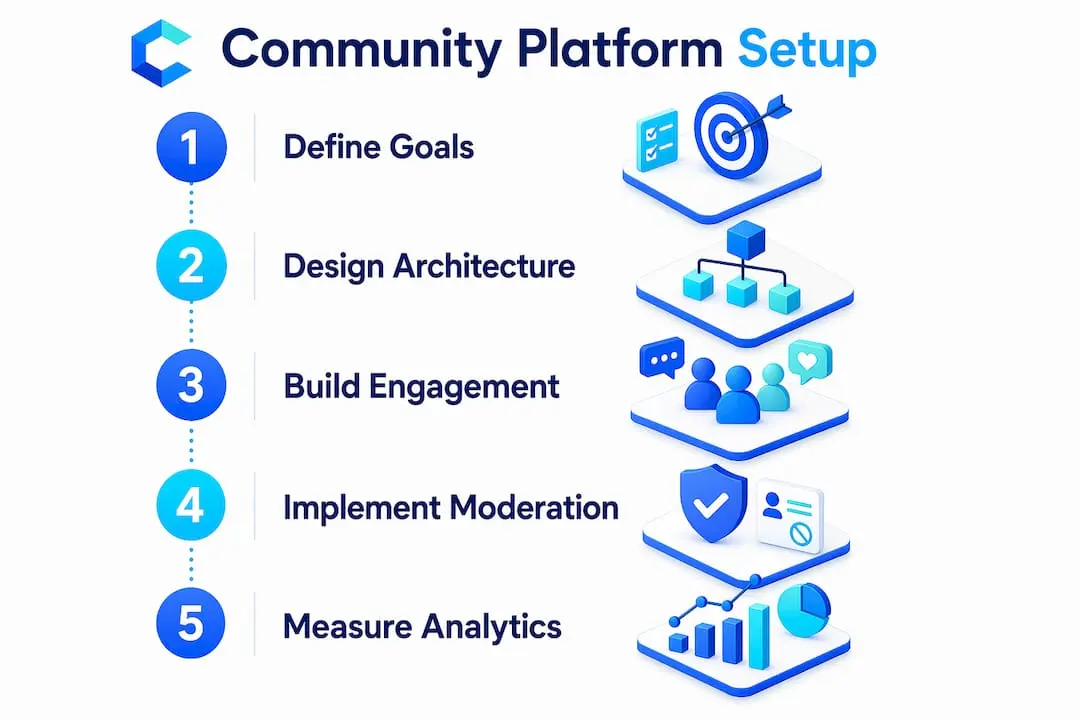
The foundation of any effective community platform is a clearly defined goal. Goals drive all platform decisions, including group creation and content publication. Without a specific target, such as improving renewal rates or growing non-dues revenue, your configuration becomes guesswork and your members feel it.

Membership organisations that define goals before setup build communities with purpose. A professional association aiming to reduce churn will configure its platform differently from a nonprofit focused on peer learning. The goal shapes everything: which discussion groups you create, what content you seed first, and which analytics you monitor weekly.
Platform architecture also matters. The best community building software separates public-facing content from member-only spaces, so prospective members see value before joining. This structure supports both recruitment and retention without requiring two separate systems.
How to set up a community platform effectively
Setup is where most organisations make costly mistakes. The steps below reflect current best practice for membership bodies launching or relaunching a digital community.
- Define your goal first. Renewal rate improvement, non-dues revenue, peer learning, or advocacy. Pick one primary goal and let it guide every configuration decision.
- Create group structures before launch. Build your discussion groups, resource libraries, and content categories before a single member logs in. An empty community feels abandoned.
- Seed content strategically. Content seeding before launch can drive substantial long-term growth. One organisation grew its membership from 30,000 to over 80,000 in five years using this approach. Seed at least ten substantive posts per group before opening the doors.
- Write community guidelines on day one. Guidelines must exist before the first member joins to prevent poor behaviour from becoming the norm. Reversing established norms is far harder than setting them correctly from the start.
- Plan your onboarding sequence. Automated welcome messages, a pinned “start here” post, and a prompt to introduce themselves all reduce early drop-off.
Pro Tip: Wait to introduce paid tiers or premium content until you have at least 50 genuinely engaged members who would notice if the community disappeared. Premature monetisation drives early churn and damages trust before the community has found its rhythm.
The temptation to monetise early is understandable, especially for nonprofits under budget pressure. Resist it. A community with 50 deeply engaged members is worth more long-term than one with 500 passive sign-ups who never return.
What features should you look for in community platforms?
The best community platforms for membership organisations combine several capabilities in one place. Switching between separate tools for forums, events, and email creates friction for both staff and members.
Core features to evaluate:
- Discussion forums and member directories that support peer-to-peer connection and searchable profiles
- Event management integration for both in-person and virtual events, with registration, reminders, and post-event content access
- Resource libraries where members can access guides, recordings, and templates without leaving the community
- Learning management system (LMS) integration supporting cohort-based courses and self-paced learning pathways
- Behavioural and engagement analytics that show which members are active, which are at risk of lapsing, and which content drives the most interaction
- Automation tools for onboarding sequences, moderation alerts, and personalised content recommendations
- Mobile accessibility so members can participate from any device without a degraded experience
Platforms that unify community, learning, and analytics improve member engagement and support data-driven decisions. This matters because members who experience a joined-up journey, from discussion to learning to events, stay longer and engage more deeply.
Pro Tip: When evaluating virtual community solutions, ask vendors specifically how their platform connects community activity to learning progress. If those two systems are separate databases, your team will spend hours reconciling data that should flow automatically.
AI moderation and workflow automation are now standard expectations, not premium extras. AI-powered moderation tools reduce manual workload and apply rules consistently, which is critical when your team is small and your community is growing.
Best practices for moderating online communities
Moderation is the most underestimated part of community management. Poor moderation does not just create conflict. It signals to good members that the space is not worth their time.
- Apply rules consistently. Enforcing rules equitably is the single most important moderation principle. Warning one member for behaviour you ignore in another destroys trust faster than almost any other mistake.
- Build a distributed leadership model. Promoting active members to voluntary moderation roles lightens your team’s workload and builds a group of invested advocates. These members often become your most effective recruiters.
- Act within the first 48 hours. New members who do not engage meaningfully within their first seven days have a 70% chance of churning within 30 days. The first 48 hours are the highest-leverage window for prompting that first interaction.
- Use automation for routine moderation. Set keyword filters, auto-approve trusted members, and schedule regular digest emails. Automation handles volume; your team handles nuance.
- Review guidelines quarterly. Communities evolve. A guideline that made sense at launch may need updating as your membership grows or your focus shifts.
Pro Tip: Assign a “community champion” from your existing membership before launch. This person seeds early discussions, welcomes new members publicly, and models the tone you want. It costs nothing and dramatically improves early engagement rates.
Effective community engagement tactics combine clear rules with genuine human warmth. Members need to feel both safe and welcomed. Rules without warmth produce compliance. Warmth without rules produces chaos.
How to boost member engagement and retention
Engagement is not a single event. It is a series of small interactions that compound over time into loyalty and renewal. Your platform should make those interactions easy to find and easy to complete.
Practical engagement strategies that work for membership organisations:
- Peer discussion prompts. Post a weekly question in your most active group. Members who answer once are far more likely to return. Community building ideas like structured discussion threads consistently outperform passive content libraries for driving repeat visits.
- Mentorship matching. Pair newer members with experienced ones using a simple intake form. This creates a relationship that extends well beyond the platform itself.
- Event integration. Members who attend events engage more deeply in the community before and after. Use your platform to host pre-event discussions and post-event resource sharing.
- Learning pathways. Structured courses tied to community discussion groups keep members returning for both knowledge and connection.
- Churn risk monitoring. Use your analytics dashboard to flag members who have not logged in for 14 days. A personalised outreach message at that point recovers a meaningful proportion of at-risk members.
Engagement software for associations now makes it possible to automate much of this outreach without losing the personal touch. The key is combining automation with genuine human follow-up for your highest-value members.
For nonprofits specifically, engagement often connects directly to fundraising. Members who feel part of a community give more and give more often. Fundraising ideas for nonprofits that are embedded in community activity, such as peer-to-peer campaigns or member-led events, consistently outperform standalone appeals.
Getting involved in associative life is also a theme that resonates across sectors. Resources on member involvement in 2026 highlight how digital communities lower the barrier to participation, particularly for members who cannot attend in person.
CRM integration ties all of this together. When your community platform shares data with your CRM, you can see the full member picture: what they read, which events they attended, when they last renewed, and what content prompted their most recent login.
Key takeaways
An online community management platform succeeds when clear goals, consistent moderation, and integrated analytics work together from day one.
| Point | Details |
|---|---|
| Set goals before configuration | Define one primary goal, such as renewal rate improvement, before building any group structures or content. |
| Seed content before launch | Post at least ten substantive pieces per group before members join to prevent the community feeling empty. |
| Write guidelines on day one | Community rules must exist before the first member joins to prevent poor norms from taking hold. |
| Act fast on new members | Members who do not engage within seven days have a 70% chance of churning within 30 days. |
| Delay monetisation | Introduce paid tiers only after reaching at least 50 genuinely engaged members to protect early retention. |
Why I think most organisations get community management backwards
Most membership bodies I have observed launch their community platform and then wait for engagement to happen. They treat the platform as infrastructure, like a car park, and assume members will use it simply because it exists. That is the wrong mental model entirely.
A community platform is not infrastructure. It is a programme. It requires the same intentional design as a conference or a mentorship scheme. The organisations that grow from 30,000 to 80,000 members do not do so by accident. They seed content, they appoint champions, they monitor analytics weekly, and they iterate.
The distributed leadership model is the insight I find most underused. Volunteer moderators and community champions are not a workaround for a small team. They are the mechanism by which a community develops its own culture and self-sustains. Paid staff cannot manufacture that. They can only create the conditions for it.
My honest observation is that premature monetisation is the single most common mistake I see. Organisations under financial pressure introduce paid tiers before the community has proven its value to members. The result is predictable: early adopters feel exploited, engagement drops, and the community never recovers its momentum. Patience here is not passive. It is the most strategic decision you can make.
Finally, analytics are not a reporting tool. They are a management tool. If you are not reviewing engagement data weekly and adjusting your content and outreach accordingly, you are flying blind. The data tells you who is at risk, what content resonates, and where your next community champion is hiding.
— Rob
How Colossus supports your community management goals
Colossus brings together the tools membership organisations need to run a thriving digital community without stitching together multiple platforms.
Our membership management features include discussion forums, event management, CRM, email marketing, and analytics in one place. That means your team spends less time switching between systems and more time building genuine member relationships. Colossus also integrates event management software directly into the member experience, so pre-event engagement and post-event follow-up happen within the same community space your members already use. If you want to see how Colossus fits your organisation’s specific goals, get in touch with our team for a personalised walkthrough.
FAQ
What is an online community management platform?
An online community management platform is software that combines discussion forums, content management, analytics, and member communication tools into a single system. It is designed to help membership organisations and nonprofits build and sustain engaged digital communities.
How do I manage online communities effectively?
Effective community management starts with clear goals, written guidelines before launch, and consistent moderation. Members who do not engage within their first seven days have a 70% chance of churning within 30 days, so early activation is the highest priority.
What features matter most in community engagement tools?
The most important features are discussion forums, event integration, behavioural analytics, and automation for onboarding and moderation. Platforms that combine community interaction with learning management systems deliver the strongest long-term engagement results.
When should a membership organisation introduce paid community tiers?
Paid tiers should only be introduced after at least 50 genuinely engaged members are active in the community. Monetising too early damages trust and accelerates churn before the community has established its value.
How does CRM integration improve community management?
CRM integration connects community activity data, such as logins, content views, and event attendance, to member records. This gives your team a complete picture of each member’s engagement and makes personalised outreach far more effective.