Onboarding checklist for members: a practical guide

TL;DR:
- A member onboarding checklist includes 3 to 5 high-value tasks designed to engage new members quickly and increase retention. Personalising content based on sign-up data and automating email sequences improve participation and long-term loyalty. Regularly tracking key metrics and updating the checklist ensures ongoing effectiveness and member satisfaction.
An onboarding checklist for members is a structured set of 3–5 high-value tasks designed to integrate new members smoothly and encourage active participation from day one. The industry term for this process is “member onboarding,” and getting it right is the single biggest factor in whether a new member renews or quietly disappears. Organisations like Raybourn Group and WhatsBuzzn have published frameworks showing that a well-designed checklist directly improves retention. This guide gives membership coordinators and administrators a practical, step-by-step system to build one that works.
What does an effective onboarding checklist for members include?
The best membership onboarding checklists are short by design. Best-in-class checklists limit tasks to 3–5 high-value actions, each completable in under 5–10 minutes, and target a 60%+ completion rate within 90 days. That completion rate is directly linked to higher renewal rates. More tasks do not mean better onboarding. They mean lower completion and higher drop-off.

A welcome kit should anchor your checklist. It includes a personalised welcome letter, clear access instructions, a benefits overview, key contacts, an FAQ, and ideally a short video walkthrough. Each element answers a question the new member has not yet thought to ask. Clarity at this stage prevents the confusion that causes early disengagement.
The table below shows the five core tasks most effective for new member onboarding, with realistic time estimates and the purpose each task serves.
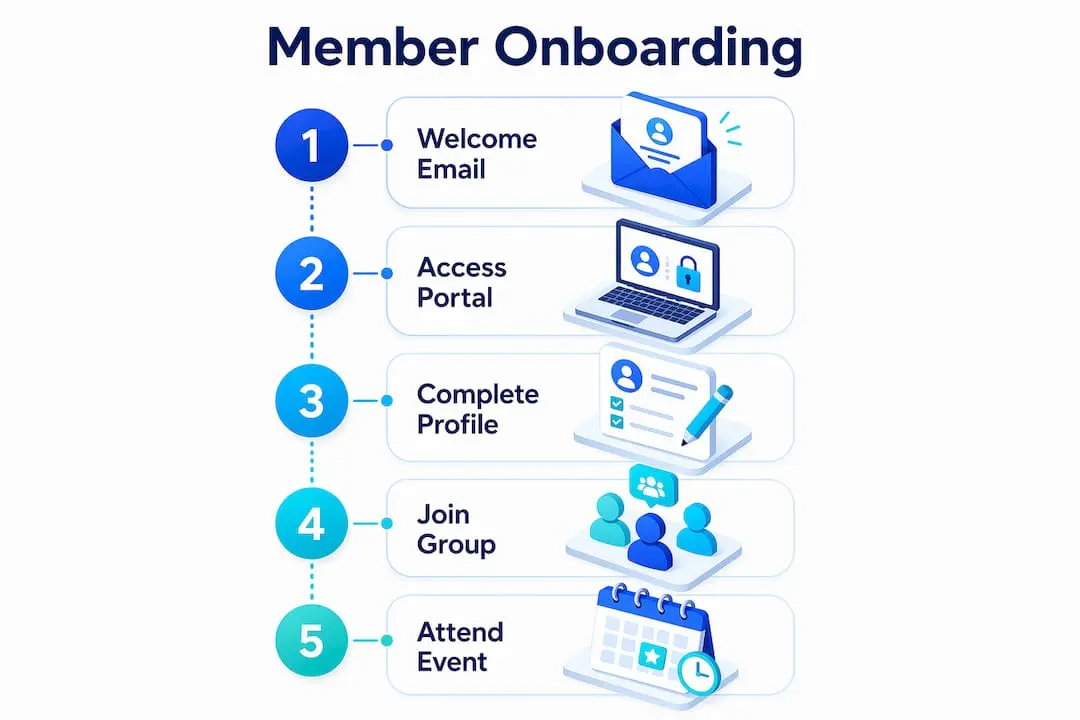
| Task | Estimated time | Purpose |
|---|---|---|
| Read welcome email and access portal | 3–5 minutes | Confirms access and sets expectations |
| Complete member profile | 5–8 minutes | Personalises experience and aids community matching |
| Join a community group or forum | 2–3 minutes | Builds early belonging and peer connection |
| Access one key resource or training | 5–10 minutes | Delivers immediate value and demonstrates membership worth |
| Register for an upcoming event | 3–5 minutes | Creates a future touchpoint and deepens engagement |
Pro Tip: Place your single most important action, such as completing a profile or joining a community group, as task one. Members who complete the first step are significantly more likely to finish the rest of the checklist.
How do you personalise the onboarding experience to increase engagement?
Personalisation is the difference between a member who feels welcomed and one who feels processed. Tailoring welcome content to a member’s industry, role, and interests creates a natural engagement path and builds long-term advocacy. The data you collect at sign-up is your starting point. Use it.
Segmentation is the practical mechanism for personalisation. Divide your new members by:
- Industry or sector to recommend relevant resources, case studies, or working groups
- Role or seniority to tailor learning paths, whether that is introductory content for new professionals or peer networks for senior leaders
- Stated interests captured in your sign-up form to surface the events, forums, or content most likely to resonate
- Geographic location to highlight local chapters, regional events, or time-zone-appropriate webinars
Introducing new members to people and small group activities early builds a sense of belonging that sustains long-term engagement. Even one positive early interaction significantly increases ongoing participation. A mentor programme or a “buddy” system costs very little to run and delivers measurable results.
Pro Tip: Add two or three personalisation fields to your sign-up form, such as job title, primary goal, and area of interest. These three data points let you segment your checklist and communications without overwhelming the member at registration.
What tools and systems support an efficient member onboarding process?
The right tools remove manual effort from your team and create a consistent experience for every new member. A dedicated onboarding hub or microsite is the most effective starting point. It centralises all checklist tasks, resources, and contacts in one place, so members are not hunting through emails to find what they need.
Membership management software and CRM platforms are the backbone of a scalable onboarding process. Key features to look for include:
- Automated email sequences triggered by sign-up, so every member receives timely communications without manual intervention
- Progress tracking that shows which checklist items a member has completed and flags those who have stalled
- Segmentation tools that allow you to send different content to different member groups based on sign-up data
- Event registration integration so members can book their first event directly from the onboarding checklist
Automated onboarding email sequences that include a welcome message, an engagement nudge, a poll, and a check-in message improve member activation and retention. A proven sequence runs as follows: a welcome email on day 0, an engagement prompt on day 1, a short poll on day 3, a nudge on day 7, and a final check-in on day 14. This cadence keeps your organisation present without overwhelming the new member.
| Tool type | Core function | Onboarding benefit |
|---|---|---|
| Membership management software | Member records, renewals, communications | Centralises data and automates key touchpoints |
| CRM platform | Contact tracking, segmentation, history | Enables personalised follow-up at scale |
| Onboarding hub or microsite | Checklist delivery, resource access | Reduces friction and consolidates the member journey |
| Email automation tool | Sequence delivery, open rate tracking | Maintains consistent contact without manual effort |
| Event management software | Registration, attendance tracking | Connects onboarding to live engagement opportunities |
Colossus brings all of these functions into one platform, which removes the integration headaches that come with stitching together separate tools. For membership coordinators managing hundreds or thousands of members, that consolidation is a practical advantage.
How should you monitor and improve your onboarding checklist?
Tracking the right metrics tells you where your checklist is working and where members are dropping off. The key performance indicators for any new member onboarding guide are:
- Welcome email open rate. This is your first signal. A low open rate means your subject line or sender name needs attention before anything else.
- Profile completion rate. Members who complete their profile are more engaged across every subsequent metric. Track this within the first seven days.
- Checklist completion rate. Aim for 60%+ completion within 90 days. Below that threshold, renewal rates typically suffer.
- First event attendance. Tracking first event attendance is a leading indicator of long-term engagement. Members who attend one event in their first 90 days are far more likely to renew.
- Churn signals. Watch for members who open no emails after day 7 or who have not logged in after two weeks. These are early warning signs that require a personal outreach.
A clear 90-day onboarding journey with milestones, mentor programmes, and timely feedback leads to lifelong member loyalty. Set your benchmarks at the 30-day, 60-day, and 90-day marks. Review completion data at each milestone and adjust the checklist based on where members consistently stall.
Pulse surveys are underused in member onboarding. A three-question survey sent at day 30 gives you qualitative data that no dashboard can provide. Ask what was most useful, what was confusing, and what the member wishes they had known sooner.
“The most effective onboarding programmes treat the first 90 days as a structured journey, not a single welcome event. Milestones, check-ins, and feedback loops are what convert a new sign-up into a committed member.”
Iterate your checklist at least once per quarter. Member needs change, your organisation’s resources change, and what worked six months ago may no longer reflect your best content or events. A static checklist is a declining one.
Key takeaways
A well-structured member onboarding checklist, limited to 3–5 tasks and supported by automation, personalisation, and regular metric reviews, is the most direct path to higher member retention and renewal.
| Point | Details |
|---|---|
| Limit checklist tasks | Cap tasks at 3–5 actions under 10 minutes each to maximise completion rates. |
| Personalise from sign-up data | Use industry, role, and interest fields to tailor content and communications from day one. |
| Automate your email sequence | Run a day 0 to day 14 automated sequence to maintain contact without manual effort. |
| Track the right KPIs | Monitor open rates, profile completion, and first event attendance as leading indicators. |
| Iterate every quarter | Review checklist performance at 30, 60, and 90 days and update based on member feedback. |
What I have learned about onboarding checklists that actually work
The most common mistake I see membership coordinators make is treating onboarding as a one-time communication event. They send a welcome email, attach a PDF of member benefits, and consider the job done. Then they wonder why renewal rates are disappointing.
The over-communication trap is equally damaging. Flooding a new member’s inbox in the first 48 hours causes analysis paralysis and increases abandonment. Simplicity is not laziness. It is respect for your member’s time and attention.
What actually works is a checklist that feels achievable. Three tasks, each taking less than five minutes, completed in the first week, does more for long-term engagement than a 20-step onboarding programme that nobody finishes. The goal is not to show members everything your organisation offers. The goal is to get them to their first meaningful action as quickly as possible.
Engagement beyond the first 90 days is where most organisations fall short. Onboarding should hand off naturally to a year-round engagement strategy. If your checklist ends at day 14 and you have no plan for day 91, you are building a leaky bucket. The coordinators who get this right treat the 90-day mark as a transition point, not a finish line.
— Rob
How Colossus supports your member onboarding process
Building and managing a membership onboarding checklist manually is time-consuming and inconsistent. Colossus gives membership coordinators the tools to automate onboarding sequences, track checklist completion, segment members by profile data, and connect every new member to events and resources from a single platform.
Our membership management features include CRM tools, email automation, event registration, and progress tracking, all designed for organisations that rely on member engagement to grow. If you want to see how Colossus handles the full member onboarding process, from welcome email to 90-day check-in, explore our platform features to find out what is possible for your organisation.
FAQ
What is an onboarding checklist for members?
An onboarding checklist for members is a structured list of 3–5 tasks designed to help new members access benefits, complete their profile, and engage with the organisation quickly. It is the primary tool for turning a sign-up into an active, engaged member.
How many tasks should a membership onboarding checklist include?
Best practice limits checklists to 3–5 tasks, each completable in under 10 minutes. This keeps completion rates high and avoids overwhelming new members in their first week.
What KPIs should I track for new member onboarding?
Track welcome email open rates, profile completion rates, checklist completion within 90 days, and first event attendance. These four metrics are the leading indicators of long-term engagement and renewal.
How do I personalise the member onboarding process?
Use data collected at sign-up, such as job title, industry, and stated interests, to segment members and tailor your welcome content, recommended resources, and event invitations. Personalising onboarding content to a member’s role and goals significantly increases connection and long-term advocacy.
How often should I update my onboarding checklist?
Review and update your checklist at least once per quarter. Use completion data, pulse survey responses, and churn signals to identify which tasks are working and which need replacing.